What Is Biltong? The South African Cured Meat Explained
Biltong is a South African cured and air dried meat that dates back to the 17th century, when Dutch settlers at the Cape of Good Hope needed a reliable way to preserve beef, venison and game on long journeys. The name comes from Dutch roots, bil meaning buttock and tong meaning strip. It is not a snack trend. It is a preservation method with a few hundred years of proof behind it.
Related: How Biltong Is Made, and Why Kosher Biltong Is Hard to Make at Home
What separates it from every other dried meat is the combination of three things done in a particular order: a vinegar and salt cure, a thick cut of whole muscle, and drying in moving air with no heat applied. Take away any one of those and you have a different food. What follows is what each step does, why it is done that way, and what the finished product is actually like to eat.
Where the name comes from, and what it tells you
The Dutch origin of the word is a description rather than a brand. Bil for the hindquarter, tong for a strip. That is exactly what the food is, a strip of meat from the back end of the animal, and the name has outlasted several centuries and two languages because it was accurate.
The method traveled the way the people did. Preserving meat without refrigeration was a practical necessity for anyone moving across country with more meat than could be eaten fresh, and the Southern African climate, dry air and reliable wind, happened to suit air drying particularly well. What began as necessity became a recognizable style with its own spice profile and its own expectations about texture.
The cut, and what whole muscle means
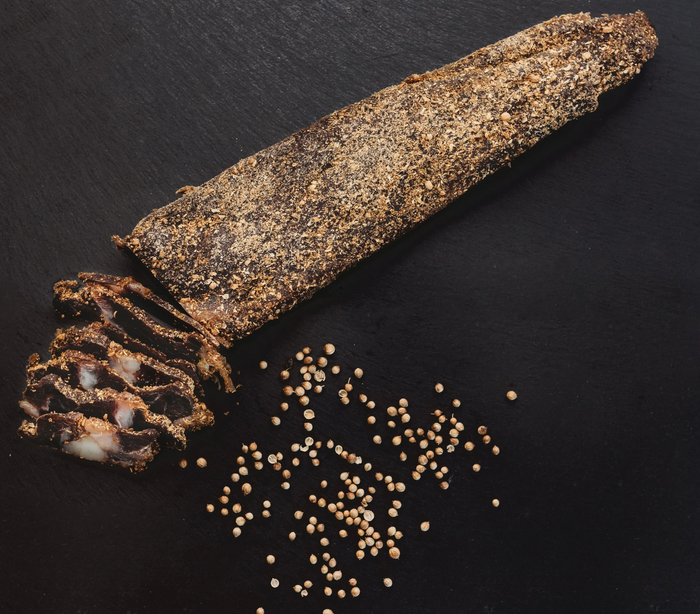
The process starts with whole muscle cuts, typically topside, silverside or eye of round, cut thick. Whole muscle means exactly what it says: an intact piece of a single muscle, not meat that has been ground, mixed and reformed into a shape. You can see the difference on a cut face, where the fiber structure of a real muscle is visible and a formed product shows none.
Those particular cuts are chosen because they are large, lean and uniform. Lean matters because fat does not dry the way muscle does and can turn on you over a long shelf life. Uniform matters because a strip of even thickness dries evenly, and an uneven strip has thin ends finished long before the middle is ready.
Thickness varies by what the finished product will be. A slab destined to be sold whole and sliced later is cut thicker than something intended to be sold as ready cut pieces. Either way it is far thicker than a jerky slice, which is the single most visible difference between the two.
The vinegar wash
Before the meat ever reaches the drying rack, it gets a thorough treatment with vinegar, salt and spices. The vinegar does two jobs at once. It drops the pH of the meat to a level where spoilage and pathogenic organisms struggle to establish, and it begins breaking down collagen in the muscle through acid action. That second effect is why biltong has a tenderness that quick dried products do not. Malt, cider and wine vinegar are all traditional choices, and each leaves a slightly different background note.
Timing is a genuine craft decision. Too brief a wash and the acid has not done enough work. Too long and the surface takes on a sharpness that never fully fades. Producers argue about this and there is no single right answer, only a house style.
Coriander, and the rest of the spice
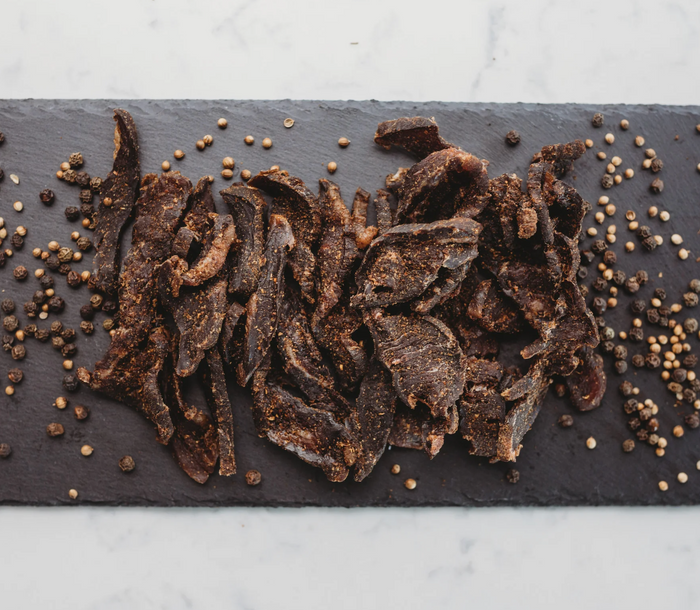
Coriander seed is the one spice that makes biltong taste like biltong. Toasted and cracked rather than ground fine, it gives the warm, faintly citrus note that sits under everything else. Black pepper follows, and after that the field opens up. Garlic, chili, brown sugar in some houses, and various regional additions all appear.
The spice is not only about taste. Salt in the mix draws water out of the meat by osmosis before drying even begins, which gives the process a head start and lowers water activity in the surface layer where problems would otherwise start. Spice, cure and preservation are the same act here rather than separate stages.
Salt does more than season
Salt binds water. Water bound by salt is not available to microorganisms, which is why two products at the same measured moisture content can keep very differently depending on how salty they are. This is the reason a low salt dried meat has to be dried further to reach the same stability, and why very low salt versions of traditional cured products tend to be either much drier or much shorter lived.
It is a balance rather than a maximum. Too much salt and the product is unpleasant. Too little and either the drying has to go further than the texture can survive, or the shelf life gets shorter than a producer can honestly claim.
Air, not heat
This is the definitional step. Biltong hangs in moving air at ordinary room temperature and loses water slowly over days. No heat is applied. The meat is never cooked, which is why the interior of a finished piece keeps a deep red color rather than the gray brown of something that has been through a dryer.
Three variables have to work together: airflow, humidity and time. Too little airflow and the surface stays damp, which invites problems. Too much and the outside dries and tightens before the inside has released enough water, sealing moisture in where it does not belong. Humidity sets how fast air can accept water at all, which is why the same process behaves differently in different climates and seasons. Time is the one that cannot be rushed, and a producer trying to speed things up is usually reaching for heat, which changes the product into something else.
Water activity, the thing that actually governs keeping
People assume moisture percentage is what makes a dried food stable. The real governor is water activity, meaning how much of the water present is chemically free rather than bound up by salt and by the meat. A finished piece of biltong holds a noticeable amount of water and is still shelf stable, because most of that water is not available to anything that would spoil it.
This is also why biltong can be pleasant to eat while a fully dehydrated product is not. It does not need to be bone dry to keep. It needs its water tied up, and the cure is what ties it up.
Wet, medium and dry are the same meat
Ask ten people how they like their biltong and you will get three answers. Wet, which comes off the rack early and is soft and deeply red through the middle. Medium, the common middle ground with a firm outside and a yielding center. Dry, taken further, firmer throughout, more concentrated in taste and longer keeping.
These are not different products or different qualities. They are the same strip stopped at different points. Preference is genuinely personal, and it is the main reason a sampler is a sensible first purchase rather than a marketing device.
Fat behaves differently from lean
Lean muscle gives up water steadily. Fat does not, because there is little water in it to give. A fatty edge on a strip stays soft while the lean around it firms up, which is why some people seek out fattier pieces and others trim them off. Over a long shelf life fat is also the component most likely to go off, which is why heavily marbled cuts are not traditional for biltong even though they are prized elsewhere.
A little fat carries taste and keeps a piece from eating dry. A lot of it shortens the useful life of the product. Where a producer draws that line is one of the real differences between one house style and another.
Slab or sliced, and why it changes the eating
A slab is dried whole and cut afterward. Sliced biltong is cut before or soon after drying. Those are genuinely different products even from identical meat, because a slab keeps its protective outer surface intact and gives up moisture to the room slowly, while cut faces exchange moisture much faster.
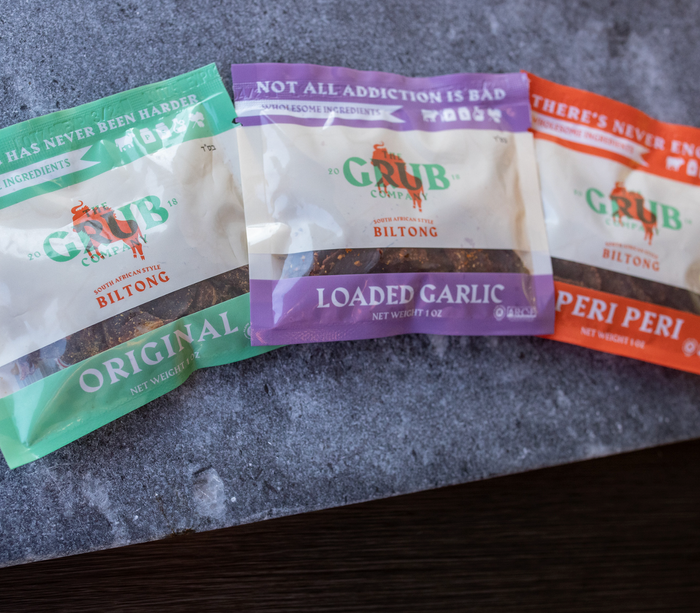
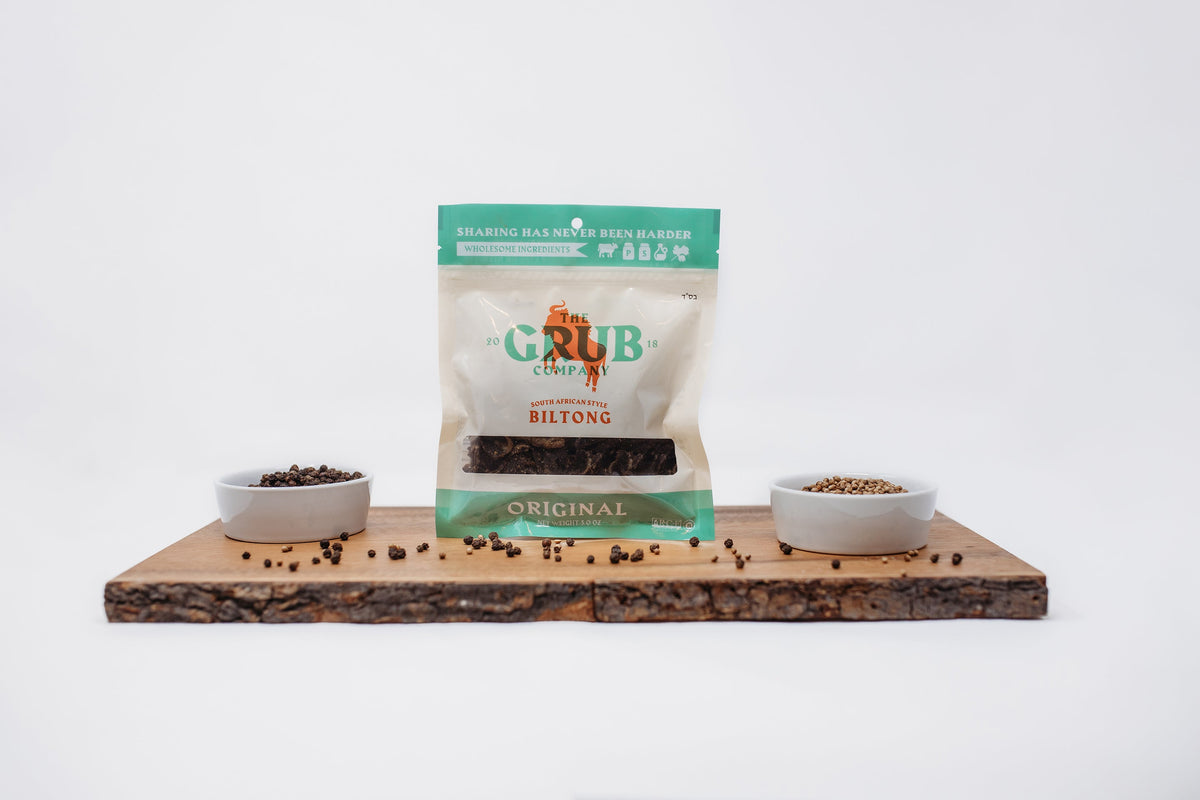
Practically, Biltong Slabs at $58.00 put the slice thickness decision in your hands and hold their condition longer once opened. Sliced Biltong at $11.99 is ready to eat from the bag. Sliced Biltong Mini's at $4.99 are the smallest format. The Biltong Sampler Pack at $12.99 exists precisely so you can find out which of these suits you, and Bulk Biltong at $58.00 for a full pound is the format for people who already know.
What it tastes like
Beef first, more concentrated than fresh meat because the water is gone and what remains is the rest. Then coriander, warm and slightly citrus. Then a background tang from the vinegar that reads as brightness rather than sourness when it is done well. Salt runs through all of it. Compared with most American dried meat there is little or no sweetness, which is the thing first time eaters notice most.
Texture is where it wins people over. A good piece resists briefly, then gives. It is not the string pulling chew people associate with dried meat, and it is not brittle. The nearest comparison is a well rested piece of rare steak that has been concentrated rather than cooked.
Beef, game and everything else
Beef is the default, but the method was never limited to it. Venison, springbok, kudu and ostrich all appear in South Africa, and the historical record is full of whatever the hunter came home with. Game biltong tends to be leaner and firmer than beef, with a stronger taste, and it dries faster because there is less fat slowing water loss.
In the United States, beef dominates for supply reasons rather than culinary ones. The lean cuts that suit the method are widely available and consistent, which matters a great deal when a producer is trying to hit the same result week after week. A wildly variable raw material makes a validated process much harder to run.
How long it keeps, and what actually changes
Unopened and properly packaged, biltong has a long shelf life because there is very little available water in it for anything to work with. What happens over time is not usually spoilage. It is drift. The piece continues to lose a little moisture, gets firmer, and concentrates in taste. A wet piece becomes a medium piece and a medium piece becomes a dry one.
Once a bag is open, the room takes over. A dry house pulls moisture out and firms the pieces up. A humid one does the opposite and softens them, which is the condition under which surface problems become possible. Sealed storage slows both directions down. Cold storage slows them further still, at the cost of some texture, and freezing holds a product almost where it is if you are keeping a large amount for a long time.
How it differs from jerky, in one paragraph
Jerky is sliced thin and dried fast with heat, often with added sugars or smoke. Biltong skips heat entirely, relies on a vinegar and salt cure, and uses much thicker cuts. The finished product is denser, less stringy and generally less sweet. That is the whole difference and it does not need more space than this.
The plain nutrition facts
Because drying removes water and leaves everything else behind, dried beef is concentrated by weight. A 100 gram serving of finished biltong contains roughly 30 to 35 grams of protein, which reflects how much water weight the meat sheds on the rack. It also carries the salt used in the cure, which is worth knowing if you watch your sodium intake for any reason. There is usually little or no added sugar in a traditional preparation, which is a straightforward compositional difference from most sweet marinated dried meats rather than a claim about anything else.
Bottom line
Biltong is whole muscle beef, cured in vinegar and salt with coriander leading the spice, hung in moving air until enough water is gone, and never heated. Every part of that description is load bearing, and a product missing any of it is something else wearing the name. If you are starting out, the sampler at $12.99 is the honest way to find out which cure level and which format you actually like before you commit to a pound.
Frequently Asked Questions
What exactly is biltong?
Biltong is a South African cured and air dried meat, usually beef, made from thick cuts of whole muscle. The meat is washed in vinegar and packed with salt and spices, coriander above all, then hung in moving air at ordinary room temperature until it has lost enough water to be shelf stable. No heat is applied at any point. The method dates to the 17th century at the Cape of Good Hope, where preserving meat without refrigeration was a practical necessity rather than a style choice.
What does biltong taste like?
Beef first, more concentrated than fresh meat because the water has gone and everything else has stayed. Then coriander, warm and faintly citrus, which is the note that makes biltong recognizable. Underneath that sits a brightness from the vinegar cure and salt running through the whole thing. Traditional preparations carry little or no added sugar, which is the difference first time eaters notice most if they are used to sweet marinated dried meats. The texture resists briefly and then gives.
Why is biltong not cooked?
Because the preservation comes from acid, salt and slow water loss rather than from heat. The vinegar cure lowers the pH of the meat early, salt binds water so that less of it is available to spoilage organisms, and days of moving air remove the rest gradually. Adding heat would speed drying but change the product, cooking the outside and producing the gray brown interior of a heat dried snack instead of the deep red center that a properly hung piece of biltong keeps.
Which cuts of beef are used for biltong?
Large, lean, uniform muscles, most commonly topside, silverside or eye of round. Lean is preferred because fat holds little water and does not dry the way muscle does, and because fat is the component most likely to go off over a long shelf life. Uniform thickness matters because an even strip dries evenly, while an uneven one has thin ends finished long before the middle is ready. Heavily marbled cuts prized for steak are not traditional here for exactly those reasons.
What is the difference between wet, medium and dry biltong?
They are the same meat stopped at different points on the rack. Wet comes off early, soft and deeply red through the middle. Medium is the common middle ground, firm outside with a yielding center. Dry has hung longer, is firmer throughout, tastes more concentrated and keeps longer. None of them is better made than the others, and preference is genuinely personal. This is the main practical reason a sampler pack is a sensible first purchase rather than a marketing device.
Why is coriander in almost every biltong recipe?
Coriander seed, toasted and cracked rather than ground fine, produces the warm, slightly citrus note that sits underneath everything else and makes biltong taste like biltong rather than like generic dried beef. Black pepper usually follows it, and beyond those two the field opens up to garlic, chili and regional additions that vary by household and by producer. The spice mix is not purely about taste either, since the salt in it starts drawing water out of the meat before drying begins.
Should I buy slabs or sliced biltong?
Slabs are dried whole and cut later, which lets you set the thickness of every slice and means the piece keeps its protective outer surface intact, so it exchanges moisture with the room slowly and stays in condition longer after opening. Sliced biltong is ready to eat straight from the bag and is the easier everyday choice. Biltong Slabs are $58.00, Sliced Biltong is $11.99, Sliced Biltong Mini's are $4.99, and the Biltong Sampler Pack at $12.99 lets you compare before choosing.
Once you know what biltong is, the next question is usually where to get a bag of it that is worth eating. We make ours in Florida from grass-fed kosher beef, air-dried in small batches — what we sell, what it costs and how it ships.