What Is Biltong? The Complete Guide to South Africa's Air-Dried Beef
Biltong is beef that has been washed in vinegar, salted, coated in cracked coriander and pepper, and hung in moving air for days until enough water has left it to make it safe to eat without ever being cooked. It comes from South Africa. It is not jerky, and the difference is not a detail — it is the entire thing. This is the complete guide: what it is, how it is made, what happens inside the meat while it dries, why it is safe, what it tastes like, how to judge it, and every question people ask afterward.
Where to get it: Glatt Kosher biltong for sale, made in Florida and shipped anywhere in the US (free over $50).
The short answer, for anyone in a hurry
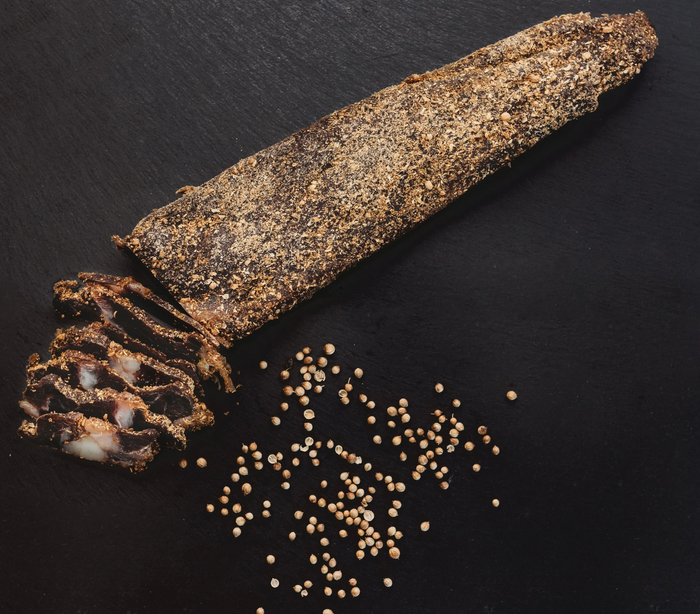
Take a whole strip of beef cut along the grain. Dip it in vinegar. Salt it, brush off the excess, then coat it in roasted coriander seed and black pepper. Hang it in a cool room with air moving over it. Wait between three days and two weeks depending on thickness. The meat loses roughly half to two thirds of its weight in water. What is left is dense, dark red-brown, firm at the edge and tender in the middle, and tastes overwhelmingly of beef.
That is biltong. No heat at any point, and no step that a seventeenth-century farmer could not have performed.
Where the word comes from
"Biltong" is Afrikaans, built from two Dutch roots: bil, meaning rump or hindquarter, and tong, meaning strip or tongue. The word describes the cut and the shape — not the animal, not the flavor, and despite what everyone assumes on first hearing it, not tongue.
Pronounced BILL-tong. Two syllables, hard T.
That the name describes the cut is worth pausing on. Whoever named it did not choose the spice, the vinegar or the drying as the defining feature. They chose the fact that you take a whole hindquarter muscle and cut it into long strips. Three and a half centuries later that is still the single clearest line between biltong and everything else in the dried-meat family.
How it is actually made, step by step
| Stage | What happens | Why it matters |
|---|---|---|
| 1. The cut | Whole muscle sliced into thick strips with the grain — usually silverside or topside | Cutting with the grain leaves the long fibers intact, which is why finished biltong shreds instead of snapping |
| 2. Vinegar | Dipped or briefly soaked in brown or cider vinegar | Drops the surface pH at the moment the meat is most vulnerable. Also leaves the background tang you can taste |
| 3. Salt | Salted, rested an hour or several, excess brushed off | Pulls water out by osmosis before drying even begins. Salt is the preservative, not the seasoning |
| 4. Spice | Coriander seed roasted and cracked, plus black pepper, garlic, and whatever the maker adds | Coriander is the signature. Roasting it is the difference between good biltong and flat biltong |
| 5. The hang | Days in cool, dry, moving air. Pieces must not touch | Slow water loss is what produces tenderness. Fast drying seals the outside and traps moisture inside |
| 6. The cut, again | Sold whole as a slab, or sliced across the grain | Cutting across the grain after drying is what makes it easy to eat |
Notice steps 1 and 6. The meat is cut one way before drying and the other way after. That reversal is deliberate and it is most of why biltong eats the way it does. Cut it across the grain at the start and the long fibers are severed before they ever dry; the piece loses its structure, dries unevenly, and ends up closer to jerky in texture no matter what you put on it.
The spice blend, ingredient by ingredient
A traditional blend is five or six things. Every one of them is doing a job.
Coriander seed
The signature, and the one people cannot name. Roasted and cracked, coriander seed turns warm and faintly citrusy — nothing like the green herb from the same plant. It is the note that tells you, before anything else does, that you are eating biltong and not something else.
Two things matter about how it is handled. Roasting drives off raw, slightly soapy volatiles and develops the nuttiness; unroasted coriander tastes flat and a little dusty. Cracking rather than grinding keeps the seed in pieces large enough to cling to a wet surface and stay aromatic through days of airflow. Ground coriander turns to powder, coats unevenly, and gives up most of its aroma in the first day of drying.
If you ever want a quick read on whether a maker is paying attention, ask whether they roast and crack their coriander. It is a small question that separates people quickly.
Black pepper
Heat and structure. Cracked coarse, for the same reason as the coriander — surface adhesion and slow aroma release. Pepper also contributes a mild antimicrobial effect, which mattered a great deal before anyone knew why it worked.
Salt
Not seasoning. Salt is one of the three barriers that make the whole method possible, and the amount is set by preservation rather than taste. Coarse salt is preferred because it dissolves more slowly and draws water out over hours instead of minutes, which gives a more even result.
This is also why biltong is unavoidably a salty food. You cannot make a low-salt biltong by using less salt; you make an unsafe one.
Vinegar
Brown vinegar or apple cider vinegar traditionally, sometimes red wine vinegar. Never balsamic — too sweet, and the sugar interferes.
The choice affects flavor at the margins, but the function is chemical rather than culinary, and it is covered in full below.
Garlic, and the variations
Garlic is common and not universal. From there, makers diverge: chili for heat, brown sugar in small quantities to balance a hot blend, roasted garlic for a savory version, tomato powder for depth. These are legitimate variations on a fixed base — they are not what makes it biltong.
What makes it biltong is the vinegar, the coriander and the air. Everything else is a maker's signature.
Why it is safe without cooking
This is the question underneath every other question, so it is worth doing properly. Three barriers work together, and none of them is heat.
Acid
The vinegar wash drops the pH on the surface of the meat at the exact moment the surface is most exposed — freshly cut, room temperature, full of available water, before any drying has happened.
That opening window is the genuine weak point of any no-heat method. Cooking gets through it by killing what is present. Air-drying cannot, so it uses acid instead: most spoilage organisms cope badly with a sharp drop in surface pH, and the vinegar buys the slower barriers the days they need to take over.
Biltong is the only major dried-meat tradition that begins this way. Kilishi in West Africa does not. Ethiopian qwanta does not. American jerky does not — it uses heat. That single step is why the biltong method survived in a hot climate with no refrigeration, and why it still works.
Salt
Salt draws water out of the meat by osmosis, and does exactly the same to any bacteria in it — a bacterium in a salty environment loses water across its own membrane and cannot function. It is the oldest preservative there is.
In biltong it is doing structural work from the first hour, before drying has removed anything at all.
Water activity — the one that actually carries it
Bacteria need water they can use. Not water that is present — water that is free, unbound to proteins and salts. The measure is called water activity, on a scale where pure water is 1.0.
| Water activity | What can still grow | Foods in this range |
|---|---|---|
| 0.98–1.00 | Effectively everything | Fresh meat, fresh produce |
| 0.91–0.97 | Most bacteria, including pathogens | Cured but still moist meats |
| 0.86–0.90 | Staphylococcus aureus; most others stop | Some fermented sausage |
| 0.80–0.85 | Molds and yeasts only | Dry-cured ham, aged cheese |
| Below 0.80 | Very little. Shelf-stable | Properly dried biltong, jerky |
Dry the meat into that bottom band and there is not enough usable water left to support growth, whatever the temperature. That is why a sealed bag does not need a fridge.
One distinction that matters and gets missed constantly: water activity is not moisture content. Two pieces with identical moisture can behave completely differently depending on how tightly that water is held by proteins and dissolved salt. Only the free water feeds bacteria. Makers measure water activity with an instrument. Consumers cannot, which is why who made it matters more than how it looks.
If that sounds exotic, it is the same principle behind prosciutto, bresaola, country ham and hard cheese. None of those are cooked either. Nobody worries about them.
What is happening inside the meat while it hangs
Drying looks like nothing happening slowly. Several things are happening at once.
Water leaves in two stages
Stage one is surface evaporation: water leaves the outside into the passing air. It is fast, and its speed depends on how dry and how fast that air is.
Stage two is migration: water from deeper inside travels outward to replace what left. It is slow, and its speed is set by the meat — the cut, the thickness, the grain direction.
The entire craft is keeping those two in balance. Let stage one outrun stage two and you get case hardening: the outside dries into a shell the inner water cannot cross. The piece looks finished and is still wet inside. That trapped water is where mold appears a week later, in a sealed bag, in somebody's cupboard.
Proteins concentrate rather than change
Heat denatures muscle protein — the fibers contract, toughen and shorten, which is why cooked meat bites differently from raw. At room temperature none of that happens. The protein structure stays essentially as it was; there is simply less water sitting between the strands.
That is the whole reason properly air-dried biltong pulls apart into soft threads while jerky resists. It is not a difference of degree. It is a different physical state of the same protein.
Flavor concentrates, and the spice moves inward
As water leaves, everything dissolved in it becomes more concentrated — the beef flavor intensifies simply because there is less water diluting it. Meanwhile the salt and the surface spices migrate slowly inward over days.
Do the same job in six hours and neither has time to happen. The spice sits on the outside as a coating and the interior tastes like plain dried meat.
Fat is the variable that causes trouble
Fat does not lose water the way muscle does, because there is very little water in it to lose. In a marbled cut the fat stays soft while the meat around it dries, so the piece dries unevenly. Worse, fat oxidizes on exposure to air over days, and rancid fat has a distinct paint-like smell that no amount of good spice will hide.
This is why biltong is made from lean cuts and why trimming matters more than beginners expect.
So is biltong raw?
No. "Raw" means untreated — meat as it came off the animal. Biltong has been acidified, salted, spiced and dried until most of its water is gone. It has been transformed, just not by heat.
The confusion is understandable. We are taught that meat safety is a temperature, and for fresh meat that is true. It is not the only route, and it never was — every curing tradition on earth predates the thermometer, and most of them are still in use.
What it tastes like
Beefier than you expect, and much less sweet than you expect.
Most American jerky is built on a sugar-and-soy marinade, so the first thing you taste is the glaze. Biltong has no marinade to hide behind. You get beef, then salt, then the warm citrus note of coriander, then a faint sourness the vinegar left behind. The finish is meat, not sugar.
Texture depends entirely on how far it was dried. A wetter biltong is tender and yields immediately. A drier one is firm and separates into strands. South Africans argue about which is correct and the split is roughly down the middle. Neither is more authentic.
| Style | Weight lost | Character | Suits |
|---|---|---|---|
| Wet | ~50% | Soft, deep red core, yields immediately | Newcomers; anyone who dislikes chewy food |
| Medium | 55–60% | Firm edge, tender center — the standard | Most people, most of the time |
| Dry | 65%+ | Firm throughout, shreds, intense | Traditionalists; long keeping; strong flavor |
A useful thing to know before you buy: you can move biltong drier at home but never wetter. Leave the bag open overnight and medium becomes dry. There is no way back. So if you are unsure, buy on the wetter side.
What cut it is made from
Traditionally silverside and topside — lean cuts from the hindquarter with long straight muscle fibers and very little fat running through them.
| Cut | Character | What it produces |
|---|---|---|
| Silverside | Very lean, long straight fibers, firm | The benchmark. Clean shred, holds shape, dries evenly |
| Topside | Lean, slightly softer | More tender, higher yield, less structure |
| Eye of round | Extremely lean, uniform | Very consistent; can be austere alone |
| Sirloin / rump | More fat, richer | Richer flavor, shorter shelf life, harder to dry evenly |
| Forequarter | Fattier, coarser grain | Used where hindquarter is unavailable; needs hard trimming |
Most serious makers blend, usually silverside-led with some topside. The ratio is a genuine production decision, not a detail: silverside gives structure and consistency, topside gives tenderness and yield. Push too far toward topside and pieces lose their shape in the bag; too far toward silverside and the result can be tough.
Grass-fed against grain-fed
Grass-fed beef is leaner, more deeply flavored and firmer. Grain-fed is fattier and milder. For biltong, leaner is generally better — the drying is more predictable and there is less fat to oxidize over days of air exposure. Grass-fed biltong also tends to finish darker.
Biltong and jerky are not versions of each other
| Biltong | Beef jerky | |
|---|---|---|
| Cooked | No | Yes |
| Drying time | 3 days to 2 weeks | 4–12 hours |
| Cut direction | With the grain, sliced across after | Against the grain, sliced thin before |
| Marinade | Vinegar only | Soy, sugar, Worcestershire |
| Added sugar | None in an original blend | Commonly 15–20 g per 3 oz |
| Preservatives | Not required | Usually sodium nitrite |
| Texture | Tender, shreds along the grain | Chewy, tears against it |
| Signature spice | Coriander | Varies; often smoke |
| Origin of the word | Dutch/Afrikaans bil + tong | Quechua ch'arki, from the Andes |
That last row is the one people find most surprising. The two are not a tradition that split — they are separate inventions on different continents that solved the same problem and later ended up on the same shelf. Calling biltong South African jerky is like calling prosciutto Italian bacon: it names a real family resemblance and misses what the thing is.
Where it sits among the world's cured meats
| Biltong | Bresaola | Prosciutto | Bündnerfleisch | |
|---|---|---|---|---|
| Origin | South Africa | Lombardy | Italy | Switzerland |
| Cut | Silverside / topside strips | Eye of round, whole | Whole leg | Round, whole |
| Cure | Vinegar + salt | Salt + wine + spice | Salt only | Salt + wine + herbs |
| Drying time | Days to 2 weeks | 1–3 months | 12–36 months | Weeks to months |
| Heat applied | None | None | None | None |
| Nitrates | Not required | Usually used | Usually used | Usually used |
| Eaten as | Snack, by the handful | Thin slices, plated | Thin slices, plated | Thin slices, plated |
Biltong belongs in that company and not in the snack aisle — it is an uncooked cured meat that happens to be eaten casually. Note also that it is the only one of the four that needs no nitrates, because the vinegar and the depth of drying do work the others achieve chemically.
The nutrition, honestly
| Per 3 oz | Biltong | Typical mass-market jerky |
|---|---|---|
| Protein | ~36 g | ~27–33 g |
| Calories | ~240 | ~250–300 |
| Added sugar | 0 g in an original blend | ~15–20 g |
| Carbohydrate | Near zero | ~20–25 g |
| Nitrates / nitrites | None required | Commonly present |
| Ingredients | 5–7 | Frequently 12+ |
| Protein per 100 calories | ~15 g | ~11 g |
The biltong figures are ours. The jerky column is a category range, because brands vary enormously.
That last row is the honest measure of a protein food, because it strips out portion-size games. Roughly 15 g of protein per 100 calories is close to the ceiling for any whole food — biltong is essentially concentrated lean beef with the water taken out, and an ounce of it represents two to three ounces of the original meat.
The caveat is sodium. Salt is doing preservation work, so biltong is a salty food by design. An ounce is a serving, not a handful, and if you are managing sodium closely it belongs in the same mental category as cured ham and hard cheese.
The formats, and which one you actually want
| Format | What it is | Best for | The trade-off |
|---|---|---|---|
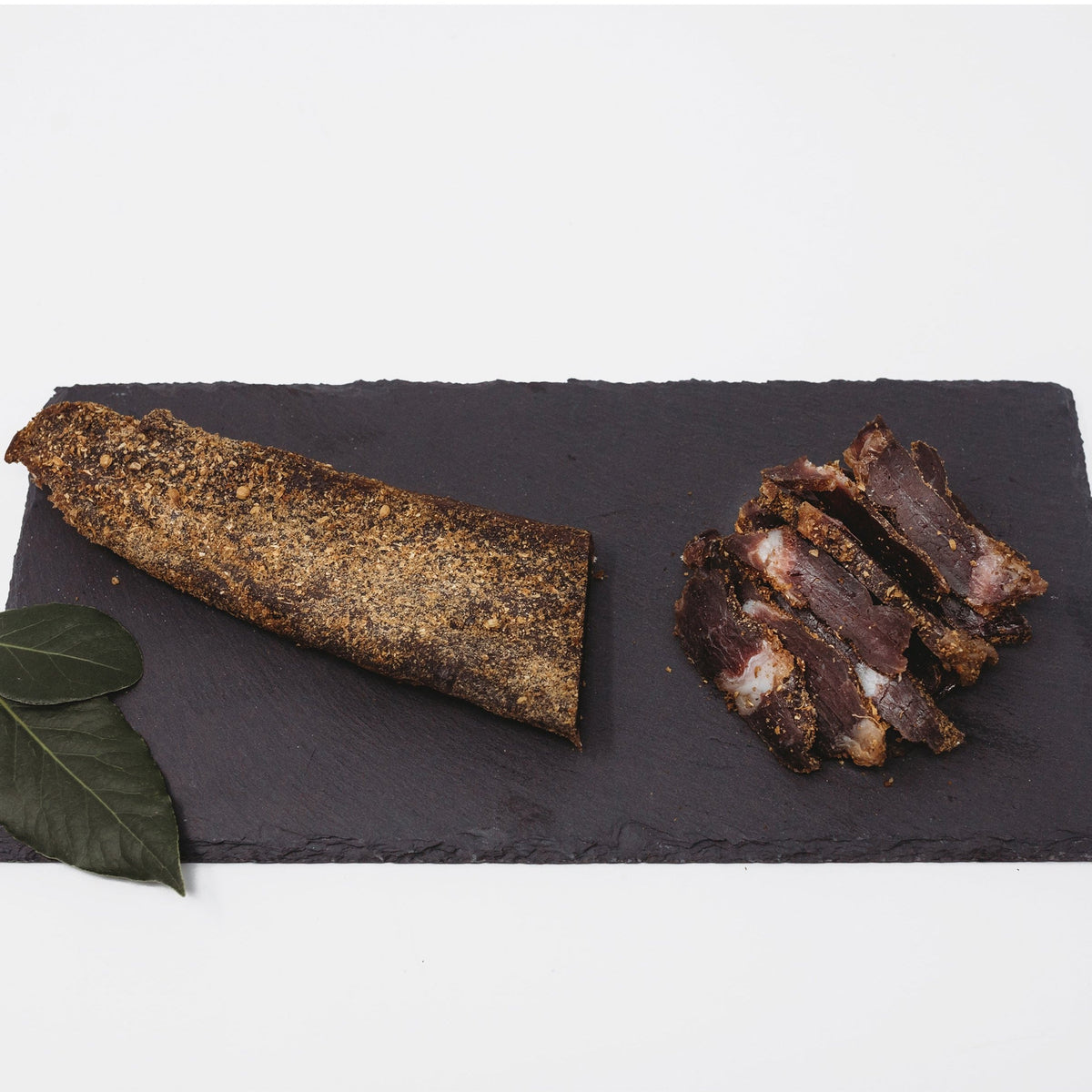
| Slab | A whole dried strip, uncut | Boards, hosting, cutting to taste | Needs a knife, so most people don't |
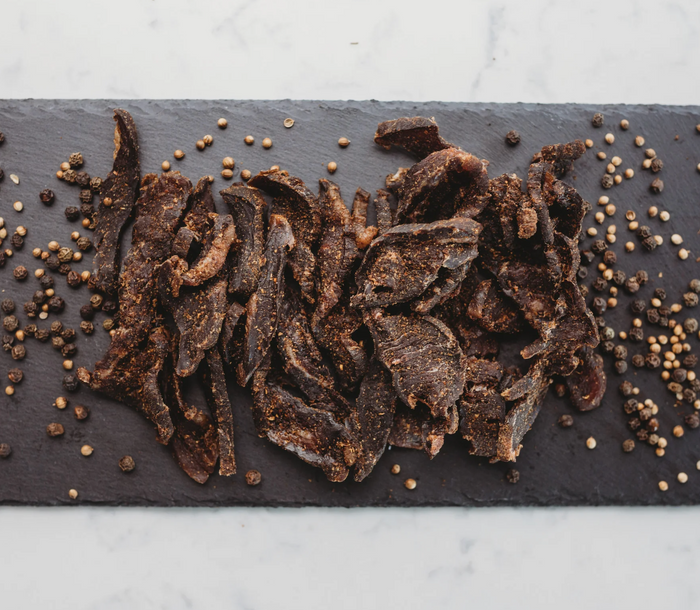
| Sliced | Cut across the grain | Everyday eating | More surface area, dries faster once open |
| Minis | Smaller pieces, single-serve | Trying flavors, travel, kids | Highest cost per ounce |
| Bulk | Sliced, by the pound | Households, offices | Must be portioned on arrival |
| Droëwors | Dried sausage, same spice family | Snacking on the move | A cousin, not biltong |
| Chili bites | Small, drier, spiced pieces | Heat seekers | Drier by design |
A slab holds moisture far better than sliced once opened, because most of the meat is protected by the outside of the piece. If a bag is going to live on your counter for two weeks, buy a slab. If you want to eat it in the car, buy sliced.
Slice thickness matters as much as dryness. Under 2 mm reads as delicate and disappears quickly — good on a board with cheese. Three to five millimeters is the everyday format. Eight millimeters and up is for chewing slowly, and is what most people picture when they think of biltong.
How to judge whether a bag is any good
You can tell most of it before you eat any.
- Color. Deep red-brown, darker at the edges. Uniform pale brown suggests heat drying. Gray suggests poor airflow or meat that was not fresh going in.
- The cut face. Sliced biltong should show a gradient — darker firm rim, lighter softer center. That gradient is the record of slow drying. A uniform cross-section means heat or over-drying.
- Visible cracked spice on the surface, with a little loose in the bag. Powder-coated means the coriander was ground rather than cracked.
- Smell. Beef, vinegar, coriander. Sweet or smoky means jerky seasoning. Sour, ammoniac or paint-like means send it back.
- The bend test. It should bend and yield — not snap like a cracker, not feel damp.
- The first chew. It should shred along the grain. Tearing across the grain like jerky means it was cut and dried the jerky way.
- The finish. You should taste beef last, not sugar.
- An oxygen absorber in the bag. That small sachet is what makes a months-long shelf life credible.
What goes wrong, and what it looks like
| Problem | What you see or taste | Cause |
|---|---|---|
| Mold | Raised, fuzzy growth — white, green or blue-green | Under-dried, or opened in humid air |
| Salt bloom (harmless) | Flat white crystalline dusting that brushes off | Salt or spice migrating to the surface |
| Case hardening | Hard shell, damp interior | Dried too fast |
| Rancidity | Paint-like or crayon smell | Fat oxidized — too much fat left on |
| Gaminess | Livery, metallic edge | Poor-quality or aged meat going in |
| Toughness | Tears rather than shreds | Cut against the grain, or over-dried |
| Blandness | Tastes of salt and nothing else | Coriander unroasted, or too little spice |
| Sliminess | Tacky surface | Bacterial growth from moisture — discard |
The distinction that catches people out is salt bloom against mold. Salt bloom is flat, crystalline and brushes away. Mold is raised, fuzzy and has structure. Look at it in good light from an angle: mold casts a texture, salt does not. And if one piece has mold, discard the whole bag rather than that piece — what is visible on one indicates conditions the rest of the bag shared.
How long it keeps
| Condition | How long | What happens over time |
|---|---|---|
| Sealed with an oxygen absorber, cool and dry | 3–6 months | Essentially nothing. This is the design case |
| Opened, resealed, room temperature | 2–3 days | Keeps drying; flavor concentrates, texture hardens |
| Opened, refrigerated in a sealed container | 1–2 weeks | Dries slower; the risk is condensation, not spoilage |
| Opened, humid room | 1–2 days | Pulls moisture from the air; mold becomes possible |
| Frozen, wrapped tight | 6 months+ | Holds well — little free water to form damaging ice |
| Left open deliberately | Indefinitely | Becomes very dry. Safe, and some people prefer it |
Biltong does not need refrigeration while sealed. That is the entire point of the method. It stops being true the moment you open it — and the single most useful habit anyone can adopt is pressing the air out before resealing.
Why it costs what it costs
Two structural facts, neither of which any producer can engineer around.
Yield. It takes roughly two to three pounds of raw beef to make one pound of biltong, because the drying goes that far. Jerky is dried less and its marinade adds weight back as sellable product. That ratio alone puts a floor under the price.
Time and space. A batch occupies a controlled room — airflow and humidity managed — for days or weeks. A jerky producer turns raw beef into finished product inside a shift. The biltong maker turns over their floor space a fraction as often.
Which is why anyone selling far below the category floor has changed an input: a cheaper cut, a shorter dry that leaves water weight you are paying for, or sugar to carry a weaker product. Converted to dollars per ounce, properly made biltong lives in a fairly narrow band, and prices well underneath it are a signal rather than a bargain.
How to eat it
Straight from the bag is the honest answer, and how the overwhelming majority is eaten. But it is a genuine ingredient and rewards being treated as one:
- On a board — sliced thin with a sharp hard cheese, pickles and dried fruit. It behaves like bresaola.
- Over salad — shredded, in place of bacon. The salt seasons the plate.
- With eggs — chopped in at the end, off the heat, so it warms without cooking.
- On a baked potato — with butter and cheese.
- In a stew — a South African habit. It rehydrates and adds depth without browning anything.
- With a drink — a hoppy beer cuts the salt; a bold red matches the density. Pinotage if you want to complete the theme.
The one thing not to do is cook it hard. It is already dried and cured; heat only tightens it and drives off the aromatics in the coriander.
Who ends up liking it
People who find jerky too sweet. Anyone eating low-carb who wants protein that is not a bar. People who want a shelf-stable snack with a six-item ingredient list. And, without exception, anyone who grew up in South Africa and has spent years failing to explain this to Americans.
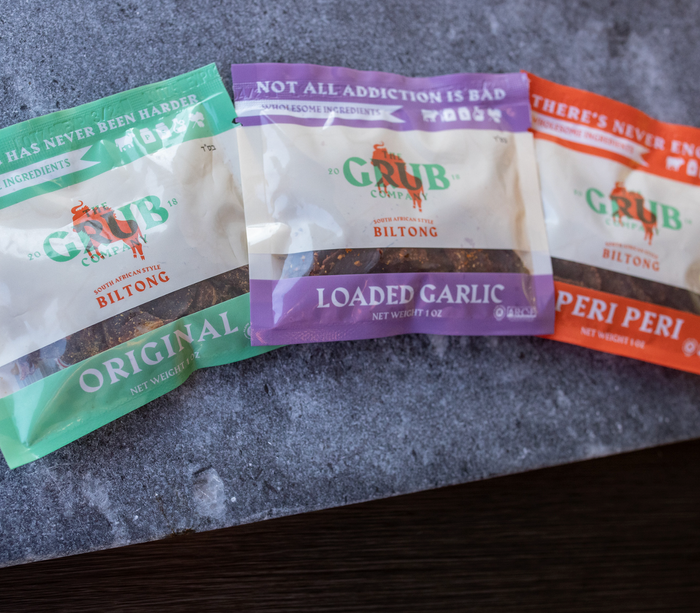
If you have never had it, start with an Original blend. It is the one with nowhere to hide, and every other flavor makes more sense once you have tasted it.
Questions people ask next
Is it the same as jerky? No. Cured versus cooked, unsweetened versus sweetened, cut in opposite directions, and separate inventions on different continents.
Is biltong raw? No — cured, not cooked, not raw. Vinegar, salt and low water activity do what heat does elsewhere.
Can I freeze it? Yes, and it holds up well. Wrap tightly, thaw in the fridge, then bring to room temperature before eating.
Is it gluten free? A traditional blend contains no gluten ingredients. Check the specific product.
Is it keto? Yes — near-zero carbohydrate in an unsweetened blend. Heat blends may include a little sugar.
Is it made from game? It can be. Kudu, springbok, eland and ostrich biltong are all traditional in South Africa. Commercial biltong in the US is beef.
Why is some darker than others? Longer drying, more surface oxidation, a heavier coriander coat or a stronger vinegar wash all darken it.
Why is there a white dusting on it? Usually salt or spice that has migrated to the surface. Flat and crystalline is salt; raised and fuzzy is mold, and that bag should go.
Is the soft red middle undercooked? There is nothing to undercook. A firmer edge and softer center is the correct structure. A uniform cross-section is the thing to be suspicious of.
Does it need refrigeration? Not while sealed. After opening, refrigerate if you will not finish it in two or three days.
How do you pronounce it? BILL-tong.
What does the name mean? Rump strip, from Dutch bil and tong. No tongue involved.
New to it? Start here → · What "air-dried" actually means → · Shop biltong →
Ready to try it? Start here — what to order first, and the one mistake almost every first order makes.