How to Tell Whether Biltong Was Dried Properly Just by Looking at It
You can tell most of what matters about a piece of biltong before you eat it. The surface, the cut face, the way the color changes from the edge inward and the way the fat sits are all a written record of what happened in the drying room. Read them and a bag stops being a guess.
Shop the real thing: buy biltong online, Glatt Kosher and made in Florida. US orders over $50 ship free.
This is not a party trick, and it is not about spotting a bad batch so much as knowing what you have got. Two pieces that weigh the same and cost the same can have been dried at very different speeds, and speed is where nearly every real fault in dried meat comes from. What follows is what we look at when we inspect our own work, translated into what you can see with a bag in your hand and no equipment at all.
Start with the outside, because the outside dried first
Drying works from the surface in. Water leaves the outer millimeter of meat, air carries it away, and more water travels out from deeper in the muscle to replace what left. That migration is the whole process. Everything you see on the outside of a finished piece happened before anything happened in the middle.
So the surface is the oldest part of the story. It has been exposed the longest, it has been in contact with air the longest, and it is the part that reacted with the spice and the vinegar wash before the interior had dried at all. A surface that looks even, matte and firm all over tells you the air moved evenly around that piece for the whole run.
An uneven surface tells you the opposite. If one face is noticeably darker and harder than the other, that piece sat against something, or the air was moving past one side and stalling on the other. It is usually still perfectly good eating. It just means the two halves of that piece are at different points in the same process, and you will taste the difference across a single bite.
Color is a record of speed, not of quality
Deep red to near black on the outside is normal for air dried beef. The color comes from two things happening at once. Myoglobin, the protein that makes raw beef red, darkens as it loses water and reacts with oxygen. At the same time the spice layer and whatever sugars are present darken slowly on their own.
What the shade actually tells you is how long the piece spent drying and how much surface it had while it did. A thin slice that dried quickly will be lighter than a thick slab of the same meat, because the slab spent far longer in the air. Neither is better. They are different products of the same craft.
The one shade worth pausing on is a dull, grayish brown that looks flat rather than deep, especially if it is patchy rather than uniform. That usually means the piece has been sitting in a bag with more moisture than it should have, and the surface has partially rehydrated. It is a storage signal, not a drying signal, and we come back to it below.
The gradient from edge to core is the most useful thing you can see
Break or cut a piece across its thickness and you will see a band of dark, firm meat around the outside and a lighter, redder core. That gradient is normal. It is the physical map of the drying front, showing you exactly how far the process traveled inward before the piece came off the rack.
A narrow dark rim with a wide red core means the piece was dried gently and stopped relatively early. It will be soft, it will taste more of beef than of concentrated beef, and it will not keep as long. A wide dark band with only a thin lighter line in the middle means a longer, more complete dry. Firmer, saltier tasting, longer lasting.
What you want to see is a gradient that is smooth. The dark should shade into the light, not stop at a hard line. A sharp boundary between a very hard outer shell and a distinctly soft middle is the visual signature of drying that went too fast at the start, and that is the one genuine fault in this whole article.
Reading a cut face
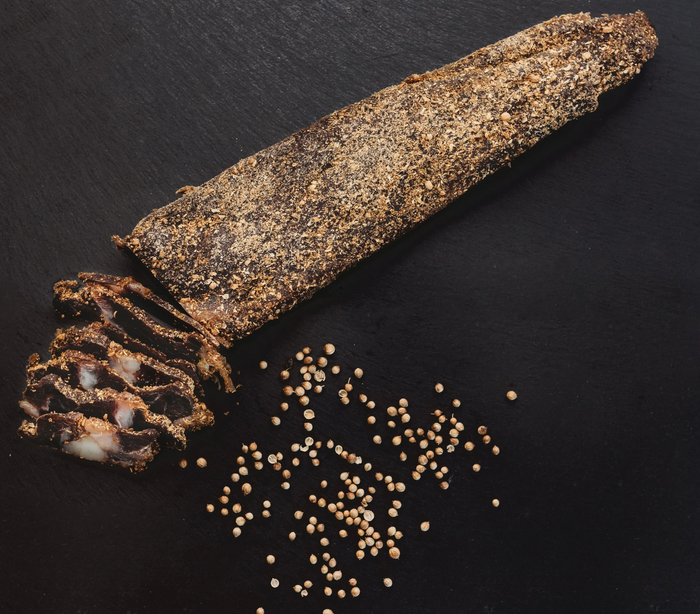
The cut face of a slab is the most informative surface in a bag, which is one of the arguments for buying a slab and doing the cutting yourself. Hold it up to a window rather than a ceiling light. Daylight shows the gradient far better than a warm bulb does.
Here is what a good cut face looks like:
- A grain you can see. The muscle fibers should be visible as fine parallel lines, not a uniform paste.
- A smooth color transition from rim to core, with no hard boundary.
- Fat that reads as distinct seams or specks, still separate from the lean around it.
- A face that looks matte and slightly dry to the eye rather than glossy and wet.
- No cavities, splits or hollow pockets running along the grain.
Cavities are worth a word. A small split that follows the natural seam between two muscles is nothing, and you will see it in good product. A hollow pocket in the middle of solid muscle is a different thing. It means the outside contracted faster than the inside could follow, and the meat tore itself apart internally as it shrank.
A wet middle is not automatically a fault
This is where most people get it wrong. A softer, moister center is the intended result for a large proportion of good biltong, and it is the whole point of anything sold as wet or medium. The interior of a thick piece is meant to stay redder and softer than the shell. That is not underdone. That is the product.
The way to judge it is by feel more than by sight. Press the middle with a thumb. A correct soft center gives a little and then springs back, and it feels like meat. It should feel cool and dense rather than slick. When you cut it, the face should be moist looking without leaving anything on the blade.
Now the honest trade. A softer center has more available water in it, which means it will change faster than a drier piece will, in every direction. It develops flavor faster and it also reaches the end of its useful life faster. If you buy a wetter piece you are buying something at a livelier point in its own timeline, and it wants to be eaten sooner rather than kept.
Case hardening, the fault a wet middle sometimes points to
Case hardening is what happens when the outside of a piece dries so fast that it seals. The surface tightens into a shell that water can no longer easily cross, and the interior is trapped behind it with nowhere to go. From the outside the piece looks finished. Inside, it never dried at all.
Air that is too dry, too warm or moving too fast causes it. That sounds counterintuitive, because more airflow feels like better drying, and for the first hours it is. Past a point the surface loses water faster than the interior can resupply it, the outer layer contracts and hardens, and the whole process stalls behind a wall it made itself.
You spot it by the hard line. A case hardened piece has a rigid outer shell of a fairly even thickness and then an abrupt change to a soft, distinctly wetter middle, with no gradient between the two. Squeeze it and the outside barely moves while the inside squashes. That combination, rigid shell plus soft center plus no transition, is the one thing on a cut face that is genuinely a problem rather than a preference.
What the fat is telling you
Fat does not dry the way lean does. It carries very little water to begin with, so while the muscle around it is shrinking, the fat mostly stays where it is. That is why fat seams stand slightly proud of the lean on a well dried cut face, and why a piece with a lot of fat feels different in the hand from a lean one.
Fresh, well kept fat on dried beef is white to cream, firm at room temperature, and opaque. As fat ages in air it turns more yellow, then more translucent, and it starts to feel greasy rather than waxy. A little yellowing on an older piece is ordinary and it is part of what gives well aged dried meat its depth. A lot of yellowing with a slick, oily feel means the fat has gone further than you want.
The practical version is this. If you are keeping something for a while, lean pieces keep better than fatty ones, every time, because fat is the part that eventually decides how long a piece stays good. If you are eating it this week, fat is where a lot of the flavor lives and you should want it there.
The spice layer, and what a bare patch means
Biltong is typically vinegar washed and then spiced before it goes on the rack, with coriander in the mix more often than not. What you see on the outside of a finished piece is that layer, dried onto the meat and partly absorbed into the first millimeter of it. Coarse ground spice stays visible as flecks. Finer grinds mostly disappear into the surface color.
A bare patch, meaning a spot where the meat is clearly darker and unspiced while everything around it is coated, tells you that spot was pressed against the rack or against another piece while it dried. It is cosmetic. That patch will taste plainer than the rest of the piece and nothing else about it has changed. Bare patches on a lot of pieces in one bag tell you the drying room was packed, which is a scheduling fact, not a safety one.
Sheen, dust and condensation
Run your eye across the surface at an angle to the light. A correctly dried and correctly stored piece has a low, dry sheen, close to matte, sometimes with a faint dusting where spice has come loose. It looks like something that has finished doing what it was doing.
Three surface conditions are worth telling apart:
- Dry and matte with loose spice dust. Normal, and usually a sign the piece has been in a bag for a while and has settled.
- A soft, even gloss with a slightly tacky feel. Surface moisture, picked up from the bag or the room. Not spoilage on its own, but the piece has taken water back on.
- Visible beads or a wet film, often with fogging on the inside of the bag. Condensation. The piece was warm when it was sealed, or it went from cold to warm inside a closed bag.
The third one is the only one that needs action. Condensation on a dried meat means liquid water is sitting on a surface that was designed not to have any, and that is the condition under which surface problems actually start. Open the bag, let the piece sit in moving room air until the surface goes matte again, then repack it.
White on the surface: what it is and what it is not
White deposits on dried meat cause more panic than anything else, and most of the time they are nothing. As water leaves the surface it carries dissolved salt with it, and when the water evaporates the salt stays behind as fine crystals. Amino acids from the drying protein do the same thing. Both look like a faint white bloom.
The tell is texture and shape. Salt and amino acid crystals are flat against the surface, sharp edged under a close look, and they are dry and gritty rather than soft. They come off on a dry cloth. They tend to appear in the same places water was leaving fastest, which is usually along edges and high points.
What you do not want is anything fuzzy, raised or spreading in circles, anything with a blue, green or black tint, or anything soft and slimy to the touch. Those are not crystals and they are not a stage of drying. A piece showing any of that goes in the bin, not into a trim and taste test, and if one piece in a bag has it, treat the whole bag as suspect rather than picking around it.
Slabs and slices need different eyes
A slab is dried whole and cut later, so almost everything above applies to it directly. You get a real outside and a real inside, a proper gradient, and a cut face you can read. Our Biltong Slabs at $58.00 are the format where the inspection in this article actually pays off, because there is a genuine interior to inspect.
Sliced product is a different object. Once meat is cut thin, there is no protected interior left. Every slice is very nearly all surface, so you will not see a dramatic gradient and you should not expect one. What you look for instead is consistency across the bag. In our Sliced Biltong at $11.99, and in the Sliced Biltong Mini's at $4.99, the question is whether the pieces resemble each other, not whether any one of them has a red core.
The Biltong Sampler Pack at $12.99 is the easiest way to run this comparison on your own kitchen table, because you get more than one thing to hold side by side. Comparing two formats teaches you more in five minutes than reading about either one of them does.
A three step inspection you can run right now
Everything above collapses into a short routine. It takes under a minute.
- Look at the bag before you open it. The inside should be clear, not fogged. Loose spice dust at the bottom is fine and expected.
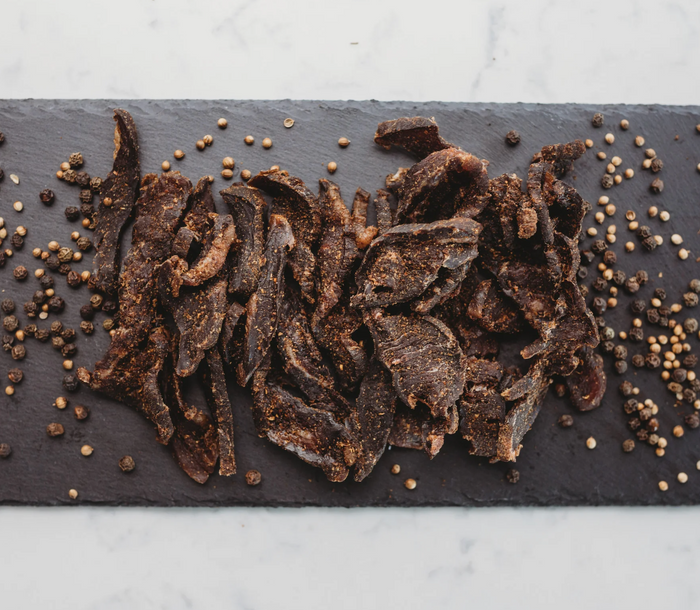
- Look at a whole piece in daylight, turning it. You want an even matte surface, a deep color rather than a flat gray one, and fat that is white to cream and firm.
- Break or cut one piece and look at the face. You want visible grain, a smooth shade change from rim to core, and no hard boundary between a rigid shell and a soft middle.
If all three come back clean, you have a well made piece and the rest is preference. If the third one shows a hard line, you have found the only real fault this inspection can detect, and it is worth saying so to whoever sold it to you.
Things that look wrong and are not
Plenty of what people report as defects are just what dried meat does. Worth naming them so you stop worrying about them.
- Pieces of different sizes in one bag. Muscles are not uniform and drying shrinks them unevenly. A bag of identical rectangles would be the strange thing.
- A darker, harder end on a long piece. That end had more air around it.
- Spice dust at the bottom of the bag. It came loose in transit. It has not gone anywhere useful, but nothing is wrong.
- A faint sour note on opening. Vinegar is part of the process and it announces itself when a bag is first opened. It fades within a minute in open air.
- Pieces that are firmer at the end of a bag than at the start. That is a real and expected change, and it has nothing to do with how the meat was dried.
None of those are worth a second thought. The list of things that genuinely are worth acting on is short: a hard shell over a soft middle with no gradient, visible condensation inside the bag, anything fuzzy or slimy, and fat that has gone translucent and oily. Four items. Everything else is variation.
Bottom line
Good biltong looks like something that dried slowly and evenly. Deep and even color on the outside, a smooth shade change from rim to core when you cut it, visible grain, firm pale fat, and a matte surface with no wet sheen. A soft middle belongs in that description rather than arguing with it, as long as the shade change into it is gradual.
The single thing to train your eye on is the transition. Gradual means the process was patient. Abrupt means it was rushed. Once you can see that difference, you can judge a bag in about fifteen seconds, and you will never again mistake a properly wet center for a piece that did not finish.
Frequently Asked Questions
Is a soft or wet center in biltong a sign it was not dried enough?
Usually not. A softer, redder center is the intended result in a lot of good biltong, and it is the whole point of anything sold as wet or medium. The test is the transition. If the color and firmness shade gradually from the dark rim into the softer core, the piece dried evenly and the middle is meant to be that way. If there is a rigid shell and then an abrupt jump to a soft middle with no gradient between them, that is case hardening, and it means the outside sealed before the inside could dry. Judge the boundary, not the softness.
What does the white powder on my biltong mean?
Almost always salt and amino acids that traveled to the surface with the water and stayed behind when it evaporated. They look like a fine white bloom, they sit flat against the meat, they feel dry and gritty, and they wipe off with a dry cloth. They tend to gather along edges and high points where water was leaving fastest. What you do not want is anything fuzzy, raised, spreading in rings, tinted blue, green or black, or soft and slimy. Those are not a stage of drying and that piece should be thrown out.
Why is one end of my piece darker and harder than the other?
Air did not move evenly around it. Whichever end had more air passing over it lost water faster and finished darker and firmer. It happens when pieces hang close together or when one face rests against a rack. The eating experience changes across the piece and nothing else about it has. If you want the two ends to even out, seal the piece in a bag on its own for a few days and the moisture will redistribute from the softer end toward the firmer one.
Does darker biltong mean better biltong?
No. Color mostly records how long a piece spent in the air and how much surface it had while it was there. A thin slice dries fast and finishes lighter. A thick slab dries slowly and finishes much darker, because the same meat spent far longer reacting with air. Both can be excellent. The shade worth pausing on is a flat, patchy gray brown rather than a deep even color, which usually means the surface has taken moisture back on in storage.
Can I tell anything useful from a bag of sliced biltong, or do I need a slab?
You can, but you are looking for different things. A slice is very nearly all surface, so there is no meaningful interior to inspect and no dramatic gradient to find. What you judge instead is consistency across the bag, whether the pieces resemble each other in color and firmness, whether the fat is pale and firm, and whether the surface is matte rather than tacky. A slab is the format where a cut face inspection actually tells you about the drying, because a slab has a genuine inside.
What should the inside of the bag look like when I open it?
Clear, not fogged. Loose spice dust at the bottom is normal and expected, since coarse ground spice comes off in transit. What you do not want to see is fogging or beads of water on the inside of the plastic, which means condensation. That happens when a piece was sealed while still warm or when a cold bag was brought into a warm room. Open it, let the pieces sit in moving room air until the surfaces go matte again, then repack.
Is a hollow pocket inside a slab a problem?
It depends on where it sits. A split that follows the natural seam between two muscles is ordinary and you will find it in good product. A hollow pocket in the middle of solid muscle is different. It means the outer layer contracted faster than the interior could follow and the meat pulled apart internally as it shrank. That is the same rushed drying that causes case hardening, and it is a fair thing to raise with whoever sold it to you.