Why the Silverside-to-Topside Ratio Controls Everything in the Drying Room
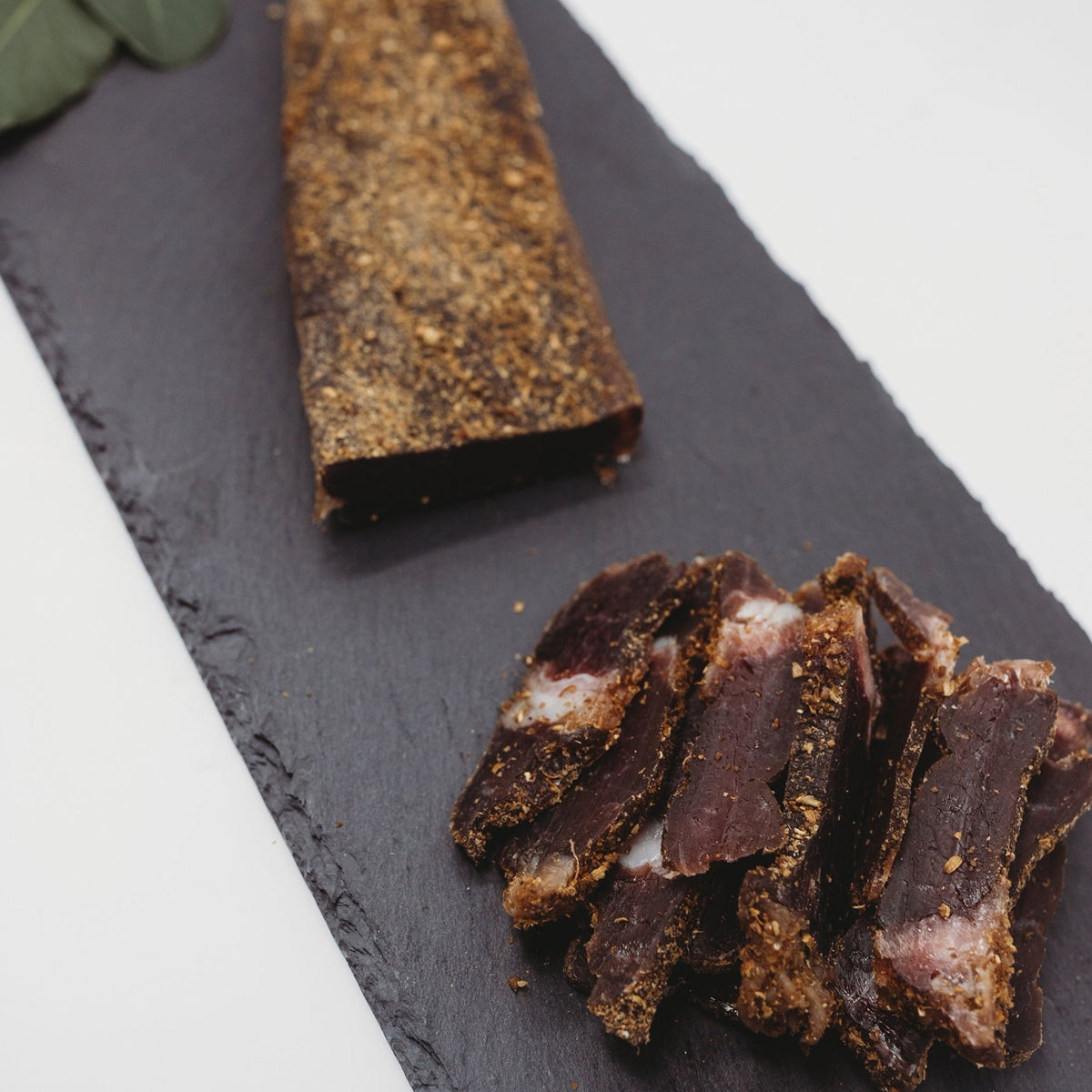
The silverside-to-topside ratio in a biltong batch directly controls every drying room variable: silverside's lean muscle loses moisture faster and case-hardens if ambient humidity isn't dropped and hang time extended, while topside's intramuscular fat buffers moisture loss and allows tighter scheduling. Mixing both cuts in a single zone without separating airflow forces a compromise setting that simultaneously over-dries the silverside and under-dries the topside, producing texture variance that makers routinely misattribute to spice blends or curing time rather than the ratio itself. This is why the ratio is a closely guarded production variable, and why it shows up most nakedly in slab-format products, where there is nowhere for inconsistency to hide.
Want some on hand? Order biltong online: Glatt Kosher, air-dried in Florida, free US shipping over $50.
Why Silverside and Topside Behave So Differently in the Drying Room
The difference comes down to fat. Topside carries more intramuscular fat woven through its muscle fibers. That fat doesn't give up moisture the way lean muscle does. It holds, it buffers, and it slows the evaporation rate at the surface. The result is a cut that dries at a pace you can predict and schedule around. You can build a drying-room routine for topside and trust it.
Silverside is a different animal. It's the leaner of the two cuts, which means there's very little intramuscular fat to slow anything down. Moisture leaves quickly, and it leaves from the outside in. That matters because when the surface of a piece of biltong dries too fast relative to the interior, you get case-hardening: a dense, dry crust forms on the outside while the center is still at a moisture level you'd never want to serve. The interior never gets the chance to equalize with the drying environment because the exterior has already sealed.
Preventing case-hardening in a silverside-heavy batch means doing specific things to the drying environment. Ambient humidity needs to drop. Not by a little, but meaningfully, because you're trying to slow the rate at which the surface loses moisture relative to what's happening deeper in the muscle. Hang time needs to extend, because the only way to let the interior reach target moisture without blowing out the exterior is to slow the whole process down and give it more time. And airflow has to be managed carefully, because active air circulation that a leaner cut needs for even drying will accelerate surface evaporation if it isn't calibrated right.
Our grass-fed beef adds another layer to this. Grass-fed silverside is leaner than its grain-finished counterpart, which tightens every one of those margins further. The margin between a properly dried piece and a case-hardened one is narrower when the beef has less fat to buffer with. That's why our operation uses what you'd call a dual-zone drying protocol, because you cannot treat grass-fed silverside and topside as interchangeable inputs in the same airflow environment. They are not interchangeable. They have different physics.
Topside, by contrast, gives you room to breathe. The intramuscular fat acts as a natural moisture buffer. It moderates the evaporation rate from the inside out, which means the exterior and interior of each piece tend to reach their target moisture level within a much narrower window of time. That makes scheduling possible. You know roughly when a topside-dominant batch will be ready, and the variance from one piece to the next is manageable. A topside-heavy room is a predictable room. A silverside-heavy room is a room that demands constant attention.
What Happens When You Mix Both Cuts in a Single Zone
Here is where most of the real problems begin. When you batch silverside and topside together in a single drying zone without separating airflow, you are forced into a compromise. You set your humidity, your temperature, and your circulation for something in between what each cut actually needs. There is no setting that is correct for both at once.
What that compromise produces is predictable, and it is not good. The silverside, exposed to a humidity level that was set with topside in mind, dries faster than it should. The surface loses moisture at a rate the interior cannot match. You get case-hardening on the silverside pieces. The topside, exposed to airflow that was calibrated for leaner muscle, retains more moisture than it should. You end up with topside that is under-dried, with a texture that feels different, sometimes softer than it should be, sometimes uneven in a way that's hard to name but easy to notice.
The output of a single-zone mixed batch is a range of textures across pieces that were hung at the same time, in the same room, under the same conditions. Some pieces are overdone. Some are underdone. The average might be acceptable. But anyone who pays close attention, and the kind of customer who buys biltong slabs by the pound absolutely does pay close attention, will notice.
The tempting explanation when customers flag texture variance is to look at the spice blend. Maybe the coriander ratio shifted. Maybe the vinegar cure ran longer this time. Those are the knobs that feel controllable, so they get adjusted. The variance persists. The actual driver, which is the silverside-to-topside ratio and the single-zone compromise it creates, goes unexamined. This is the hidden cause that most makers never isolate, and it is the reason ratio data is treated as proprietary in this business.
Running separate zones by cut is the solution, but it is not a small operational commitment. It means more space, more equipment, more monitoring, and more discipline about what goes where. It means that when a batch comes in with an unusual ratio, because grass-fed beef sourcing does not always produce uniform cut yields, you have to be willing to adjust the drying-room schedule for that specific batch rather than running everything on the same clock. That kind of operational flexibility is what separates a maker who gets consistent texture from one who doesn't.
Why Slabs Expose What Bulk and Sliced Formats Conceal
Here is the part that most people don't think about until they've bought both formats side by side. Sliced biltong and bulk bags are forgiving formats. When biltong is sliced and sold by the bag, the pieces inside represent a range of cuts, a range of positions on the hanging rack, and a range of textures. Any single piece that came out a little too dry or a little too soft gets averaged out by the pieces around it. The overall eating experience of the bag is acceptable because you're not evaluating any one piece in isolation. You're tasting the average.
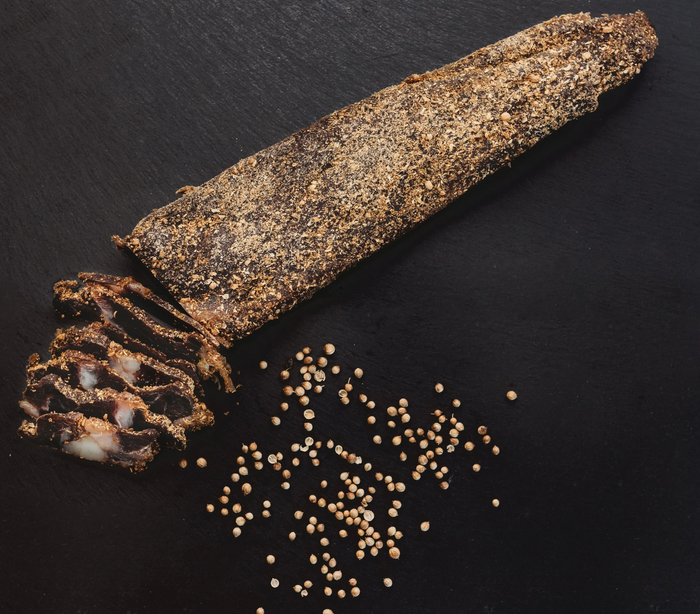
A slab is a single piece. One continuous cut of beef, hung as one unit, dried as one unit, and sold as one unit. When you slice it yourself, every slice you pull from that slab tells you something about the whole. If the ratio problem produced case-hardening on the outside while the interior ran soft, you feel that in the first few slices versus the slices you pull from the center. There is nowhere for inconsistency to hide. The slab is the most honest format in the category, which is exactly what makes it the most demanding format to produce consistently.
Our Biltong Slabs carry a note that is worth taking seriously: inventory is generally low because we set aside only a handful of slabs per batch, and that can mean wait times of two to three weeks for shipment. That is not a logistics limitation. That is a direct consequence of the ratio problem. You cannot produce slabs at scale without being ruthlessly selective about which pieces from a batch meet the standard that a slab format will make visible. The pieces that don't make that cut go into sliced format, where the averaging effect protects the experience. The ones that do make it become slabs.
Sliced formats are also where another layer of the problem compounds. Thinner cuts expose more surface area relative to the volume of the piece. That compresses the drying-time window. The margin between correctly dried and over-dried is smaller in a thin slice than in a thick slab. So when the ratio is off and the drying-room setting is a compromise, sliced product made from silverside pieces will show the damage faster and more dramatically than slab product from the same batch. It's a smaller target to hit, and a missed compromise hurts it more. This is why our sliced formats, including the Sliced Biltong and the Sliced Biltong Mini's, demand the same ratio discipline as slabs, even though the sliced format is more forgiving about hiding individual-piece variance in a bag.
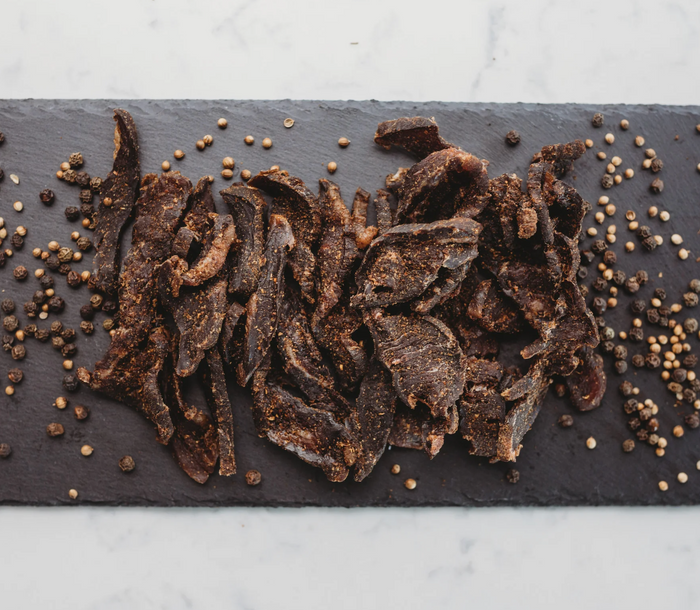
The Bulk Biltong, a full pound of sliced biltong in one bag, is where the averaging effect is strongest. A one-pound bag represents enough individual pieces that batch-to-batch ratio variance becomes nearly invisible to the buyer. A bag that pulls from a silverside-heavy batch and a bag that pulls from a topside-heavy batch will taste like the same product to most people. The per-piece texture variance is real, but the aggregate eating experience smooths it out. That's not a knock on the format. It's why bulk is the right choice for charcuterie boards and parties, where you're putting out a variety of pieces for a variety of people. But it also means bulk format never forces a maker to confront whether their ratio is right. Slabs do.
Why Makers Keep the Ratio Private, and What That Tells You
If the silverside-to-topside ratio were just a production detail with no real consequence, makers would talk about it freely the way they talk about spice blends or curing times. They don't. The ratio is the variable that actually controls texture consistency, and texture consistency is the thing that separates a product a customer will re-order from one they won't. Keeping the ratio proprietary is keeping the real quality lever proprietary.
There's another reason ratio data stays private. Publicizing it would force a conversation about batch-to-batch consistency that most producers don't want to have. When you tell a customer your target ratio, you've implicitly committed to hitting it. And when a batch comes in with a different yield from the butcher, and grass-fed beef yields vary more than grain-finished beef because the animals are not raised to a uniform finished weight, the gap between your stated ratio and your actual ratio becomes visible. It's easier to say nothing. The spice blend gets the credit when a batch is great. The spice blend takes the blame when a batch isn't. The ratio sits quietly underneath both.
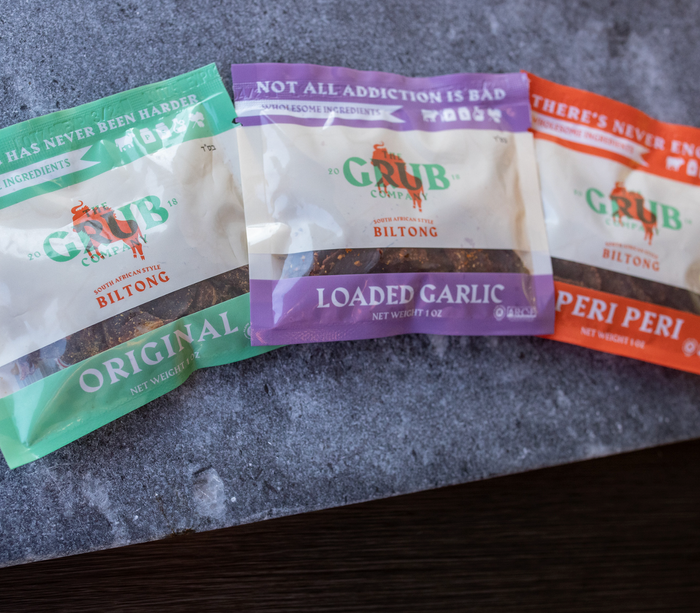
This is also why sampler packs work the way they do in this business. Our Biltong Sampler Pack lets a first-time buyer try all three flavors, Original, Peri Peri, and Loaded Garlic, in small quantities before committing to a full-size order. It's a sensible entry point for someone who doesn't yet know which flavor profile they want. But it's also the format most insulated from the ratio variable, because each mini bag is drawing from a mixed batch where piece-to-piece variance is averaged across the bag. The sampler is an honest way to try the flavor. The slab is the format that tells you the most about how the maker actually runs their drying room.
The scarcity of our slabs, that handful per batch, those two-to-three week wait times, is the truest thing we can tell you about the difficulty of the ratio problem. We don't put everything that comes out of the drying room into a slab. We put the pieces that earned it. The rest goes into sliced format, where it belongs, and where it's still excellent biltong. But the slab is where the ratio is most visible, most honest, and most demanding. That's exactly why it's the format worth waiting for.
If you care about texture, and you've tried enough biltong to know that texture is the real differentiator, the slab is the format that tells you what a maker is actually capable of. Everything else can hide behind the average. Slabs cannot. That's the whole point.
A few things are worth knowing before you place an order, so here are the questions we hear most often when customers are weighing slabs against sliced.
Frequently Asked Questions
Why does slab biltong sometimes have different texture near the outside versus the center?
That's case-hardening, and it's the most common sign of a silverside-heavy batch run in a single drying zone without the right humidity control. When the exterior of a lean piece dries faster than the interior can equalize, you get a denser crust on the outside while the center retains more moisture. A correctly managed batch, with ambient humidity dropped appropriately and hang time extended, allows the interior and exterior to reach target moisture at roughly the same pace. When you buy slab format, you'll notice this problem immediately if it exists, because there's no averaging effect to cover it.
Is the long wait time for slab orders a shipping issue or a production issue?
It's a production issue, specifically a consequence of how selective the process has to be. We set aside only a handful of slabs per batch, because not every piece that comes out of the drying room meets the standard that a slab format demands. Pieces with any texture inconsistency go into sliced format instead. The wait, which can run two to three weeks, reflects how often a qualifying slab is ready, not how long it takes to ship. We'd rather tell you that honestly than promise faster delivery and send you something that doesn't live up to what a slab should be.
Does the grass-fed beef you use make the ratio problem harder to manage?
Yes, and we don't pretend otherwise. Grass-fed beef silverside is leaner than grain-finished beef, which means there's less intramuscular fat to buffer moisture loss. That narrows the margin between a perfectly dried piece and an over-dried one. It also means the gap between how silverside and topside behave in the drying room is wider than it would be with grain-finished beef. We use a dual-zone drying protocol specifically because of this. Grass-fed beef is worth the extra discipline in the drying room because the flavor and nutritional profile are genuinely different, but the discipline is non-negotiable.
If I order Bulk Biltong instead of slabs, am I getting a lower quality cut?
No, but you're getting a different format with a different use case. Bulk sliced biltong draws from the same batches and the same grass-fed beef. The difference is that a one-pound bag of sliced biltong averages out piece-to-piece variance in a way that a single slab cannot. If you're building a charcuterie board, hosting a party, or stocking up for a week of snacking, bulk sliced is exactly the right format and the right value. If you want to evaluate the maker's drying-room discipline in its most honest form, the slab is the format that does that. Both are real biltong. They just serve different purposes.
Why do makers not publish their silverside-to-topside ratios?
Because the ratio is the real quality variable, and publishing it creates accountability that most makers don't want. If you tell customers your target ratio and then your grass-fed beef yield comes in differently from one batch to the next, the gap between your stated ratio and your actual ratio becomes visible in the texture of the product. It's easier to talk about spice blends and cure times, both of which matter but neither of which is the master variable. The makers who run consistent slabs know their ratio and protect it, not out of secrecy for its own sake, but because it's the thing that actually drives what a customer can taste.
Should I start with the Sampler Pack or go straight to slabs if I'm new to biltong?
Start with the Sampler Pack. It's the honest answer. The sampler gives you all three flavors, Original, Peri Peri, and Loaded Garlic, in small quantities so you can find out which one you'll actually reach for before you commit to a full-size order or a pound of slabs. Slabs are for when you already know what you want and you want the format that delivers the most direct, least processed eating experience. They're also worth the wait. But walking in with no flavor preference and ordering a slab is a bet you don't need to make. The sampler is exactly what it's there for.
Why do sliced biltong minis show texture variance more than the standard sliced format?
Thinner and smaller cuts expose more surface area relative to their volume. That compresses the drying window, which means the margin between correctly dried and over-dried is tighter for a mini piece than for a standard slice. When the drying-room setting is a compromise because of a mixed-cut batch, that tighter margin shows up in the mini format first and most clearly. It's the same physics as the slab problem, just in the opposite direction. Managing that requires the same ratio discipline, the same zone separation, and the same attention to airflow, even though the mini is the most casual format in the lineup.
Ready to pick one? Browse Biltong Bulk & Wholesale.