Why Does Biltong Get Misunderstood? The Real Reasons
Biltong gets misunderstood because nearly everyone in North America reaches for the same shortcut: it is jerky with a foreign name. That single substitution is wrong at the process level, the texture level and the flavor level, and it generates almost every other mistaken idea people arrive with. Once you know where the confusion starts, the product makes considerably more sense.
Want some on hand? Order biltong online: Glatt Kosher, air-dried in Florida, free US shipping over $50.
We have watched this happen in real time often enough to have a list. What follows is that list, written from the position of people who make the stuff and who would rather explain it once properly than keep meeting the same wrong expectation.
The jerky comparison is the root of almost everything
Jerky is marinated and dried with heat. Biltong is cured in vinegar and salt and dried in moving air at ambient conditions, over days rather than hours, with no heat applied. Those are different preservation methods, not different recipes for the same method. Heat firms protein fast and drives out water fast. Air takes its time and leaves the piece denser with more of its water still in it.
So when somebody bites into biltong expecting the firm snap of a jerky strip and gets a tender pull instead, the natural conclusion is that something is wrong with it. Nothing is wrong with it. That is what correctly made biltong is. The expectation was calibrated on a different food.
The name gives away nothing
Biltong comes from Dutch, from bil meaning rump and tong meaning strip. It describes the cut and the shape, which was perfectly informative to the people who named it and is completely opaque to everyone else. Jerky at least sounds like what it does. Biltong sounds like nothing, so shoppers fill the gap with the nearest thing they know.
There is a second effect. A word that carries no meaning also carries no promise, so a first time buyer has no framework for judging what they got. Was it supposed to be that dark. Was it supposed to bend like that. Without a reference point, anything unfamiliar reads as a defect rather than a characteristic.
Air dried gets heard as undercooked
Because biltong never meets heat, people reasonably wonder how it can be finished. The honest answer is that heat is one preservation lever among several and this category has always pulled the other ones. Salt binds part of the water in the meat, drying removes the rest, and vinegar puts acid on the surface from the first hour. What governs a dried meat is how much water is chemically available in it, which is a different quantity from the raw moisture percentage, and that is the quantity the whole process is aimed at.
The reason this is a persistent confusion rather than a passing one is that the cooking framework is so dominant. Most people have exactly one mental model for making meat shelf ready, and it involves temperature. A method that gets there over days, invisibly, through water and salt and acid, has no visual event to point at. Nothing looks like it happened, so it is easy to believe nothing did.
Chewy gets heard as tough
These are not the same property and the vocabulary does not help. Tough means resistant in a way that does not resolve, the sensation of working at something that will not give. Chewy in the biltong sense means resistance followed by release, a piece that pulls apart into short fibers once you commit to it.
The reason biltong is chewy rather than brittle is that it kept a real share of its water. That is the design. A product engineered to snap would have to be taken further and would lose the density people who like biltong are actually there for. If a piece genuinely fights you, the likely explanations are that it was cut along the grain rather than across it, or that it was taken drier than you prefer, and both are addressable by buying differently rather than by concluding the category is not for you.
The flavor lands in an unfamiliar register
Traditional biltong is coriander, black pepper, salt and vinegar. That is close to the whole list. Western dried meat snacks tend to run sweet, often smoky, frequently built on a marinade that reads as barbecue. Coriander forward, tangy, savory and not sweet at all is a different flavor language, and when nobody is prepared for it, different reads as wrong.
The vinegar note is the one that surprises people most. It is not a fault, it is not the product turning, and it is not a strong flavor once the piece has dried properly. It is a clean sour edge sitting behind the spice, and it is doing real work in the process as well as on the palate. People who dislike it on first contact very often come around, because it stops registering as an intrusion once you stop expecting sweetness.
The white bloom gets mistaken for spoilage
A pale powdery or waxy coating, most often near a fat edge, is one of the most common reasons a perfectly good piece gets thrown out. It is usually surface fat or salt showing itself. It sits flat, it wipes away and it has no smell to speak of.
Actual mold looks different in a way that is obvious once you have seen both. It is fuzzy, it has physical texture standing off the surface, it appears in patches rather than as an even coat, and it smells distinctly off. The confusion is understandable, because both are white things on meat, and the cost of the confusion is a lot of wasted product.
Price gets read as a markup
Dried meat looks expensive per ounce and the reaction is usually that somebody is charging for the story. The arithmetic is more boring than that. A large share of the raw weight of the beef leaves as water during drying, so a finished pound started life as considerably more than a pound. You are paying for the beef that evaporated, not just the beef in the bag.
On top of that, the drying itself occupies space and time. A product that takes days in a controlled environment carries the cost of those days. None of this makes biltong cheap, and we are not going to argue it should feel cheap. It does mean the comparison people instinctively make, against the price of ground beef at the same weight, is comparing two different quantities of beef.
Slab and sliced get treated as packaging
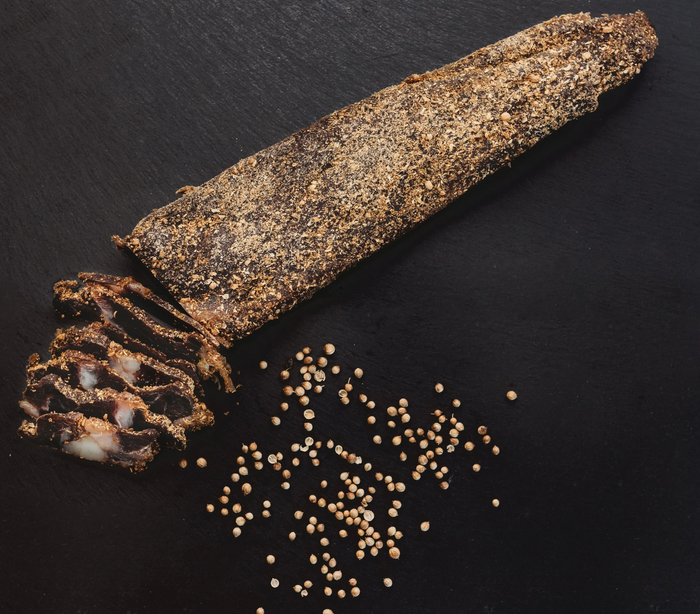
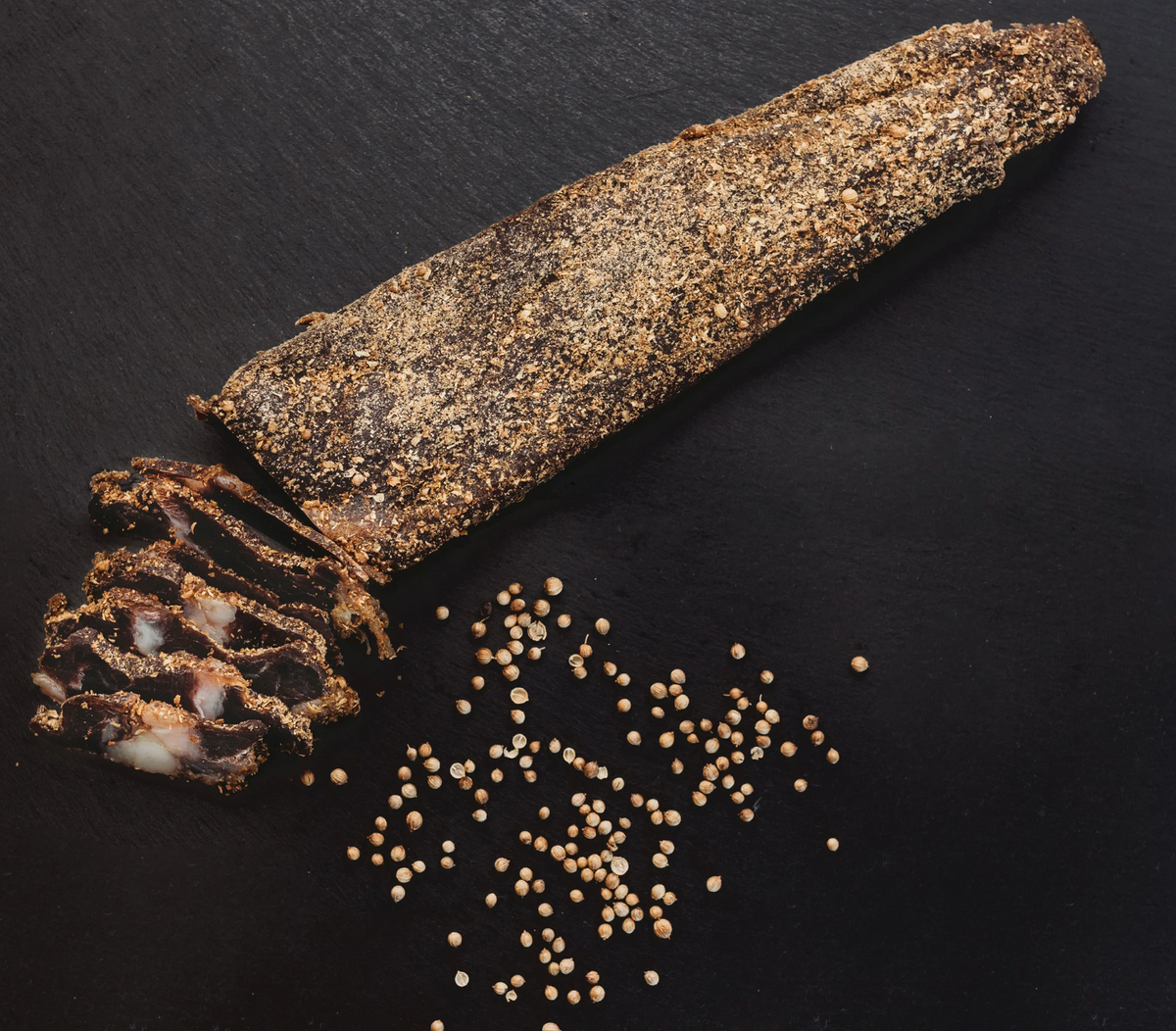
They are different products. A slab is dried whole and cut when you want it, so the interior spent the whole drying period a long way from any surface and you control the thickness on the day. Sliced product is cut before or soon after drying, uniform through, with far more exposed surface.
Someone who tried sliced biltong and found it drier than they hoped has not necessarily met their preference yet. Cutting a slab thick gives a completely different bite from the same beef and the same spice. Treating that choice as a matter of convenience rather than of eating experience is one of the more expensive misunderstandings on this list, because it sends people away from the category over a variable they never knew they could change.
One bad first encounter becomes a verdict
Biltong varies across four independent axes: the meat, how far it was dried, the spice mix and the format. That is a large space, and the odds of your first purchase landing on your preference are not great. But people do not usually say they disliked that particular product. They say they tried biltong.
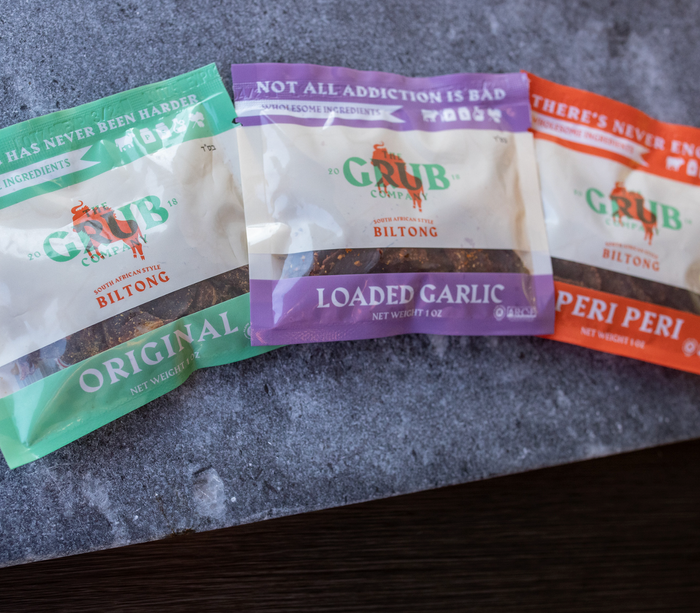
This is why we would rather sell somebody a small piece or a sampler than a large one on day one. Sliced Biltong Mini's at $4.99 exists to be a cheap experiment, and the Biltong Sampler Pack at $12.99 exists to let somebody move along more than one axis before deciding anything. A first purchase that turns into a verdict on a whole category is bad for the buyer and eventually bad for us.
It gets shelved as a health food
Biltong is dried beef with salt and spice on it. It is a whole muscle food with a short ingredient list, which is a genuine and checkable fact about its composition, and we are happy to state it plainly. What we will not do is attach a list of things it does for a person, because that is not a claim we can make about a food and it is not a claim anybody should accept from a company selling one.
The misunderstanding runs in both directions, which is what makes it interesting. Some people arrive expecting more from it than a dried meat can promise. Others dismiss it as junk without looking at what is in it. The accurate position sits between the two, and it is the position we would rather occupy publicly than either of the more marketable ones.
The dark color gets read as burnt
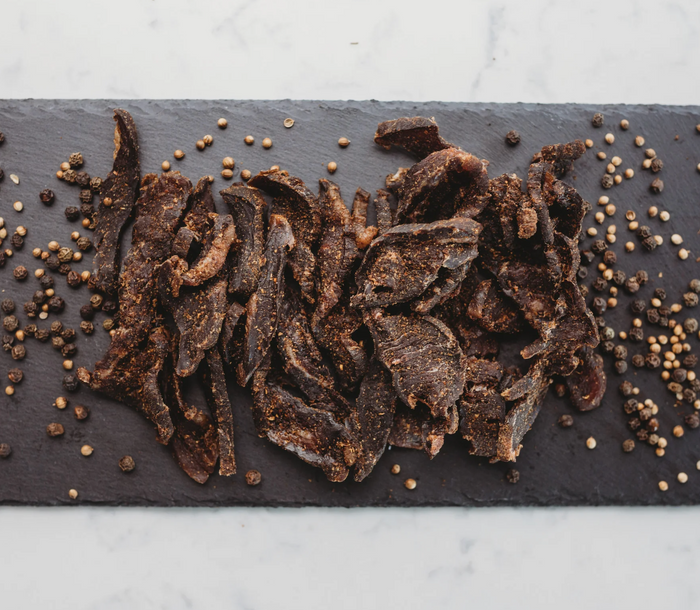
Biltong is much darker than raw beef and often darker than jerky, and first time buyers regularly read that as scorched or old. Neither is what happened. Drying concentrates everything left in the meat once the water has gone, and the pigment in beef darkens as it loses moisture and meets air over days. A pale dried meat would be the surprising one.
The spice layer adds to it. Cracked coriander and black pepper sit on the surface and darken the outside further, so the exterior of a piece reads considerably deeper than the cut face. Slicing a slab is the quickest way to see this, because the interior is noticeably lighter than the outside and nobody has done anything to it except leave it alone.
The word itself stops people asking
Nobody wants to mispronounce a food out loud, and biltong is a word most Americans have never had to say. It is straightforward, bill followed by tong, but the uncertainty is enough to keep a shopper from asking a question at a counter, and an unasked question is a purchase that does not happen.
This sounds trivial next to the process misunderstandings and it is not. A product whose name gives no clue about what it is, and which people are slightly unsure how to pronounce, has to be explained rather than recognized. That is a genuine disadvantage in a snack aisle where everything else announces itself, and it is a large part of why the jerky shortcut wins by default.
Shelf life gets assumed rather than checked
Two opposite assumptions turn up equally often. One is that a dried meat lasts indefinitely because it is dried. The other is that it needs refrigeration like fresh beef. Neither is right, and both come from filing the product in the wrong category.
The reality is that a dried meat sits in a relationship with the air around it. Dry surroundings continue to dry it, damp surroundings feed moisture back into it, and the state the drying created can drift either way. That is why storage guidance for biltong is about stability and containers rather than about a single date. Sliced product has far more exposed surface than an uncut slab and responds much faster to whatever it is sitting in.
The category placement confuses everybody
Biltong tends to end up next to snack meat, which frames it as a between meals nibble. In southern Africa it functions much more like a staple, something eaten in real quantity, brought to gatherings, kept in the house as a matter of course rather than bought as a treat.
That framing gap changes how people buy. Someone who thinks of it as a snack buys the smallest package occasionally. Someone who thinks of it as food buys a slab or a pound and works through it. Neither is wrong, but the snack framing means a lot of people never experience the product the way it is actually meant to be lived with, and the difference between those two relationships is substantial.
Bottom line
Nearly every misunderstanding about biltong traces back to one substitution, filing it as a variety of jerky. It is a different process, and the process explains the texture, the tang, the price and the shelf behavior. It is air dried after a vinegar and salt cure, not heat dried. It is chewy by design, not tough by accident. The white bloom is usually fat. The four axes of variation mean a bad first bag is a bad first bag rather than a verdict. Buy small, buy across the range, and judge it as its own thing.
Frequently Asked Questions
Is biltong just South African jerky?
No, and this single substitution generates most of the confusion around it. Jerky is marinated and dried with applied heat, usually within hours, which firms the protein quickly and produces a thin snappy strip. Biltong is cured in vinegar and salt and then dried in moving air at ambient conditions over days, with no heat involved. It keeps far more of its water, so it comes out denser and pulls apart rather than snapping. The two are parallel answers to the same preservation problem developed on different continents, and expecting one to eat like the other is what sets people up for disappointment.
Why does my biltong taste sour?
That is the vinegar, and it is meant to be there. Biltong is wiped or soaked in vinegar at the start of the cure, which puts acid on the surface from the first hour and narrows the range of things that will grow there. The clean sour edge you taste is the same acid, sitting behind the coriander and pepper. It is not a sign that the product has turned and it should not be a strong flavor once the piece has dried properly. People who find it jarring on first contact usually come around once they stop expecting the sweetness that most western dried meat snacks carry.
Is biltong supposed to be chewy or is mine tough?
Chewy and tough are different sensations and biltong should be the first one. Chewy means resistance followed by release, a piece that pulls apart into short fibers once you commit to the bite. Tough means resistance that never resolves. Biltong is chewy because it keeps a real share of its water, which is the whole design. If a piece genuinely fights you, the likely explanations are that it was cut along the grain rather than across it, or that it was dried further than you prefer. Both are fixed by buying differently rather than by writing off the category.
What is the white powder on biltong?
Usually surface fat or salt showing itself, and it turns up around the fat edge more than anywhere else. It sits flat against the surface, wipes away cleanly and has no real smell. Mold looks quite different once you have seen both. It is fuzzy with physical texture standing off the surface, it appears in patches rather than as an even coat, and it smells distinctly off. A great deal of perfectly good product gets thrown away over this confusion, which is understandable given that both are white things appearing on meat.
Why is biltong more expensive than the same weight of beef?
Because a finished pound started life as considerably more than a pound. A large share of the raw weight leaves as water during drying, so you are paying for the beef that evaporated as well as the beef in the bag. On top of that, drying occupies controlled space for days rather than hours, and that time carries a cost. The instinctive comparison against fresh beef at the same weight is comparing two different quantities of meat. None of this makes biltong cheap, and we would rather explain the arithmetic than pretend the price is arbitrary.
Does biltong need to be refrigerated?
Two opposite assumptions turn up equally often, that a dried meat lasts indefinitely and that it needs the fridge like fresh beef, and neither is right. A dried meat sits in a relationship with the air around it. Dry surroundings keep drying it, damp surroundings feed moisture back into it, and the state the drying created can drift either way. So the useful guidance is about a stable environment and a suitable container rather than about a single date. Sliced product has far more exposed surface than an uncut slab and responds to its surroundings much faster.
I tried biltong once and did not like it. Is it worth another go?
Probably, because biltong varies across four independent axes and your first purchase landed on one point of a large grid. The meat, how far it was dried, the spice mix and the format all change the experience substantially, and format changes it most while getting mentioned least. Someone who found sliced product drier than they hoped may well prefer a thick cut from a slab of the same beef and spice. The sensible second attempt is a small piece or a sampler that lets you move along more than one axis rather than another full bag of the same thing.