What Does Biltong Mean? The Word, the Method, and the Meat
Biltong means, quite literally, a strip of rump. The word comes from Dutch roots: the first part refers to the rump or hindquarter of the animal, the cut the meat was taken from, and the second part means tongue, describing the long flat tongue-like shape of a piece hanging up to dry. Put together, the name describes an object rather than a recipe. A tongue-shaped strip of rump, hung.
That is the definition, and it is more useful than it first looks. The name tells you where the meat came from and what it looked like while it was being made, which means anyone using the word correctly is talking about a cut and a process rather than a taste or a brand. This page starts with the word and then works outward into the method the word describes.
The word, taken apart
Two pieces, joined. The first names a cut from the back end of the animal. The second names a shape. Neither half refers to spice, drying time, texture or anything a modern label would call a variety.
That is characteristic of food names built by people who made the food rather than by people selling it. A maker names a thing after what is in front of them. What was in front of them was a long strip taken off the hindquarter, hanging in a row of others, each one looking rather like a tongue.
Compare that to how food gets named now, which is usually after a taste, a place or a feeling. The older kind of name is descriptive and slightly blunt, and it survives because it is accurate.
Why the tongue half is the interesting half
The rump half of the word is straightforward. The tongue half tells you something about the method, and that is easy to miss.
A piece is described as tongue-shaped because it was hanging. It was long, flat, thicker in the middle and tapered at the edges, exactly the shape you get when you cut with the grain of a large leg muscle and hang the result. The name is a record of the meat being suspended in air, which is the defining act of the whole method.
So the word quietly contains the process. Anything sitting flat on a rack, packed in a chamber or laid out under heat is not what this word was coined to describe. The name assumes hanging, and hanging assumes air moving all around the piece.
What the word does not mean
Biltong is not a flavor, a brand or a style of seasoning. There is no such thing as biltong-flavored anything in the way there is with more marketing-driven food words. The term names a preparation.
It is also not a synonym for dried meat in general. Plenty of meats are dried and are not biltong. What makes the word apply is the combination of a cure with salt and acid, spicing, and drying in moving air without heat. Remove the air drying and you have a different food, whatever it is called.
And it is not a regional adjective. The word travels with the method, so meat made this way outside South Africa is still biltong. What the word does carry is an expectation about how it was made, which is why it matters that people using it mean the same thing.
From the word to the method
Anyone typing what does biltong mean is usually asking two questions at once. What does the word mean, and what is this thing. The first has a short answer. The second needs the method, because that is where the word gets its content.
The sequence is: cut, cure, spice, hang, wait. Beef is cut into long strips along the muscle. The strips are treated with salt and washed with vinegar. Spice goes on, coriander prominent among it. Then the strips hang in moving air at ordinary temperature until enough water has left them.
Nothing in that sequence involves heat. That single absence is what separates this food from almost everything else in the dried meat aisle, and it is why a definition that skips the method leaves you knowing a word and not a thing.
Vinegar, and what the acid actually does
Vinegar is the part of the definition that surprises people, because a dried meat that tastes faintly sour is not what most Americans expect from a beef snack.
The acid lowers the surface pH during the early hours when the meat is still wet and most vulnerable. That is its practical job. Its second job is taste. Vinegar leaves a sourness in the background that cuts the salt and stops the whole thing from reading as one flat savory note.
How much and what kind is where makers differ, and it is one of the two or three variables that make two well-made pieces taste noticeably different. Too little and the piece is heavy and salt-forward. Too much and the sourness climbs over the beef, which is a real and fairly common fault.
Salt, and the water it pulls
Salt is the oldest half of the cure and the part that does most of the preserving. It draws water out of the meat by osmosis and binds part of what remains, so that the water still in the piece is less available for anything to use.
Getting it right is a balance rather than a maximum. Under-salt and the drying has to do work the cure should have done, which pushes the maker toward taking the piece harder and drier than they want. Over-salt and you get a preserved piece that nobody enjoys eating.
The amount of salt is therefore tied to the finish. A wetter, softer style needs its cure to be right, because less water is going to leave. A hard-dried piece is more forgiving, which is one reason the driest versions of this food are also the easiest to make.
Air rather than heat, and why it changes everything
Drying in air at ordinary temperature is slow. Water leaves the surface, and water from deeper in the muscle migrates outward to replace it, and that migration cannot be rushed.
Apply heat and the physics change. The outer proteins set, the surface hardens early, and the water still in the middle finds it much harder to get out. You end up with a different texture and a different taste, which is the whole of the difference between biltong and heat-dried jerky and the only line this piece gives to that comparison.
The cost of doing it with air is real. It takes days rather than hours, it depends on the room behaving, and the results vary more than a machine's would. What it buys is a piece that eats like beef rather than like a beef product, with a moist interior that heat cannot leave behind.
Water activity, or what dried really means
The word dried is doing a lot of work in any definition of biltong, and it does not mean what most people assume. It does not mean an absence of water. A good piece of biltong still holds a meaningful amount.
What matters is water activity, meaning how much of the water present is chemically available rather than bound up by salt, by acid and by the structure of the meat. That is the number governing whether a dried meat keeps, and it is why two pieces at the same raw moisture reading can behave completely differently.
This is also why a slow dry beats a fast one. Dry too quickly and the outside sets while available water is still sitting in the middle. The piece feels finished to the hand and is not finished in the way that counts.
Coriander, and the spice hand
Coriander is the spice most associated with biltong, close enough to universal that its warm citrus note is part of what people mean when they say something tastes like biltong.
Spice here goes on before drying, not after, and that changes what it does. It sits on the meat through the entire time water is leaving, working into the surface rather than resting on top of it. The result is integrated in a way that seasoning applied at the end never is.
Beyond coriander, every maker has their own hand, and this is where personal style lives. Two pieces cured and dried almost identically can taste clearly different because of the balance in the spice. This part of the craft is not standardized and should not be.
The cut behind the word
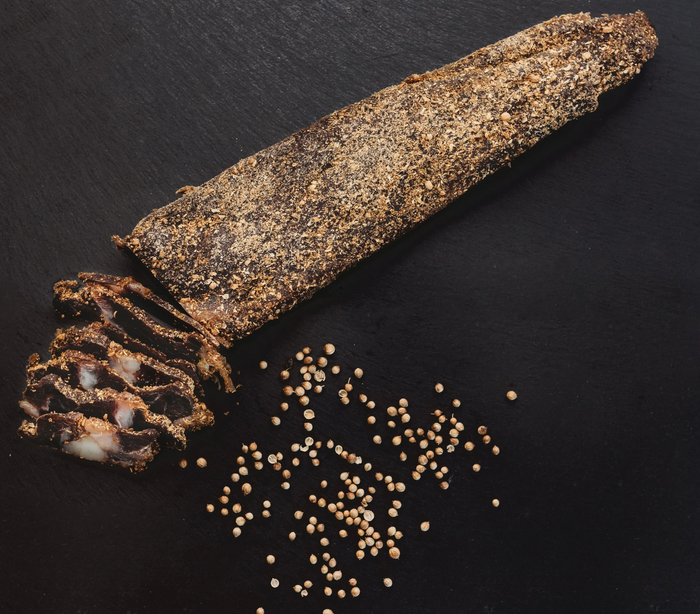
The word points at the rump, and the cuts most used in practice are silverside and topside, both from the back leg. They are lean, they have long muscle fibers running in a consistent direction, and they are big enough to yield the long strips the name describes.
Direction is a decision with consequences. Cut along the grain and you get the classic long fibrous pull, the texture people picture when they think of biltong. Cut across it and the fibers are shorter and the bite is softer.
Fat is the other variable. Fat holds almost no water, so it does not dry the way lean does. It stays soft while the muscle around it firms, which gives a fatty piece its two-part texture. Fat carries taste, and it also shortens the comfortable life of a piece, so leaving it on or trimming it off is a real trade rather than a preference.
Slab and sliced, both still biltong
The word covers both a whole hanging piece and the slices cut from one, which sometimes confuses people meeting two very different-looking products under one name.
A slab is dried whole and cut when somebody wants to eat it. Very little surface is exposed relative to its mass, so its interior stays softer and it holds its condition for longer. Biltong Slabs at $58.00 are that version, and cutting it yourself is the closest thing by mail to a counter slicing to order.
Sliced biltong is cut thin and reaches you ready to eat. Far more cut surface means more spice contact per bite and a consistent texture through the bag, and it also means the piece keeps drying faster once it is opened. Sliced Biltong at $11.99 is the everyday version, Sliced Biltong Mini's at $4.99 is the smallest bag, and Bulk Biltong at $58.00 is a full pound of the same thing.
Saying it, and using it in a sentence
Biltong is pronounced with a short first syllable, roughly bill, and a second that rhymes with song. Three sounds, no trap in it.
Grammatically it behaves as a mass noun in the way that bread or cheese does. You have some biltong, not a biltong. A single piece is a piece of biltong or a slice of biltong. You would say the biltong is dry rather than the biltongs are dry.
Small point, but it is the sort of thing people quietly worry about before saying a new word out loud in a shop, and getting it wrong is the most common tell that somebody has only ever read about this food.
Why the meaning matters when you buy
Knowing what the word means changes what you look for. If biltong names a cure plus air drying rather than a taste, then the useful questions to ask a seller are about method rather than adjectives.
Was it dried in air or in heat. Is it cut with the grain or across it. Is it taken to a wet finish or a hard one. Those three answers tell you more about what will arrive than any amount of description about richness and depth.
It also explains why two products both correctly labeled biltong can be so different from each other. The word is broad by design. It names a method, and within that method there is a wide range of legitimate choices, which is exactly why a sampler is the sensible way to find your own place in it.
Bottom line
Biltong means a tongue-shaped strip of rump, from Dutch roots naming the cut and the shape of a hanging piece. Underneath the word is a method: beef cut along the grain, cured with salt and vinegar, spiced with coriander among other things, and hung to dry in moving air with no heat at any point. Dried here does not mean waterless. It means the water that remains has been made unavailable, which is what lets the meat keep.
If you want to know what the word means in your own mouth rather than on a page, the Biltong Sampler Pack at $12.99 is the cheapest honest way to find out. If you already know and want the version closest to how the word was coined, Biltong Slabs at $58.00 is a whole hanging piece for you to slice yourself.
Frequently Asked Questions
What does the word biltong mean?
It means a tongue-shaped strip of rump. The name is built from Dutch roots, one naming the rump or hindquarter that the meat was cut from, the other meaning tongue and describing the long flat shape of a piece hanging up to dry. So the word describes an object rather than a taste or a recipe. That is why it tells you something useful: anyone using it correctly is referring to a particular cut prepared by a particular method, not to a seasoning style or a brand of snack.
How do you define biltong?
Biltong is beef that has been cut into strips, cured with salt and washed with vinegar, spiced with coriander among other things, and then hung in moving air at ordinary temperature until enough water has left it that it keeps. The definition rests on two things. There is a cure with both salt and acid, and there is drying in air with no heat at any stage. Take away the air drying and you have a different food. Everything else, the spice balance and how far the drying is taken, varies between makers.
Is biltong an Afrikaans or a Dutch word?
The roots are Dutch, and the word came into Afrikaans, which is the language it is most associated with today. Both parts of it are descriptive rather than poetic: one refers to the rump cut, the other to a tongue, meaning the long flat tapered shape of a strip hanging to dry. That kind of plain descriptive name is typical of foods named by the people who made them rather than by the people selling them, which is part of why it has lasted.
Does biltong mean dried meat in general?
No. Many meats are dried and are not biltong. The word carries an expectation about method, specifically a cure using both salt and an acid, spicing before drying, and drying in moving air without heat. Meat dried by heat is a different product whatever else you call it. The word is not a regional label either, so meat made this way outside South Africa is still correctly called biltong. What the word does not specify is how far the drying goes, which is why two products both properly labeled biltong can eat very differently.
What does dried actually mean for biltong?
Not waterless. A good piece of biltong still holds a real amount of moisture, and a slab cut open should be visibly darker and softer in the middle than at the edge. What governs keeping is water activity, meaning how much of the remaining water is chemically available rather than the raw moisture percentage. Salt, acid and the structure of the meat all bind water so that it is present but unusable. This is also why drying slowly beats drying fast, since a fast dry sets a firm outside while available water is still sitting in the middle.
How do you pronounce biltong?
The first syllable is short, close to bill, and the second rhymes with song. There is nothing awkward in it once you have said it once. It also behaves as a mass noun in English, in the way bread or cheese does, so you would say some biltong rather than a biltong, and a single piece is a piece of biltong or a slice of biltong. Saying biltongs is the usual sign that somebody has read about it without having bought it.
Why does the meaning of the word matter when buying?
Because it points you at the right questions. If biltong names a cure plus air drying rather than a taste, the things worth asking a seller are whether it was dried in air or in heat, whether it was cut with the grain or across it, and whether it was taken to a wet finish or a hard one. Those answers predict what arrives far better than any description of richness or depth. It also explains why two correctly labeled products differ so much, which is why a sampler is the sensible way to find your own preference.