Why Biltong Is Cut With the Grain, Not Against It
Biltong is cut with the grain, running the knife along the direction the muscle fibers travel rather than across them. That is the opposite of what every steak cook has been taught, and it is not a stylistic quirk or a regional habit. It is a defining property of the category, and a piece cut the other way is not a differently styled biltong but a worse product that falls apart in the bag.
Where to get it: Glatt Kosher biltong for sale, made in Florida and shipped anywhere in the US (free over $50).
The reason sits in what drying does to a muscle fiber. Once the water is gone, the fibers are no longer soft bundles that need shortening to be chewable. They are stiff, dense strands that hold a piece together. Cut along them and you keep that structure intact. Cut across them and you sever every strand at once, and the piece loses the only thing holding it in one piece.
What grain means in a piece of muscle
Muscle is built from long fibers running in parallel, bundled together into visible strands. In a whole cut you can see the direction they run as a set of fine lines across the surface. That direction is the grain, and it is consistent within a given muscle, which is why butchers talk about a cut having a grain at all.
Every decision about cutting meat is really a decision about the angle at which you meet those fibers. Perpendicular means you cut them short. Parallel means you leave them long. Everything that follows in this piece comes from that one choice, made before the knife ever touches the meat.
Why steak advice says the opposite
Cut a cooked steak against the grain and you shorten every fiber the eater has to break. Their teeth then only need to separate short segments rather than tear through long strands, and the meat reads as tender. It is genuinely good advice for cooked meat and it works for the reason people say it works.
It relies on an assumption, though, and the assumption does not carry over. Cooked meat has soft fibers held together by connective tissue and moisture. Cutting them shorter reduces the effort without threatening the structure of the slice, because the slice was never depending on fiber length to stay whole. In dried meat, it is depending on exactly that.
What drying does to a muscle fiber
As water leaves, the protein structure inside each fiber tightens and the fiber shrinks. It shrinks noticeably across its width and much less along its length, so what began as a plump soft strand becomes a thin stiff one. Multiply that across every fiber in the piece and you get the density and the darkening that dried meat is known for.
What you also get is a fundamental change in how the piece holds together. In fresh meat the fibers are held by moist connective tissue. In dried meat that tissue has dried down too, and the strength of the piece now comes mostly from the fibers themselves running unbroken through it. The fibers stopped being the thing you chew through and became the thing you are relying on.
What happens when you cut dried meat against the grain
Take a properly dried slab and cut it across the fibers. The knife severs every strand it passes through, and what you have left is a slice whose structure is a set of short fiber stubs held together by not very much. It looks fine on the board.
Then handle it. It crumbles at the edges, sheds fine meat dust into the bag, and breaks apart under any pressure at all. Bite into it and it shatters rather than yielding, giving you fragments in the mouth instead of a piece to work on. That is the whole failure mode, and anyone who has cut a dried slab the wrong way once has seen it immediately.
What cutting with the grain gives you instead
Run the knife along the fibers and every strand in the resulting piece runs its full length from one end to the other. Nothing has been severed. The piece is essentially a bundle of intact parallel strands, which is a genuinely strong structure for its weight.
That strength shows up in three practical ways. The piece survives being carried around and handled. It does not shed. And when you bite it, it does not break, it tears, separating along the fibers in the direction they run rather than snapping across them.
The tear is the point
That tearing action is the thing biltong eaters are actually attached to, whether or not they have a name for it. You bite, the piece resists, and then it gives way along a line rather than fracturing. You are pulling strands apart rather than crushing a slice.
It also slows the eating down in a way that matters to the flavor. A piece that shatters delivers everything at once and is gone. A piece that tears releases its salt and its savory compounds gradually as you work through it, which is why a modest quantity of good biltong feels like more food than the same weight of something that crumbles. Structure and flavor delivery are the same subject here.
Why this is a category property and not a preference
It is tempting to file this under house style, as if some makers cut one way and some the other. That is not the situation. Air-dried whole-muscle beef cut against the grain does not hold together well enough to be sold as a snack, and the eating experience it produces is not the one the category is named for. The cutting direction is upstream of nearly everything people describe when they describe biltong.
Compare the description someone gives of good biltong with the description of a dry crumbly snack and you find the difference is almost entirely a structural one. The long chew, the tear, the way a piece holds up in a pocket. Every item on that list traces back to fibers left unbroken. Change the cutting direction and you have changed the product rather than seasoned it differently.
Connective tissue runs with the grain as well
Fibers are not the only thing lined up in a muscle. The thin sheets of connective tissue that wrap the fiber bundles run in the same direction, and drying turns them from soft membranes into something closer to tough film. They are the chewiest material in the piece by a wide margin.
Cut along the grain and those sheets stay as long thin ribbons lying inside the slice, running parallel to everything else. You barely register them. Cut across the grain and you turn every one of them into a disc sitting square across the bite, so your teeth meet the toughest material in the piece head on with no way around it. People describe the result as leathery, and they blame the drying when the cut is what did it.
The grain even shapes how the meat dried in the first place
Water leaves a muscle more readily along the fiber direction than across it, because the fibers act like channels and the sheets between them act like barriers. A whole slab therefore dries fastest from its cut ends, where those channels are open, and more slowly through its long sides.
This is a small point with a practical consequence. The ends of a slab are usually the driest and firmest part of it, and the middle is the softest, and that gradient has nothing to do with carelessness. It also means the exposed face you create every time you cut a slab starts drying faster than the rest of the piece. Cutting only what you plan to eat is not fussiness, it is limiting how many fast-drying faces you open at once.
Thickness interacts with direction
Direction is the first decision. Thickness is the second, and they work on each other.
- Thin and with the grain gives you a piece that tears easily and eats quickly while still holding together in the hand.
- Thick and with the grain gives you a long, serious chew and a piece that is close to indestructible.
- Thin and against the grain is the worst combination available, since there is not enough material left to survive the severed fibers.
Notice that two of those three are usable and the third is not. Thickness is a genuine preference where reasonable people differ. Direction is not really open in the same way.
How to find the grain on a slab
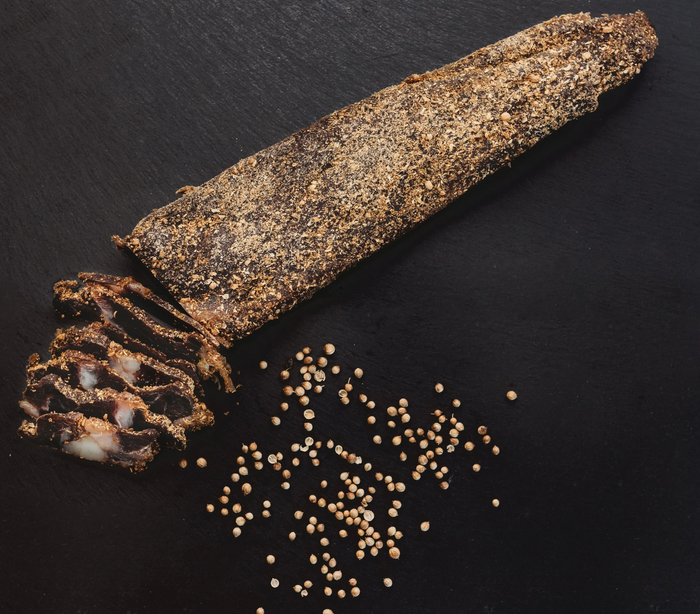
On a whole dried piece the grain is easier to read than on raw meat, because drying has made the strands more distinct. Look at the surface in decent light and you will see fine parallel lines running the length of the piece. Those lines are the fibers. Your cuts should follow them, not cross them.
If the lines are hard to see, use the ends. Look at the two cut faces of the slab and one of them will show you the fibers end on, as a texture of tiny bundles rather than lines. That is the face you are not cutting parallel to. Point your knife the other way, along the length, and you are correct.
Cutting a slab well, in practice
A sharp knife matters more here than most people expect. A dull blade on a dried piece compresses and tears rather than slicing, and it will make a mess of the edge no matter how correctly you have oriented the piece. Sharpen first, then cut.
Work slowly and let the knife do the work rather than pressing down hard. Cut in long strokes along the length of the piece. If a slab has firmed up considerably, a short rest at room temperature makes it easier to cut cleanly, and if it has been refrigerated then it should reach room temperature anyway before you eat it. Cut what you plan to eat rather than the whole slab at once, since a whole slab keeps far better than a pile of slices.
Where a different cut still has a use
The honest concession is that direction stops mattering when the piece stops being eaten as a piece. If you are chopping biltong finely to scatter over something, or reducing it to a coarse powder to season with, structure is irrelevant because you are destroying it deliberately. Nobody needs to find the grain to make crumbs.
There is also a thin-shaving case, where a piece is cut very fine to lay across a dish rather than to be eaten by hand. Even then, shaving along the grain gives you a shaving that holds its shape rather than fragmenting on the plate. The exceptions are narrower than they first appear, and they all involve giving up on the piece as a piece.
What this means for which product you buy
If the cutting direction is settled and you would rather not think about it again, buy it already cut. Sliced Biltong at $11.99 has been cut along the grain by someone who knew where the grain was, at a thickness chosen for an even chew, and every piece in the bag behaves the same way. Sliced Biltong Mini's at $4.99 are the same decision in a single-sitting portion.
Biltong Slabs at $58.00 hand the knife to you, which is worth doing for two reasons. You can cut thick on a day you want a long chew and thin on a day you do not, and you can see the grain and the fat with your own eyes and cut around both. The slab is the format where all of this becomes yours rather than ours. If you are not sure which you would rather have, the Biltong Sampler Pack at $12.99 is the least expensive way to find out how you like your biltong before committing.
Bottom line
Cut biltong along the fibers, never across them. Steak advice points the other way because cooked meat is soft and shortening its fibers makes it easier to chew without threatening the slice. Dried meat is the reverse case. The fibers have stiffened into the structure of the piece, so severing them leaves you with a slice that crumbles, sheds and shatters instead of one that tears.
The tear is what people mean when they say biltong. The long chew, the way a piece holds up, the gradual release of flavor as you work through it. All of it comes from fibers left running end to end. Sliced Biltong at $11.99 and Sliced Biltong Mini's at $4.99 have that decision made for you. Biltong Slabs at $58.00 leave it in your hands, which is a real advantage as long as you point the knife the right way.
Frequently Asked Questions
Why is biltong cut with the grain when steak is cut against it?
Because the two situations are opposites. Cooked steak has soft fibers held together by moisture and connective tissue, so cutting across them shortens the strands your teeth have to break and the slice still holds together. In dried meat the water is gone, the fibers have tightened into stiff strands, and those strands are now the main thing holding the piece together. Cutting across them severs the structure. The slice crumbles at the edges, sheds meat dust and shatters when you bite it, instead of tearing the way biltong is supposed to.
What does cutting with the grain actually change about the texture?
It changes how the piece gives way in your mouth. With every fiber running unbroken from one end of the slice to the other, biting does not fracture the piece. It tears, separating along the fiber direction. That is the chew biltong eaters recognize, and it also slows the eating down, so salt and savory compounds release gradually as you work through the piece rather than all at once. A slice cut the wrong way delivers everything immediately and is gone, and it will not survive being carried around.
Is this a preference or is it how biltong has to be made?
It is a property of the category rather than a house style. Air-dried whole-muscle beef cut across the fibers does not hold together well enough to work as a snack, and it does not produce the eating experience the category is known for. Take any description of good biltong, the long chew, the tear, the way a piece survives a pocket, and every item on the list traces back to fibers left unbroken. Change the cutting direction and you have changed the product, not seasoned it differently. Thickness is a real preference. Direction is not.
How do I find the grain on a biltong slab?
Drying makes the fibers more visible than they are on raw meat, so look at the surface in decent light and you should see fine parallel lines running the length of the piece. Those lines are the fiber direction, and your cuts should follow them rather than cross them. If the lines are hard to read, check the two cut ends of the slab. One of them shows the fibers end on, as a texture of tiny bundles rather than lines. That is the face you should not be cutting parallel to. Point the knife along the length instead.
What is the best way to cut a slab at home?
Sharpen the knife first. A dull blade compresses and tears a dried piece rather than slicing it, and it will ruin the edge regardless of how correctly you have oriented the slab. Cut in long slow strokes along the length of the piece and let the blade travel rather than pressing down. If the slab has firmed up a lot, a short rest at room temperature makes for a cleaner cut, and a refrigerated piece should warm up before eating anyway. Cut only what you plan to eat, since a whole slab keeps much better than a pile of slices.
Should I buy sliced biltong or a slab if I care about the cut?
If you would rather not think about the cutting direction again, buy it already cut. Sliced Biltong at $11.99 has been cut along the grain at a thickness chosen for an even chew, and every piece in the bag behaves the same way. Sliced Biltong Mini's at $4.99 do the same in a single-sitting portion. Biltong Slabs at $58.00 give you the knife, which means you choose thickness by the day and can see the grain and the fat before you cut. If you are undecided, the Biltong Sampler Pack at $12.99 is the cheapest way to learn your preference.