What Happens Inside Biltong After It Leaves the Drying Room
Drying is not the end of the process. The moment a piece of biltong reaches the moisture we want, the enzymes inside the meat are still working, the fat is still reacting with the air touching it, and the flavor is still moving. Slowly, and quietly, but it moves. The slab you cut into on the first day and the same slab a few weeks later are not the same eating experience.
Ready to try it? Buy Glatt Kosher biltong online. Made in Florida, free US shipping on orders over $50.
This is the part of the craft that almost never gets written down, because the drying room is the photogenic bit and everything after it looks like storage. It is not storage. It is a second, slower stage that we do not control nearly as tightly as the first one, and understanding it explains why our Biltong Slabs at $58.00 taste the way they do compared to our Sliced Biltong at $11.99, which is the same meat handled differently.
Meat is still chemically alive after it stops being wet
A muscle does not shut down when it stops being part of an animal. The proteins that made it work are still there, and so are the enzymes whose job was always to break those proteins down and rebuild them. Removing water slows those enzymes to a crawl. It does not switch them off, and no amount of air can, short of cooking the meat, which is exactly what biltong deliberately never does.
That is the whole starting point. Heat destroys enzymes. Air drying does not. A jerky that has been through a heat step has had most of that internal machinery shut down before it ever reaches a bag. Biltong keeps it, running at low speed, for as long as the piece exists. Everything else in this article follows from that single difference.
What the enzymes are actually doing in there
Two families matter. The first breaks proteins apart, cutting long muscle proteins into shorter chains and eventually into free amino acids. Those fragments taste of something. Long proteins are essentially flavorless, being too big for your tongue to register. The short peptides and free amino acids they become are where savory depth lives, which is the same reason a long-cured ham tastes of more than a fresh one.
The second family works on fat, cutting whole fat molecules into free fatty acids. On its own that is a mild change. What it does is set the table for the next thing, because free fatty acids are far more reactive with oxygen than the intact fat they came from. The enzymes do not create the strong flavors. They release the raw material that air then turns into strong flavors.
Both families run faster when there is more water available to them, faster when it is warm, and slower when it is cold and dry. That gives you the practical rule buried in all of this. Anything you do that keeps a piece cool and dry slows the flavor development down. Anything that warms it or lets it pick up humidity speeds it up.
Water activity is the governor, not the moisture percentage
The number that matters is not how much water is in the meat. It is how much of that water is chemically free to take part in reactions, which the trade calls water activity. Salt binds water. So do the proteins themselves. A piece can hold a fair amount of moisture by weight and still have very little of it available, which is why a well made biltong can be pleasantly soft and still keep.
This distinction is why two pieces that feel equally dry to the hand can behave completely differently over the following weeks. The one with more free water has more enzyme activity, more microbial risk, and a faster clock in every direction. Drying targets are really water activity targets wearing a moisture number as a disguise.
Fat and oxygen, the second clock
Fat oxidation is the change most people have tasted without having a name for it. Oxygen attacks the unsaturated bonds in fat and produces a cascade of smaller compounds, some of them pleasant and nutty at low levels, some of them sharp and painty at high ones. It is a slow chain reaction that speeds itself up once it starts, and light and warmth both push it along.
At low levels it is a good thing and we would not want it gone. A little oxidized beef fat is a large part of what makes aged dried meat smell like aged dried meat rather than like raw beef. Past a certain point it turns, and there is no coming back from it. The window between interesting and rancid is real, and where a given piece sits in that window depends mostly on how much fat it carries and how much air has reached it.
Three clocks running at different speeds
It helps to think of a finished piece as three timers running at once.
- The moisture clock, which keeps drying the piece slowly wherever air can reach it, making it firmer and more concentrated over time.
- The enzyme clock, which keeps breaking proteins into savory fragments and deepening the meat flavor.
- The oxidation clock, which works on the fat and eventually decides how long the piece stays good.
The first two mostly improve a piece, up to a point. The third one sets the deadline. Every storage decision anyone gives you about dried meat is really an argument about which of those three clocks you are trying to slow down and what you are willing to give up to do it.
Surface area is the entire argument between a slab and a slice
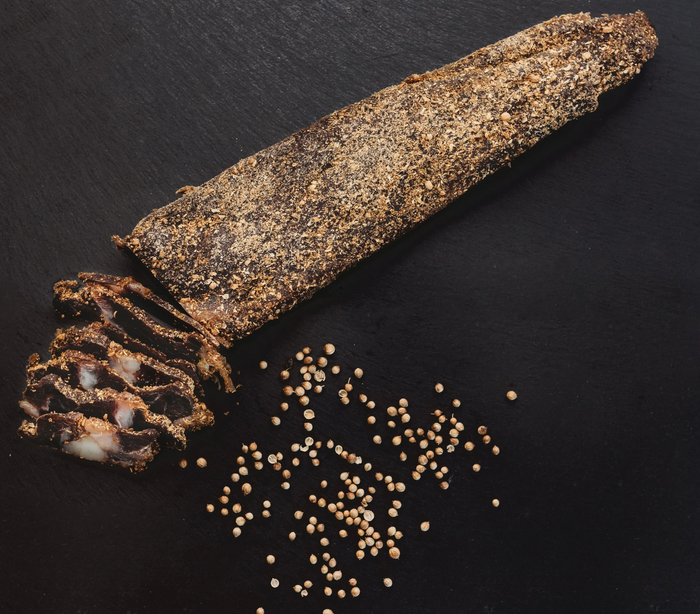
Here is where the mechanism becomes a purchase decision. A slab is dried as a whole piece of muscle. The outside is exposed to air, the inside is not. That outer layer dries harder and darker and acts as a shell, and the meat under it stays softer, redder, and largely shielded from oxygen. The slab is doing all three of its clocks on a protected interior.
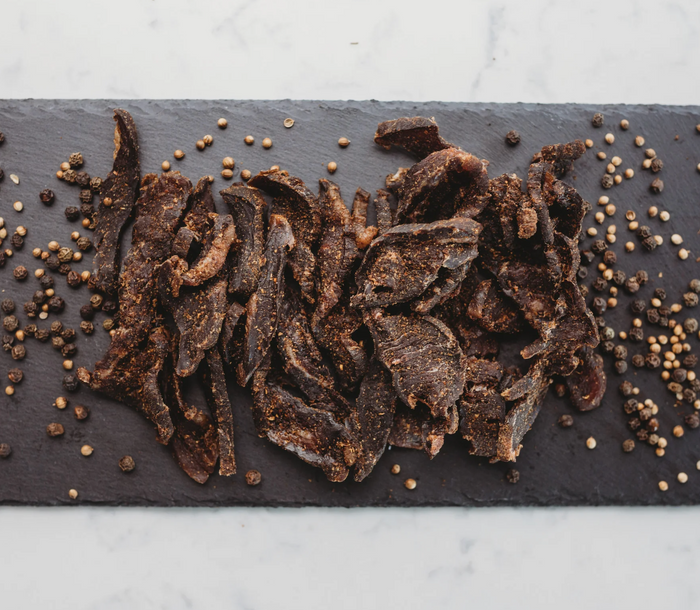
Slice that same muscle before or soon after drying and you have multiplied the exposed area many times over. Every slice has two broad faces open to the air. There is no protected interior left, because everything is interior and exterior at once. That is not a defect. It is what makes sliced biltong ready to eat by the handful, evenly textured, and consistent from one piece to the next.
The trade is straightforward and we will state it plainly. Sliced Biltong at $11.99 gives you convenience and evenness, and its oxidation clock runs faster because far more of the fat can meet air. Biltong Slabs at $58.00 give you a piece that keeps developing behind its own shell, and asks you to do the cutting.
Why a slab tastes different from the first cut to the last
Cut a slab open on the day it arrives and you get a contrast in a single bite. The rim is firm, dark and concentrated. The middle is softer and reads as meatier and less salty, because the salt distributed itself through less dry material there. Two textures, one piece.
Leave that slab a while, cutting from it as you go, and the contrast narrows. Moisture keeps migrating outward and evaporating, the middle firms up, and the savory fragments the enzymes have been producing accumulate through the whole piece rather than just near the surface. The eating experience gets more uniform and more concentrated at the same time. People who buy slabs regularly usually develop a preference for a particular point in that arc, and it is rarely day one.
What sliced biltong is optimized for instead
Sliced product is not a slab that lost an argument. It is aimed at a different job. Every piece is the same thickness, so every piece has the same chew. There is no rim and middle problem, no knife, no learning curve about which direction to cut, and no piece that is drier than the one before it.
What you give up is the aging window. A sliced piece has already had most of the interesting internal development happen on a much shorter timeline, and once the bag is open the oxidation clock speeds up considerably, because now the air is not just around the bag but around every face of every slice. Sliced biltong wants to be eaten. It is not a keeping product and we would rather say so.
Why cold slows everything and what it costs you
Refrigeration slows all three clocks. That is the honest appeal of it. Enzymes work more slowly at low temperature, fat oxidizes more slowly, and the piece changes less week to week. For a large slab that will take a person a long time to work through, this is genuinely useful.
The cost is condensation. A cold piece brought into a warm room picks up moisture on its surface, and surface moisture on dried meat is how mold problems begin. If you refrigerate, the piece needs to come back to room temperature inside its container before it gets opened, so the water condenses on the container rather than on the meat. That single habit is the difference between refrigeration helping and refrigeration hurting.
Reading the changes yourself
You do not need instruments to track this. The signals are all available to your hands and nose.
- A piece that has firmed up and darkened at the edges has run its moisture clock forward. That is normal and usually tastes more concentrated.
- A deeper, rounder, more savory smell without any sharpness is the enzyme clock doing its work. That is the part worth waiting for.
- A sharp, oily, crayon-like note is fat oxidation gone past its window. That piece is done and no amount of storage will bring it back.
- Any fuzzy growth, any damp surface, or any sour smell is a different problem entirely and is not aging.
The first three are a spectrum. The last one is a stop sign. Learning to tell the difference between developed and turned takes maybe three or four pieces of practice, and after that you will never be unsure again.
What we can and cannot promise about aging
We want to be careful here, because there is a version of this article that overclaims. We do not sell a controlled aging program. We do not put a slab in a chamber and hold it at a fixed temperature for a specified number of weeks, and we are not going to pretend the arc a slab takes in your kitchen is something we engineered for you.
What we can tell you is what the mechanism is and which format gives it room to run. A slab has a protected interior and a slow internal clock, and the people who keep buying them are usually buying that. A bag of slices does not, and the people who keep buying those are buying something else that is equally real. Both are correct choices for different eaters.
Choosing a format once you understand the mechanism
Put the whole thing on one line and the decision gets easy. If you want a piece that keeps developing and you are willing to cut it yourself and eat it over an extended stretch, Biltong Slabs at $58.00 are built for exactly that. If you want an even, ready product and you will finish it reasonably quickly, Sliced Biltong at $11.99 is the more sensible buy and nothing is lost.
Between them sit two other honest answers. The Biltong Sampler Pack at $12.99 is the low-risk way to find out which textures you actually respond to before committing to a large piece. Sliced Biltong Mini's at $4.99 are portion-sized, which means each one is opened and eaten in one go and the oxidation clock never gets a chance to matter at all. If you already know you want sliced product and you want a great deal of it, Bulk Biltong, 1LB of Sliced Biltong at $58.00 is the volume version of the same decision.
The part of this that surprises people most
Almost everyone who learns this comes away with the same reaction, which is that they have been treating dried meat as a finished object when it is closer to a slow-moving one. Bread goes stale, cheese ripens, wine changes in the bottle. Dried meat sits in the same family, and the only reason it does not get talked about that way is that the timescale is long enough to be invisible unless you are paying attention.
Once you start paying attention it changes how you buy. You stop asking only what a piece tastes like and start asking what it is going to taste like in three weeks, and whether the format you are buying gives it the chance to get there.
Bottom line
Biltong keeps changing after it leaves the drying room, because air drying never destroys the enzymes that a heat step would, and because fat and oxygen keep working on each other for as long as the two are in contact. Protein breakdown deepens the savory flavor and generally improves a piece. Fat oxidation eventually ends it. Those two processes racing each other is the whole story of what a dried piece of beef does with its life.
Format decides how much room that story gets. A slab at $58.00 is dried whole, keeps a protected interior behind its own hardened shell, and develops for weeks. Sliced Biltong at $11.99 exposes every face at once, which makes it even and immediate and short-lived by design. Neither is the better product. One is a piece you keep, and one is a piece you eat, and now you know which one you are buying.
Frequently Asked Questions
Does biltong keep changing after it is dried?
Yes. Air drying removes water but never applies the heat that would destroy the enzymes inside the meat, so those enzymes keep working at low speed for as long as the piece exists. Protein breakdown continues, producing short peptides and free amino acids that read as savory depth on the tongue. Fat keeps reacting with whatever oxygen reaches it. The changes are slow enough to be invisible day to day and obvious across several weeks, which is why a slab you have been cutting from for a month tastes deeper and more concentrated than it did on the first day.
Why does a slab taste different from sliced biltong if it is the same meat?
Surface area. A slab is dried as one whole piece, so only its outside meets the air. That outer layer hardens into a shell and the interior stays softer and shielded, which lets the slow internal changes run without much oxygen reaching the fat. Slicing multiplies the exposed area many times over, so every face is an outside face. Sliced Biltong at $11.99 is even, ready to eat and consistent piece to piece. Biltong Slabs at $58.00 keep a protected interior that carries on developing. The meat is the same. The exposure is not.
Is fat oxidation the same thing as the biltong going bad?
Not at first. Oxygen reacting with fat produces a range of compounds, and at low levels they are a large part of what makes aged dried meat smell aged rather than raw. The process runs as a chain reaction that accelerates once it is underway, and past a certain point the pleasant nutty notes turn sharp and oily. That point is not reversible. A piece that smells crayon-like or paint-like has gone past its window. Fuzzy growth, a damp surface or a sour smell are a different problem entirely and have nothing to do with oxidation.
Should I refrigerate a biltong slab to slow all this down?
You can, and it works. Cold slows enzyme activity and fat oxidation together, which is useful for a large slab that will take a long time to work through. The catch is condensation. A cold piece brought into a warm room collects moisture on its surface, and surface moisture on dried meat is how mold gets started. If you refrigerate, let the piece return to room temperature while it is still sealed in its container, so any water condenses on the container instead of the meat. Done that way, refrigeration helps rather than hurts.
What is water activity and why does it matter more than moisture content?
Water activity describes how much of the water in a piece is chemically free to take part in reactions, rather than how much water is present by weight. Salt and the meat proteins themselves bind a share of that water and take it out of circulation. Two pieces can feel equally dry to the hand while behaving completely differently, because the one with more free water runs faster on every clock, including enzyme activity and microbial risk. Drying targets in this craft are really water activity targets, expressed as a moisture figure for convenience.
How do I tell developed flavor from a piece that has turned?
Use your nose first. A deeper, rounder, more savory smell with no sharpness to it is protein breakdown doing its work, and that is the flavor worth waiting for. Firmer edges and a darker color mean the piece has dried further, which usually tastes more concentrated. A sharp, oily, crayon-like note means fat oxidation has gone past its useful window and the piece is finished. Anything fuzzy, damp or sour is not aging at all and the piece should be discarded. Three or four pieces of practice is usually all it takes to read the difference reliably.