The Meat Is the Product: Why Sourcing Decides Biltong
The meat you start with sets the ceiling on the biltong you finish with, and nothing that happens afterward raises it. Drying, spicing and cutting are all real craft and all of them can lower that ceiling through carelessness. None of them can lift it. That is not modesty about our own process, it is a statement about what drying physically does to a piece of beef.
Shop the real thing: buy biltong online, Glatt Kosher and made in Florida. US orders over $50 ship free.
Air drying removes water. It does not add anything. Whatever was already in the muscle stays behind and becomes a larger share of what is left, which means the process is a concentration step rather than a transformation. Good beef concentrates into good biltong. The other kind concentrates too.
What concentration actually means here
Take a wet piece of beef and remove a large share of its water over days of moving air. The proteins stay. The fats stay. The minerals stay. The compounds that give the meat its taste stay. All of them are now packed into far less mass than they started in.
Every mouthful of finished biltong therefore carries more of the original meat per bite than the raw beef did. That is the whole appeal of the category and it is also the trap. Intensity is not selective. It does not distinguish between the qualities you were hoping to bring forward and the ones you were hoping nobody would notice.
Cooking can hide things. Heat creates new compounds, browning builds taste that was not in the raw ingredient, sauces cover ground. Air drying does none of that. It has no chemistry that adds a taste from outside the meat, so there is nothing to hide behind.
The flaws that get louder
Beef that was slightly livery, slightly metallic, slightly sour from poor handling, or carrying the flat note of meat frozen and thawed badly will present all of that more strongly once the water is gone.
The same applies to fat that was already on the turn. Fat oxidizes, and oxidized fat tastes of old oil and cardboard. Start with fat that has been sitting warm or has been exposed to air too long and you are drying a defect into a concentrated form.
People often read those notes as a spice problem or a drying problem, because that is where the taste seems to arrive. It arrived much earlier. The dryer only made it audible.
Cut selection happens before anyone dries anything
Silverside and topside are the traditional biltong cuts and there is a structural reason for it. They are large, uniform, relatively lean muscles with grain running consistently in one direction, and that consistency is what lets a whole piece dry evenly from the outside in.
A muscle that varies in thickness dries unevenly. Thin ends overshoot while the middle is still wet. A muscle threaded with heavy connective tissue turns tough in a way no amount of careful slicing repairs, because the toughness is structural rather than a matter of how you cut it.
None of that is fixable downstream. A producer who receives the wrong muscle is choosing between drying it badly and selling it as something it is not. The decision that mattered was made at the point of selecting which part of the animal was going to become biltong.
Fat is decided by the animal, not the dryer
How much fat is in the meat, how it is distributed, and how firm it is are all determined long before any producer sees it. They come from the breed, the feed, the age of the animal and how it was handled after slaughter.
A producer can trim fat off. A producer cannot put fat in, and cannot change how that fat is marbled through the muscle. If you like a fattier biltong, what you are enjoying was decided upstream and simply not removed.
Fat also behaves differently through drying. It holds much less water than lean muscle to begin with, so it does not firm up in the same way, and it stays soft in a finished piece. That is why the fat is where quality shows first and where it fails first.
What spice can and cannot do
Coriander, salt and pepper are the backbone of a traditional biltong spice, and they are doing something specific. They season, they contribute to the cure, and coriander in particular brings an aromatic note that has become part of what the category tastes like.
What they do not do is cover. Spice sits mostly on the surface of a piece and the interior remains the meat you started with. Bite through a slab and the middle is beef. Nothing you dusted on the outside is going to be present in that mouthful in any meaningful amount.
Increase the spice enough to actually mask a taste and you have made a different product, one where the spice is the point and the beef is a carrier. That is a legitimate thing to make. It is not biltong doing what biltong does.
The vinegar wash is a cure step, not a repair
Biltong is typically washed in vinegar before spicing. It lowers surface pH, which makes the exterior an unfriendly place for organisms during the days when the meat is still wet enough to be at risk, and it contributes a tang that belongs in the finished taste.
It is a safety and character step operating on the surface. It does not reach into the muscle and it does not change what that muscle is. Meat with a problem going into the vinegar comes out with the same problem and a lower surface pH.
Consistency is a sourcing problem
Ask any producer what is hardest and the answer is rarely a single great batch. It is making this batch taste like the last one. Consistency is where sourcing shows itself most plainly, because process can be held steady and meat cannot be argued with.
Muscles vary between animals in size, fat, moisture and density. Feed a dryer a run of similar pieces and a fixed process produces similar results. Feed it pieces that vary widely and the same fixed process produces varied results, because drying time is a function of the piece, not of the schedule.
Producers can compensate by handling batches separately and judging by feel rather than by clock. That is real work and it improves the outcome. What it cannot do is make two different animals into the same product.
Why drying is craft and still not the deciding factor
We are not arguing that process does not matter. Airflow, humidity and time have to work together, and getting them wrong produces specific failures. Too fast and the outside seals while the middle is still wet, which is a texture problem and a safety problem at once. Too slow in air that is too still and the surface stays hospitable to things you do not want.
The point is the direction of the relationship. Process is a filter that decides how much of the starting quality survives to the plate. A great process on ordinary meat gives you well made ordinary biltong. An indifferent process on excellent meat gives you a waste of excellent meat. Neither one crosses over.
This is also the one place where the difference from heat dried products is relevant, and one paragraph is all it needs. A drying method that uses heat cooks as it dries and creates taste in the process. Air drying does not, so it has less to hide behind and depends more on the input.
Handling is part of sourcing, and it is invisible
Sourcing is not only which animal and which muscle. It includes everything that happened to that muscle between the slaughterhouse and the dryer, and most of it leaves no visible mark on the raw meat.
Meat that was chilled promptly and held cold behaves differently from meat that spent hours warm. Meat frozen once and thawed carefully is fine. Meat that went through several freeze and thaw cycles has had its cell structure damaged, loses more liquid, and carries a flat quality that drying then concentrates along with everything else.
How long the meat was held before drying matters too. A short controlled rest lets the muscle relax and improves texture. Too long in the wrong conditions and the surface has already started down a path you do not want to preserve at higher intensity.
A producer with control over this part of the chain can protect quality that was there. A producer buying at arms length from whoever has beef this week is inheriting a history nobody wrote down. Both can run identical drying rooms and get different results for reasons that have nothing to do with the drying room.
What a buyer cannot judge
Here is the honest part. You cannot verify sourcing from a photograph, and you should be skeptical of anyone who implies that you can.
A photograph of a farm tells you a photograph was taken. Words like premium and hand selected are not defined terms and carry no obligation. Even a stated origin tells you where an animal was, not what it ate, how old it was, or how the meat was handled in the days after slaughter, which are the variables that actually change what you taste.
The finished product also hides its own history well. Drying, spicing and vinegar all sit between you and the raw material, and a very short taste at a market stall is not enough to see through them. This is genuinely a low information purchase the first time.
So we are not going to tell you a story here about our supplier, our farms, a country of origin or a grading standard. Those are specific factual claims, and a blog post is not where anyone should be reading them for the first time.
What a buyer can actually judge
You are not helpless. You just have to judge the things that are visible in the product rather than the things that are asserted around it.
- Fat behavior. Look at how the fat sits in a cut piece and how it tastes. Clean and rich means it was handled well. Any note of old oil or cardboard means it was not, and that is a sourcing and handling signal you can detect directly.
- Grain and structure. Even, consistent muscle grain across pieces suggests the right cuts arrived. Ragged connective tissue running through slices suggests they did not.
- Batch to batch sameness. Buy twice. If the second order tastes and chews like the first, someone upstream is controlling the input. This is the most useful test available to any buyer and almost nobody runs it.
- Whether the beef reads as beef. In a well sourced piece the meat is the loudest thing in the bite. If the spice is the only thing you can identify, ask why.
- Texture at the same thickness. Compare like with like. A thin slice will always chew more easily, so the comparison only means something at a similar cut.
Format changes what you can learn
How you buy affects how well you can run those tests. Sliced Biltong Mini's at $4.99 and the Biltong Sampler Pack at $12.99 are cheap enough to be a trial, and the sampler in particular puts different styles next to each other, which is more informative than one type in isolation.
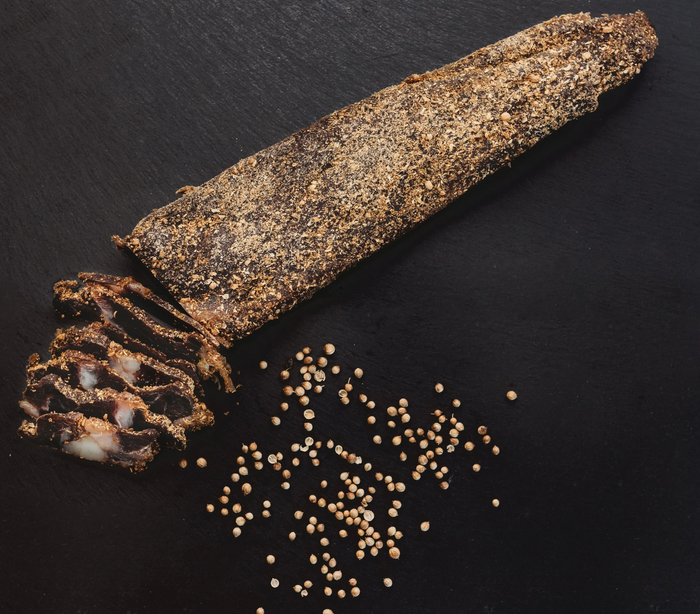
Sliced Biltong at $11.99 is the ordinary way in. Biltong Slabs at $58.00 tell you the most, because a slab is uncut and you get to see the cross section yourself when you cut it. Grain, fat distribution, how the interior looks against the dried edge. All of that is hidden in a bag of pre cut slices and open to inspection in a slab.
Bulk Biltong, 1LB of Sliced Biltong at $58.00 is a repeat purchase rather than a first one. It is the right buy once you have already answered the sourcing question to your own satisfaction, not the way to answer it.
Why price is a partial signal
Beef is the dominant cost in biltong and drying removes a large share of the starting weight, so a finished pound represents substantially more raw meat than a pound of anything wet. That is the honest reason dried meat costs what it does, and it is why the number on a bulk pack is not a markup story.
Price tells you what could not have been cut. It does not prove what was chosen. A high price is compatible with mediocre sourcing and generous margins, and no shopper can tell those apart from the shelf. Treat price as a floor on possibility rather than as evidence.
Bottom line
Sourcing decides the outcome because drying is a concentration step and concentration is not selective. It brings forward whatever was there, including the parts nobody wanted, and no spice blend or drying schedule reaches into the middle of a piece of beef to fix what the beef already is.
Since you cannot verify sourcing from a photograph or a phrase, judge it where it becomes visible. Look at the fat, look at the grain, and buy the same thing twice to see whether it is the same thing twice. A slab shows you the most because it hides the least. That is a slower way to decide than reading a label, and it is the only one that actually tells you anything.
Frequently Asked Questions
Does the cut of beef matter for biltong?
It matters more than almost anything a producer does afterward. Silverside and topside are the traditional cuts because they are large, fairly lean and uniform, with grain running consistently in one direction, and that uniformity is what allows a whole piece to dry evenly from the outside in. A muscle that varies in thickness dries unevenly, with thin ends overshooting while the middle is still wet. A muscle carrying heavy connective tissue stays tough no matter how carefully it is sliced, because the toughness is structural rather than a slicing problem.
Can spices hide poor quality meat?
Not in any real way. Spice sits mostly on the surface of the meat, so the interior of a piece remains exactly the beef it started as. Bite into a slab and the middle is unseasoned muscle. Coriander, salt and pepper season the outside and contribute to the cure, but they are not present in enough quantity to mask what the meat tastes like. Push the spice high enough to actually cover something and you have made a spice led snack where the beef is a carrier, which is a different product from biltong.
Why does drying make bad meat taste worse?
Because air drying removes water and adds nothing. Proteins, fats and the compounds that carry taste all stay behind, packed into far less mass than they started in, so every bite carries more of the original meat than the raw beef did. Concentration is not selective. A livery, metallic or slightly sour note in the starting beef becomes a stronger version of itself, and fat that had already begun to oxidize brings its old oil character forward. Cooking can build new tastes to cover flaws. Air drying has no such chemistry.
How can I tell if biltong was well sourced?
Judge the product rather than the claims around it. Look at how the fat sits and tastes, since clean rich fat indicates good handling and any cardboard or old oil note indicates the opposite. Look at the muscle grain across several pieces, since even consistent grain suggests the right cuts arrived. Then buy twice. If the second order chews and tastes like the first, someone is controlling the input, and batch to batch sameness is the single most useful test available to a buyer. A slab shows more than pre cut slices because you see the cross section yourself.
Does more fat mean better biltong?
It means a different biltong, and which you prefer is a taste question. Fat carries a rich mouthfeel and a lot of what people enjoy in a good piece, and how much of it there is comes from the animal rather than from any decision a producer makes later. A producer can trim fat away but cannot add it or change how it is marbled through the muscle. Fat also stays softer through drying because it holds much less water than lean muscle, which is why it is both where quality shows and where a piece turns first.
Is air dried beef different from heat dried beef?
Yes, and the difference matters to this subject in one specific way. Heat dried products cook as they dry, and cooking creates new taste compounds that were not in the raw meat, which gives that process something to hide behind. Air drying works with moving air, time and a cure rather than heat, so it creates no new tastes of its own. Everything you taste in finished biltong was either in the beef already or applied to the surface as spice or vinegar, which is why the starting meat carries so much weight.
What does a vinegar wash do to biltong?
It lowers the pH at the surface of the meat, which makes the exterior an inhospitable place for organisms during the early days when the piece is still wet enough to be at risk, and it contributes the tang that belongs in a traditional biltong taste. It is a cure and character step working on the surface. It does not reach into the muscle and it does not change what that muscle is, so meat with a problem going into the vinegar comes out with exactly the same problem.