What Happens to Biltong Fat During and After Drying
Fat and lean behave like two different materials during drying, and the piece you buy is the result of how those two materials argued with each other. Lean gives up water readily. Fat barely gives up any, because there is very little water in it to give. That one asymmetry decides the texture of a finished piece, how it keeps, and how its flavor develops in the weeks after it comes off the rack.
Want some on hand? Order biltong online: Glatt Kosher, air-dried in Florida, free US shipping over $50.
It also explains the thing buyers ask us about most often without realizing what they are asking. When one piece looks fattier than the last one, that is not a slip in the process. It is the animal, showing through. Understanding what fat does through drying turns that observation from a worry into a useful signal about what you are holding.
Lean loses water, fat mostly does not
Lean muscle is roughly three quarters water before anything happens to it. Drying is a matter of persuading a large share of that water to leave, which is what makes a piece shrink, darken and firm up. The protein network tightens as the water goes, and what you are left with is dense and concentrated in a way the raw meat never was.
Fat tissue is built the other way around. It is mostly lipid, with only a small fraction of water in it. Put a piece of fat in the same airflow for the same number of days and it comes out looking much as it went in. It does not shrink meaningfully, it does not harden, and it does not concentrate. Two materials, one drying room, entirely different outcomes.
What that asymmetry does to a single piece
Now put both in the same piece of meat, which is what every real cut is. The lean portions pull inward as they lose water. The fat portions stay roughly where they were. The piece ends up with lean that has done all the shrinking and fat that has done none of it, sitting side by side.
You can feel this in the hand. A lean piece is uniformly firm. A piece with a real fat seam has firm sections interrupted by softer, more yielding ones, and it will bend at the fat rather than at the lean. That is not softness from underdrying. It is a material that was never going to harden in the first place.
The two kinds of fat you are dealing with
There is a useful distinction here that gets flattened in most writing about dried meat.
- Seam fat, the visible layer or cap running along one edge of a cut. You can see it, you can trim it, and you can decide about it.
- Intramuscular fat, the fine marbling woven through the lean itself. You cannot trim it and you mostly cannot see it, and it is doing quiet work on the flavor of every bite.
Trimming is a judgment about the first kind only. The second kind arrived with the animal and leaves with it. A cut that marbles well produces a dried piece that eats richer even when every visible scrap of fat has been cut away, which is why two lean-looking pieces can taste noticeably different.
Why fat content changes the texture you experience
Chewing dried lean is work in the good sense. The tightened protein network resists your teeth, releases slowly, and gives the long savory chew people come to biltong for. Fat does not resist. It gives way immediately and it coats, and that coating changes how you experience everything around it.
A fattier piece therefore reads as softer, moister and milder, even when its actual moisture is identical to the lean piece next to it. That is a genuinely counterintuitive point and it trips people up constantly. The fat is not adding water. It is adding a material that requires no effort to break down and that spreads across your palate while the lean is still being worked on.
Where the fat sits changes how the whole piece dries
Fat does more than refuse to dry. It stops the lean underneath it from drying too, because water cannot pass through a fat layer anywhere near as easily as it passes through muscle. A fat cap running along one face of a cut is effectively a lid on that face.
The result is a piece that dries unevenly through no fault of the airflow. Moisture leaving the covered side has to travel sideways through the lean and out through an uncovered face, which takes longer. The lean directly under a heavy fat seam stays wetter than lean on an open face for the entire run, and it is still wetter when the piece comes off the rack.
This is why fatty pieces carry more internal variation than lean ones, and why the softest bite in a slab is very often the one nearest the fat. It also explains a decision that looks aesthetic and is not. Trimming a heavy cap back before drying is partly about the finished product and partly about letting the meat under it dry at the same rate as everything else.
Salt and spice work on lean, not on fat
The vinegar wash and the salt and the spice that go onto biltong before it dries are all water-based, and they move through the meat the way water does. Lean takes them up readily. Fat is a poor host for anything that dissolves in water and takes up very little of it.
So the fat in a finished piece is close to unseasoned relative to the lean around it. That is a large part of why a fatty bite reads as milder and less salty. It is not diluting the seasoning. It is contributing a portion of the bite that the seasoning never really reached.
The reverse holds for the aromatic side of the spice, which is fat-soluble and does migrate in, mostly after drying rather than during it. Fat ends up low on salt and comparatively high on spice aroma, which is an unusual combination and worth noticing next time you eat a piece with a visible seam. Take a bite of the lean and then a bite that includes the fat, and the two taste like different seasonings on the same meat.
Beef fat is firm at room temperature and that matters
Beef fat has a relatively high melting point compared with the fat in most other meats. At normal room temperature it is solid and slightly waxy rather than soft. Take a piece straight from a cold place and the fat is firmer still, and it can read as unpleasant and greasy on a cold palate.
The same piece at room temperature is a different food. The fat has softened toward the point where it releases its flavor compounds instead of just sitting there. If you keep your biltong cold, this is the single most useful habit to adopt. Let it warm up before you eat it. Nothing else about the piece changed, but the fat did, and the fat is doing more of the work than you think.
Fat is where a great deal of the flavor is stored
A large share of what we recognize as beef flavor lives in fat rather than in lean. The compounds responsible are fat-soluble, which means they accumulate in the fat and get released from it when it softens in your mouth. Lean contributes savory depth and mineral notes. Fat contributes the richness and the length of the finish.
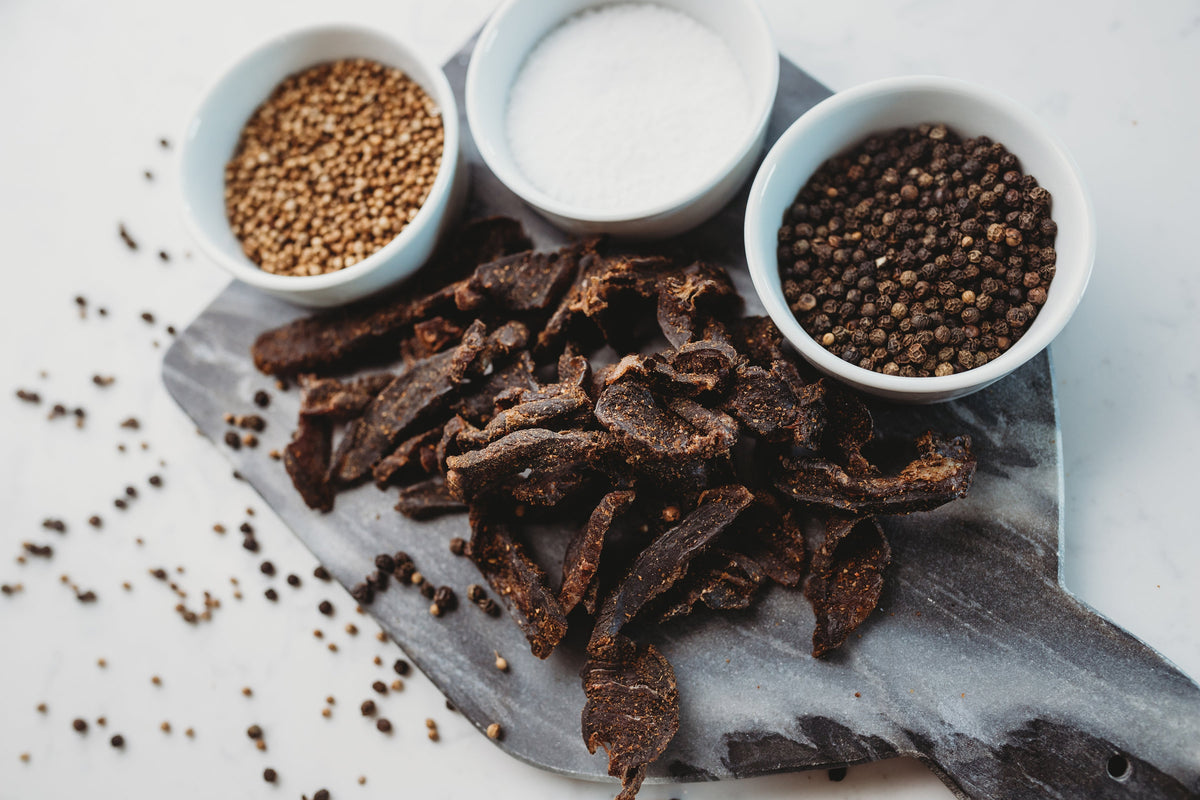
Spice works the same way. Many of the aromatic compounds in the seasonings traditionally used on biltong, coriander among them, are more soluble in fat than in water. They migrate into the fat during and after drying and stay there. A fattier piece tends to carry more of the spice character and hold it longer, which is one of the reasons the same seasoning reads as louder on one piece than another.
Fat sets the keeping clock
Here is the trade-off, stated straight. Everything fat gives you in flavor and texture, it takes back in shelf life. Lean that has been dried properly is a hostile place for anything to happen. Fat is not. Fat reacts with oxygen over time, and that reaction gets faster once it has started, and it eventually produces the sharp oily flavor that means a piece is finished.
So a fattier piece is a shorter-lived piece. Not by a dramatic margin, but reliably. If you are buying something to work through slowly, leaner is the safer choice. If you are buying something to eat within a reasonable window, fat is a straightforward upgrade to the eating and costs you nothing you will notice.
Why fat varies from piece to piece and bag to bag
Beef is not a manufactured material. Two animals of the same breed, raised the same way, deliver cuts with visibly different fat distribution, and the same is true of two cuts taken from different parts of the same animal. Any dried meat made from whole muscle inherits that variation directly, because there is no grinding or blending step in which it could be averaged away.
This is worth saying clearly, because the food industry has trained everybody to read variation as a fault. In a formed and reconstituted product it would be. In a whole-muscle dried product it is evidence of the opposite, which is that nobody homogenized anything on the way to your hand. The variation is the honest signature of the category.
What a buyer should actually do with this information
Notice the fat, and let it set your expectation rather than your complaint.
- More visible fat means a softer, richer, milder eat with a longer finish, and a piece that wants to be eaten sooner rather than later.
- Less visible fat means a firmer, longer chew with more concentrated savory character, and a piece that will keep more patiently.
- Either way, letting the piece reach room temperature before eating gets you closer to what it is capable of.
Neither profile is the good one. They are two different products that happen to arrive under the same name, and knowing which one is in your hand is worth more than wishing it were the other.
How trimming decisions get made, honestly
Every maker of dried meat trims, and every trimming decision is a compromise between two real things. Cut away all the seam fat and you get a product that is consistent, keeps longer and photographs beautifully, and that has given up part of what makes whole-muscle dried beef worth eating in the first place. Leave everything on and some pieces become greasy and the keeping window shortens.
The reasonable position is in between, and it moves depending on the cut in front of you. Anyone who tells you they trim to an exact standard on every piece is either grinding and reforming the meat or is not looking at it very hard. Whole muscle does not permit that kind of precision, and we would rather explain that than pretend otherwise.
What the format tells you before you buy
Format is the part of this you can control at checkout, and it changes how much say you have over fat.
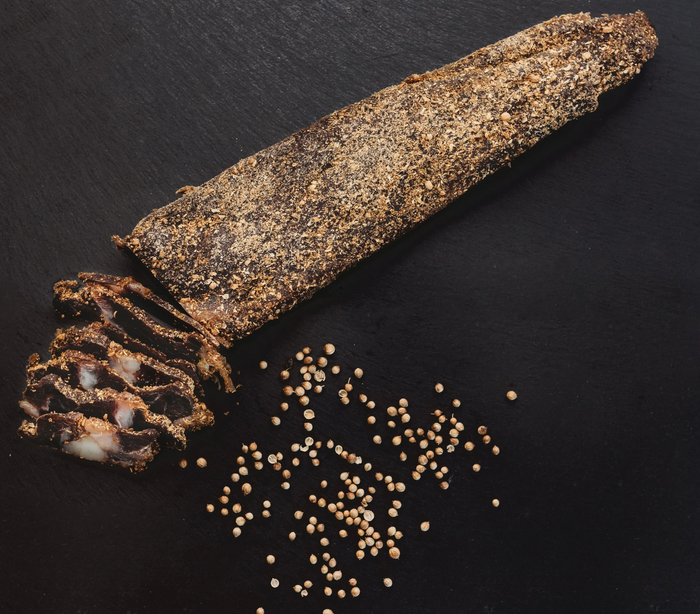
Biltong Slabs at $58.00 give you the most control of anything we sell. The piece arrives whole, so you can see exactly where the fat sits, cut around a seam you do not want, or cut straight through it if you do. Every slice becomes your decision rather than ours. That is the real argument for a slab beyond the aging question, and it is the one slab buyers usually discover second.
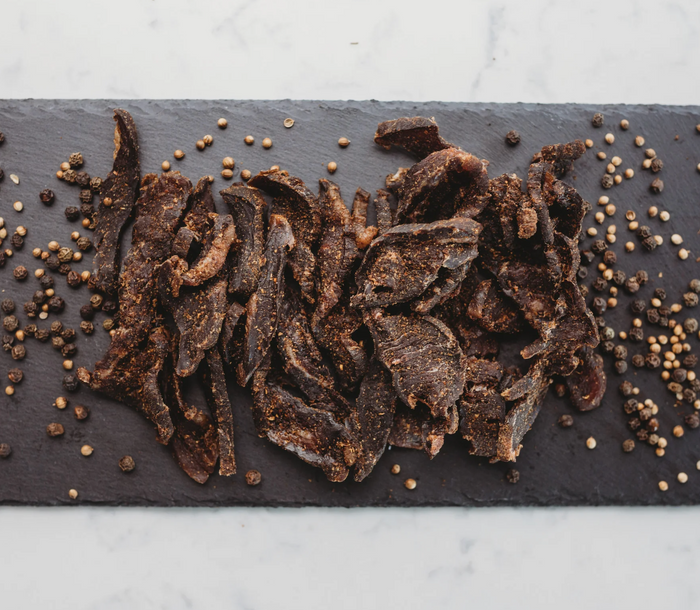
Sliced Biltong at $11.99 has already had the trimming and cutting decisions made. What you get is the average of the piece it came from, distributed evenly across the bag, which is exactly what most people want most of the time. Sliced Biltong Mini's at $4.99 work the same way at a smaller portion, and because each one gets opened and finished in a sitting, the shorter keeping window that fat brings never comes into play.
Storing a fattier piece differently
Since fat is the part with a deadline, storage should aim at fat rather than at moisture. Keep the piece out of direct light, because light accelerates the oxygen reaction. Keep it cool but not damp. Keep the air around it to a minimum by using a container the piece actually fills instead of a large one with a lot of headspace.
The one thing not to do is seal a fatty piece airtight while it is still on the softer side and leave it somewhere warm. Trapped moisture and no airflow is the condition that invites surface mold, and a fattier piece has more soft surface for that to happen on. A container that breathes a little is the better answer for anything you plan to keep more than a few days.
Bottom line
Fat and lean go into the same drying room and come out as different materials, because lean surrenders most of its water and fat has almost none to surrender. That single fact drives everything a buyer notices. A fattier piece is softer, richer, milder and shorter-lived. A leaner piece is firmer, more concentrated, chewier and more patient. Both come from the same craft and the same cuts.
When the fat content of your bag looks different from last time, you are reading the animal rather than a mistake. Choose against it deliberately. Biltong Slabs at $58.00 let you make the fat call yourself, slice by slice. Sliced Biltong at $11.99 and Sliced Biltong Mini's at $4.99 hand you an even distribution and take the decision off your plate. And whichever you buy, let it come to room temperature first, because cold fat is telling you almost nothing about what the piece can do.
Frequently Asked Questions
Why does some biltong have more fat than the bag I bought last time?
Because beef is not a manufactured material. Two animals raised the same way produce cuts with visibly different fat distribution, and two cuts from the same animal differ as well. A whole-muscle dried product inherits that variation directly, since there is no grinding or blending step where it could be averaged away. In a formed and reconstituted product, variation would be a fault. Here it is the opposite, and it tells you nobody homogenized the meat on its way to you. Read it as a signal about the piece rather than as an inconsistency in the process.
Does fat make biltong softer or is that a sign it was underdried?
Fat makes it softer, and that is not underdrying. Lean muscle is around three quarters water and loses most of it during drying, which is why it shrinks and firms up. Fat tissue holds very little water to begin with, so it comes out of the drying room close to how it went in. Chew a fattier piece and the fat gives way immediately while the lean still resists, so the whole bite reads as softer and moister even when the actual moisture matches a lean piece exactly. The softness is the material, not the process.
Does fat content affect how long biltong keeps?
Yes, and this is the real trade-off. Properly dried lean is a hostile place for anything to happen. Fat is not, because it reacts with oxygen over time in a chain reaction that speeds up once it starts, eventually producing the sharp oily flavor that means a piece is finished. A fattier piece is therefore a shorter-lived piece. The margin is not dramatic but it is reliable. If you are buying something to work through slowly, leaner is safer. If you will eat it within a reasonable window, fat costs you nothing you will notice.
Why does biltong taste better at room temperature?
Beef fat has a relatively high melting point and is solid and slightly waxy at normal room temperature. Straight from a cold place it is firmer still, and it can read as greasy and closed up on a cold palate. Warm the same piece and the fat softens toward the point where it releases the fat-soluble compounds it has been holding, which include a large share of the beef flavor and much of the spice character. Nothing else about the piece has changed. Letting it warm before eating is the cheapest improvement available to you.
Can I choose how much fat is in what I buy?
Format is where you get the most say. Biltong Slabs at $58.00 arrive as one whole piece, so you can see exactly where the fat sits and cut around a seam you do not want or straight through one you do. Every slice becomes your call. Sliced Biltong at $11.99 has already had those decisions made and gives you the average of the piece it came from, spread evenly through the bag. Sliced Biltong Mini's at $4.99 work the same way in a single-sitting portion, which sidesteps the shorter keeping window that fat brings.
Should fatty biltong be stored differently from lean biltong?
Aim the storage at the fat, since that is the part with a deadline. Keep the piece out of direct light, because light speeds up the reaction between fat and oxygen. Keep it cool without letting it get damp. Cut down the air around it by using a container the piece actually fills rather than a large one with a lot of empty space. What not to do is seal a softer fatty piece airtight and leave it somewhere warm, since trapped moisture with no airflow is exactly the condition that invites surface mold.