Why Authentic Biltong Costs What It Does: The Yield Problem Nobody Talks About
Authentic biltong costs more than commodity jerky primarily because of yield math that most producers never disclose: whole-muscle grass-fed beef loses significant weight during traditional slow curing, meaning you are paying for the raw pounds that evaporated, not just the ounces in the bag. Add grass-fed sourcing premiums, hand-slicing labor on slab formats, controlled-humidity curing time that cannot be accelerated, and per-flavor ingredient blending across three distinct spice profiles, and the price per finished ounce is structurally higher before a single margin dollar is added. That is the real story. Everything else is downstream of that one fact.
Ready to try it? Buy Glatt Kosher biltong online. Made in Florida, free US shipping on orders over $50.
The Yield Math: Where the Weight Goes and Why It Costs You
When we hang a whole-muscle cut of grass-fed beef to cure, the weight that leaves the drying room is meaningfully less than the weight that went in. Moisture exits the meat slowly over days inside a controlled-humidity environment. That moisture loss is not a defect. It is the process. The collagen firms, the flavor concentrates, and what remains is dense, tender, and genuinely unlike anything that goes through a heat-dryer in a few hours. But that lost moisture is also lost weight, and lost weight is lost revenue. The price you see on the bag accounts for everything that used to be beef and is now humidity in the air.
Commodity jerky handles this differently. Mass-market jerky often starts with ground or reformed meat, which processes faster, absorbs seasoning more uniformly, and loses proportionally less structural integrity during heat-drying than a whole-muscle cut does during a long, slow hang. Whole-muscle cuts cannot be rushed through that process without destroying the texture that makes biltong worth eating. You cannot run a whole silverside through an industrial dryer at high heat and call it biltong. You will get something, but it will not be that.
Grass-fed beef adds another layer to the cost before any curing moisture loss is calculated. Sourcing grass-fed cattle, verifying that supply chain, and carrying the premiums that come with that certification all cost real money. The beef entering our drying room is not a commodity trim block. It is a whole muscle from a grass-fed animal with a traceable supply chain behind it. By the time curing shrink is applied on top of that sourcing premium, the finished cost per ounce is structurally higher than grain-fed jerky trim will ever be, even before labor or certification costs enter the picture.
This is the yield problem. It is not a talking point. It is arithmetic. And it is the reason that anyone selling authentic biltong at the price of mass-market jerky is either sourcing differently or not making real biltong.
The SKU Ladder Is Not a Marketing Tier. It Is a Yield-Distribution System.
Look at how our catalog is actually structured: Sliced Biltong Mini's at $4.99, Sliced Biltong at $11.99, Biltong Slabs at $58, and Bulk Biltong at $58. The same dollar figure on both the Bulk and the Slab is not a coincidence and not lazy pricing. It is the same underlying yield cost expressed across two very different formats for two very different buyers.
The Mini at $4.99 is an entry point. It lets a first-time buyer taste the product without committing to a full bag, but the per-ounce rate inside that Mini reflects the same grass-fed sourcing and curing shrink as every other format. Small packages carry higher per-ounce production costs because the fixed costs of curing, hanging, and handling do not scale down proportionally with portion size. That is just reality, and it is the same reality any real charcuterie or cheese producer deals with on small-format packaging.
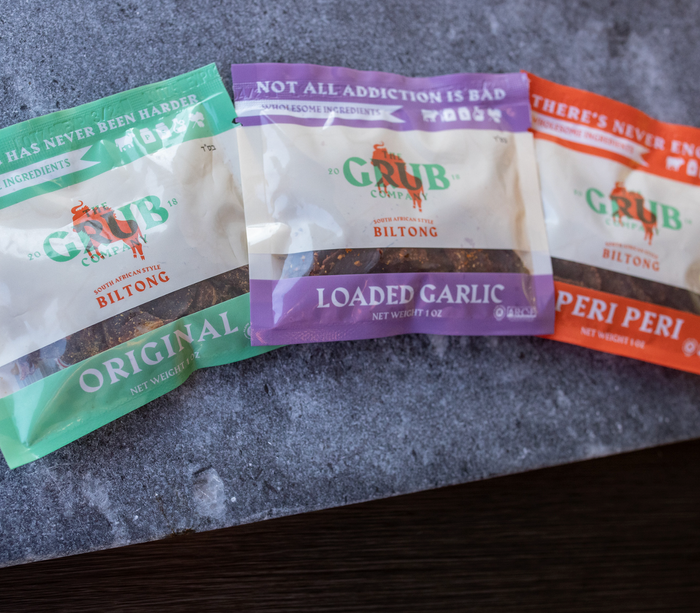
The Sampler Pack at $12.99 goes a step further. It contains one mini bag each of Original, Peri Peri, and Loaded Garlic, and it pairs with a flavor-matching quiz on the site. A quiz signals something important: this product requires consumer education rather than impulse shelf placement. You do not need a quiz to grab a bag of jerky at a gas station. The quiz exists because biltong has enough flavor nuance across three distinct profiles that choosing incorrectly is a real outcome, and we would rather guide you to the right bag than have you disappointed. That consumer education is a cost of selling a complex product well. It is also one reason biltong does not compete on the same shelf as commodity jerky, literally or economically.
The Bulk 1LB at $58 is where the yield math becomes most transparent. A full pound of finished, sliced biltong represents significantly more than a pound of raw beef, because that finished pound is post-curing, post-shrink, post-hang. The price reflects what it actually costs to produce one pound of finished product from whole-muscle grass-fed beef. No format hides that cost better than a bulk bag, because the quantity makes the per-ounce rate easy to calculate. When buyers do that math, they often say the price is fair once they understand what they are holding.
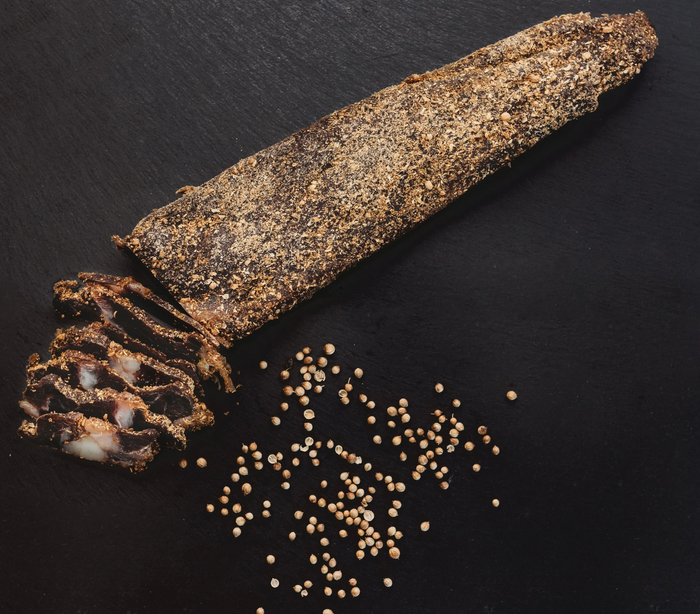
The Slab at $58 is a different story. You are buying whole slabs, uncut, and slicing every bite yourself off the block. Slab inventory is held back batch by batch in small quantities, which is why 2-3 week wait times are a real possibility on that SKU. Holding back slabs by batch is not a supply chain failure. It is evidence that the curing timeline controls availability, not a warehouse decision. You cannot rush a slab. The controlled-humidity curing time is fixed by biology and physics, and any attempt to compress it changes the product. The wait is the process made visible.
The Slab format also preserves something that pre-sliced formats give up: the interior of the meat does not oxidize until the moment you cut it. Pre-sliced biltong begins surface oxidation immediately after cutting. It is still good, and we account for that in how we package and ship it. But a slab held whole keeps more of its moisture gradient intact and delivers a genuinely different texture when you slice it fresh. That texture is why slab buyers tend to come back for slabs and rarely switch down to pre-sliced. Once you slice a fresh slab yourself, the comparison is difficult to unfeel.
So the SKU ladder from Mini to Slab is not a good-better-best branding exercise. Each format absorbs the same yield-loss cost differently, and it does so in a way that gives different buyer types the option to pay for exactly what they need, rather than subsidizing a single format that would have to price in all the inefficiencies of the others.
The Fixed Costs That Commodity Producers Simply Do Not Carry
Traditional curing requires time and space. Controlled-humidity space is not cheap, and neither is the time that a whole-muscle cut spends hanging in it. Industrial jerky production compresses that time with heat, which changes the protein structure, changes the texture, and changes the flavor, but it does compress the timeline. A heat-dried product can move from raw beef to packaged product in hours. Authentic biltong cannot. The fixed cost of holding beef in a controlled environment for the full curing period is a cost that runs on the clock whether the batch is large or small.
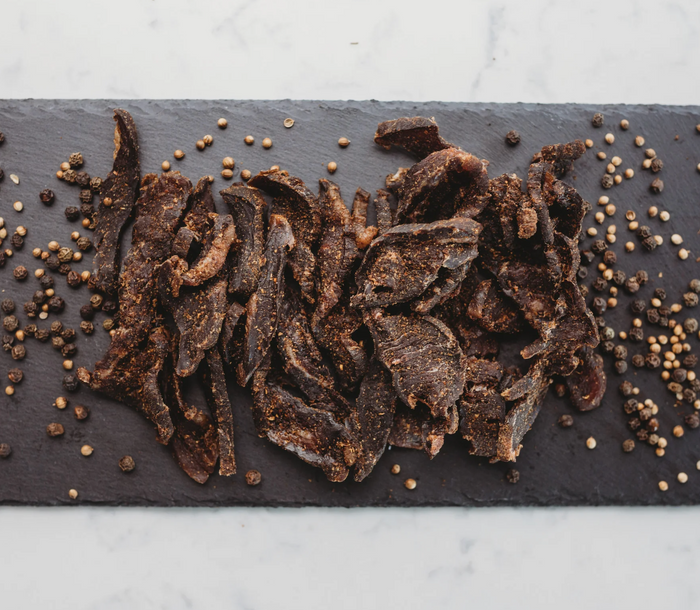
Hand-slicing is another cost that commodity producers automate away. When you order Biltong Slabs, the slicing happens at your kitchen counter, by your hand, when you want it. But our pre-sliced formats are cut by hand, not by a deli slicer running at industrial speed. Hand slicing produces the irregular, slightly varied thickness that gives each piece its own bite. It also means there is a person doing skilled work on every bag, and that labor is in the price. You cannot replicate hand-sliced texture with a mechanical uniform cutter. The irregular edge and varying thickness is not an inconsistency. It is what happens when a real person cuts real beef.
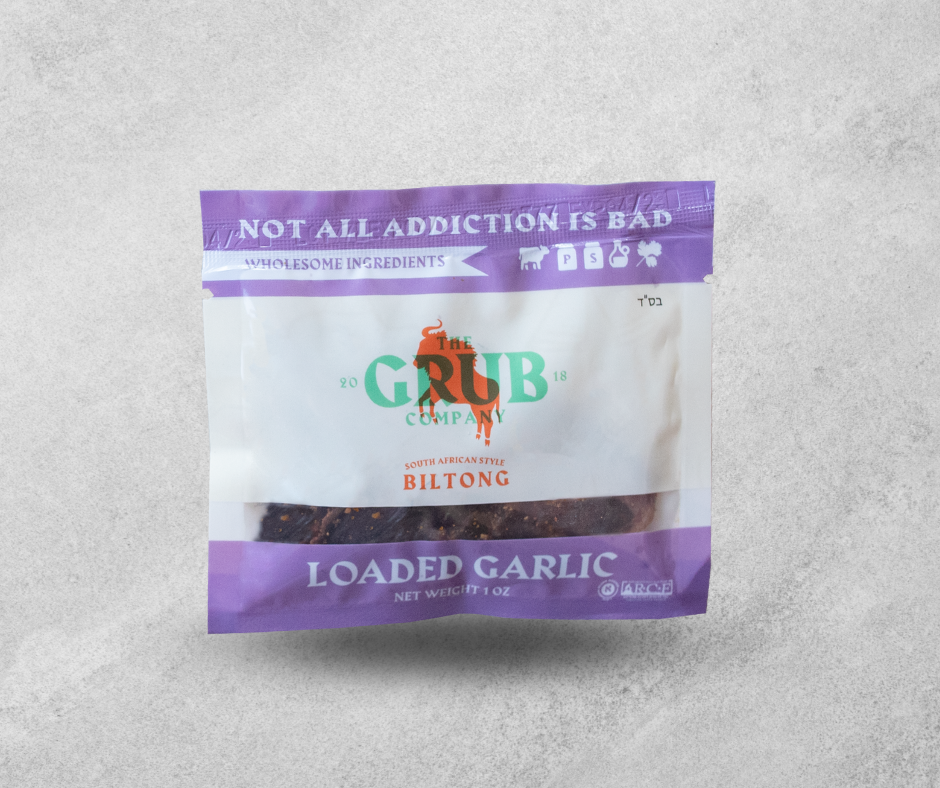
Then there are the three flavor profiles. Original, Peri Peri, and Loaded Garlic each require their own ingredient sourcing and their own blending ratios. Pre-made commodity seasoning packets are cheaper than sourcing individual components and blending them to a house recipe, because the economics of scale flow to whoever produces the seasoning at volume. We do not use pre-made packets. Each flavor profile is a deliberate formulation, and each one needs its own inventory of components that do not cross over to the others. That is not a complexity we apologize for. It is the reason the three flavors taste distinct rather than like variations of the same base salt-and-smoke profile you find in most mass-market jerky.
Glatt Kosher certification on our Sliced Biltong and Sliced Biltong Mini's is another real cost that commodity producers do not carry. Certification requires ongoing oversight, supply chain compliance, and ingredient vetting that adds operational complexity. Families buying biltong for Shabbos or Yom Tov are not shopping for a commodity. They need a product they can trust completely, and the certification is the mechanism that makes that trust verifiable. That mechanism costs money, and it should. Trust is not free to produce.
All of these fixed costs, the curing time, the controlled-humidity space, the hand-slicing labor, the per-flavor ingredient sourcing, the certification overhead, sit underneath every format in the catalog. They do not disappear because you ordered the $4.99 Mini. They are just distributed differently. The Mini absorbs them across a small portion with a higher per-ounce rate. The Bulk Biltong absorbs them across a full pound with a lower per-ounce rate but a higher upfront number. The Slab gives you the best possible texture outcome and asks you to do the slicing yourself, which is partly how we keep that format available at the same price as the full pound of pre-sliced bulk.
The Slab Wait Time Is the Yield Economics Made Visible
If there were one thing we would point to as proof of everything written above, it would be the 2-3 week wait time on Biltong Slabs. We are transparent about it on the product page. Slab inventory is held back batch by batch because we put aside only a handful per batch, and the batch timeline is controlled by the curing process, not by how many orders are in the queue.
A 2-3 week lead time in ecommerce is unusual enough to require an explanation. In our case, the explanation is the simplest possible one: the beef is still curing. You cannot ship something that is not finished. The curing is not a step we can skip or shorten without turning slab biltong into something else entirely. So the wait is real, and it is structural, and it is a direct function of the same fixed-time process that drives the price.
Consider what that wait time tells you about how the product is made. No slab is pre-made in quantity and warehoused for months. No large cold storage facility is holding a year's worth of finished slabs waiting for orders. Each batch produces a limited number of slabs, a handful come aside, and when those are gone, the next ones are not ready until the next batch finishes curing. That is a small-batch curing operation behaving exactly the way a small-batch curing operation should behave. The wait is evidence of the process, not a failure of logistics.
Think about what the alternative would look like. A producer who could ship slabs in two days either has an enormous warehouse of pre-made inventory or is not curing the beef the same way. Neither of those options produces the product we are selling. The 2-3 week wait is, in its own way, a quality signal. If the lead time disappears, something else has changed.
The honest bottom line is this: authentic biltong costs what it costs because of yield loss, sourcing quality, curing time, and per-flavor blending complexity, none of which compress without changing the product. If the price seems high relative to what you are used to paying for packaged meat snacks, the gap is almost entirely explained by the weight that was lost to evaporation on the way to the bag in your hand. You are paying for what remained, not for what started. And what remained, if the process was done right, is the reason people describe this as meat candy and mean it as a compliment.
The format you choose should match how you want to engage with it. The Sampler Pack is the right first order if you are new, because flavor preference is real and the quiz exists for a reason. The Bulk 1LB is the honest choice for regular buyers who already know their flavor. The Slab is for people who want the best possible texture and are willing to wait for it and do their own slicing. Every format is a different answer to the same underlying cost structure. Pick the one that fits how you eat.
Before you go, a few of the questions we hear most from people working through this decision for the first time.
Frequently Asked Questions
Why does a 1LB bag of biltong cost the same as a biltong slab when the slab is unsliced?
Both the Bulk 1LB Sliced Biltong and the Biltong Slabs are $58, but they are not the same product for the same buyer. The Bulk 1LB is pre-sliced and ready to eat from the bag, which means the slicing labor, packaging, and handling are already done. The Slab is uncut, which means you do the slicing yourself at home, but you get the benefit of zero oxidation on the cut surface until the moment you slice it. The underlying yield cost is identical because it is the same grass-fed beef going through the same curing process. The format just changes who handles the final step and what the texture outcome is.
What causes the 2-3 week wait time on Biltong Slabs?
The wait is the curing process. We set aside only a handful of slabs per batch, and slabs are not ready to ship until the batch finishes curing in a controlled-humidity environment. There is no way to shorten that timeline without changing the product. If you order slabs and see a 2-3 week shipping estimate, that is an accurate signal that your slabs are still curing, not a logistics issue. If you need biltong faster, the pre-sliced Sliced Biltong or the Mini's ship sooner because they are cut from batches that have already finished the full curing cycle.
Is the Sampler Pack a good first order if I have never tried biltong before?
It is the right first order for most new buyers. At $12.99, the Sampler Pack includes one mini bag of Original, Peri Peri, and Loaded Garlic. Those three flavors are genuinely different from each other in a way that matters. Peri Peri has heat. Loaded Garlic is savory and bold in a different direction. Original is the baseline that everything else is measured against. Buying a full bag of one flavor before you know which profile suits you is a real risk, because flavor preference in biltong is personal. The Sampler Pack paired with the Flavor Selector Quiz on the site is how we suggest new buyers start.
Does grass-fed beef actually change the cost, or is it just marketing?
It changes the cost in two real ways. First, grass-fed beef carries sourcing and supply chain verification costs that grain-fed trim does not. The per-pound raw input cost is higher before any curing begins. Second, grass-fed whole-muscle cuts behave differently during slow curing than commodity trim does during heat-drying, and the yield of finished biltong per pound of raw beef reflects the quality of the starting material. We use grass-fed beef because it produces a better finished product, and the price reflects what that input actually costs, not a branding premium layered on top of the same underlying beef.
Which format gives me the best value per ounce?
The Bulk 1LB Sliced Biltong at $58 gives you the lowest per-ounce rate in the catalog. A full pound of finished, sliced, ready-to-eat biltong is as efficient as this format gets. The Mini's and the Sampler Pack carry a higher per-ounce rate because small-format packaging does not scale fixed curing and handling costs the same way. The Slab is similar in total price to the Bulk but requires your own slicing, so the value trade-off there is texture and freshness versus convenience, not a better or worse per-ounce deal.
Which products are Glatt Kosher certified?
Our Sliced Biltong and Sliced Biltong Mini's carry Glatt Kosher certification. The Biltong Slabs are also in the Kosher Biltong range. If Kosher certification is a requirement for your household, the Sliced Biltong and Sliced Biltong Mini's are the confirmed certified formats in our catalog. We do not extend certification claims beyond what is verified on each individual product, so if you are buying for a specific Kosher observance context, check the product page for each format before ordering.
Why does biltong cost so much more per ounce than beef jerky at the grocery store?
The gap is almost entirely yield loss and input quality. Grocery store jerky typically starts with lower-cost grain-fed trim or ground and reformed meat, processed quickly at high heat with pre-made seasoning blends. Authentic biltong starts with whole-muscle grass-fed beef, hangs in a controlled-humidity environment for the full curing cycle, and loses significant weight to moisture evaporation during that process. The price on the finished bag has to account for every pound of raw beef that became humidity rather than finished product. That yield math, on top of grass-fed sourcing premiums, produces a structurally higher cost per finished ounce before any margin is applied.
Ready to pick one? Browse Biltong Bulk & Wholesale.