What Meat Candy Is, and Why We Make a Jerky At All
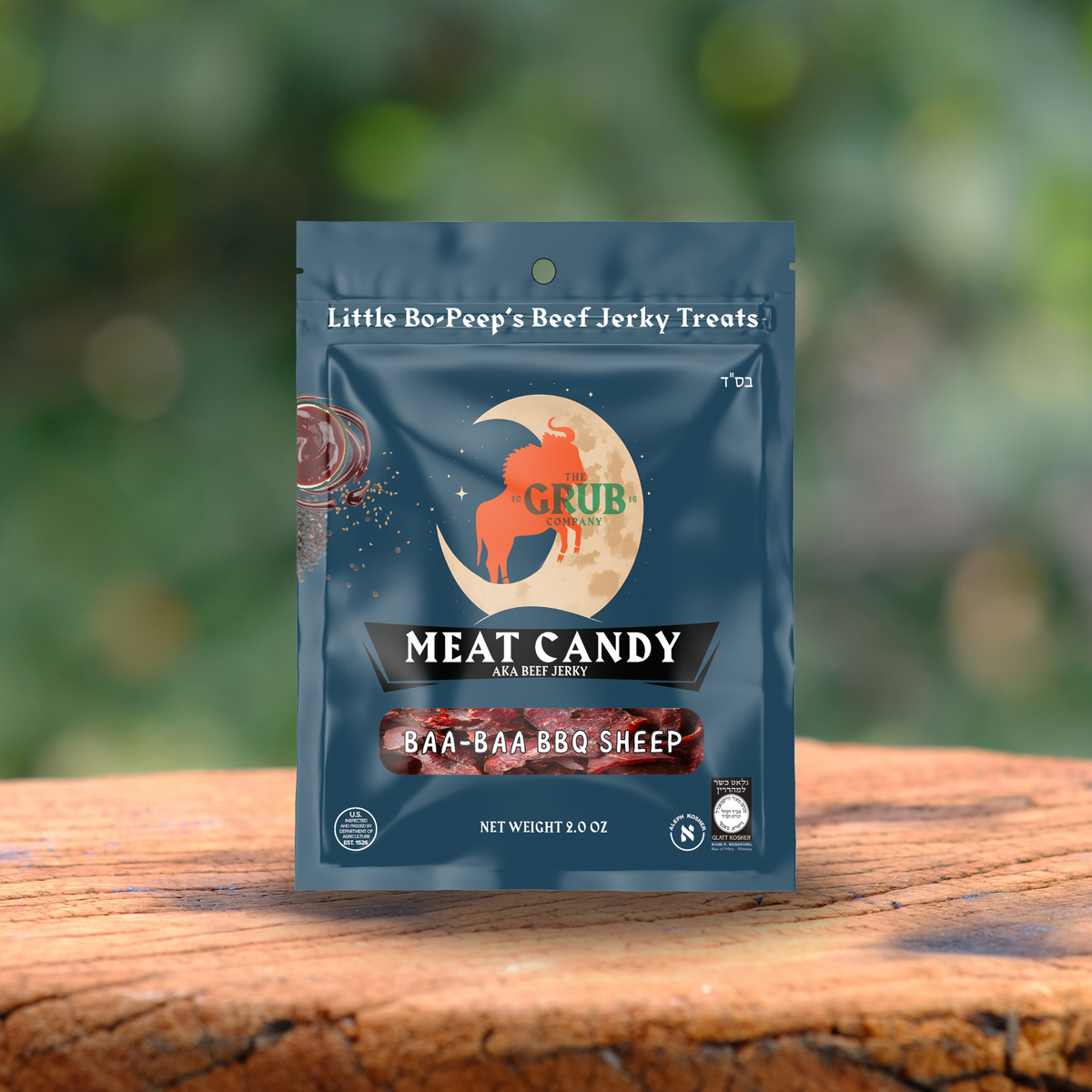
Meat Candy is our jerky, it costs $7.99, and it is the only thing we make that is not biltong. That is a deliberate choice rather than an accident of the catalog. We sell it because there are moments a jerky handles better than any biltong we could hang, and pretending otherwise would be a sales position rather than an honest one.
Where to get it: Glatt Kosher biltong for sale, made in Florida and shipped anywhere in the US (free over $50).
Most of what gets written about jerky by biltong makers is really an argument that biltong is better. We are not going to write that. The two are different products built for different jobs, and if you know which job you are trying to fill, the choice stops being a debate about quality and becomes a question of what you actually want in your hand.
What Meat Candy is
Meat Candy is beef jerky. The name is on the front of the bag and the description is on the back, and neither is doing anything clever. It sits at $7.99 in a range that otherwise runs from Sliced Biltong Mini's at $4.99 up to Biltong Slabs at $58.00, which puts it near the bottom of the price ladder without being the cheapest thing we sell.
The category it belongs to is well defined. Jerky is beef that has been sliced thin, marinated in something wet, and then dried with applied heat rather than left to hang in moving air. The marinade is where the character comes from. It is a soak, so it carries salt, sugar and whatever aromatics the maker wants deep into a thin piece of meat before any drying starts.
The name points at the register the style plays in. Jerky leans sweet more often than it leans sour, and the sweetness is not decoration. It is structural. Sugar in a marinade behaves differently under heat than salt does, and it changes both the surface of the finished piece and the way that surface holds together in a bag.
The one paragraph on how it differs from biltong
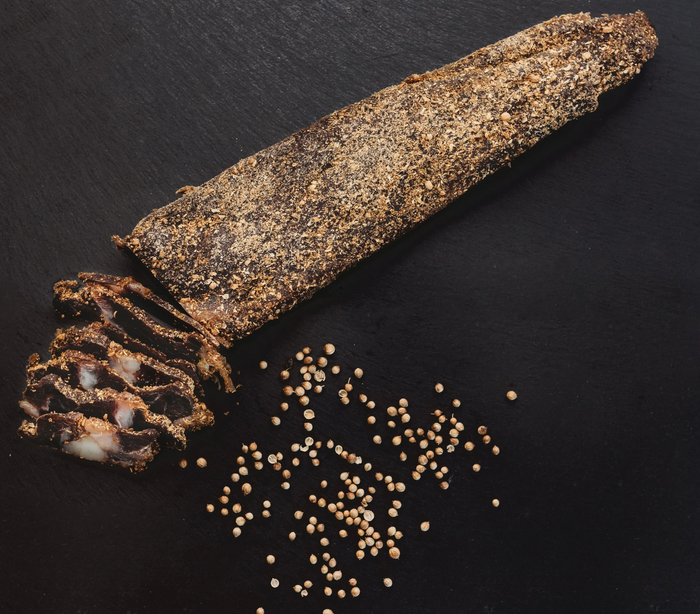
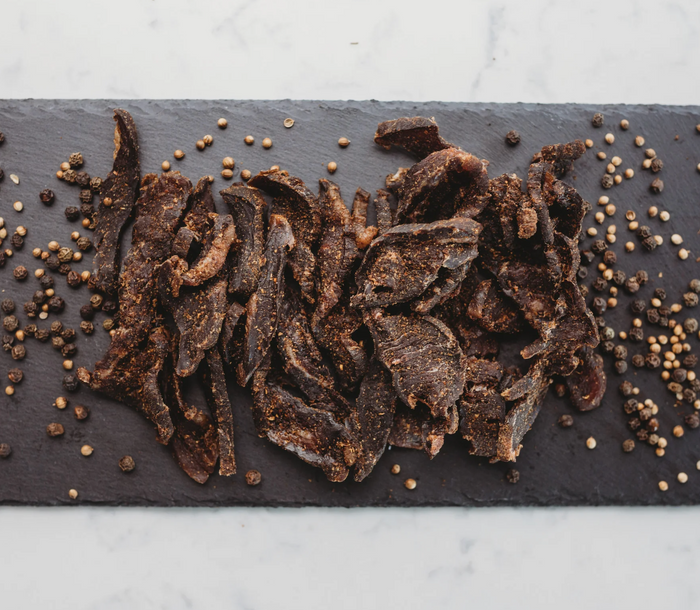
Biltong is air dried, vinegar washed, and usually cut thicker, so it dries slowly from the outside in and keeps a softer core. Jerky is heat dried from a thin slice, so it finishes fast, dries close to evenly through its thickness, and ends up firm all the way rather than layered. Everything else that follows in this article is a consequence of that one mechanical difference, and we are not going to spend the rest of the piece relitigating which method is superior, because the site has plenty of that already and it is the wrong question.
Why a biltong maker would make a jerky at all
The honest answer is that a range built only on biltong leaves gaps, and we would rather fill them ourselves than tell a customer to go without. Biltong is a specific thing. It is tangy from the vinegar, coriander forward, and it comes out of the bag with a texture that people either love immediately or need a few pieces to get used to. That first bag is a genuine hurdle for some people.
Jerky has no such hurdle. Nearly every American adult has eaten it, knows what to expect from it, and does not need any explanation before opening the bag. When you are handing something to a room full of people who did not come for a lesson in South African curing, that matters more than any argument about craft.
There is a second reason, and it is about flavor architecture rather than familiarity. A vinegar washed, air dried piece of beef is at its best when the spice is dry and aromatic. It does not take a wet glaze well, because the surface is already doing a job. Jerky is built for exactly that. If we want a sweet, sticky, savory profile in the range, jerky is the format that can carry it, and no amount of biltong technique gets us there.
What jerky does that biltong does not
Start with the marinade. Because jerky is soaked before drying rather than washed and coated, flavor goes all the way through the slice instead of living mostly in the first millimeter. Bite a piece of biltong and the spice hits first, then the beef. Bite a piece of jerky and the two arrive together, because they were never in separate layers.
Then the surface. Heat drying with sugar present produces a finish that is slightly tacky and glossy rather than dry and dusty. That surface holds a glaze, takes a sweet and savory combination without it sliding off, and gives the piece a completely different feel in the hand. It is also why jerky and biltong should not share a container, which we come back to below.
The third thing is consistency of chew. A thin, evenly dried slice gives you roughly the same resistance in every bite of every piece. Biltong does not, and is not supposed to. Slab dried biltong has a firm rim and a softer middle by design. For a lot of eating occasions that variation is the pleasure. For some, it is a complication nobody asked for.
Who should reach for the jerky
The clearest case is the person who has never eaten biltong and did not choose to. Somebody who picks up a piece off a plate at a party, or a kid, or a coworker who wandered past the bowl. Jerky asks nothing of them. Biltong, honestly, asks a little.
The second case is anyone who does not get on with sour. The vinegar wash is central to what biltong is, and the tang it leaves is not subtle. Some people love it from the first piece. Others find it sharp against what they expected from dried beef. Those people are not wrong and they are not going to be talked around, and Meat Candy at $7.99 is a much better answer for them than a second attempt at a biltong they already told you they did not like.
The third case is the sweet tooth, plainly. If what you actually want from a meat snack is the savory and sweet combination, biltong will never give it to you no matter which flavor you pick. That is not a limitation we are apologizing for. It is what air drying with vinegar and coriander produces.
The occasions where jerky wins outright
Some situations are decided by the format rather than the flavor:
- A lunchbox, where a firm and uniform piece survives being squashed against everything else better than a soft cored one.
- A shared bowl at a party full of people you have not briefed on what biltong is.
- A long drive where you want a single texture you can eat without thinking about it.
- Anywhere you are handing food to children, who tend to prefer sweeter and simpler.
- A first order for somebody whose taste you genuinely do not know, alongside something else.
None of those are about one product being better made than the other. They are about the fact that a firm, even, sweet leaning piece of meat is a lower risk thing to put in front of an unknown person than a tangy, variable textured one.
Where it sits in our range by price
At $7.99, Meat Candy sits above Sliced Biltong Mini's at $4.99 and below Sliced Biltong at $11.99. That ladder is worth understanding because it tells you what each thing is for. The Mini's are a taste, a top up, a thing you throw in a bag. Sliced Biltong at $11.99 is the standard bag you buy when biltong is what you came for.
Meat Candy in between is the crossover purchase. It is the thing you add when you are ordering biltong for yourself but somebody else in the house will also be eating from the same order. It is also, frankly, the least intimidating single item to send to somebody who has never bought from us.
If you want to compare the two styles properly, the honest route is one bag of each rather than a sampler of biltong flavors. The Biltong Sampler Pack at $12.99 answers a different question, which is which biltong flavor suits you. It will not tell you whether you prefer air dried to heat dried, because everything in it is air dried.
What Meat Candy is not
It is not a cheaper biltong. The price difference between $7.99 and $11.99 reflects a different product with a different yield and a different process, and buying the jerky to save four dollars on a biltong craving will leave you unsatisfied for reasons that have nothing to do with value.
It is not a starter biltong either. We have seen the logic before, that somebody should work up to biltong through jerky, and it does not hold. They are not points on the same scale. Eating a lot of jerky does not prepare your palate for a vinegar wash any more than eating a lot of white bread prepares you for sourdough. If you want to try biltong, try biltong, and start with the Mini's at $4.99 if you want the smallest possible commitment.
It is also not a fallback for when we are out of something. We make it on purpose, we price it on purpose, and it earns its place in the range on the days when jerky is what the moment calls for.
The trade we are making by selling both
Here is the real cost of a mixed range, and we would rather say it than have you discover it. Making two products with two different processes means neither one gets the whole of our attention, and every maker who tells you otherwise is selling you a story. Biltong is the center of what we do. Meat Candy is a genuine second product rather than a second business.
The upside is a range that answers more than one question. The downside is that a customer who arrives wanting a dozen jerky varieties will find one. If jerky variety is what you are shopping for, we are honestly not the deepest range you will find, and the depth we do have runs the other way, through biltong formats and biltong flavors.
We think that is the right shape for a store built on air drying. The jerky is there because the range needed it. It is not there because we intend to become a jerky company.
Storing them together is a mistake
This is the practical consequence of the two surfaces being different. Jerky finished with sugar has a slightly tacky exterior that stays a little pliable. Biltong has a dry, matte, sometimes dusty surface with loose spice on it. Put them in one container and the spice migrates onto the jerky, and the jerky's surface moisture migrates the other way.
Nothing dangerous happens. What happens is that the biltong picks up moisture at its surface, loses some of the firm dry exterior that makes it what it is, and the jerky ends up dusted with coriander it was never meant to carry. Both taste muddled. Keep them in their own bags and this is a non issue.
The same logic applies to a party bowl. If you are putting both out at once, use two bowls. It costs you nothing and it keeps each one tasting like itself for the whole evening.
How we would actually order it
For a household where one person is the biltong eater and the rest are not, we would put Sliced Biltong at $11.99 in the order for that person and one Meat Candy at $7.99 for everyone else. That combination covers a week for most families and nobody has to eat around something they do not like.
For a gift to somebody whose taste you do not know, we would send Meat Candy plus the Biltong Sampler Pack at $12.99. The jerky is the safe landing, the sampler is the invitation, and the recipient gets to find out for themselves which direction they lean without you having guessed on their behalf.
For a party, work backward from the crowd. A room of people who already know biltong wants Biltong Slabs at $58.00 or Bulk Biltong at $58.00 and no jerky at all. A room of mixed or unknown guests wants both, in separate bowls, with the jerky in the more accessible spot.
When we would tell you not to buy it
If you came here for biltong, buy biltong. That sounds obvious and it is still the most common mistake we see in a first order, where somebody adds the jerky out of curiosity, eats it first because it is the familiar thing, and forms an impression of the store from the one product that is least representative of what we do.
If you are avoiding sugar, the jerky style is the wrong end of our range for you and biltong is the straightforward answer, because air dried beef with a vinegar wash and a dry spice does not need a sweetener to work. We are stating a composition fact there, not making any other kind of claim.
And if you are buying for somebody who has told you they love biltong, do not get clever. Get them more biltong. Meat Candy is a good product and it is not what that person is asking for.
Bottom line
Meat Candy exists because a range built entirely on air dried beef leaves real gaps, and $7.99 is the price of filling them properly rather than pretending they are not there. It is a jerky, made as a jerky, for the moments a jerky is the right thing. Buy it for the unfamiliar crowd, the sweet tooth, the lunchbox and the mixed household. Buy biltong for yourself if biltong is what you want, because nothing in the jerky is trying to be a substitute for it.
Frequently Asked Questions
Is Meat Candy the same as beef jerky?
Yes. Meat Candy is our beef jerky, sold at $7.99. The name describes the register the style plays in rather than a different category of food. Jerky as a style means beef sliced thin, marinated in something wet, then dried with applied heat. That is what it is. The rest of our range is biltong, which is air dried rather than heat dried and vinegar washed rather than marinated, so Meat Candy is the one item on the shelf made by a different process.
Why does a biltong company sell a jerky at all?
Because a range built only on air dried beef leaves gaps we would rather fill ourselves. Biltong is tangy from the vinegar wash and has a firm exterior with a softer core, which some people need a few pieces to get used to. Jerky needs no introduction, holds a sweet and savory glaze that biltong cannot carry, and gives the same chew in every bite. When you are feeding a mixed crowd or handing something to a child, those things decide the outcome more than any argument about craft.
Should I buy Meat Candy before I try biltong?
No. They are not points on the same scale, so eating jerky does not prepare you for biltong. If biltong is what you are curious about, start with Sliced Biltong Mini's at $4.99, which is the smallest commitment we sell. Buy Meat Candy when a jerky is what you actually want, or when you are ordering for somebody else in the house who has not taken to biltong. Buying it as a stepping stone tends to leave people with the wrong impression of both products.
Can I store Meat Candy and biltong in the same container?
Keep them separate. A jerky finished with sugar has a slightly tacky surface, and biltong has a dry matte surface carrying loose spice. Put them together and the spice migrates onto the jerky while surface moisture travels the other way, so the biltong softens at the outside and the jerky picks up coriander it was never built for. Nothing harmful happens. Both simply stop tasting like themselves. Two bags, or two bowls at a party, and the problem disappears.
Which is better value, Meat Candy at $7.99 or Sliced Biltong at $11.99?
Neither, because they are not the same purchase. The four dollar gap reflects a different process and a different yield, so buying the jerky to save money on a biltong craving is a false economy that leaves you wanting the thing you did not buy. Decide by what the moment needs. If you want tang, coriander and a soft core, that is the $11.99 bag. If you want an even chew and a sweeter profile that anyone will recognize, that is the $7.99 bag.
What should I order if I am buying for a mixed household?
One bag of Sliced Biltong at $11.99 for the person who wants biltong, and one Meat Candy at $7.99 for everyone else. That covers a week in most homes and nobody has to eat around something they do not enjoy. If you are sending a gift and genuinely do not know the person's taste, pair Meat Candy with the Biltong Sampler Pack at $12.99 so they get a safe landing and an invitation in the same box.
Does the jerky come in as many varieties as the biltong?
No, and we would rather say so plainly. The depth in our range runs through biltong, in formats from Sliced Biltong Mini's at $4.99 up to Biltong Slabs at $58.00 and in the flavors across those formats. Meat Candy is one product. If a wide jerky selection is what you are shopping for, we are not the deepest range you will find. We make one jerky, we make it because the range needed it, and we put our attention into the air drying.