Why Biltong Comes in Different Thicknesses, and Which One to Pick
Thickness is the single decision that changes biltong most, more than flavor and more than the size of the bag. A thin slice and a thick cut of the same beef, dried in the same room with the same spice, come out as two genuinely different eating experiences. Knowing which one you want is worth more than any other piece of buying advice we can give.
Shop the real thing: buy biltong online, Glatt Kosher and made in Florida. US orders over $50 ship free.
The reason is not preference dressed up as physics. Thickness governs how fast water leaves the meat, how far the drying front travels before a piece is finished, and how the piece behaves for the days after you open the bag. Everything you notice in your mouth is downstream of that.
What thickness means in a piece of biltong
There are two separate moments where thickness gets decided, and they produce different products. Meat can be cut into slices and then dried, or a whole piece can be hung and dried as a slab and cut afterward. Both are legitimate. They are not interchangeable.
Cut first and you control the exact thickness of every piece before drying starts, and every piece dries at the same rate. That is how you get a bag where the tenth piece eats like the first. Dry first and the thickness of the finished slice is your decision at the board, after the drying has already happened, which means you can cut the same slab thick one day and thin the next.
This is why a slab is not just a bigger bag of biltong. It is a piece of dried meat that has not yet been turned into its final format. You are buying the raw material for whatever thickness you want, and the knife is yours.
The ratio that governs everything
Drying is a surface event. Water leaves through the outside of a piece and nowhere else, so the amount of surface a piece has, relative to how much meat is sitting behind that surface, decides how fast the whole thing dries.
Halve the thickness of a slice and you have not halved the drying time. You have changed the ratio in a way that shortens it considerably more than that, because a thin piece is almost all surface and has very little interior for water to travel out of. A thick cut has a large volume hidden behind a comparatively small area of skin, and every molecule of water in the middle has a long way to travel before it reaches air.
That distance is the whole story. Water in the center of a thick piece has to migrate outward through muscle fiber to get to the surface before it can evaporate, and muscle is not an open pipe. The journey is slow, and it gets slower as the outer layers dry and tighten.
Why thin firms up faster, and keeps firming
A thin slice reaches its finished state quickly and evenly. There is not enough depth for a meaningful difference between the outside and the middle, so what you get is a piece that is close to uniform through its cross section. Firm, consistent, done.
The consequence shows up later. A piece that is already close to even has very little internal moisture reserve, so when it sits in air, the small amount it has left keeps leaving. Thin biltong continues to firm up in an open bag noticeably faster than a thick cut does, and after a few days in a bag you keep reopening, a thin slice can go from pleasantly chewy to genuinely hard.
That is not spoilage and it is not a fault. It is the same process that made the biltong in the first place, still running, in your kitchen instead of our drying room. The way to stop it is to close the bag properly and eat a thin format at the pace it is built for, which is faster than a slab.
Why thick holds a soft core for longer
A thick cut ends up layered rather than uniform. There is a dark firm rim where the drying front got to first, a transition zone, and a redder softer core that the front never fully reached. That structure is the intended result rather than an unfinished job.
Once the piece is in a bag, that core is a reservoir. The interior holds more available moisture than the rim does, and it slowly feeds the outer layers as the outer layers dry further. The result is a piece that resists going hard for a long time, because it has something left to give.
The honest trade runs the other way. More available moisture in the middle also means more happening in the middle, so a thick cut with a genuinely soft core is a livelier thing than a thin slice and it changes character faster in flavor even as it stays softer in texture. Thin goes hard first. Thick moves on first.
What the two thicknesses feel like to eat
A thin slice gives way immediately. You bite, it separates along the grain, and the flavor arrives all at once because the spice on the surface is a large fraction of the total piece. It is a snack in the plainest sense, and you eat several without deciding to.
A thick cut resists. You get the firm exterior first, then the softer interior behind it, and the two arrive in sequence rather than together. There is more beef flavor relative to spice, because the interior is mostly unspiced meat and there is a lot more of it per piece.
Neither is the refined version of the other. If you want dried beef to taste of spice and disappear quickly, thin is correct. If you want something you chew on for a while and taste changing as you go, thick is correct.
Thickness and flavor concentration
Spice lives on the outside. That means the spice to meat ratio in your mouth is a direct function of thickness, and it is one of the least understood things about buying biltong.
Cut a slab thin and every slice carries two spiced faces around a small amount of interior, so the seasoning reads strong. Cut the same slab thick and each slice carries the same two faces around much more meat, so the seasoning reads mild and the beef dominates. Same slab, same spice, same day, completely different intensity.
This is genuinely useful. If a flavor is too assertive for you, cutting thicker calms it down. If a flavor is too quiet, cutting thinner brings it forward. You have a dial, and most people never touch it.
The thin end of our range
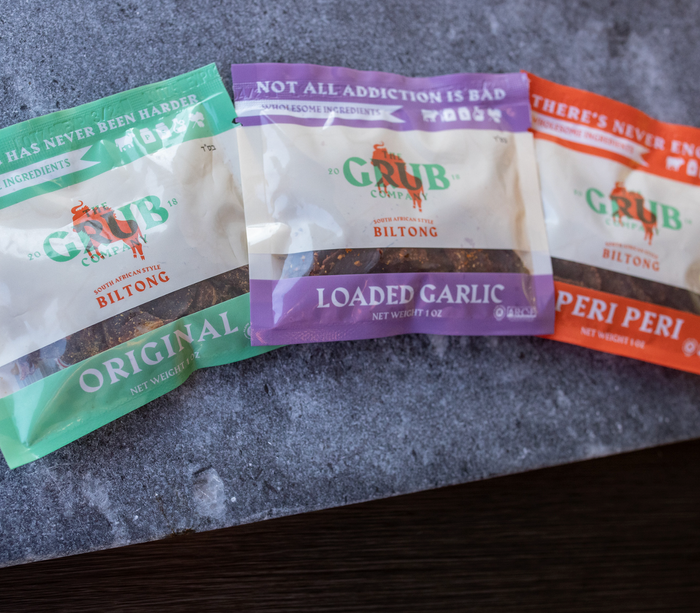
Sliced Biltong Mini's at $4.99 is the smallest and quickest thing we sell. Thin, already cut, ready to eat, and finished in the time it takes to have a conversation. It is the format for a pocket, a desk drawer, a lunchbox and a first try. It is also the right way to test a flavor before committing to a larger bag.
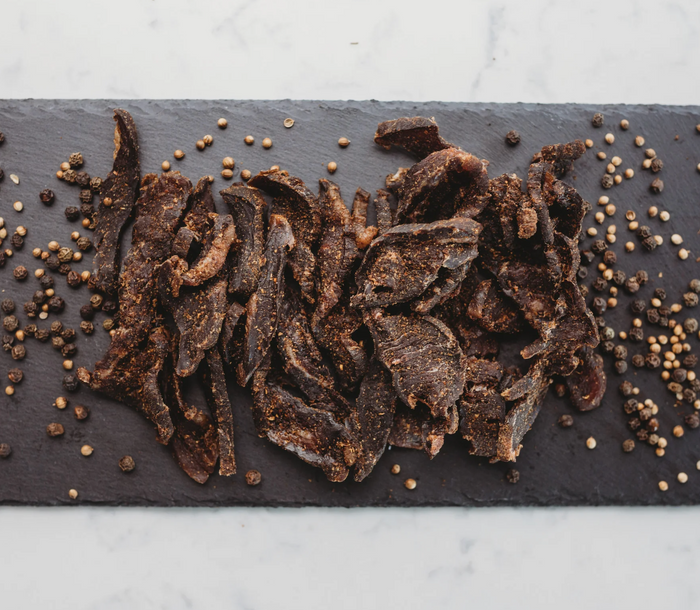
Sliced Biltong at $11.99 is the same idea at the size of an actual snacking habit. Pre sliced, consistent piece to piece, no equipment and no decisions. This is the bag most people should buy most of the time, and it is the one we would put in front of somebody who says they just want good biltong without a project attached.
For a serious quantity of the sliced format, Bulk Biltong at $58.00 gives you a pound of it. Same thickness, same eating experience, more of it, which suits a household that goes through biltong steadily rather than occasionally.
The thick end, where you choose
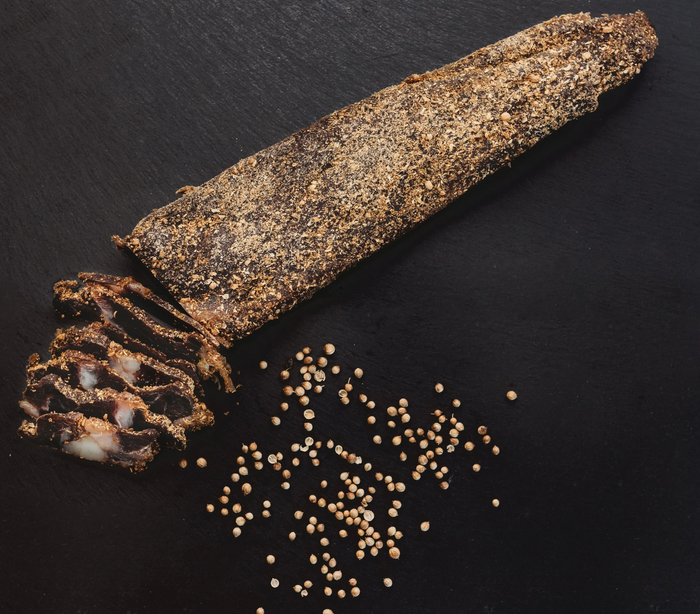
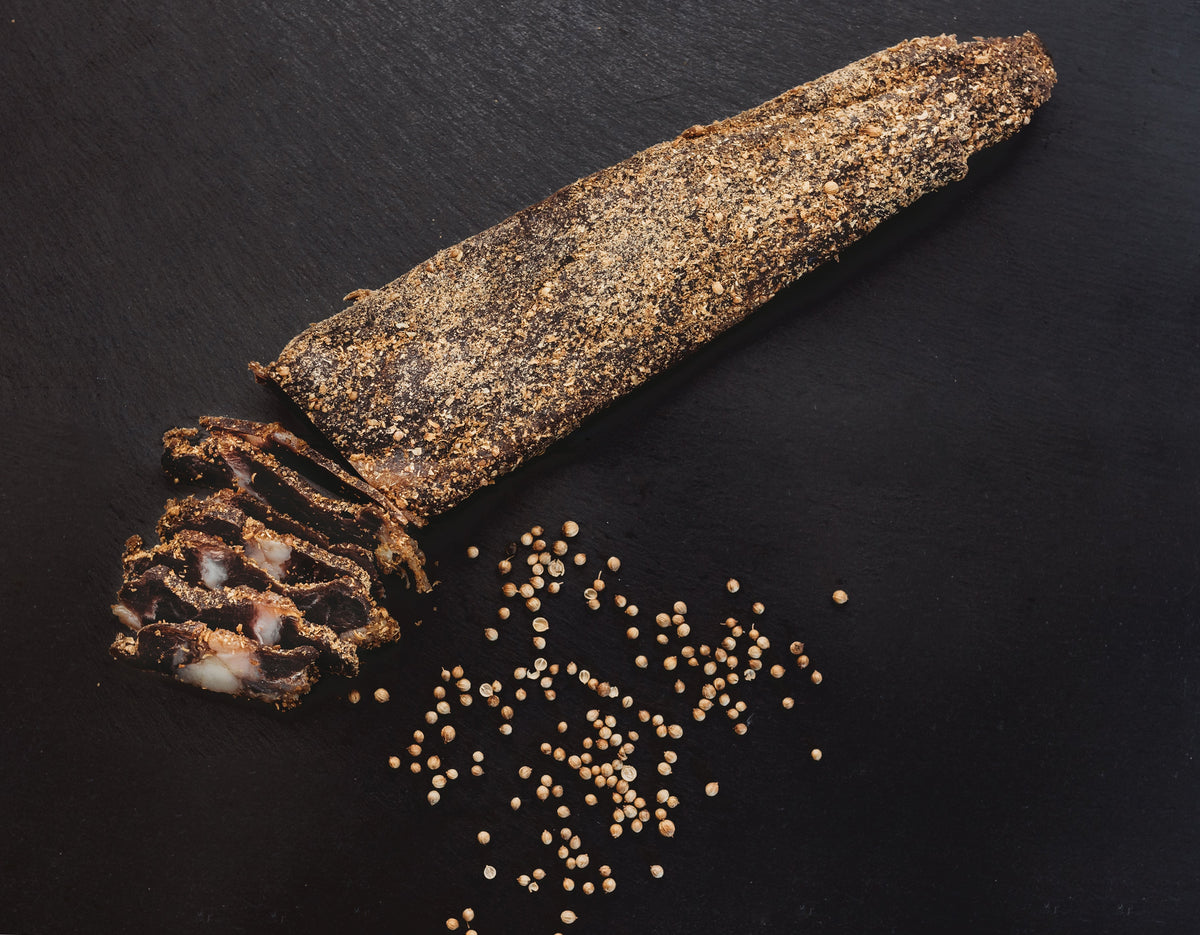
Biltong Slabs at $58.00 is the format where thickness stops being our decision and becomes yours. You get dried meat that has not been sliced, and you cut what you want when you want it. Thick chunks off the end for chewing, thin shavings for a board, medium slices for a bowl, all from the same piece over the course of a week or more.
The keeping advantage is real and it is the reason serious biltong eaters buy slabs. An uncut slab has a small surface area relative to its mass, which means very little of it is exposed to air. Every slice you cut creates two new faces that immediately start drying. Leave the slab whole and it stays where it is. Cut the whole thing at once and you have turned it into the thin format, with the thin format's shorter window.
The cost is that you need a decent knife, a board, and thirty seconds before you eat. For a lot of people that is a pleasure. For some, it is a barrier, and if you know you will not do it, the $11.99 sliced bag is the more honest purchase.
How to cut a slab well
A few things make the difference between slices you are pleased with and a pile of ragged fragments:
- Use a long, thin, sharp blade. A short thick knife crushes dried meat instead of parting it.
- Cut with the grain rather than across it if you want the classic long chew, and across it if you want a shorter, more tender bite.
- Cut only what you are about to eat, and put the rest of the slab back whole.
- Start thicker than you think. You can always cut the next one thinner once you have tasted the first.
- Wipe the blade between passes, because dried meat leaves a film that makes the next cut harder.
If a slab has firmed up more than you like, cutting it thinner brings the chew straight back into range. That is the recovery move, and it is another reason the slab is the format that forgives you.
Matching thickness to the occasion
A shared bowl at a party wants thin. People take a piece, eat it in a few seconds, and take another, and nobody wants to be visibly working on a chunk while holding a conversation. Sliced Biltong at $11.99 or several bags of the Mini's at $4.99 does this job without any preparation.
A board with cheese and pickles wants thin as well, cut fresh off a slab if you can, because shavings sit better next to other things and pick up their neighbors on the way to your mouth.
A long drive, a hike, or a stretch of work where you want something to occupy you wants thick. A chunk lasts, it does not need attention, and it does not run out in four minutes the way a handful of thin slices does.
What to do if you bought the wrong thickness
If you bought thin and wanted more chew, you cannot make it thicker, and that is the honest limit of the sliced formats. What you can do is stop the bag drying further by closing it tightly and keeping it out of warm air, so the pieces at the bottom eat closer to the pieces at the top.
If you bought a slab and it is more work than you want, cut the whole thing into slices at once, put them in a sealed container, and treat it as the sliced format from that point. You will lose the long keeping advantage, so plan to eat it within a shorter window, but you get exactly the product you wanted.
And if you genuinely do not know which you prefer, the cheapest experiment we sell is a bag of Mini's at $4.99 next to a normal Sliced Biltong at $11.99, eaten over the same few days. The difference will be obvious by the third piece.
Why thickness is not the same as size
People conflate these two constantly, and they are unrelated. Size is how much biltong is in front of you. Thickness is how deep any single piece is through its cross section. A pound of thin slices and a pound of thick chunks weigh the same and eat nothing alike.
You can see the confusion in how people shop. Somebody who found a small bag too firm often buys a bigger bag of the identical product, which changes nothing about the eating, because the pieces are cut the same way. What they needed was a different thickness, which in our range means moving from a sliced format to Biltong Slabs at $58.00 rather than moving up in quantity.
The reverse mistake happens too. Somebody buys a slab because it sounds like the serious purchase, then discovers they wanted convenience rather than control. Quantity and thickness are two separate questions. Answer them one at a time and you will get the right bag far more often.
What thickness does to a piece over a long trip
Take biltong somewhere warm and the thickness decides how it copes. Warm air holds more moisture and moves faster around a bag, and both of those speed up whatever exchange is going to happen between the meat and the air around it.
A thin slice in a hot car for a day comes out drier and harder than it went in, because it had very little to lose and lost some of it. A thick cut in the same car comes out with a warmer, softer core and a rim that has firmed slightly, because the interior reservoir buffered the change. Neither has spoiled. They have moved in opposite directions from the same conditions.
The practical rule follows from that. For heat and long journeys where you want the piece to still be pleasant at the far end, thick is more forgiving. For a short trip where you are eating it the same day, thickness barely matters and convenience should decide.
Bottom line
Thin dries fast, tastes of spice, eats quickly and hardens quickly once the bag is open. Thick dries slowly, tastes of beef, holds a soft core for far longer and asks for a knife. Buy Sliced Biltong Mini's at $4.99 to test a flavor, Sliced Biltong at $11.99 for everyday eating with no preparation, and Biltong Slabs at $58.00 when you want to make the thickness decision yourself, every time, for as long as the slab lasts.
Frequently Asked Questions
Does thicker biltong take longer to dry?
Considerably longer, and not in proportion to the thickness. Drying happens at the surface, so what matters is how much surface a piece has relative to the volume of meat sitting behind it. A thin slice is almost all surface with very little interior, so it finishes fast. In a thick cut, water in the middle has to travel outward through muscle fiber before it can evaporate at all, and that journey slows down further as the outer layers dry and tighten around it.
Which thickness stays soft the longest after I open the bag?
Thick, every time. A thick cut finishes with a firm rim and a softer core, and that core holds more available moisture than the outside does. It slowly feeds the outer layers as they continue to dry, so the piece resists going hard for a long time. A thin slice has almost no reserve left, so it keeps firming in an open bag and can move from chewy to genuinely hard within a few days of regular opening.
Why does the same flavor taste stronger on some pieces than others?
Because spice lives on the outside and thickness changes the ratio. A thin slice carries two seasoned faces around a small amount of interior meat, so the spice reads strong. A thick slice carries the same two faces around much more unspiced beef, so the seasoning reads mild and the meat dominates. If you buy Biltong Slabs at $58.00 and cut your own, that ratio becomes a dial you control. Cut thinner to bring a flavor forward, thicker to calm it down.
Should I buy a slab or pre-sliced biltong?
Buy Biltong Slabs at $58.00 if you want to choose the thickness yourself and keep the meat in good condition for longer, since an uncut slab has very little surface exposed to air. Buy Sliced Biltong at $11.99 if you want to open a bag and eat with no knife, no board and no decision. Both are the same craft. The slab is the raw material for whatever format you want on a given day, and the sliced bag is that decision already made for you.
What is the best way to cut a slab?
Use a long, thin, sharp blade, because a short thick knife crushes dried meat rather than parting it. Cut with the grain for the classic long chew, or across it for a shorter, more tender bite. Cut only what you are about to eat and put the rest back whole, since every slice creates two new faces that start drying immediately. Start thicker than you think you want, taste it, then adjust the next slice. Wipe the blade between passes.
Are Sliced Biltong Mini's just smaller pieces of the same thing?
They are the thin, pre-cut format in a small bag at $4.99, which makes them the cheapest way to find out whether a flavor suits you before committing to a larger purchase. They eat quickly and evenly, with the spice forward, and they are built for a pocket or a desk drawer rather than for keeping. If what you want is a longer chew and a softer center, the Mini's are the wrong end of the range and a slab is the right one.
My biltong has gone hard. Did I do something wrong?
Almost certainly not. Drying is the same process that made the biltong, and it does not stop when the bag is sealed at our end. A thin format left in an open bag in warm dry air keeps losing the small amount of moisture it has left, and it firms up. Close the bag tightly, keep it out of warm air, and eat thin formats at the pace they are built for. If you have a slab that has firmed up, cutting it thinner brings the chew straight back.