Why Biltong Is Salted Before It Is Spiced
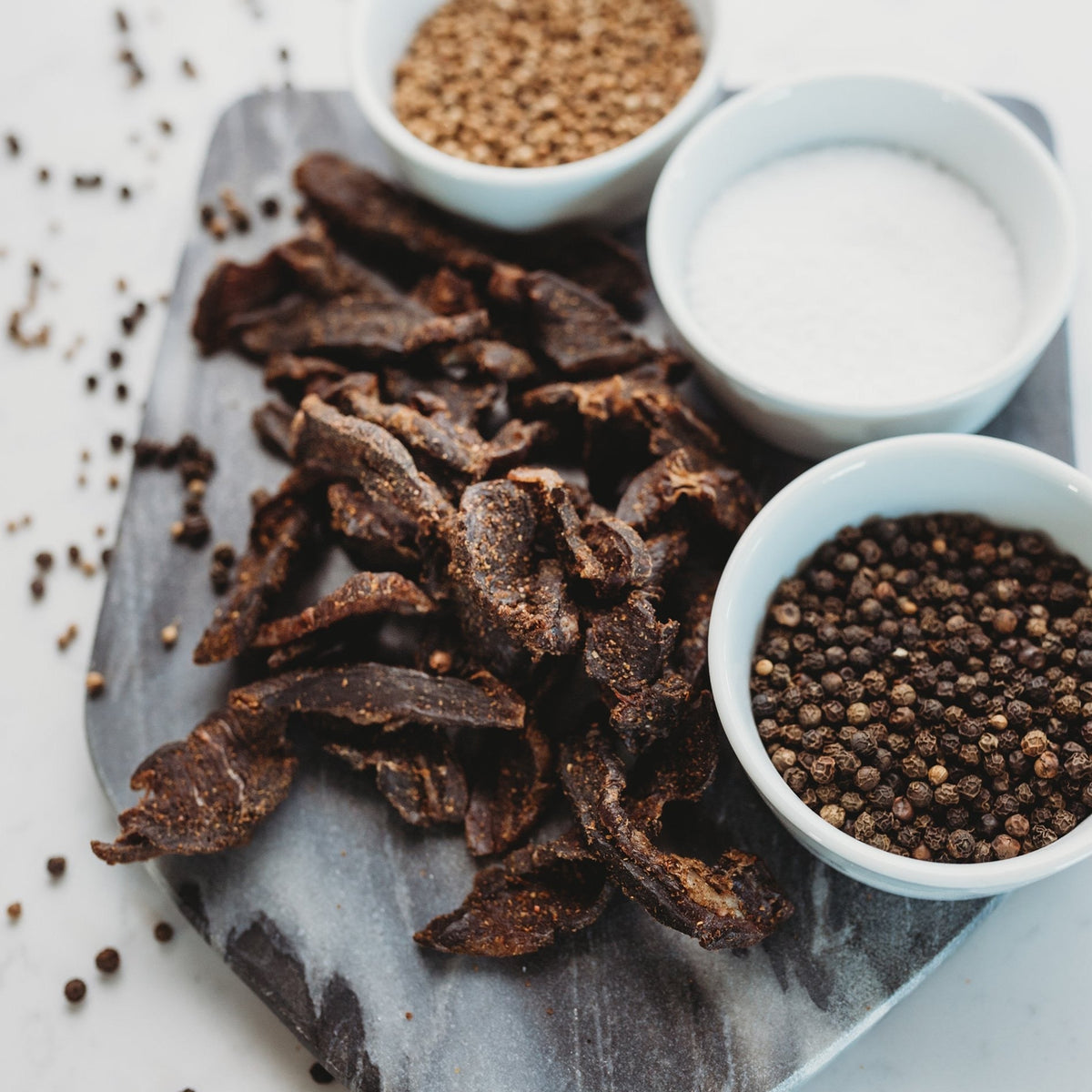
Salt goes on before spice because salt changes the surface of the meat, and spice needs a changed surface to stick to. Put coriander and pepper onto raw wet beef and most of it slides off, ends up in the bottom of the tray, and never becomes part of the finished piece. Salt first, give it time, and the meat develops a tacky protein-rich surface that grips spice and holds it through days of drying. The order is not tradition for its own sake. Each step conditions the meat for the one after it.
Shop the real thing: buy biltong online, Glatt Kosher and made in Florida. US orders over $50 ship free.
The full sequence is vinegar, salt, spice, air, and every one of those does a specific job. What we want to do here is separate them, because they get discussed as a single blur called curing and they are not one thing. Understanding what each step contributes is what lets you tell a well made piece from a rushed one by eating it.
The sequence, stated up front
Beef gets trimmed and cut. It gets a vinegar wash. It gets salted and left. Then it gets spiced. Then it hangs in moving air until it is where the maker wants it. Change the order of those middle steps and you get a different product, usually a worse one, and often one that looks correct from the outside.
That last part is why this matters to a buyer rather than only to a maker. A piece that was spiced before it was properly salted can look identical on a shelf. The failure shows up in how evenly it dried, in how much spice is actually still on it, and in whether the flavor is on the surface only or has gone somewhere into the meat.
What salt does to water
Salt on the surface of meat sets up an imbalance. There is a high concentration of salt outside the muscle and a low one inside, and water moves to even that out. So water travels from inside the meat toward the surface, where it beads up and runs off. At the same time salt travels the other way, into the meat.
Both directions matter. Pulling water out is the head start on drying, and it is a head start that air alone cannot give you at the same speed. Driving salt in is what makes the interior of a thick piece behave like cured meat rather than like raw meat with a seasoned outside. A piece that only got salt on the outside dries from the outside and stays a different food in the middle.
Free water is the number that counts
The useful way to think about drying is not how much water is in the meat but how much of that water is chemically free to do anything. Water bound to salt and to proteins is not available. Water floating loose is. The trade calls this water activity, and it is what actually governs how a dried meat keeps.
This is why salting is doing more than removing liquid. Even the salt that stays behind in the meat is binding water that never leaves, taking it out of circulation. Two pieces at the same moisture percentage can behave completely differently depending on how much salt is in them, and the salted one is the one that stays good. Drying without salting is dehydration. Drying with salting is curing, and they are not the same process.
Salt changes the surface, not just the interior
Here is the part that connects directly to spice. Salt does not only move water around, it acts on the muscle proteins themselves. At the concentrations used in curing, salt makes certain muscle proteins soluble, and they migrate to the surface with the water that is leaving. As that water evaporates, those proteins stay behind as a thin sticky film.
Anyone who has salted meat and come back an hour later has felt it. The surface goes from wet and slippery to tacky. That tackiness is dissolved protein, and it is the glue. It is the difference between a spice coating that is part of the piece and a spice coating that is dust sitting on top of it.
Why spice on a wet surface does not stay
Put cracked coriander on raw beef straight out of the trim and two things go wrong. The free water on the surface runs, and it carries the spice with it, so the coating ends up unevenly distributed before drying even begins. Then, as the piece dries, that thin runoff layer shrinks and cracks and sheds.
You see the result in the packaging rather than on the meat. A product with a lot of loose spice in the bottom of the bag was very likely spiced onto a surface that was not ready for it. Some loose spice is normal and unavoidable, because dried meat gets handled. A layer of it is a process tell.
Time is the ingredient nobody lists
Salting is not an action, it is a wait. Applying salt takes a moment. The chemistry it starts takes hours, and it is not finished when the surface stops looking wet. Salt keeps moving inward long after the outside looks done, and the difference between a piece that rested properly and one that was rushed to the spice bench is a difference in how far the salt got.
Rushing this step is the most common way to make mediocre biltong, and it is invisible at the time. The piece looks salted. It goes on to look spiced, and then it looks dried. What it tastes like is a salty exterior wrapped around underseasoned meat, which people usually describe as the flavor being only on the outside. They are right, and this is the step where that happened.
Where vinegar fits, briefly
Vinegar comes before salt and it is doing a different job. It acidifies the surface and it contributes a background sharpness that biltong would taste flat without. It also cuts the richness of the beef fat in a way that salt cannot. That is its whole role in this sequence, and it is a supporting one.
What vinegar does not do is replace salting. A vinegar wash affects the surface it touches and does not travel through a thick piece of muscle the way salt does. Treating the wash as the curing step is a mistake that leaves you with a piece that smells right and is fundamentally underdone in the middle.
Now the spice has something to hold on to
Applied to a properly salted and tacky surface, spice behaves completely differently. Cracked coriander and pepper press into a film that is already sticky and stay where they are put. The coating survives handling, survives hanging, and survives the shrinkage that happens as the piece loses water.
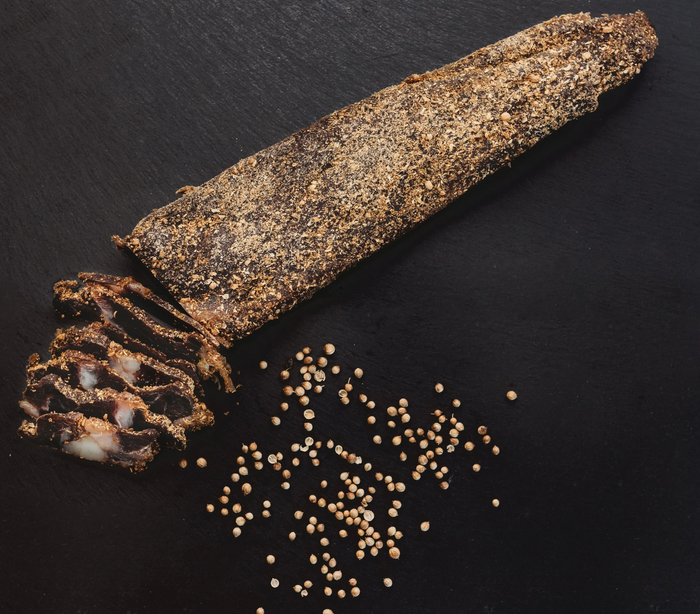
Coarse grinding helps here too. Large cracked fragments have edges and irregular faces that lock into a tacky surface, and they hold their aromatic oils longer than fine powder does. Fine ground spice packs into a dense layer that seals the surface more than it flavors it, and it releases most of its aroma before the piece ever finishes drying. Coarse grind is a decision about adhesion as much as about flavor.
Then air, and why it comes last
Air is the slowest and least controllable step, and it is deliberately last because everything before it was preparation for it. Moving air takes water off the surface, and the meat replaces that water from deeper inside, and the cycle repeats until the piece is where the maker wants it. It is a conversation between airflow, humidity and time.
Sequence protects this stage. A properly salted piece dries evenly, because the interior is already partly cured rather than fully raw. An unsalted or underrested one dries fastest on the outside and forms a hardened band that then slows moisture leaving the middle, which is a failure every dried meat tradition has a name for. The middle stays wetter than it should while the outside gets tougher than it should.
What goes wrong when the order is reversed
Spice before salt is not a subtle variation. The spice sits on wet meat and washes uneven. Then the salt has to travel through a spice layer, which slows and unevens the salting. Then the piece dries with a coating that is loosening rather than bonding.
The finished result is usually recognizable. Patchy color where the spice moved. Loose spice everywhere. A salt level that is high in some bites and low in others. Nothing about it is dangerous, it is just not good, and no amount of extra drying time repairs it. Every step in this sequence is load bearing for the step after it, which is exactly why the order is not negotiable.
Thickness sets every timing in the sequence
Nothing in this process has a fixed clock, because every step is really a distance problem. Salt has to travel from the surface to the center, and the center of a thick piece is a long way from the surface. Water has to travel the same distance in the opposite direction. Double the thickness of a piece and you have more than doubled the time every stage needs.
This is why a maker cuts to a consistent thickness before anything else happens. A tray holding pieces of wildly different sizes cannot be salted correctly, because whatever wait suits the thick ones oversalts the thin ones. Uniform cutting is not tidiness, it is the thing that makes a single set of timings valid for the whole batch. When you see a bag where some pieces are noticeably saltier than others, inconsistent cutting is one of the likely explanations.
Why the same recipe behaves differently in a different room
Written recipes for cured meat travel badly, and people who try one at home usually discover this the hard way. The instructions carry the amounts and the times. What they cannot carry is the temperature of the room, the humidity of the air, how fast that air is moving, and how thick the beef in front of you actually is.
All four of those change the outcome as much as the ingredients do. A humid kitchen extends every stage and raises the risk of the surface staying wet longer than it should. A dry room with strong airflow can form a hardened outer band before the interior has caught up. This is the honest reason a maker develops a process for their own conditions rather than borrowing one, and it is why the sequence is worth understanding as mechanism rather than memorizing as a recipe.
What the maker is actually controlling
Strip the process down and the maker has four dials. How much salt and for how long. How much acid on the surface. How coarse the spice is and when it goes on. How much air, at what humidity, for how many days.
None of those dials work independently. More salt shortens the drying time needed. Coarser spice changes how the surface breathes. Higher humidity extends everything. This is why recipes travel badly between rooms and why two makers using the identical spice mix produce noticeably different biltong. The mix is the smallest part of the outcome. The sequence and the timing are most of it.
How to tell by eating it
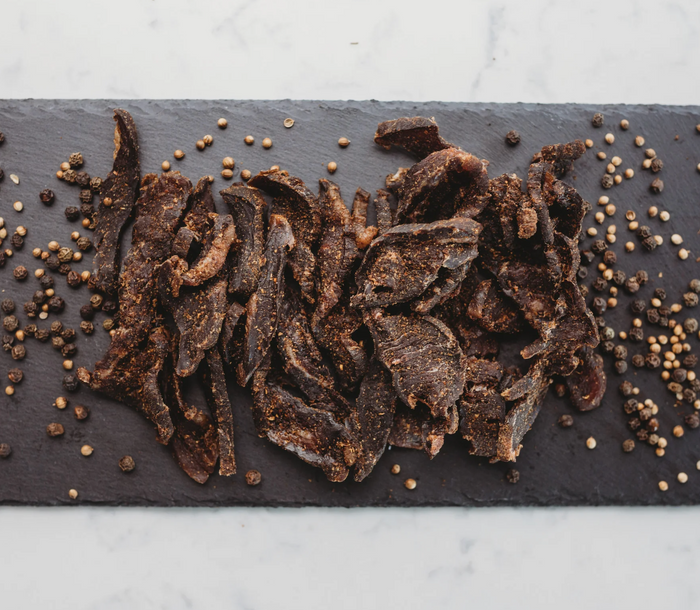
You can read the sequence out of a finished piece. Taste for whether the salt is only at the edge or present all the way through. A properly cured piece is seasoned in the middle, not just on the face. Look at whether the spice is bonded to the meat or sitting loose on it. Check whether the color is even along the piece rather than patchy where liquid ran.
Then pay attention to texture from edge to center. A gentle gradient from firmer outside to softer inside is normal and desirable. A hard shell around a distinctly wet middle is the signature of a piece that dried too fast for how it was prepared. None of this requires equipment. It requires knowing what the steps were supposed to accomplish, which is the whole reason to explain them.
Bottom line
Salt before spice because salt has to move water out and protein up before there is a surface worth spicing. Give it time, because salting is mostly waiting and the waiting is where the interior gets seasoned. Let vinegar do its smaller job of sharpening and cutting fat, and do not mistake it for the cure. Then spice a tacky surface with a coarse grind, and only then hand the piece to the air. Do it in that order and the piece is seasoned right through. Do it in any other order and you get a well dressed exterior wrapped around plain beef.
Frequently Asked Questions
Why is biltong salted before it is spiced?
Because salt changes the surface into something spice can grip. Salt pulls water out of the meat and, at curing concentrations, makes some muscle proteins soluble so they migrate to the surface. As that water evaporates those proteins stay behind as a thin tacky film. Spice pressed into that film bonds to the piece and survives handling, hanging and shrinkage. Spice applied to raw wet beef washes around with the surface liquid, dries unevenly, and sheds. The order is a mechanical requirement rather than a tradition.
What does the vinegar wash actually do?
It acidifies the surface and contributes a background sharpness that biltong would taste flat without. It also cuts the richness of beef fat in a way salt cannot. That is its role, and it is a supporting one in the sequence. What vinegar does not do is cure the meat. A wash affects the surface it touches and does not travel through a thick piece of muscle the way salt does. Treating it as the curing step gives you a piece that smells right and is underdone in the middle.
How long should meat sit in salt before spicing?
Long enough for the salt to move inward, which is hours rather than minutes, and it is not finished when the surface stops looking wet. Salting is mostly waiting. The exact time depends on the thickness of the pieces, how much salt was used and how cold the room is, so no single number covers every situation. Rushing this step is the most common way to make mediocre biltong, and it is invisible at the time. It shows up later as flavor that sits only on the outside.
What is water activity and why does it matter more than moisture content?
Moisture content is how much water is in the meat. Water activity is how much of that water is chemically free to take part in anything. Water bound to salt and to proteins is not available. Free water is. Two pieces at the same moisture percentage can behave very differently depending on how much salt is in them, because the salted one has bound up water that never left. This is why salting is doing more than removing liquid, and why drying without salting is dehydration rather than curing.
Why is the spice cracked rather than ground fine?
Two reasons, and both connect to the sequence. Large cracked fragments have edges and irregular faces that lock into a tacky salted surface and stay there, while fine powder packs into a dense layer that seals the surface more than it seasons it. Cracked pieces also hold their aromatic oils longer, releasing them gradually through the drying period instead of giving up most of the aroma before the piece has finished. Coarse grind is a decision about adhesion and timing as much as about flavor.
What happens if you spice the meat before salting it?
The spice sits on wet meat and moves with the surface liquid, so the coating is uneven before drying even starts. Then the salt has to travel through that spice layer, which slows and unevens the cure. Then the piece dries with a coating that is loosening rather than bonding. The result is recognizable. Patchy color where liquid ran, loose spice throughout the bag, and salt that is high in some bites and low in others. Extra drying time does not repair any of it.
Can I tell how a piece was made just by eating it?
To a useful degree, yes. Taste whether the salt is present all the way through or only at the edge, since a properly cured piece is seasoned in the middle. Look at whether the spice is bonded to the meat or sitting loose on it, and whether color is even along the piece rather than patchy. Then feel the texture from edge to center. A gentle gradient from firmer outside to softer inside is right. A hard shell around a distinctly wet middle means the piece dried faster than its preparation could support.