What the Coriander Is For: Reading a Biltong Spice Blend Like a Maker
Coriander is the note that makes dried beef taste like biltong instead of like seasoned dried beef. It is warm and citrusy rather than hot, it sits alongside beef fat without fighting it, and it is the one ingredient you could remove and have people immediately say that something is missing even if they could not name it. Everything else in a biltong blend is arranged around what the coriander is doing.
Once you know that, a spice blend becomes readable. The grind tells you about adhesion and about how long the flavor is meant to last. What dominates the smell tells you what the maker thinks the meat needs. What is present in quantity tells you whether the blend is framing the beef or covering it. This is a piece about reading a blend, not about where the tradition came from.
Coriander seed is not cilantro
First, clear the confusion, because it costs makers customers. The green leaf that a portion of the population finds soapy and unbearable is a different part of the same plant, with a different aroma profile. The seed is warm, faintly sweet, orange-peel citrusy, and mildly nutty. People who cannot stand the leaf are usually fine with the seed, and often love it.
If somebody tells you they will not eat biltong because they hate cilantro, they have made a reasonable mistake about the plant. The compounds that make fresh leaves taste like soap to some people are largely absent from the dried seed. It is worth saying out loud, because there is no reason for that misunderstanding to keep people from a food they would enjoy.
What coriander actually contributes
Three things happen when coriander meets dried beef. The first is aromatic lift. Beef fat is heavy and rounded, and without something bright next to it a dried piece can read as flat no matter how good the meat was. Coriander carries a citrus-floral top note that sits above the fat rather than in it.
The second is warmth without heat. Coriander has a mild, faintly sweet body that fills the space between salt and pepper, which would otherwise be a gap between sharp and hot. The third is length. Coriander lingers after the bite has gone, and that lingering is a lot of what people mean when they say biltong tastes of something they cannot quite place. If you want to know what it is doing, taste a piece with it and imagine the same piece with only salt and pepper. The gap is large.
Why it gets toasted
Toasting coriander seed before it goes anywhere near meat changes it, and the change is not subtle. Gentle dry heat drives off a little residual moisture and pushes the aromatic compounds around, turning some of the raw green edge into something rounder, nuttier and deeper. A raw seed and a toasted seed from the same jar smell like two ingredients.
The risk is real in the other direction. Coriander goes from properly toasted to burnt fast, and burnt coriander is acrid in a way nothing downstream can hide. There is no rescuing a batch of spice that went too far. That narrow window is why toasting is one of the steps that separates makers who do it by attention from operations that skip it, and skipping it is easy because nobody tasting the finished piece can point at the missing step by name.
Why it is cracked, not ground fine
Coriander seed is hollow and light, and the aromatic oils live inside it. Crack it and you open the shell, releasing aroma while leaving most of the fragment intact. Grind it to powder and you expose everything at once, which smells wonderful in the moment and is mostly gone by the time the meat finishes drying.
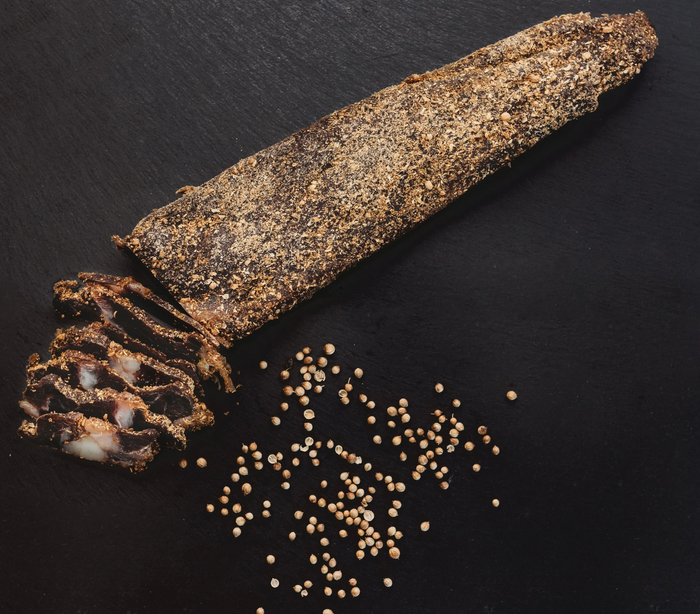
Adhesion is the other half of the argument. Cracked fragments have edges and irregular faces that lock into the tacky salted surface of the meat and stay put through days of hanging. Powder packs into a dense uniform layer that behaves more like a coating than a seasoning, and it can seal the surface enough to interfere with how evenly the piece dries. Coarse cracking is a decision about timing and about adhesion, not about looking rustic.
Grind size is the first thing to read on any blend
Look at a finished piece of biltong and you can see the grind. Visible pale fragments of seed, some of them clearly half seeds, mean the maker cracked rather than milled. A uniform dusty coating means fine grinding, and it usually means the aroma was strongest at the moment of production rather than at the moment you open the bag.
Neither is automatically wrong. Fine grind gives a more even distribution and a smoother mouthfeel, and there are products where that is the goal. What it costs is aromatic length, which is exactly the quality biltong depends on. When you see a coarse crack, the maker has decided that what you smell when you open the bag weeks later matters more than how tidy the product looks on the day it was made.
The usual cast around the coriander
Most biltong blends are short, and that shortness is a feature.
- Salt, which is part of the cure rather than only a flavor and is discussed properly elsewhere.
- Black pepper, which brings heat and a resinous bite that plays against coriander's sweetness.
- Coriander, the signature and usually the largest aromatic component.
- Sometimes a warm baking spice in small amounts, such as clove, allspice or nutmeg, sitting well under the coriander.
What is missing from that list matters as much as what is on it. There is generally no sugar, no smoke and no chili doing structural work. A blend that adds those is not making bad food, but it is making a different food, and it is making a statement about what it thinks the beef alone cannot carry.
Reading the smell when you open the bag
Open a bag and take one honest breath before you eat anything. What comes first tells you what the blend is built around. If you get citrus and warm seed, coriander is leading and the blend is doing the traditional job. If you get pepper first and heat in the nose, the maker has weighted toward pepper, which produces a sharper and more immediate product with less length to it.
If you get sweetness or smoke first, you are holding something closer to jerky in intent regardless of what the label says. And if you get very little at all, the spice was ground too fine, applied too early, or simply used sparingly, and the piece will taste mostly of salt and beef. That is not a disaster. It is information about what you are about to eat.
Black pepper, and why it is the second voice
Pepper is the other ingredient people can name in a biltong blend, and it does a different job from the one most people assume. It is not there for heat in the chili sense. Pepper brings a resinous, faintly woody sharpness plus a heat that arrives fast and clears fast, which is exactly what a long-lingering aromatic like coriander needs beside it.
The balance between those two is the single most consequential ratio in the blend. Weight it toward pepper and the product hits harder up front and finishes short. Weight it toward coriander and the product opens gently and stays with you. Neither is wrong and both exist on shelves, but they are aimed at different eaters. If you have ever preferred one dried beef over another without being able to say why, this ratio is a likely reason.
What a blend cannot fix
Spice is the last thing that happens to a piece of meat and it inherits every decision made before it. If the cut was wrong for the product, spice does not fix it. If the trimming left a seam of connective tissue running through the middle, no amount of coriander makes that piece pleasant to chew. If the drying went too far, the piece is tough and the seasoning is simply along for the ride.
This is worth saying because spice is the visible part and it takes credit it did not earn. People taste a good dried beef and praise the blend, when most of what they enjoyed was beef selection, trimming, salting and patience. The blend is real and it matters. It is the last five percent, and it can only add to what the process already built.
Framing versus covering
Every seasoning decision falls on a line between framing the main ingredient and covering it. A framing blend uses a few things in restrained quantities to make the beef read as more itself. A covering blend uses more, and louder, so that the seasoning is the thing you taste and the meat is the carrier.
Neither approach is dishonest on its own. What it tells you is where the maker thinks their quality lives. A framing blend is a bet on the meat, and it is a bet that only pays if the meat and the drying were good, because there is nowhere to hide. A covering blend is more forgiving of variable beef. When you taste a heavily seasoned dried meat and cannot tell much about the beef underneath it, you have learned something about the priorities behind it.
When a blend is hiding something
There are tells. Very heavy sweetness in a dried beef product usually means the meat needed help, because sugar rounds off flaws that would otherwise read as sharp or metallic. Heavy smoke does the same job from a different direction, because smoke is dominant and covers a lot. Chili at high levels shuts down your ability to judge anything subtle in the same bite.
None of that means a sweet or smoky product is badly made. Plenty of them are made with care and eaten happily. It does mean that the more assertive the seasoning, the less the seasoning is telling you about the meat. If you want to judge the meat, judge the least seasoned thing a maker sells. That is where nothing is standing in front of it.
How grind and cut interact
The blend does not meet the meat in a vacuum. A coarse cracked spice on a thick slab behaves differently from the same spice on a thin slice. On a slab, the spice is concentrated on the outer surface and each cut piece carries an edge of it against a large unspiced interior, so you get contrast within a single bite.
On sliced product, the ratio of surface to interior is much higher, so spice is a larger share of every mouthful and the seasoning reads stronger even when the same blend was used. This is why our Biltong Slabs at $58.00 and our Sliced Biltong at $11.99 taste different from each other despite being the same craft. Format changes how much of the blend is in each bite, and any honest maker will tell you that rather than pretending the products are identical.
What we do and what it costs us
We take the framing side of that line. Coriander leads, pepper supports, salt does its structural job, and we let the beef be the thing you taste. It is the position we would defend on any panel, and it comes with a real cost that we should say out loud rather than pretend away.
The cost is that a restrained blend has nowhere to hide. Variation in the beef shows. A batch dried slightly further than another shows. There is no wall of sweetness or smoke standing between the eater and the meat. We accept that because we would rather be judged on the part of the process that is hard to do than on the part that comes out of a jar.
A practical way to taste for it
Try this once and you will read blends differently forever. Take a piece and smell it before eating. Then eat it slowly and pay attention to what arrives first, what fills the middle, and what is still there thirty seconds later.
Salt should arrive first. Pepper should turn up early and fade. Coriander should be in the middle and should still be there at the end, which is its whole reason for being in the blend. Beef should be present throughout rather than only at the start. If any one of those steps is missing, the blend is telling you what the maker prioritized. If they all land in order, you are eating something that was put together by somebody paying attention.
Bottom line
Coriander is the signature of the style because it does a job nothing else in the blend can do, lifting the heaviness of beef fat with a citrus-warm note that lasts long after the bite is over. It is toasted to round it out, cracked rather than milled so it sticks to the meat and keeps its aroma for weeks, and used in quantity because it is the anchor rather than an accent. When you next open a bag, read it before you eat it. Grind size, what leads in the nose, and whether the beef is being framed or covered will tell you nearly everything about how the maker thinks.
Frequently Asked Questions
Is coriander in biltong the same as cilantro?
They come from the same plant but they are different parts of it with different aroma profiles. Cilantro is the fresh green leaf, and a portion of the population finds it soapy. Coriander in biltong is the dried seed, which is warm, faintly sweet, orange-peel citrusy and mildly nutty. The compounds responsible for the soapy reaction to the leaf are largely absent from the seed, so people who cannot stand cilantro are usually fine with coriander seed. It is a common misunderstanding and it keeps people away from a food they would enjoy.
Why is coriander toasted before it goes on the meat?
Gentle dry heat drives off a little residual moisture and rearranges the aromatic compounds, turning the raw green edge of the seed into something rounder, nuttier and deeper. A raw seed and a toasted seed from the same jar smell like two different ingredients. The window is narrow, because coriander goes from properly toasted to burnt quickly, and burnt coriander is acrid in a way nothing later in the process can cover. It is one of the steps that is easy to skip because nobody tasting the finished piece can name the absence.
Why crack the spice instead of grinding it fine?
Coriander seed is hollow and the aromatic oils live inside it. Cracking opens the shell while leaving most of the fragment intact, so aroma releases gradually over days of drying and is still present when you open the bag. Fine grinding exposes everything at once, which smells wonderful on the day and is largely spent by the time the meat is finished. Cracked fragments also have edges that lock into the tacky salted surface of the meat, while powder packs into a dense layer that can interfere with even drying.
What should be in a biltong spice blend?
Most traditional blends are short. Salt, which is part of the cure rather than only a seasoning. Black pepper for heat and a resinous bite. Coriander as the signature and usually the largest aromatic component. Sometimes a small amount of a warm baking spice such as clove, allspice or nutmeg sitting well under the coriander. What is generally absent matters too. No sugar, no smoke and no chili doing structural work. A blend that adds those is making a different food and telling you what it thinks the beef cannot carry alone.
How can I tell what a spice blend is trying to do?
Open the bag and take one honest breath before eating anything. Citrus and warm seed first means coriander is leading and the blend is doing the traditional job. Pepper first means a sharper, more immediate product with less length to it. Sweetness or smoke first means something closer to jerky in intent whatever the label says. Very little smell at all means the spice was milled too fine, applied too early or used sparingly. Then look at the grind. Visible seed fragments mean cracked, a uniform dust means milled.
Does heavy seasoning mean lower quality meat?
Not necessarily, and plenty of heavily seasoned dried meat is made with real care. What is true is that the more assertive the seasoning, the less it tells you about the beef underneath. Sweetness rounds off flaws that would otherwise read as sharp or metallic. Smoke is dominant and covers a lot. Chili at high levels shuts down your ability to judge anything subtle in the same bite. If you want to assess the meat itself, judge the least seasoned product a maker sells, because that is where nothing stands in front of it.
Why does the same blend taste stronger on sliced biltong than on a slab?
Because spice lives on the surface and the ratio of surface to interior is completely different between the two formats. On sliced product, more of each mouthful is surface, so the seasoning is a larger share of every bite. On a slab, the spice is concentrated on the outer face and each cut piece carries an edge of it against a large unspiced interior, giving you contrast within a single bite. Our Biltong Slabs at $58.00 and Sliced Biltong at $11.99 are the same craft and they do not taste identical.