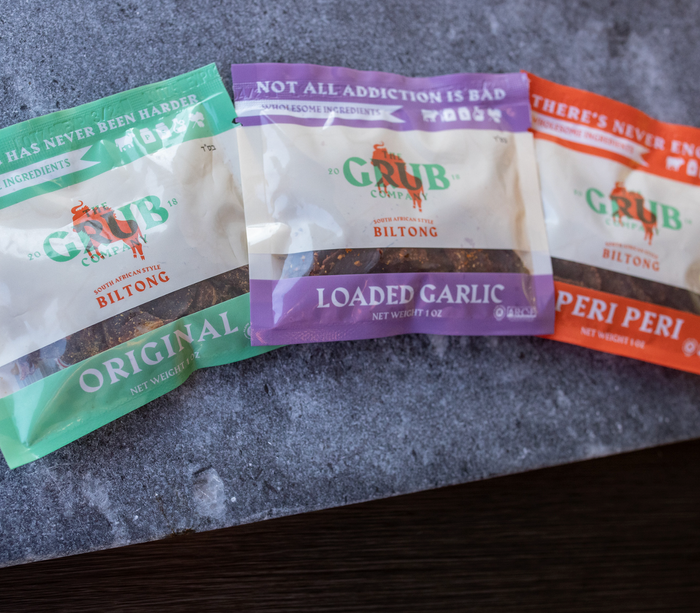
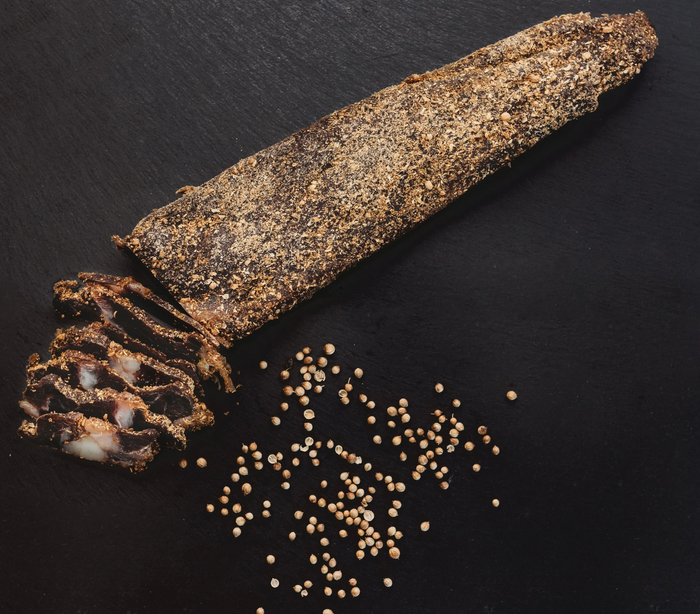
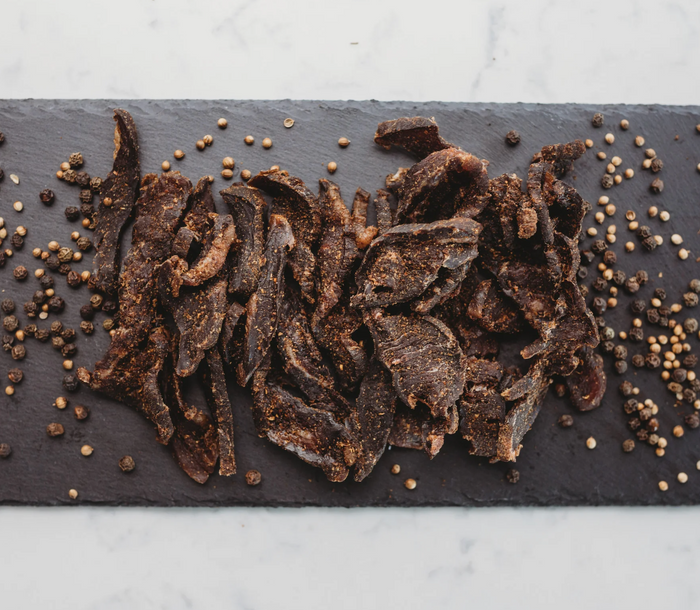
African Dried Cured Meat: Biltong and the Whole Family Explained
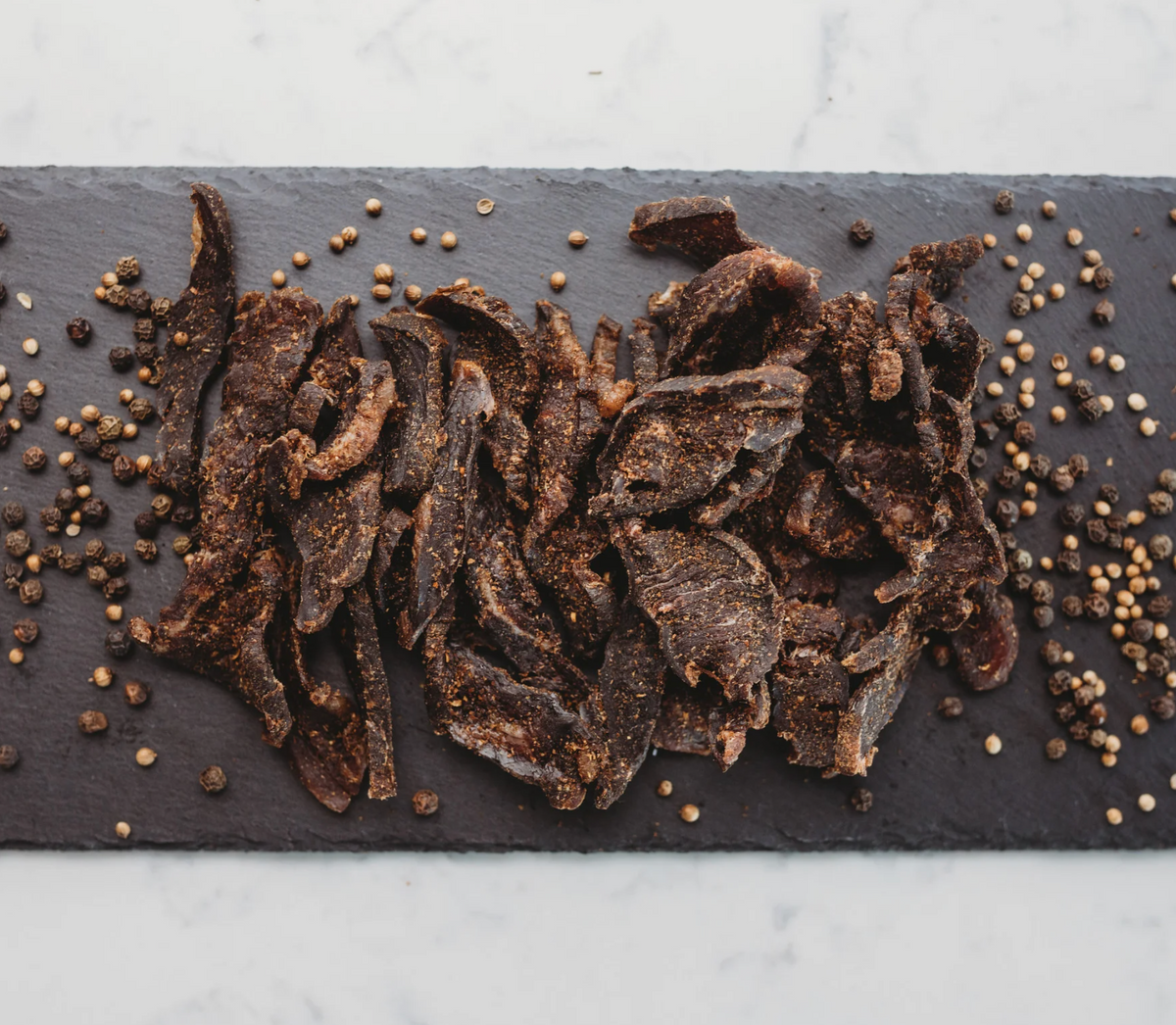
"African dried cured meat" almost always means biltong — the South African method of curing beef in vinegar and salt and air-drying it whole. But it is one of a family. This guide maps the whole family: what each one is, how it is made, how they differ, and which of them you can actually buy in the United States.
Shop the real thing: buy biltong online, Glatt Kosher and made in Florida. US orders over $50 ship free.
Why this phrase exists
People arrive at the phrase "African dried cured meat" from two directions. Some are trying to name something they ate once and cannot remember the word for. Others are working a crossword clue — biltong is a favorite of puzzle setters because it is seven letters and unambiguous.
Either way the answer is usually the same. If it was dried, cured, chewy, deeply beefy, and someone told you it came from South Africa, you ate biltong.
The family, at a glance
| Name | Origin | What it is | Cured with | Cooked? |
|---|---|---|---|---|
| Biltong | South Africa | Whole strips of beef or game, air-dried | Vinegar, salt, coriander | No |
| Droëwors | South Africa | Dried sausage, same spice family | Vinegar, salt, coriander | No |
| Chili bites | South Africa | Small, drier biltong pieces with chili | Vinegar, salt, chili | No |
| Qwanta / quanta | Ethiopia, Eritrea | Strips of beef dried and spiced, often fried after | Salt, berbere, mitmita | Often, after drying |
| Kilishi | Nigeria, Niger, Chad | Very thin sheets of beef, spice-pasted and sun-dried | Groundnut paste, spices | Briefly roasted |
| Bokkoms | South Africa (West Coast) | Salted, dried whole mullet — fish, not beef | Salt, sun and wind | No |
Two of these get confused with biltong constantly. Kilishi is the West African one — thin, nutty from the groundnut paste, and much hotter. Qwanta is the Ethiopian one, often cut into cubes and fried in spiced butter as qwanta firfir. Neither is made with vinegar, and neither shares biltong's coriander backbone.
What separates biltong from every other dried meat
Three things, and it is worth being precise because the differences are what make the flavor.
The vinegar
Biltong is the only major dried-meat tradition that begins with an acid wash. The meat is dipped or soaked in vinegar — brown, apple cider or wine vinegar depending on the maker — before any spice goes on. This drops the surface pH at exactly the moment the meat is most exposed, and it leaves a background sourness you can taste in the finished product.
The coriander
Roasted, cracked coriander seed is the signature. It is warm and faintly citrusy, and it is the note most people cannot identify but would miss immediately. Almost every other African dried meat tradition builds on chili and local spice pastes instead.
The whole-muscle drying
Biltong is dried as a whole strip, then cut. Kilishi is sliced paper-thin before drying. Jerky is sliced thin before drying. Drying a thick piece slowly and cutting it after is what produces biltong's distinctive gradient — firmer at the edge, softer at the core.
Where it came from
Drying meat in strips was already practiced across southern Africa long before Europeans arrived — it is the obvious solution in a hot, dry climate with no refrigeration. Dutch settlers arriving from the 1650s brought vinegar, salt and spice from the East India trade routes, and the two practices merged.
The Voortrekker migrations inland during the 1830s and 1840s are what standardized it. Families moving by ox-wagon needed food that would keep for months and travel without care. Biltong was the answer, and the spice profile that survived is the one that traveled best: coriander from the spice routes, salt, pepper, vinegar.
The word itself is Dutch-derived Afrikaans: bil (rump) plus tong (strip). It names the cut and the shape.
How it compares to European cured meats
People who have not eaten biltong often understand it fastest by comparison to something they have.
| Biltong | Bresaola | Prosciutto | Jerky (US) | |
|---|---|---|---|---|
| Cut | Silverside / topside strips | Whole eye of round | Whole leg | Thin slices, various |
| Cure | Vinegar + salt | Salt + wine + spice | Salt only | Sugar + soy marinade |
| Drying time | Days to 2 weeks | 1–3 months | 12–36 months | Hours |
| Heat applied | None | None | None | Yes |
| Nitrates | Not required | Usually used | Usually used | Usually used |
| Eaten as | Snack, by the handful | Thin slices, plated | Thin slices, plated | Snack |
The useful takeaway: biltong belongs with bresaola and prosciutto, not with jerky. It is an uncooked cured meat that happens to be eaten casually. The category confusion in the US comes entirely from the fact that it is sold in a snack bag.
Is uncooked cured meat safe?
Yes, when it is made properly, by the same logic that makes prosciutto safe. Three barriers work together:
- Acid — the vinegar wash lowers surface pH before drying starts.
- Salt — draws water out of the meat and out of any organisms in it.
- Water activity — once enough water is gone, there is not enough available water left to support bacterial growth. This is the barrier that carries the product long-term.
Water activity is the number professionals actually watch, not moisture percentage. It measures how much of the water present is free to be used, rather than bound up in the meat. Getting a piece below the threshold is what makes it shelf-stable without refrigeration.
What you can buy in the USA
Biltong is the one that has crossed over. It is made domestically by a number of small producers, it is sold online and in specialty grocers, and it is increasingly stocked by kosher markets — biltong suits kosher certification well, because the cuts used come from the forequarter or properly porged hindquarter and the process involves no wine or dairy.
Droëwors turns up occasionally in South African specialty shops. Kilishi and qwanta are rare outside West and East African grocers respectively, and are generally not shelf-stable commercial products in the way biltong is.
If you are looking for the thing you ate in Johannesburg or Cape Town, and it was beef, sliced, dark and coriander-heavy — it was biltong, and you can get it here.
Kilishi, in more detail
The West African one, and the most different from biltong of anything in the family.
Kilishi comes from the Hausa-speaking regions of northern Nigeria, Niger and Chad. Beef is sliced into sheets so thin they are nearly translucent — far thinner than any biltong — and sun-dried until brittle. Then comes the step that defines it: the sheets are coated in a paste of ground groundnuts, spices, onion and sometimes honey, and briefly roasted over a fire.
The result is nutty, hot and dense, closer to a savory brittle than to anything else in this list. Because the sheets are so thin and the paste seals them, it keeps extremely well in a climate that destroys most preserved food.
Two differences from biltong are worth naming. Kilishi is coated after drying rather than seasoned before it, and it is briefly heated at the end. Biltong is seasoned before and never heated. They are solving the same problem with opposite sequences.
Qwanta, and the Ethiopian approach
Qwanta — also written quanta — comes from Ethiopia and Eritrea. Beef is cut into strips, rubbed with salt and a spice blend built on berbere or mitmita, and hung to dry, frequently indoors above a hearth.
Where it diverges sharply from biltong is what happens next. Qwanta is usually a component rather than a finished snack: it is fried in spiced butter, or torn into qwanta firfir with injera, or simmered into a stew. The drying preserves it; the cooking finishes it.
That difference matters for how you think about the whole family. Biltong and kilishi are eaten as they are. Qwanta is a preserved ingredient. Same technique, different position in the meal.
The whole family, ranked by how far they are from biltong
| Distance | Food | What is shared | What is different |
|---|---|---|---|
| Closest | Droëwors | Identical spice profile, identical drying | Ground and cased rather than whole muscle |
| Very close | Chili bites | Same process, same spice base | Smaller, drier, chili-forward |
| Related | Bokkoms | Salt, wind, no heat, same culture | Fish, and no spice at all |
| Cousin | Qwanta | Strips, salt, air-drying | No vinegar; usually cooked before eating |
| Distant | Kilishi | Dried beef, preserved without refrigeration | Paper-thin, groundnut paste, roasted |
| Unrelated by descent | Jerky | Dried beef, and nothing else | Cooked, sweetened, cut against the grain, Andean origin |
Why the vinegar step is the real dividing line
Every tradition in that table solves the same problem: remove enough water, fast enough, that nothing grows before the meat is stable. They differ in what protects the meat during the opening hours, when it is freshly cut, wet and warm.
| Tradition | What covers the opening hours |
|---|---|
| Biltong | Vinegar — an acid wash that drops surface pH immediately |
| Kilishi | Extreme thinness — dries so fast the window barely exists |
| Qwanta | Heavy spice, and often smoke from an indoor hearth |
| Jerky | Heat — it cooks through the window |
| Prosciutto | Very heavy salt, and cold — cured at low temperature over months |
Read down that column and biltong's choice looks unusually elegant. Thinness costs you texture. Heat costs you the tenderness that comes from never denaturing the protein. Cold storage for months costs infrastructure. Vinegar costs almost nothing, works immediately, and leaves a flavor that turns out to suit beef.
Why "African dried meat" is a search that mostly means one thing
People arrive at the phrase from two directions and are almost always after the same answer.
The first group ate something once — on a trip, at a friend's house, at a South African restaurant — and cannot remember what it was called. Dried, chewy, deeply beefy, dark red-brown. That is biltong, and it is the only member of this family widely available outside its home region.
The second group is doing a crossword. "African dried cured meat" is a favorite clue because BILTONG is seven letters and unambiguous.
There is a third, smaller group: people who genuinely want to know the whole family, usually because they are interested in preservation, charcuterie or food history. That is who the rest of this page is for.
What you can actually buy in the United States
| Food | Availability in the US | Where to look |
|---|---|---|
| Biltong | Good and improving | Made domestically; kosher grocers, South African shops, online |
| Droëwors | Occasional | South African specialty shops, some biltong makers |
| Chili bites | Occasional | Same makers, as a side line |
| Kilishi | Rare | West African grocers in large metros |
| Qwanta | Rare | Ethiopian and Eritrean grocers and restaurants |
| Bokkoms | Effectively unavailable | — |
Biltong is the one that crossed over, for reasons that have nothing to do with it being better. It certifies well, it ships without a cold chain, it suits a modern protein-snack market, and — decisively — South African emigration created ready-made communities of people who already wanted it, in the US, the UK, Australia and Canada.
How to tell them apart in front of you
- Thick strips, dark red-brown, visible cracked coriander, shreds along the grain. Biltong.
- Thin sticks, crumbly, same spice smell as the above. Droëwors.
- Small dark nuggets, noticeably drier, chili-forward. Chili bites.
- Paper-thin sheets with a nutty coating, brittle. Kilishi.
- Strips or cubes, deep red spice, often oily or served warm. Qwanta.
- Whole small fish, hard, very salty. Bokkoms.
- Thin, glossy, sweet-smelling, tears rather than shreds. American jerky.
The two fastest tells are smell and how it comes apart. Coriander and vinegar in the nose, and separation into strands rather than a tear across, means biltong and effectively nothing else.
Is uncooked cured meat safe?
Yes, when properly made, by exactly the logic that makes prosciutto safe. Three barriers work together, and none is heat.
Acid — the vinegar wash lowers surface pH before drying starts, at the moment the meat is most exposed. Salt — draws water out of the meat and out of any organisms in it. Water activity — once enough water is gone, there is not enough available water left to support bacterial growth, whatever the temperature. That last barrier is the one that carries the product long-term.
Water activity, not moisture percentage, is what professionals measure. It describes how much of the water present is free to be used rather than bound up in proteins and dissolved salt. Getting a piece below the threshold is what makes it shelf-stable without refrigeration — the same principle behind country ham, aged cheese and every dry-cured meat in Europe.
The climates that made each of these
Preservation methods are not chosen. They are what survives in a given climate, and the map explains the family better than any list of recipes.
| Food | Climate it comes from | What the climate forced |
|---|---|---|
| Biltong | Highveld and Karoo — hot days, low humidity, reliable wind | Air-drying works, but heat makes the first hours risky. Hence vinegar |
| Kilishi | Sahel — very hot, very dry, intense sun | Dry so fast that thinness is the defense. Paste seals the result |
| Qwanta | Ethiopian highlands — cooler, wetter, indoor hearths | Drying alone is marginal, so spice and smoke assist, and cooking finishes it |
| Bokkoms | West coast — cold Atlantic wind, salt at hand | Wind and salt suffice; no spice needed |
| Prosciutto | Northern Italy — cold winters, stable cellars | Cold allows months of slow curing; no acid step needed |
| Jerky (ch'arki) | High Andes — cold nights, thin dry air | Freeze-drying by altitude; heat added later in the Americas |
Two things fall out of that. First, the acid step in biltong is a hot-climate adaptation. Prosciutto does not need vinegar because a cold cellar keeps the meat safe through the vulnerable opening period; a Karoo summer does not offer that, so the acid does the job instead.
Second, the shape of each food follows the constraint. Kilishi is thin because the Sahel lets you dry thin sheets in hours. Biltong is thick because the Highveld gives you days. Neither is a stylistic choice.
What these traditions have in common that jerky does not
Set the Andean line aside and the African traditions share a family resemblance that runs deeper than "dried meat".
- They are whole-muscle or near it. Strips and sheets, not ground and reformed. You can see the grain of the meat in the finished product.
- They are preserved before they are flavored. The salt and the drying come first; the seasoning is on top of a food that would keep anyway.
- They are unsweetened. Sugar appears nowhere in the traditional versions, which is the single clearest difference from American jerky.
- They are eaten at ambient temperature. No reheating, no refrigeration, no plate.
- They came from surplus, not scarcity. Each was invented for the moment when you suddenly have a whole animal and no way to keep it — a herding and hunting problem, not a famine one.
That last point is worth sitting with, because it explains the generosity of these foods. They are not survival rations. They are what you make when you have too much meat, which is why they were seasoned well and why they survived the arrival of refrigeration.
Droëwors, properly
If biltong is the famous one, droëwors is the one South Africans abroad miss most, and it deserves more than a line.
The name is literally "dry sausage". It is made from coarsely ground beef — often with a proportion of lamb fat — seasoned with the same coriander-led blend, piped into a thin natural casing and hung in exactly the same conditions as biltong.
The differences that matter:
- It dries much faster, because the diameter is small. Days rather than a week or more.
- The texture is crumbly rather than shredded — ground meat has no grain to separate along.
- It contains fat by design, which makes it richer and gives it a shorter shelf life than biltong.
- It is eaten whole, as a stick, rather than sliced.
Droëwors is made from boerewors, the fresh coiled sausage that is South Africa's national barbecue food. So the relationship is the same as the one between fresh sausage and dried salami — one is the raw material of the other, and the drying is the whole transformation.
Because of the fat, droëwors is more sensitive to warmth than biltong and does not travel as well. That, more than demand, is why it is far rarer outside South Africa.
Bokkoms, and what fish tells you about the meat
Bokkoms are whole mullet, salted and hung in the wind on the South African west coast until hard. No heat, no smoke, no spice — just salt and the Atlantic.
It belongs in this guide because it demonstrates that the technique was never specifically about meat. The same culture preserved fish, meat and fruit by the same means, because in that place, at that time, salt and moving air were the tools available.
Biltong is not a snack that happened to become traditional. It is the surviving member of a whole preserving culture — and the reason it survived the fridge, when most of that culture did not, is simply that it tastes good enough to want anyway.
A note on names, and why they are confusing
Search results conflate these constantly, and the reason is that English has no good general word for the category.
"Jerky" has become the default English term for any dried meat, which is unhelpful because jerky is a specific product with a specific method. Calling biltong "South African jerky" or kilishi "Nigerian jerky" imports a set of assumptions — cooked, sweetened, thin — that are wrong in every case.
"Dried meat" is accurate and useless, since it covers everything from prosciutto to a dog treat. "Cured meat" is closer but implies a nitrate cure that most of these do not use.
The honest answer is that each of these needs its own name, and biltong is the only one that has successfully carried its own name into English. That is worth knowing when you search: if you are looking for the South African one, search "biltong", not "African jerky" — you will get a completely different set of results.
How the South African version spread, and the others did not
All six of these foods are good. Only one of them is sold in American supermarkets, and the reasons are structural rather than culinary.
It travels without a cold chain. Sealed with an oxygen absorber, biltong keeps three to six months at room temperature. Nothing about distributing it requires refrigeration, which removes most of the cost and nearly all of the risk from selling it at distance.
It survived being made elsewhere. The method needs controlled airflow and low humidity, both of which are engineering problems rather than geographic ones. A drying room in Florida can reproduce a Karoo winter. A Sahel sun cannot be reproduced anywhere, which is part of why kilishi has stayed local.
It arrived with people who already wanted it. South African emigration from the 1970s onward created ready-made communities in the UK, Australia, Canada and the United States — customers who knew what it was before any marketing existed. Small makers started up to serve them, and those makers were in place when the wider market appeared.
It fitted a market that opened later. The protein-snack boom of the 2010s created American demand for high-protein, low-sugar, shelf-stable food. Biltong answered that description without changing anything about itself.
Four accidents of logistics and timing, none of them about flavor. Kilishi and qwanta are not less good; they are less portable and they arrived with smaller diasporas.
If you want to try the whole family
| Start with | Then | Then |
|---|---|---|
| Biltong, Original — the reference point, and the easiest to get | Droëwors, if you find it — same flavor, completely different texture | Chili bites, for the drier, hotter end of the same tradition |
For kilishi and qwanta, the realistic route is a West African or Ethiopian grocer in a large city, or a restaurant. Neither is commonly packaged for retail, and neither is something you should judge from a mail-order approximation.
One piece of advice that applies to all of them: try the plainest version first. Every one of these traditions has a chili-forward variant, and every one of them is easier to like and harder to learn from. The unadorned version tells you what the method actually does to meat.
What all of this means if you are just trying to buy some
If you searched for African dried cured meat and landed here wanting to eat something rather than study it, the practical version is short.
You want biltong. It is the member of this family that is made in the United States, sold online, keeps for months without refrigeration, and needs no preparation. Start with an Original blend, which is beef, vinegar, salt, coriander, black pepper and garlic — nothing else — because it is the version with nowhere to hide and the fair test of any maker.
Buy a small bag first rather than a pound. Flavors in this category differ more than they do in the jerky aisle, because there is no sugar smoothing everything toward the middle, and a pound of one flavor is a month of eating.
Quick answers
African dried cured meat, 7 letters? BILTONG.
Is biltong the same as jerky? No. Jerky is cooked and sweetened; biltong is vinegar-cured, unsweetened and air-dried.
Is droëwors biltong? No — it is sausage made with the biltong spice profile and dried the same way. A cousin, not the same thing.
What is South African dried meat called? Biltong, if it is whole muscle. Droëwors, if it is sausage.
Can it be made from game? Yes. Kudu, springbok, eland and ostrich biltong are all traditional in South Africa. Commercial biltong in the US is beef.
Droëwors, the one worth knowing about
If biltong is the famous one, droëwors is the one South Africans miss most when they leave. The name is literally "dry sausage." It is made from coarsely ground beef — often with a proportion of lamb fat — seasoned with the same coriander-led blend, piped into a thin natural casing and hung to dry in exactly the same conditions as biltong.
The differences that matter: it dries much faster because the diameter is small, it is eaten as a whole stick rather than sliced, and the texture is crumbly rather than shredded. Because it contains fat, it does not keep as long as biltong does, and it is more sensitive to warmth.
Droëwors is made from boerewors, the fresh sausage that is South Africa's national barbecue food. So the relationship is the same as the one between fresh sausage and a dried salami — one is the raw material of the other.
Bokkoms, and why the fish belongs here
Bokkoms are whole mullet, salted and hung in the wind on the South African west coast, and they are worth mentioning because they explain something about the region's food culture. The technique — salt, wind, time, no heat — is identical in principle to biltong. What varies is the raw material and the climate that made it necessary.
This matters for anyone trying to understand where biltong came from. It was not invented as a snack. It was one of several answers to the same problem: a hot country, no refrigeration, and protein that would otherwise spoil in a day. Meat, fish and even fruit were all preserved by the same means. Biltong is simply the one that turned out to taste good enough to survive the arrival of the fridge.
Why the demand for it is growing in the US
Two separate groups are driving it, and they want different things.
The first is the South African diaspora — several hundred thousand people across the US, UK, Australia and Canada, concentrated in a handful of metros. They are not discovering biltong; they are trying to source something they have eaten all their lives, and they know immediately whether a product is right.
The second is American buyers arriving from the protein-snack aisle, usually because they have decided jerky is too sweet. This group has no reference point for what biltong should taste like, which is why the first bag matters so much. An Original blend from a maker who dries properly is the right introduction; a sweetened, dehydrator-made product wearing the name is how people conclude they do not like biltong when they have not yet had any.
Try the real thing — grass-fed, certified Glatt Kosher, air-dried in small batches in the US.