Where to Buy Biltong Online in the USA: A Buyer's Guide
Short answer: buying biltong online in the USA comes down to five checks — who dried it, how it was dried, how it is packaged for shipping, what it costs per ounce, and how fast it moves from the drying room to your door. This guide walks through all five, with the numbers you need to compare any two sellers side by side.
Why buying biltong online is different from buying jerky online
Jerky is cooked. Heat drives the moisture out in a few hours, the product is shelf-stable by design, and a bag can sit in a warehouse for a year without anyone worrying about it. Biltong is not cooked. It is cured in vinegar and salt, coated in spice, and hung in moving air for several days until it loses enough water to be safe and stable.
That difference decides everything about buying it online. Biltong keeps because of water activity and packaging, not because of heat and preservatives. A seller who understands that ships fast, in oxygen-controlled packaging, in small batches. A seller who does not treats it like jerky, and you receive something either too dry to enjoy or too damp to trust.
So the question is not "who sells biltong online." Plenty of people do. The question is who is actually drying it, and how recently.
The five checks, in order
1. Who dried it — maker or reseller?
A surprising share of biltong sold online in the USA is imported, rebagged, or made under contract by a third party. There is nothing wrong with that in principle, but it changes what you can ask. A maker can tell you the cut, the batch, the spice blend and the hang time. A reseller can tell you what the label says.
The test is simple: look for a page on the site that describes the process in specifics — the cut of beef, the vinegar step, the drying time, the certification body. Vague language about "traditional methods" and "authentic recipes" with no numbers usually means the seller does not own the process.
2. How it was dried
Real biltong is air-dried whole, in a controlled environment, over days. Look for:
- A vinegar step. The meat is washed or soaked in vinegar before spicing. This is a food-safety step as much as a flavor step — it drops surface pH before drying begins.
- Days, not hours. A dehydrator run of six hours produces jerky, whatever the label calls it.
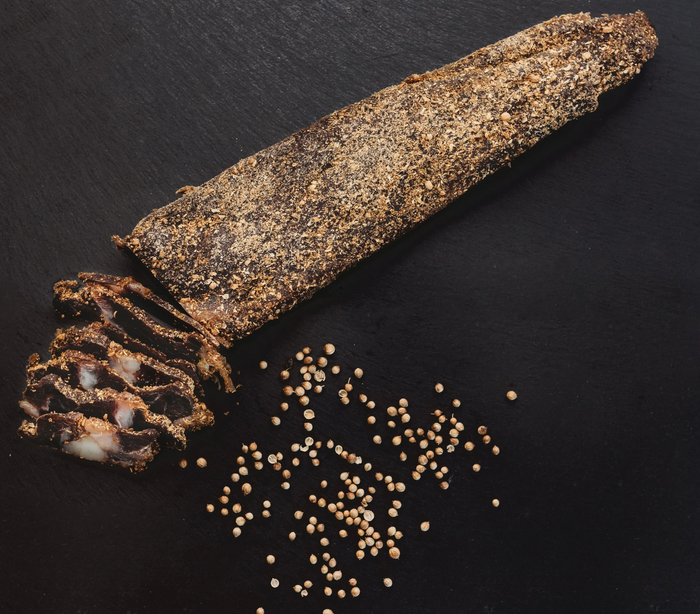
- Whole pieces, sliced after. Biltong is dried as a whole strip or slab and cut afterward. Meat sliced thin and then dried is a jerky process.
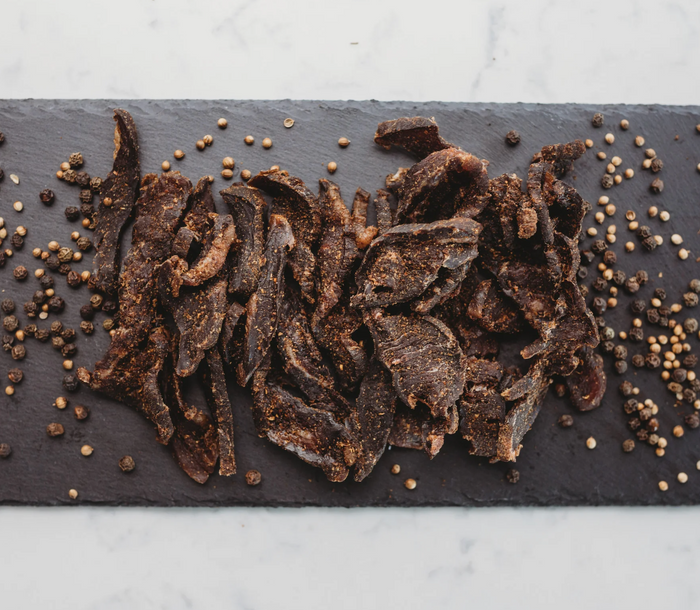
- Coriander in the spice list. Coriander is the defining biltong spice. Its absence does not disqualify a product, but its presence is a good sign the maker knows the tradition.
3. Packaging — the part most buyers ignore
This is the single biggest difference between biltong that arrives right and biltong that arrives disappointing. Biltong that is not fully dried out still contains moisture, and moisture plus oxygen plus a warm delivery truck is how you get a fuzzy bag.
Good packaging means a sealed bag with an oxygen absorber inside. That absorber is what lets an unopened bag sit in a cool, dry place for three to six months without trouble. A plain zip bag with no absorber is fine for a product you eat this week, and a poor bet for one shipped across the country in August.
4. Cost per ounce, not cost per bag
Bag sizes in this category are deliberately inconsistent, which makes headline prices useless. Convert everything to dollars per ounce before you compare. Here is how the common formats work out:
| Format | Typical size | Typical price | Cost per ounce | Best for |
|---|---|---|---|---|
| Mini / single-serve | 1 oz | $4.99 | $4.99 | Trying a flavor, lunchboxes, gym bag |
| Standard sliced bag | 3 oz | $11.99 | $4.00 | The normal weekly buy |
| Bulk sliced | 16 oz (1 lb) | $58.00 | $3.63 | Households, offices, meal prep |
| Whole slab | 16 oz (1 lb) | $58.00 | $3.63 | Slicing to your own thickness |
| Sampler pack | ~3.3 oz mixed | $12.99 | ~$3.94 | First order, before you commit |
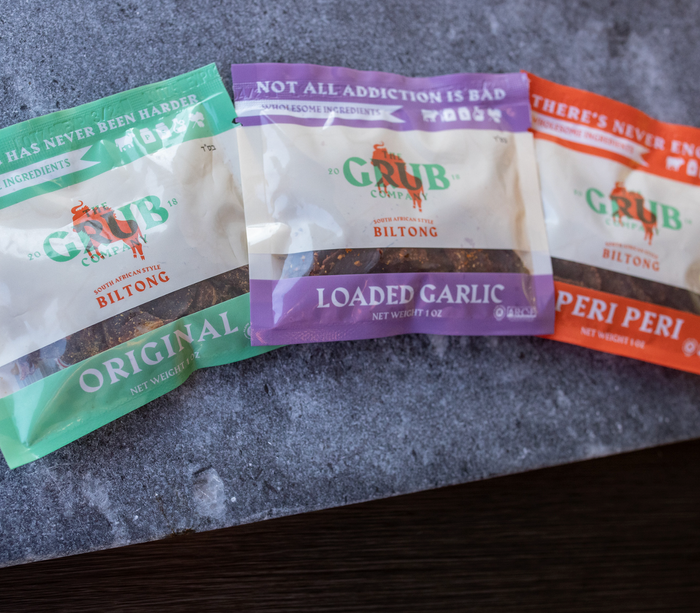
Prices above are The Grub Company's, listed so you have a real reference point rather than an average. The pattern holds across the category: the per-ounce price drops roughly 20–25% as you move from single-serve to a pound.
If you find biltong at well under $3 an ounce, something has been substituted — a cheaper cut, a shorter dry, added sugar to mask it, or more water left in the meat so you are paying for weight you cannot eat. Yield is the reason. It takes roughly two to three pounds of raw beef to make one pound of biltong. That ratio is not negotiable, so anyone selling far below the category floor has changed the inputs.
5. Shipping — speed and cost
Because biltong is a fresh-ish product, transit time matters more than it does for jerky. Look for a stated dispatch window, not just a shipping price. And check the free-shipping threshold against the size you actually want, because a $3.99 shipping fee on a $12 bag is a third again on the price.
For reference, The Grub Company ships free within the US on orders over $50, charges $2.99–$3.99 below that, and also ships to Canada, Israel and the UK on a buyer-paid basis (international orders may incur VAT or duty).
What to buy on a first order
The most common first-order mistake is buying a pound of one flavor before knowing whether you like that flavor. Biltong flavors differ more than jerky flavors do, because the spice sits on the surface of an unsweetened meat rather than being carried in a sugar marinade.
| If you are… | Order this | Why |
|---|---|---|
| New to biltong entirely | A 3 oz bag of Original | Original is the reference point. Judge everything else against it. |
| Deciding between flavors | Minis, one of each | Cheapest way to taste the full range before committing. |
| Feeding a household | Bulk sliced, 1 lb | Best cost per ounce; sliced means no prep. |
| Serving a crowd or a board | A whole slab | You control thickness, and it looks like food rather than a snack. |
| Sending a gift | Sampler or mixed pack | Removes the risk of guessing someone else's heat tolerance. |
Kosher, halal and dietary buyers
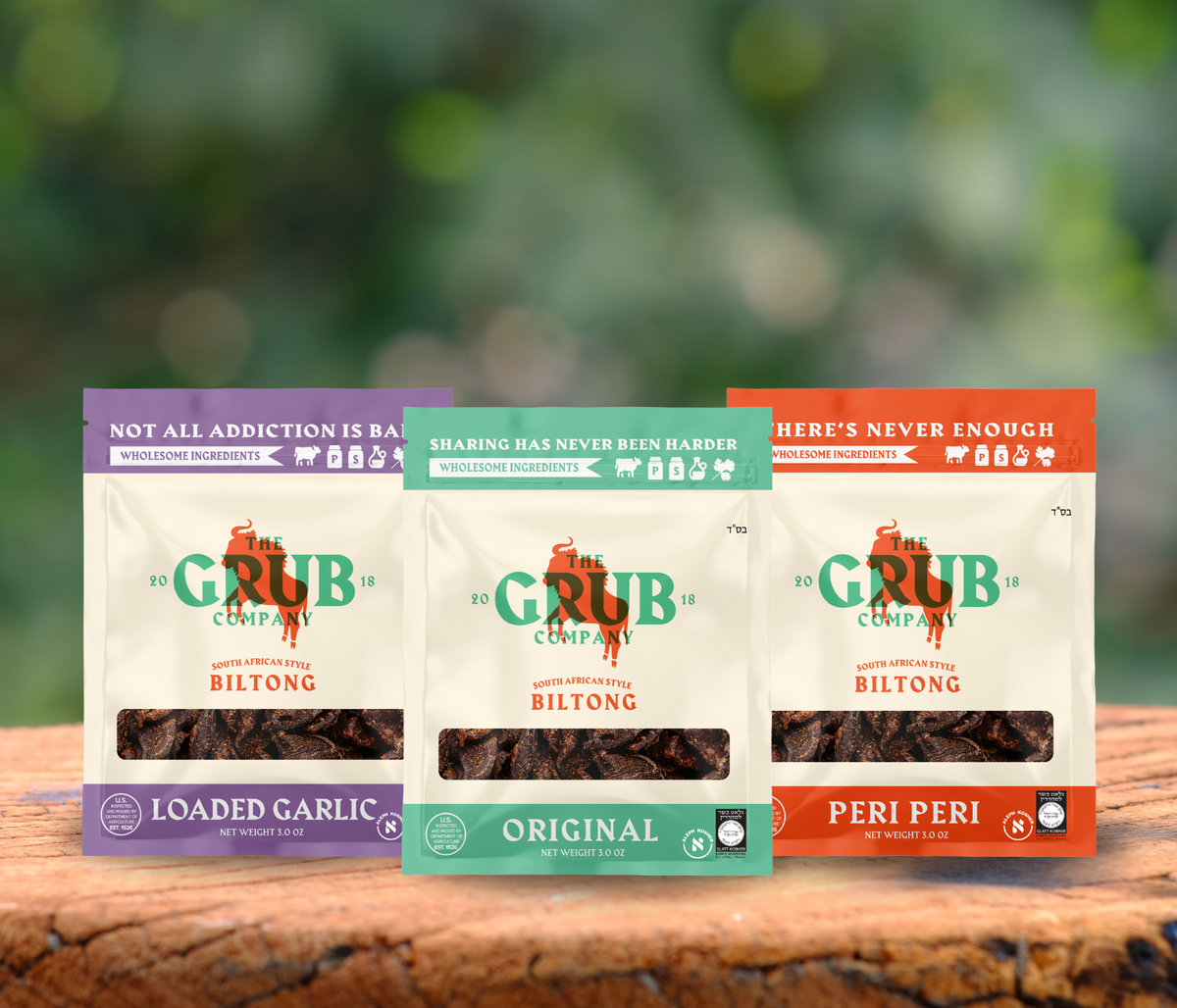
If you need certified kosher biltong, the online market narrows sharply — most US biltong is not certified, and "kosher-style" means nothing. Look for a named certifying agency and a certificate you can actually view, not a claim in the product description. The Grub Company is certified Glatt Kosher and publishes its Kashrus certificates.
For other dietary needs, biltong is naturally well suited: no cooking oil, no soy in a properly made blend, no dairy, and no added sugar in a traditional recipe. Check the ingredient list rather than the marketing. A short list — beef, vinegar, salt, coriander, pepper, garlic — is what a real blend looks like.
Red flags on a biltong product page
- No ingredient list. If you cannot see what is in it before you buy, assume sugar and preservatives.
- Sugar high in the list. Some heat blends use a small amount of brown sugar for balance. Sugar as the second ingredient means you are buying candy.
- Nitrates or nitrites. Properly dried biltong does not need them. Their presence signals a shortcut on drying time.
- No drying time or process described anywhere on the site.
- A shelf life stated in years. Unopened biltong with an oxygen absorber is good for months, not years. A multi-year claim describes a different product.
- Stock photography of raw steak. Makers photograph their own product. Resellers photograph the idea of it.
Buying online vs buying in a store
In-store buying lets you see the product, which is genuinely useful — you can check the color and the cut. Online buying gives you the full range of flavors and formats, and, from a maker who ships promptly, fresher product than a shelf that has been restocked monthly.
If a kosher grocer near you carries a brand you like, that is a good way to buy the weekly bag. For anything beyond a single bag — bulk, gifts, specific flavors, sampler packs — online is usually the better route, because a grocer stocks the one SKU that sells fastest.
Who is actually selling it: four kinds of seller
Every biltong site in the US falls into one of four categories, and knowing which you are on tells you what questions are worth asking.
| Type | How to spot it | What you get | What to ask |
|---|---|---|---|
| The maker | Describes their own process, names cuts and drying times, photographs their own racks | Freshest product, someone who can answer a real question | When was this batch dried? |
| The rebagger | Buys in bulk, packs under their own label. Vague sourcing | Can be perfectly good; nobody can explain a bad batch | Who makes it? |
| The importer | South African branding, heritage language, long transit | Genuine tradition, unpredictable freshness | How long since it left the drying room? |
| The marketplace listing | Third-party seller on a large platform | Convenience; storage conditions unknown | Who fulfills it, and how long has it sat? |
None of these is disqualifying. But the difference between a maker and a reseller shows up the day something is wrong with a bag — one can tell you why, and the other can only forward your email.
The quickest test costs you one email. Ask what cut they use and how many days they dry it. A maker answers in a sentence. Anyone else takes days, or answers a different question.
The questions worth asking before a first order
- What cut, and in what ratio? "Silverside, with some topside" is an answer. "Premium beef" is not.
- How long do you dry it, and at what temperature? Days and room temperature is what you want to hear. Hours means jerky.
- Do you roast your coriander? A small question that reveals how much care goes in.
- How soon after drying do you ship? Freshness is the whole advantage of buying direct.
- Is it packed with an oxygen absorber? This decides whether a months-long shelf-life claim is credible.
- Can you tell me the batch date on what I would receive? Producers who track batches can. It is the most revealing question on the list.
- What is your dispatch window? Not shipping speed — how long before it leaves.
You do not need all seven. Asking any two and reading how they answer tells you most of what the twelve-point inspection would.
What arrives, and the first five minutes
Most of what can go wrong with an online order is visible immediately.
- Check the seal. Intact, with an oxygen-absorber sachet inside. A compromised seal is worth an email rather than a shrug.
- Look for a pack or batch date. More useful than a best-before, because it tells you how recently it was dried rather than how long someone estimates it will last.
- Smell it on opening. Beef, vinegar, coriander. Sweet or smoky means jerky seasoning. Sour, ammoniac or paint-like means contact the seller.
- Look at a cut face. Sliced biltong should show a gradient — firmer dark rim, softer redder center. Uniform color suggests heat.
- Portion a bulk order immediately. This is the single habit that decides whether buying in bulk was worth anything.
- Try one piece before storing the rest. If it is drier than you like, that is fixable in one direction only, so plan accordingly.
Storing what you ordered
| Condition | How long | What to do |
|---|---|---|
| Unopened, sealed with an absorber | 3–6 months | Cupboard, cool and dark |
| Opened, room temperature | 2–3 days | Press the air out and reseal |
| Opened, refrigerated | 1–2 weeks | Sealed container, not the open bag |
| Humid climate, opened | 1–2 days | Refrigerate from the start |
| Frozen, wrapped tight | 6 months+ | Portion first; thaw in the fridge |
Biltong is hygroscopic — it pulls moisture out of humid air, which raises its water activity and partially undoes the drying. That is the mechanism behind every number in that table, and the reason an opened bag behaves so differently in Phoenix and in Miami.
The single most useful habit costs nothing: press the air out before you reseal.
Subscriptions, and when they beat bulk
Most makers now offer recurring delivery, and it is worth a moment rather than a reflex no.
The case for it is freshness. Biltong is at its best within weeks of drying. A subscription delivering a fresh sealed bag every week or two means you are never eating the tail end of a pound that has been opened eleven times. Per ounce it usually sits between single bags and bulk.
The case against is that you will eat what arrives. If that is the point, good. If you are trying to moderate, a subscription removes the natural friction of having to reorder.
The practical test: if you buy biltong more than once a month anyway, a subscription is almost certainly better product at a similar price. If you buy occasionally, it is not.
Shipping abroad
Meat import rules vary sharply by country and change without much notice. A few points that hold generally:
- Check the destination's rules before you order, not after. Many countries restrict or prohibit meat imports outright.
- Label customs forms honestly. Mislabeling is how a package gets destroyed rather than delayed.
- Send fewer, larger shipments. Every parcel is a separate customs event and a separate delay.
- Send sealed product only. Never repackage — you lose the seal and the absorber, which is the entire preservation system.
- Expect duty or VAT on arrival in most of Europe and in Israel.
For reference, we ship to Canada, Israel and the UK on a buyer-paid basis, and free within the US on orders over $50.
A short buying checklist
- Does the site describe the actual drying process, with time and method?
- Is there a vinegar step and coriander in the spice list?
- Is the bag sealed with an oxygen absorber?
- What is the cost per ounce, converted?
- What is the dispatch window, and the free-shipping threshold?
- If you need certification, is a real certificate viewable?
- Does the ingredient list contain anything you did not expect?
Seven questions, most of them answerable in two minutes on a product page. They separate the makers from the rebaggers more reliably than any review score.
Subscription versus one-off ordering
Most biltong makers now offer a recurring option, and it is worth a moment's thought rather than a reflex no.
The case for it is freshness. Biltong is at its best within weeks of drying, and a subscription that delivers a fresh sealed bag every week or two means you are never eating the tail end of a pound that has been opened eleven times. The per-ounce price usually sits between single bags and bulk.
The case against it is that you will eat what arrives. If that is the point, good. If you are trying to moderate, a subscription removes the natural friction of having to reorder.
The practical test: if you buy biltong more than once a month anyway, a subscription is almost certainly better product at a similar price. If you buy it occasionally, it is not.
What arrives, and what to do in the first five minutes
- Check the seal. Intact, with an oxygen-absorber sachet inside. A compromised seal is worth an email to the seller rather than a shrug.
- Look for a pack or batch date. More useful than a best-before date, because it tells you how recently it was dried.
- Smell it on opening. Beef, vinegar, coriander. Sweet or smoky means jerky seasoning; sour or ammonia means contact the seller.
- Portion a bulk order immediately. This is the single habit that decides whether buying in bulk was worth it.
- Try one piece before storing the rest. If it is drier than you like, that is fixable in the other direction only — so plan accordingly.
If your first bag is wrong
Two failure modes account for most disappointing first orders, and neither means biltong is not for you.
Too dry. Very common, and usually a batch or storage issue rather than a maker's intent. Nothing can be done to reverse it, but it tells you to buy on the wetter side next time, or from a maker who ships faster.
Too sweet. This one is diagnostic. Biltong should not taste sweet. If it does, check the ingredient list — you have probably bought a jerky-process product with a biltong name, and the fix is a different producer rather than a different flavor.
A genuine third possibility is that you tried peri peri first and found it too hot to judge anything else. Original exists for a reason; it is the blend with nowhere to hide, and it is the fair test of any maker.
The formats, translated for someone buying blind
You cannot pick a piece up, so the format decision carries more weight online than it does in a shop. Each one behaves differently after it arrives.
| Format | How it ships | How it behaves once opened | Buy it if… |
|---|---|---|---|
| Sliced, 3 oz | The default. Nothing to go wrong | More surface area, so it dries out faster | You want to eat it this week without thinking |
| Minis, 1 oz | Individually sealed | Each bag is a fresh start | You are testing flavors, or you want portion control |
| Whole slab, 1 lb | Robust; nothing to crush | Holds moisture far better — most meat is protected by the outside | It will live on a counter for weeks, or you are serving people |
| Bulk sliced, 1 lb | One large bag | Needs portioning on arrival or the last third goes hard | You are organized, and price per ounce matters |
| Sampler | Mixed small quantities | Small bags, quickly finished | First order, or a gift |
The slab is the format online buyers most often overlook and most often should choose. Because far less of the meat is exposed to air, an opened slab is still good a week later while an opened bag of sliced has hardened. It costs you a knife and thirty seconds.
What the price tiers actually mean
| Per ounce | What you are usually getting |
|---|---|
| Under $2.50 | Not biltong in any meaningful sense, or heavily under-dried — you are buying water weight |
| $2.50–$3.50 | Commodity cuts, shorter drying, often sweetened to carry it |
| $3.50–$4.50 | The working range for properly made biltong |
| $4.50–$5.50 | Grass-fed, certified, small-batch, or single-serve packaging |
| Over $5.50 | Specialty, game meat, or you are paying for the box |
The floor exists for a physical reason. It takes roughly two to three pounds of raw beef to make one pound of biltong, and a batch occupies a controlled drying room for days. No process change gets around either. A price well beneath the band is a signal about the inputs, not a bargain.
Compare like with like, too: a 1 oz bag against another 1 oz bag, a pound against a pound. Single-serve sits high on that scale for packaging reasons rather than quality reasons.
Buying online against buying in a shop
| Online | In a shop | |
|---|---|---|
| Range | Every flavor and format | Usually one or two SKUs, almost always sliced |
| Freshness | Often better — shipped days after drying | Depends how fast that shop turns it |
| Inspection | Not possible before buying | You can see color, cut and date |
| Price per ounce | Better, especially in bulk | Retail markup |
| Speed | Days | Today |
| Slabs and bulk | Standard | Rarely stocked |
In the US, biltong in person means kosher grocers and South African specialty shops far more often than supermarkets — it is a slow-turning specialty item that most chains do not carry. The split most regular buyers settle on: the weekly bag from a local shop if there is one, and online for everything else, because the shop will have sliced Original and nothing more.
Timing an order around when you will actually eat it
A small thing that changes the value of an order more than most people expect.
Biltong is at its best within weeks of drying, and every day between the drying room and your kitchen spends some of that. Three practical consequences:
- Order for the month ahead, not the quarter. Sealed biltong keeps three to six months, but "keeps" and "is at its best" are different claims. If you are buying for a specific occasion, buy near it.
- Order early in the week. A Thursday shipment that slips becomes a Monday delivery, and for anything sitting in a warm facility over a weekend that is two extra days at temperature.
- For an event, order a week ahead rather than the week of. Not because the product is fragile — it is not — but because small makers dry to order in batches, and a large quantity is a production question rather than a stock question.
None of this matters for a single bag going into a cupboard. All of it matters for a pound intended for a party.
How to judge the maker before you judge the meat
The website tells you about the producer; the bag tells you about one batch. The producer is the better predictor, and you can read one in about four minutes.
| Check | Good sign | Warning sign |
|---|---|---|
| Cut named | Silverside, topside, or a stated blend | "Premium beef" and nothing more |
| Drying described | Days, air-dried, hung | Hours, dehydrated, slow-cooked |
| Vinegar step | Explicitly part of the process | Never mentioned |
| Coriander | Present, usually first or second spice | Absent — likely a jerky recipe renamed |
| Sugar position | Absent from Original | Second or third ingredient |
| Preservatives | None listed | Sodium nitrite, potassium sorbate |
| Ingredient count | 5–7 | 12+ |
| Packaging | Oxygen absorber stated or visible | Plain zip bag, no mention |
| Photography | Their own racks and product | Stock images of raw steak on marble |
| Flavor range | A few, done properly | Twenty, from a small operation |
Score a site out of ten from its own pages. Eight or more is a serious producer. Below five you are probably looking at a reseller, which is not disqualifying but changes who can answer you when something is wrong.
Common questions
Is it safe to buy biltong online? Yes, and it is one of the easier foods to buy that way — shelf-stable, no cold chain, and a sealed bag arriving after three days in transit is in exactly the condition it left in.
How do I know it is real biltong? Vinegar in the process, coriander in the spice, days rather than hours of drying, no sugar high in the ingredients, and a shred rather than a tear when you chew it.
What should it cost? Between roughly $3.50 and $5.00 an ounce depending on format. Well under $3 means something was substituted.
How long does shipping take, and does it matter? Transit matters more than it does for jerky, because biltong is at its best within weeks of drying. Look for a stated dispatch window, not just a shipping price.
Should my first order be big or small? Small. A 3 oz bag of Original, or minis in a few flavors. A pound of one flavor is a month of eating and the most common first-order regret.
Do I need to refrigerate it when it arrives? Not while sealed. Three to six months in a cupboard. After opening, two or three days at room temperature or a week or two in the fridge.
Is online fresher than a shop? Usually, yes — a maker shipping direct sends product dried more recently than a shelf that gets restocked monthly.
Can I buy in bulk for an office or an event? Yes, and get in touch early rather than late — small makers dry to order in batches, so a large quantity is a production question rather than a stock question.
What if the bag is wrong when it arrives? Tell the seller. Any producer worth buying from would rather hear it than lose you quietly.
See what we sell, what it costs and how it ships — grass-fed, certified Glatt Kosher, air-dried in small batches in the US. Or go straight to the shop.