South African Air-Dried Meat: What “Air-Dried” Actually Means
"Air-dried" is the most important phrase on a biltong bag and the least understood. It does not mean "dried in the open air." It means no heat was ever applied — that the water left the meat slowly, at room temperature, over days, carried away by moving air. That single constraint decides the texture, the flavor, the safety and the price. Here is what is actually happening in a drying room.
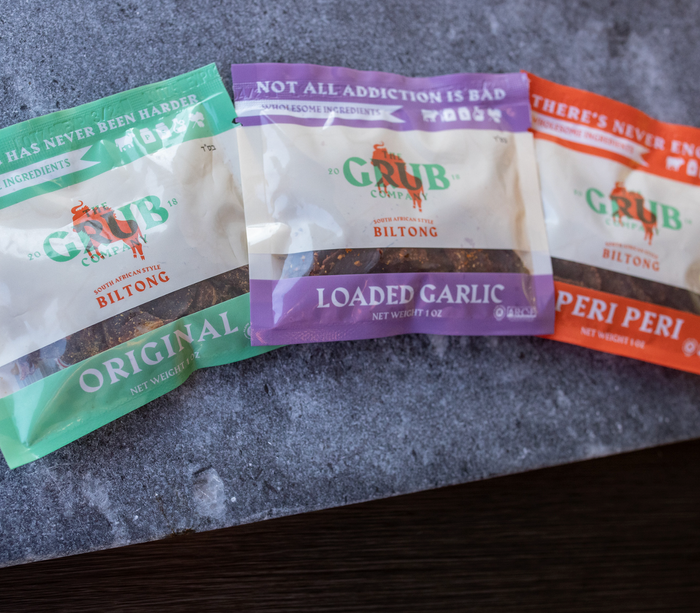
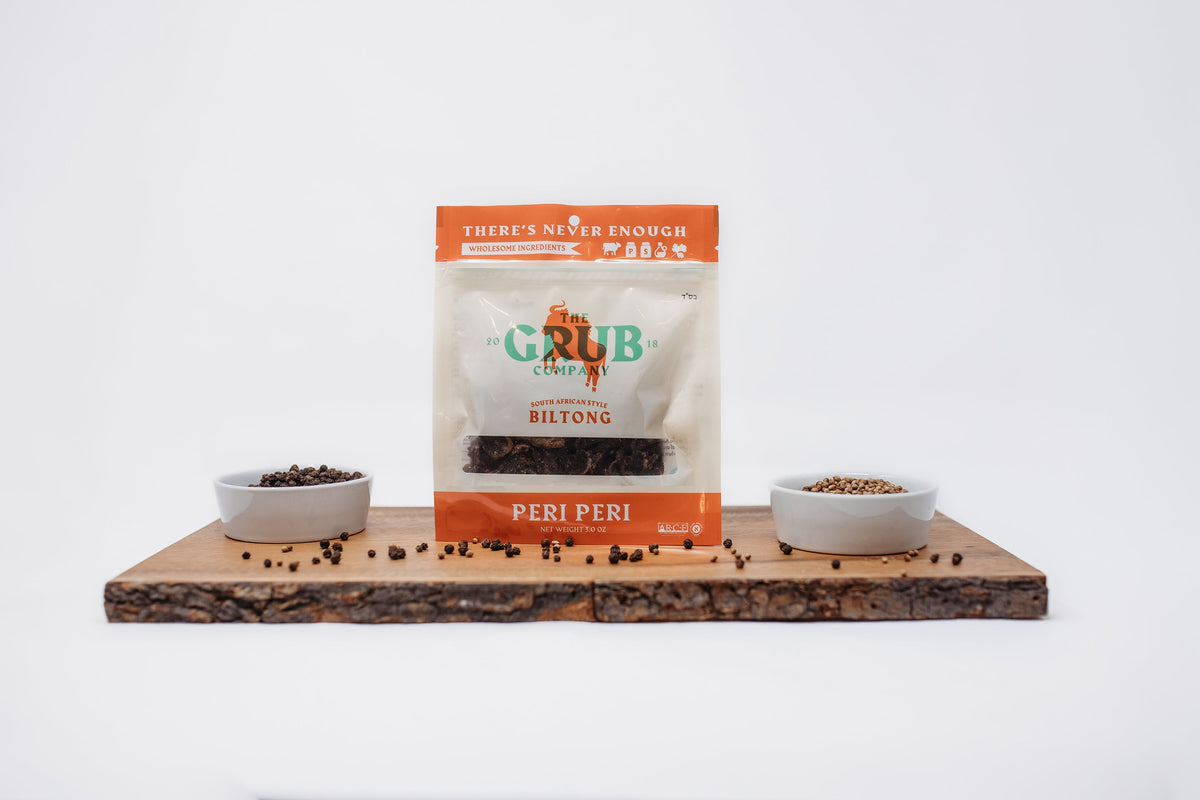
Where to get it: Glatt Kosher biltong for sale, made in Florida and shipped anywhere in the US (free over $50).
What air-drying is not
Three things get called drying and only one of them is this.
| Method | Temperature | Time | What happens to the protein |
|---|---|---|---|
| Air-drying | Room temperature | Days to weeks | Nothing cooks. Structure stays intact; water leaves |
| Dehydrating | ~135–160°F | 4–12 hours | Proteins begin to set. Texture tightens |
| Smoking / cooking | 160°F+ | Hours | Fully cooked. Fibers contract and toughen |
A dehydrator at 155°F is not a slow air-dryer. It is a low oven. The meat that comes out of it is cooked meat with the water removed, and it eats like it — short, tight fibers that resist rather than yield. That is jerky, and it is a perfectly good food; it is simply not the same food.
The test is not temperature on a label. It is time. Anything finished in a working day was heated. Biltong takes days because nothing is pushing the water out except air.
What is physically happening
Water leaves meat in two stages, and the whole craft is in managing the handoff between them.
Stage one: the surface. Water evaporates off the outside into the passing air. Fast, and it depends entirely on how dry and how fast that air is.
Stage two: migration. Water from deeper inside travels outward to replace what left. Slow, and its speed is set by the meat itself — the cut, the thickness, the grain.
Get those two in balance and the piece dries evenly all the way through. Let stage one outrun stage two and you get case hardening: the outside dries into a shell that the inner water cannot cross. The piece looks finished. Inside it is still wet, and that trapped water is where mold starts a week later, in a bag, in someone's cupboard.
This is the single most common failure in home drying and the reason commercial makers control humidity rather than just blowing air.
The four variables in a drying room
| Variable | Too little | Too much | Roughly where you want it |
|---|---|---|---|
| Airflow | Stagnant air saturates; mold | Case hardening | Steady and gentle, over every surface |
| Humidity | Outside dries too fast | Water will not leave; mold | Low, and stable |
| Temperature | Drying stalls | You are cooking | Cool room, no heat source |
| Spacing | — | Touching pieces trap moisture and mold at the contact point | Nothing touching anything |
Humidity is the one people underestimate. Drying is a competition between the meat and the air over who holds the water. In a humid room the air is already carrying what it can hold, so the meat keeps its moisture, water activity never drops far enough, and mold arrives before dryness does. That is why the same recipe behaves completely differently in Arizona and in Florida.
Why it has to be slow
Three reasons, and they compound.
Even drying. Slow gives stage two time to keep up with stage one. No shell, no wet core.
Texture. Heat makes muscle fibers contract and toughen. Removing water at room temperature leaves the fiber structure essentially as it was, just with less water between the strands — which is why properly air-dried biltong pulls apart into soft threads instead of fighting back.
Flavor concentration. Over days, the spice on the surface works inward and the beef flavor concentrates as the water goes. Do it in six hours and the spice sits on the outside like a coating.
How a maker knows it is done
Not by time. Time is the worst indicator, because thickness, humidity and airflow all swamp any schedule.
| Method | What it tells you | Reliability |
|---|---|---|
| Water activity meter | How much water is actually available to bacteria | The real answer. What commercial makers use |
| Weight loss | 50% ≈ wet · 55–60% ≈ medium · 65%+ ≈ dry | Good proxy. Requires weighing before hanging |
| Squeeze | Firm with slight give | Works with experience |
| Bend | Yields, does not snap or flop | Rough but useful |
| Cutting one open | Firm dark edge, deeper red center, not glistening | Definitive, destroys a piece |
| Elapsed days | Almost nothing | Do not rely on it |
Water activity, not moisture percentage, is the number that matters. Two pieces can hold identical amounts of water and behave completely differently depending on how tightly that water is bound up in proteins and salt. Only the free water feeds bacteria. This is the entire scientific basis of the method, and it is why "how moist is it" is the wrong question.
The drying room itself
Everything above happens inside a space that is doing one job: holding air at a state where it will accept water from meat, steadily, for days.
That is harder than it sounds, because the air changes as it works. Air passing over wet meat picks up moisture. If it is not replaced, the space saturates, drying stalls, and what you have is a warm damp box full of hanging protein — which is a mold incubator rather than a drying room. So the room needs air moving through it, not merely moving around inside it.
| Element | What it does | What goes wrong without it |
|---|---|---|
| Intake and exhaust | Replaces moisture-laden air with drier air | The space saturates; drying stops |
| Circulation | Moves air over every surface, not just the front row | Pieces at the back stay wet and mold |
| Humidity control | Keeps the air able to accept water | Weather decides your product |
| Spacing and hooks | Nothing touches anything | Contact points stay wet and mold from the inside out |
| No heat source | Keeps it curing rather than cooking | You have made jerky |
| Darkness | Light accelerates fat oxidation | Rancidity before dryness |
A home drying box is a scaled-down version of exactly this: a cabinet, hooks, a small fan, vents low and high, and a low-wattage bulb whose job is gentle convection rather than warmth. It works for the same reasons and fails for the same reasons.
Why humidity beats every other variable
If you change one thing about a drying environment, change the humidity.
Drying is a competition between the meat and the air over who holds the water, and the air's capacity is finite. In a dry room the air is thirsty and pulls moisture steadily out of the meat. In a humid room the air is already carrying close to what it can hold, so very little leaves the meat at all — water activity never falls far enough, and mold arrives before dryness does.
This is why the same recipe behaves completely differently in different places, and why makers in humid climates run dehumidifiers rather than bigger fans. More airflow through saturated air does not help much; you are pushing wet air past wet meat.
It also explains something consumers notice. An opened bag in an air-conditioned house stays good for three or four days. The same bag in a humid room in August is a one- or two-day proposition, because biltong is hygroscopic — it will pull moisture back out of humid air, raising its own water activity, undoing part of what the drying room achieved.
Thickness, and why it decides the schedule
Nothing affects drying time as much as how thick the piece is, and the relationship is not linear.
Water in the center of a thick piece has further to travel to reach the surface, and the path is through meat rather than air. Double the thickness and you more than double the time, because you have both increased the distance and reduced the surface-to-volume ratio that drives evaporation.
| Piece | Rough drying time | Character |
|---|---|---|
| Thin strips (~1 cm) | 2–4 days | Dries evenly and fast; easy to over-dry |
| Standard strips (2–3 cm) | 4–7 days | The usual commercial target |
| Thick slabs (4 cm+) | 1–2 weeks | Best gradient and keeping; highest case-hardening risk |
Those are ranges rather than schedules, and that is the point. Humidity, airflow and the cut itself shift them enough that time is the worst possible way to judge doneness. A thick piece in a humid week and a thin piece in a dry one can be days apart and still both be right.
Why the vinegar comes first
Air-drying has one genuine weak point: the beginning.
In the first hours the meat is freshly cut, at room temperature, full of available water, and nothing has dried yet. That window is when a problem would establish itself. Heat-based methods get through it by cooking. Air-drying cannot, so it uses acid instead.
The vinegar wash drops the surface pH exactly when the surface is most exposed, buying the slow barriers — salt, then falling water activity — the days they need. It is the reason this method worked in a hot country with no refrigeration, and it is unique to biltong among the world's dried meats.
Salt and vinegar are not seasonings here
Air-drying only works because two other things are doing structural work alongside it, and both are usually mistaken for flavoring.
Salt starts the drying before the meat is hung. Applied to a wet surface it draws water out by osmosis over the following hours — so a piece going into the drying room has already lost moisture and already has a salt concentration hostile to bacteria. Skip or skimp on it and the air has to do all the work from a wetter starting point, in a piece with no chemical defense.
Vinegar covers the opening hours, which is when a no-heat method is genuinely exposed. It is the only step in the sequence that acts immediately.
Put the three together and you can see why the order is fixed: acid for the first hours, salt for the first day, water activity for everything after. Each barrier hands off to the next. Remove one and there is a window where nothing is holding the line.
How air-drying shapes flavor, not just safety
Everything so far has been about making meat safe. The reason anyone bothers is that the same slowness makes it taste better, in three specific ways.
Concentration. Everything dissolved in the meat's water becomes more concentrated as the water leaves. An ounce of finished biltong represents two to three ounces of beef, and it tastes like it — this is the difference people notice first and attribute vaguely to "quality".
Spice migration. Over days, salt and surface spices work slowly inward. In a six-hour process there is no time for this: the spice sits on the outside as a coating, and the interior tastes of plain dried meat. In a week-long dry, the coriander is in the piece rather than on it.
Enzymatic change. Meat's own enzymes stay active at room temperature and keep working through the drying period, breaking some proteins into smaller fragments — including compounds that read as savory depth. Heat shuts this down almost immediately. It is a large part of why long-cured meats taste more complex than quickly dried ones, and why biltong has a depth that a dehydrator cannot reproduce at any temperature.
That last point is the honest answer to "why can't I just make this faster." You can remove the water faster. You cannot make the days pass faster, and some of what you are paying for only happens during them.
What the finished piece should look like
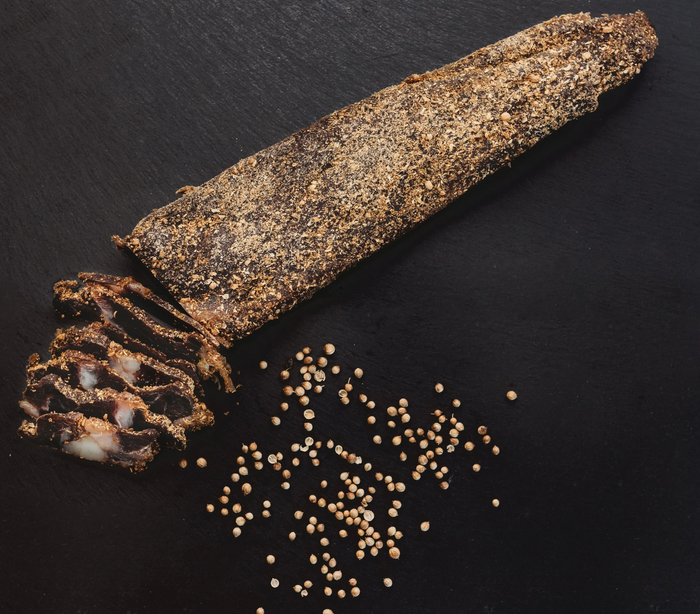
- A color gradient across the cut face. Darker, firmer rim; deeper red, softer center. That gradient is the record of slow drying. A uniform cross-section means heat, or over-drying.
- Deep red-brown, not gray. Gray suggests poor airflow or meat that was not fresh going in.
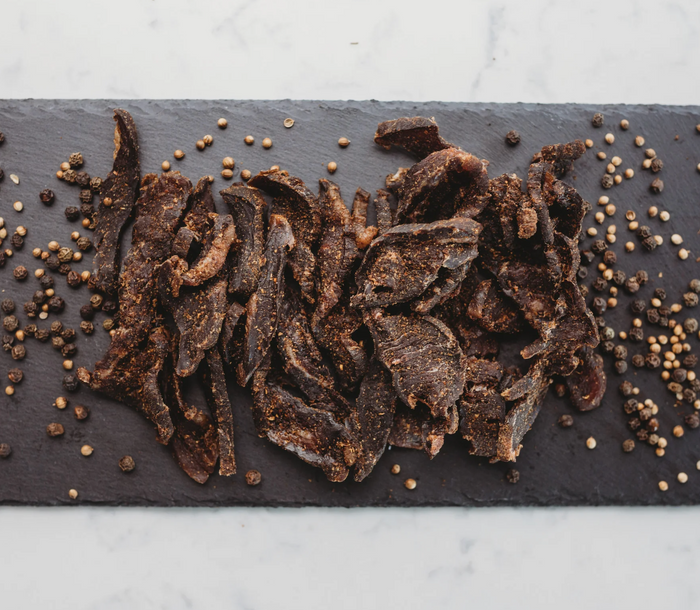
- Cracked spice still visible on the surface, some loose in the bag. Powder-coated means the coriander was ground, not cracked.
- It bends and yields. It should not snap like a cracker or feel damp.
- It shreds along the grain when you chew. Tearing across the grain like jerky means it was cut and dried the jerky way.
What goes wrong in a drying room
Six failure modes account for essentially everything, and each has a visible signature. If you make your own, this is your diagnostic list. If you buy, it is why the maker matters.
| Failure | What you see | Cause | Fix |
|---|---|---|---|
| Case hardening | Hard shell, damp interior; mold days later in the bag | Surface dried far faster than water could migrate out | Slow the airflow, raise humidity slightly, cut thinner |
| Surface mold | Raised fuzzy growth, white to blue-green | Humidity too high, or pieces touching | More air exchange, more spacing, more vinegar |
| Rancidity | Paint or crayon smell | Fat oxidized over days of air and light exposure | Trim harder; keep the space dark |
| Uneven batch | Some pieces done, others wet | Dead spots in the airflow; crowding | Circulation, and rotate positions |
| Gray color | Dull gray rather than red-brown | Poor airflow, or meat that was not fresh going in | Better circulation; better beef |
| Too salty | Salt dominates everything | Salt left on too long, or not brushed off | Shorter salt phase; brush thoroughly |
Notice that four of the six are airflow or humidity problems, not recipe problems. People new to this reliably tune the spice blend when the thing that needs attention is the room.
Why so few producers do it this way
Air-drying is not a secret. Any competent food producer could do it. Very few choose to, and the reasons are entirely commercial.
A jerky line turns raw beef into finished, packed product inside a shift. The same floor space runs a batch a day, five days a week. An air-drying room holds one batch for a week or more, and during that week it produces nothing else. Before you account for anything else, the biltong maker is turning over their production space a fraction as often — and paying rent on it the whole time.
Then the yield. Two to three pounds of raw beef per finished pound, against a jerky process that dries less far and adds marinade weight back as sellable product.
Then the control. Humidity management is equipment and monitoring that a dehydrator does not need, and a batch that goes wrong on day five is a week of space and a week of beef, not an afternoon.
Put together, that is why the shelf is dominated by heat-dried product, why air-dried costs more, and why anyone selling air-dried meat far below the category floor has changed something upstream. The economics do not bend.
What air-drying costs, and why the price follows
Every advantage on this page is bought with time and space, and both show up in what you pay.
| Air-dried biltong | Heat-dried jerky | |
|---|---|---|
| Time per batch | Days to two weeks | Under a day |
| Floor space tied up | The whole batch, the whole time | Hours |
| Equipment | Controlled room: airflow + humidity | Dehydrator or smoker |
| Yield | 2–3 lb of beef per 1 lb finished | Less loss; marinade adds weight back |
| Batches per month | Few | Many |
That yield line is the one to remember. It takes two to three pounds of raw beef to make one pound of biltong, and no process change gets around it. Anyone selling far below the category floor has changed an input — a cheaper cut, a shorter dry leaving water weight you are paying for, or sugar to carry a weaker product.
Air-dried across the world's cured meats
Biltong is not unusual in being air-dried. It is unusual in how it gets there.
| Biltong | Bresaola | Prosciutto | Jerky | |
|---|---|---|---|---|
| Heat applied | None | None | None | Yes |
| Acid step | Vinegar | Wine | None | None |
| Salt cure | Yes | Yes | Yes | In the marinade |
| Drying time | Days to 2 weeks | 1–3 months | 12–36 months | Hours |
| Nitrates | Not required | Usually | Usually | Usually |
| Cut relative to grain | With, then sliced across | Whole muscle | Whole leg | Against |
| Eaten as | Snack, by the handful | Plated, thin slices | Plated, thin slices | Snack |
Two rows deserve attention. Biltong is the only one with a vinegar step — the others rely on salt and time alone, or on wine, which is milder. And it is the only one that routinely needs no nitrates: the combination of an acid start and a fast, deep dry does chemically what the long-cure traditions achieve with curing salts.
The other thing that table shows is where biltong actually sits. It is a fast cure by the standards of European whole-muscle charcuterie and a very slow one by the standards of the snack aisle. It occupies a gap almost nothing else does — which is why it is genuinely hard to categorize on a shelf, and why it so often ends up mislabeled as jerky by people who have to put it somewhere.
Can you air-dry meat at home?
Yes, and the equipment list is short: a box, hooks, a small fan, vents low and high, and somewhere cool, dark and not humid. What it demands is not gear but patience and one habit.
Weigh the meat before you hang it. Weight loss is the only proxy for water activity available in a domestic kitchen, and without a starting number you are guessing. Aim for at least 50% loss for a wet style, 55–60% for medium, 65% and up for dry.
The three failures that account for nearly all bad homemade biltong are all environmental rather than culinary: the wrong cut (too much fat), a humid room (the air will not accept the water), and stopping too early (the outside looks done long before the inside is). None of them is a recipe problem, which is why people who keep tweaking their spice blend keep getting the same result.
One more thing worth knowing: kitchens are usually the most humid room in a house, which makes them the worst place to dry meat. A spare room, a garage or a cupboard away from cooking will do better than the place with the counter space.
The full home method, step by step →
Reading a label for it
Good signs: "air-dried", "hung", "cured", a drying time stated in days, vinegar mentioned, coriander in the spice list, an oxygen absorber in the bag.
Warning signs: "dehydrated", "slow-cooked", "smoked", a time in hours, no process described anywhere, sugar high in the ingredients, nitrates or nitrites.
That last one is quietly informative. Properly air-dried meat does not need nitrites — falling water activity does the preserving. Their presence on a biltong label is a question about whether the drying went far enough.
What air-drying means after you buy it
The method does not stop mattering when the meat leaves the drying room. Three consequences follow you home.
It is hygroscopic — it will take water back. A piece dried to a stable water activity is stable only relative to the air around it. Open the bag in a humid room and the meat starts pulling moisture out of the air, raising its own water activity, partially undoing the drying. This is why an opened bag lasts three or four days in an air-conditioned house and one or two in a humid one, and why "how long does it keep" has no single answer.
The seal and the sachet are doing real work. Unopened, biltong sits behind two barriers: a sealed bag that keeps ambient humidity out, and an oxygen absorber that removes the oxygen mold would need even if moisture did creep up. Both disappear the moment you open it, which is the whole reason the numbers change so sharply from months to days.
It keeps drying, and that is not spoilage. Left open, biltong simply continues what the drying room started — it gets firmer and more intense, indefinitely. Some people do this deliberately. Hard biltong is safe; only fuzzy, tacky or off-smelling biltong is not.
Put practically: press the air out when you reseal, refrigerate if your house is humid or you will not finish it within a couple of days, and judge a piece by smell and surface rather than by how hard it has become.
How to tell air-dried from heat-dried in front of you
You do not need the label. The two processes leave different physical evidence.
| Test | Air-dried | Heat-dried |
|---|---|---|
| The cut face | Visible gradient — dark firm rim, lighter softer center | Uniform color all the way through |
| How it comes apart | Shreds into strands along the grain | Tears across, in short pieces |
| Resistance | Yields, then separates | Resists, then gives way at once |
| Surface | Matte, cracked spice visible | Often slightly glossy from a glaze |
| The bend | Bends and yields | Snaps, or flexes like leather |
| Aroma | Beef, vinegar, coriander | Smoke and sweetness |
| Finish | Tastes of beef last | Tastes of glaze last |
The cut face is the single most reliable of these, and it is the hardest to fake. That gradient is a physical record of water having left slowly, from the outside inward, over days. A process that finishes in six hours cannot produce it — there was never a period during which the outside was substantially drier than the inside for long enough to leave a mark.
Quick answers
Does air-dried mean raw? No. It means cured rather than cooked. Acid, salt and low water activity make it safe — the same barriers that make prosciutto safe.
Can I air-dry meat at home? Yes, in a box with a fan and low humidity. Weigh before hanging and aim for at least 50% weight loss. The full home method is here.
Is a dehydrator air-drying? Only on a fan-only setting with no heat. At normal dehydrator temperatures you are cooking.
Why is air-dried more expensive? Days of controlled space per batch, and two to three pounds of beef per finished pound.
Does it keep as well as cooked jerky? Sealed with an oxygen absorber, three to six months — comparable. It gets there through low water activity rather than preservatives.
Why is the middle softer? Because it dried from the outside in, slowly. That gradient is the evidence the method was followed.
The complete guide to biltong → · Taste what days of drying does →