Grub Biltong Ingredients: Every Flavor Listed and Compared
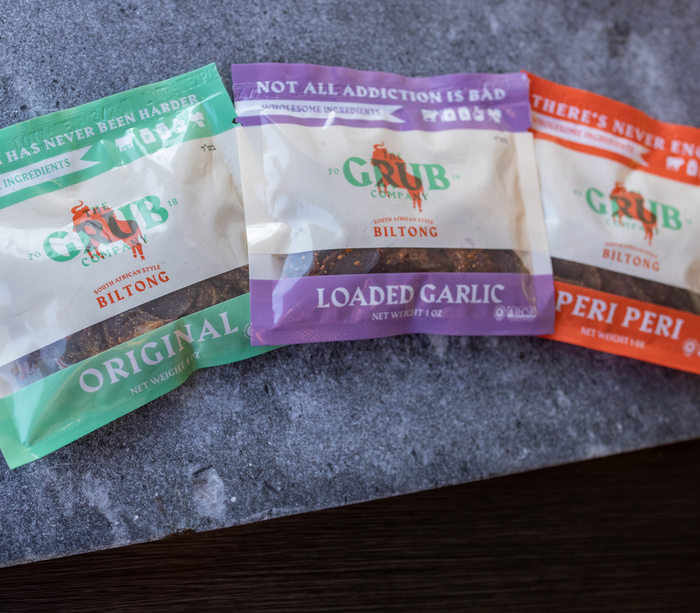
Grub Biltong comes in three flavors, and the full ingredient list for each one is: Original, grass-fed kosher beef, coriander, black pepper, salt, garlic, vinegar, Peri Peri, grass-fed kosher beef, coriander, red pepper, black pepper, salt, garlic, vinegar, brown sugar, Loaded Garlic, grass-fed kosher beef, coriander, garlic, roasted garlic, salt, tomato powder, vinegar. All three are air-dried in small batches in Florida, certified Glatt Kosher by Harav Weissmandl. All three contain no MSG, no preservatives, and no nitrates or nitrites.
At a glance
- Peri Peri is the only Grub biltong flavor with added sugar. Original and Loaded Garlic have none.
- Loaded Garlic is the only flavor with tomato powder, and the only one without black pepper.
- Coriander appears in all three flavors and is coriander seed, not leaf.
- All three flavors share the same grass-fed kosher beef base and air-dried process.
- The Sampler Pack contains one mini bag of each flavor, the practical way to compare all three before committing to a larger size.
The Full Ingredient Lists, Side by Side
All three flavors start from the same foundation: grass-fed kosher beef, coriander, salt, garlic, and vinegar. What separates them is a small number of additions or swaps that shift the flavor profile entirely. Here is each list in full, as Grub lists it on the product page.
Original
- Grass-fed kosher beef
- Coriander
- Black pepper
- Salt
- Garlic
- Vinegar
Peri Peri
- Grass-fed kosher beef
- Coriander
- Red pepper
- Black pepper
- Salt
- Garlic
- Vinegar
- Brown sugar
Loaded Garlic
- Grass-fed kosher beef
- Coriander
- Garlic
- Roasted garlic
- Salt
- Tomato powder
- Vinegar
A few things stand out when you put the three lists next to each other. Peri Peri is the only flavor with added sugar. That one ingredient, brown sugar, makes it the outlier across the whole lineup. It also adds red pepper, which brings actual heat that the other two flavors do not have.
Loaded Garlic drops black pepper entirely. In its place, you get garlic twice: raw garlic and roasted garlic together, plus tomato powder. That combination does a lot of work without any heat or sweetness. If you notice tomato powder on that list and it matters to you for dietary reasons, hold that thought. The next section covers exactly why it matters.
Original is the shortest list of the three. Six ingredients, nothing added for heat or sweetness, nothing doubled up. Its one addition to the base five is black pepper. That makes it the most stripped-down version of the recipe.

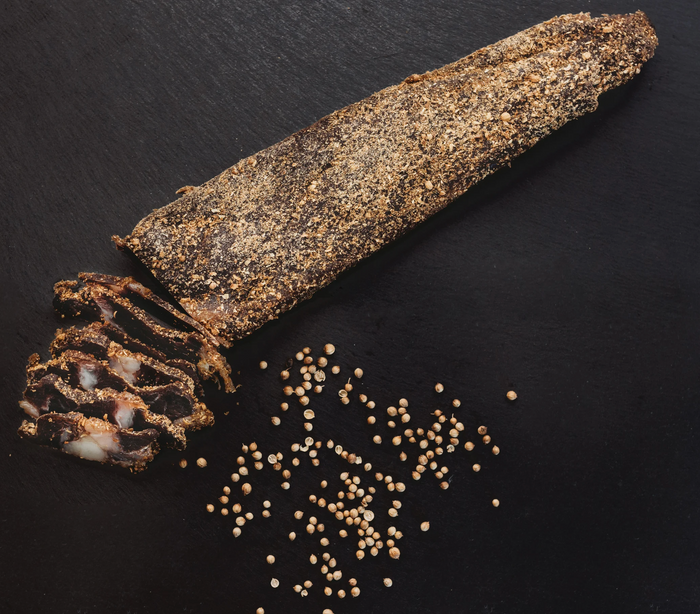
One ingredient all three share is worth naming: the coriander. In biltong, coriander means coriander seed. The coriander in Grub biltong is coriander seed. Coriander seed is a traditional biltong spice, and that distinction matters if you are tracking seed spices for any reason.
None of the three flavors contain MSG, preservatives, nitrates, or nitrites. The beef is air-dried in small batches in Florida, never cooked. Vinegar and salt do the curing work. That is the process for all three, regardless of which flavor you pick.
All three flavors are certified Glatt Kosher. You can see the full biltong range and its available sizes and formats in one place if you want to compare packaging before choosing a flavor. For households that require certified Glatt Kosher meat snacks, our kosher biltong page has more.
What the Differences Actually Mean for How Each Flavor Tastes
Reading an ingredient list tells you what is in the bag. It does not tell you what each ingredient actually does when you eat it. Here is what each difference means in practice.
Original is the most beef-forward of the three. The coriander seed adds a warm, faintly citrusy note, the classic South African biltong spice. Black pepper gives a mild background heat, but it is background, not front-of-mouth. Salt and vinegar do the curing work. No sweetness anywhere. What you taste first is the beef, and the spices exist to frame it, not compete with it.
Peri Peri is where the lineup gets its heat. Red pepper is the ingredient doing that. Brown sugar is also in the Peri Peri blend, which makes it the only Grub biltong flavor with added sugar, and that sugar is not incidental. It rounds the edges of the red pepper's heat so the flavor lands as a building warmth rather than a sharp punch. This is not sweet biltong in the way that glazed jerky is sweet. Think of the sugar as a backdrop that keeps the heat from coming across as raw or one-dimensional. Original and Loaded Garlic have no added sugar at all, so if you are comparing flavors side by side, Peri Peri registers as the most complex and the most different from the other two.

Loaded Garlic goes in a completely different direction. Instead of heat or sweetness, it doubles down on savory depth. The ingredient list carries both garlic and roasted garlic, which matters because roasted garlic tastes genuinely different from raw or dried garlic. Raw garlic is sharp and bright. Roasted garlic is mellow, slightly sweet on its own, and earthy. Putting both in the same blend produces a layered garlic flavor that is more developed than just a garlic-dusted piece of meat. There is no black pepper in Loaded Garlic, which is worth flagging even from a pure flavor standpoint: the absence of pepper makes the garlic and tomato powder cleaner on the palate. Tomato powder is subtle at this level of use, but it adds a faint savory umami note that the other two flavors do not have.
If you are tasting all three together, a natural order exists. Start with Original to get your baseline. Move to Loaded Garlic for savory contrast without heat. Finish with Peri Peri, because the heat is the last thing you want clearing your palate. The Biltong Sampler Pack makes that easy, with one mini bag of each flavor.
How the Ingredient Lists Map to Common Dietary Filters
The ingredient differences between the three flavors matter most when you are eating to a protocol. Knowing what each list contains gets you most of the way there, but a few details are worth spelling out because they are not obvious at a glance.
The Autoimmune Protocol, or AIP, is the dietary filter where the ingredient lists diverge the most sharply. AIP has two phases: an elimination phase where a long list of foods comes out entirely, and a structured reintroduction where foods return in a specific order, starting with the least inflammatory and ending with the most.
In the AIP elimination phase, four ingredients across the Grub lineup get removed:
- Black pepper is eliminated on AIP Phase 1. That removes it from Original and Peri Peri, both of which list it. Loaded Garlic contains no black pepper, so it clears that particular hurdle.
- Coriander seed is a seed spice, and seed spices are eliminated in AIP Phase 1. All three flavors contain coriander. That means no Grub biltong flavor is fully AIP Phase 1 compliant based on coriander alone.
- Red pepper is a nightshade, and nightshades are eliminated on AIP. Red pepper appears in Peri Peri and nowhere else. That rules Peri Peri out during the elimination phase on three counts: the red pepper, the black pepper and the coriander seed.
- Tomato powder is also a nightshade. It appears only in Loaded Garlic. This is the one that surprises people. Loaded Garlic has no black pepper and no red pepper, so it looks clean at first. But tomato powder is a nightshade elimination ingredient, and it is right there in the list.
Garlic and salt are both allowed on AIP, so those ingredients do not create problems for any flavor.
One honest caveat here: the AIP status of vinegar and brown sugar is not something we can confirm. Vinegar is in all three flavors and brown sugar is in Peri Peri, so if you are following AIP closely, check the current guidance from a source you trust before drawing a conclusion about either one.
AIP reintroduction brings foods back in stages, not all at once. Black pepper and seed spices return in Stage 1, which is the first stage of reintroduction. Nightshades, including tomato powder and red pepper, come back last.
That means the order for Grub's flavors maps onto AIP reintroduction like this: Original contains black pepper and coriander seed, both of which are reintroduced in Stage 1 of AIP reintroduction. Loaded Garlic has no black pepper, but it does include tomato powder, a nightshade. Peri Peri has red pepper, a nightshade, as well as black pepper.
For people who are not doing AIP but are watching added sugar, the filter is simpler. Peri Peri is the only flavor with brown sugar. Original and Loaded Garlic both contain no added sugar.
Looking at the ingredient lists, Original is the only flavor that contains no nightshade ingredients. Peri Peri has red pepper. Loaded Garlic has tomato powder. Neither of those is obvious from the flavor name alone, which is exactly why the full ingredient lists are worth reading before you order.

What the Kosher Certification Covers, and What It Does Not
The Glatt Kosher certification by Harav Weissmandl certifies the biltong's kosher status. That is what the certification covers. Reading it as a nutritional audit or an ingredient verification is a different thing entirely, and it is not what the cert is for.
What the certification says nothing about is whether brown sugar appears in a given flavor, or whether a spice qualifies under a particular dietary protocol. Those are questions the ingredient lists answer, not the certification.
So here is how to read the two things in parallel:
- Kosher status: All three flavors are certified Glatt Kosher. That holds for every Grub biltong flavor.
- Ingredient claims: These come from the ingredient lists on the product pages. No flavor contains MSG, preservatives, nitrates, or nitrites. Original and Loaded Garlic contain no added sugar. Peri Peri does contain brown sugar.
None of those ingredient facts are things the kosher certification established. They are established by what is actually in the product. The cert and the ingredient list are doing two different jobs.
One practical consequence: if you are buying for a kosher household, the certification is the thing to look at. If you are buying because you want no added sugar, or no nightshades, or no black pepper, the ingredient list is the thing to look at. You need both, and neither one substitutes for the other.
No flavor contains nitrates, nitrites or preservatives, and the biltong is air-dried, never cooked.
Choosing a Flavor (and Why the Sampler Pack Exists)
So you have three flavors, you know exactly what's in each one, and the question is just which bag to open first. Here is a practical way to think about it.
Original is the place to start if you have never had biltong before. The ingredient list is the shortest, the flavor is the most beef-forward, and nothing in it will surprise you. No heat, no sweetness, no roasted depth, just salt, coriander, black pepper, garlic, and vinegar doing what they do on good grass-fed beef. If you want to understand what biltong actually tastes like before you layer anything on top of it, this is the one.
Peri Peri is for the person who wants heat and does not mind a little sweetness working underneath it. The red pepper gives the only real heat in the lineup. The brown sugar does not make it candy. It rounds out the spice rather than sitting in front of it. If you already know you like spicy meat snacks, Peri Peri is an easy reach. What it is not: a subtle flavor. It is the most assertive of the three, and that is the point.
Loaded Garlic is the one that surprises people. It has no black pepper and no heat, but the combination of coriander, garlic, and roasted garlic gives it a depth that the other two do not have. There is no added sugar. The tomato powder is quiet in the finished product but it is there, which matters if you are watching nightshades. For anyone who wants a savory, full-flavored bite without any spice or sweetness, Loaded Garlic is the answer.
The honest caveat on all three: biltong is a texture as much as a flavor, and people are often surprised by it the first time. The flavor choice matters, but so does the format.
That is exactly why the Biltong Sampler Pack exists. It contains one mini bag of each flavor, Original, Peri Peri, and Loaded Garlic, so you can try the whole range before committing to a larger format. If you are deciding between a three-ounce bag and a full pound, the sampler is the right first order. You can read more about how to approach it in our guide on choosing the right biltong sampler pack for beginners.
Bottom Line
The ingredient lists for all three Grub biltong flavors are short and specific enough that one glance tells you what you need to know. If you want the cleanest, most beef-forward option with no added sugar and no surprises, that is Original. If you want heat, Peri Peri is the only flavor that has it, and you are also getting brown sugar as part of that blend. If you want savory depth without any heat or sweetness, Loaded Garlic is the one, though the tomato powder matters if nightshades are on your watch list. When you are not sure which direction to go, the Biltong Sampler Pack puts one mini bag of each in your hands at once. That is the practical way to decide.
Still deciding? These are the questions people ask most before placing their first order.
Frequently Asked Questions
What are the ingredients in each Grub Biltong flavor?
Original contains grass-fed kosher beef, coriander, black pepper, salt, garlic, and vinegar. Peri Peri contains grass-fed kosher beef, coriander, red pepper, black pepper, salt, garlic, vinegar, and brown sugar. Loaded Garlic contains grass-fed kosher beef, coriander, garlic, roasted garlic, salt, tomato powder, and vinegar. All three are air-dried in small batches in Florida, certified Glatt Kosher by Harav Weissmandl, and contain no MSG, no preservatives, and no nitrates or nitrites.
Is there added sugar in any Grub Biltong flavor?
Yes, but only in one. Peri Peri is the only Grub biltong flavor with added sugar, in the form of brown sugar. Original has no added sugar. Loaded Garlic has no added sugar. If you are watching sugar intake or following a protocol that tracks it, Original and Loaded Garlic are the two flavors to choose from.
Does Loaded Garlic biltong contain black pepper?
No. Loaded Garlic is the only Grub biltong flavor with no black pepper. The heat and bite you would get from black pepper in Original and Peri Peri are simply absent here. What you get instead is a deeper, more savory garlic profile built from both garlic and roasted garlic. For anyone who avoids black pepper, Loaded Garlic is the one flavor in the lineup that does not include it.
What is the coriander in Grub Biltong, seed or leaf?
It is coriander seed. All three Grub biltong flavors use coriander seed, not coriander leaf. That is the traditional biltong spice, and it reads as warm and slightly citrusy rather than herbal. This matters for anyone following a dietary protocol that distinguishes between seed spices and leaf herbs, since seeds and leaves fall into different categories on protocols like AIP.
Which Grub Biltong flavor is the mildest?
Original is the most neutral and beef-forward of the three. It has no added sugar and only a mild background warmth from black pepper, so nothing competes with the flavor of the meat itself. Loaded Garlic is also mild in terms of heat but has a more assertive savory profile from the garlic and roasted garlic. Peri Peri is the only flavor with real heat, from the red pepper. If you are new to biltong and want a clean starting point, Original is the place to start.
Can I try all three flavors before buying a full bag?
Yes. The Biltong Sampler Pack includes one mini bag of each flavor, Original, Peri Peri, and Loaded Garlic, so you can taste all three before committing to a larger size. It is the right first order if you are unsure which flavor suits you, or if you want to compare them side by side.
Does the Glatt Kosher certification confirm what ingredients are used?
No. The Glatt Kosher certification by Harav Weissmandl certifies the biltong's kosher status. It is not a nutritional audit and does not verify individual ingredient claims like no MSG, no preservatives, or no nitrates. Those are separate facts you confirm by reading the ingredient lists directly. The certification and the ingredient lists are two different things, and both matter for different reasons.