Peri Peri and Beyond: What Spice Does to Biltong Besides Taste
A spice coating on biltong is a physical layer before it is a flavor. It sits on the wet surface of the meat before anything hangs, it changes how that surface dries, and it is still doing something to the piece weeks later in a sealed bag. Choosing peri peri over anything else is a decision about the piece, not only about the taste.
Related: Spicy Beef Jerky: How Hot Is Hot, and Where Peri Peri Biltong Fits
Where to get it: Glatt Kosher biltong for sale, made in Florida and shipped anywhere in the US (free over $50).
Most spice writing treats seasoning as a coat of paint applied to a finished object. On air dried meat it is nothing like that, because the spice goes on before the object is finished and then spends the entire drying process in contact with the part of the meat that is doing the most work. What follows is what that layer actually does.
When the spice goes on, and why the timing matters
The order of operations in biltong is fixed and it is not arbitrary. The meat is cut, it goes through a cure with salt, it gets a vinegar wash, and it is spiced while the surface is still damp. Then it hangs.
That damp surface is the whole reason the spice sticks at all. A dry piece of meat sheds spice. A wet one holds it, and as the surface dries over the following hours, the spice is effectively laminated on. What starts as a loose coating becomes part of the outer layer of the piece.
The consequence is that the spice is present for the entire dry rather than applied to the result of it. Every hour that the surface is losing water, it is losing it through a layer of ground seed and chili and salt, and that layer is not neutral about the process happening underneath it.
A coating is a partial barrier
Water leaving the meat has to get past the spice to reach the air. A coating slows that transit, in the same way that a light dusting of anything on a wet surface slows evaporation from it. The effect is modest rather than dramatic, and it is real.
A heavier, finer coating slows it more, because fine particles pack together and leave fewer gaps. A coarse coating slows it less, because there are open paths between the pieces. Two identical cuts, one heavily coated and one lightly coated, do not finish at exactly the same moment on the same rack.
That is one of the quiet reasons a maker does not simply pile on more seasoning to make a stronger flavor. Past a point you are no longer adjusting taste, you are adjusting the drying, and a coating heavy enough to genuinely slow the surface is a coating heavy enough to change what the piece becomes.
Grind size does two jobs at once
Particle size decides both how the spice behaves physically and how it reads on the tongue, and the two do not always point the same way.
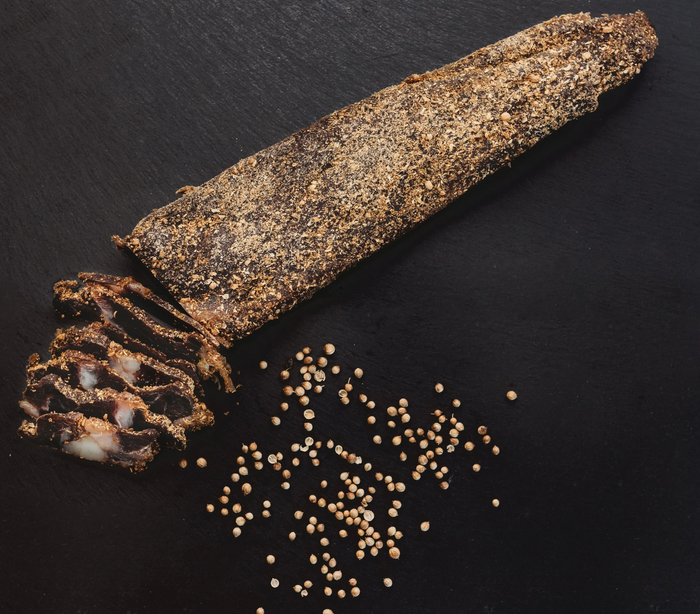
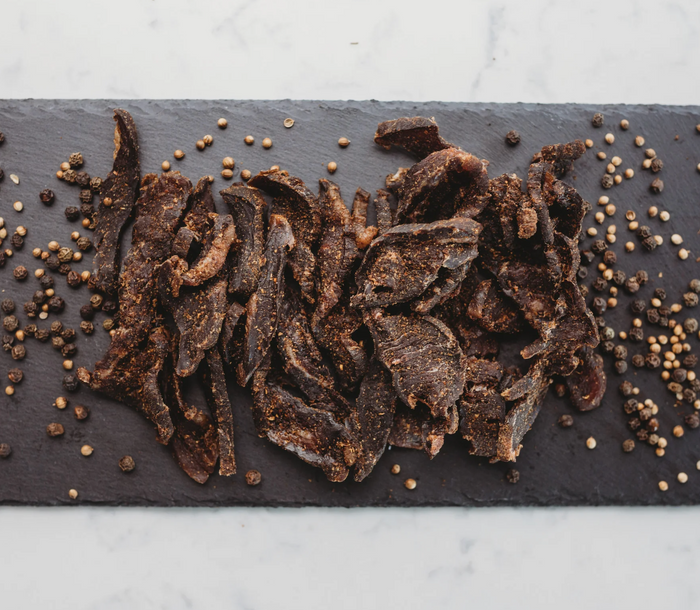
Coarse ground spice stays visible as distinct flecks on the finished piece. It gives intermittent bursts rather than a constant level, because you are hitting a fleck or you are not. Physically it leaves the surface more open, so it interferes least with drying, and it is the more forgiving choice on a thick cut that has a long time on the rack.
Fine ground spice mostly disappears into the surface color and gives a steady, even flavor across every bite. It packs tighter, so it slows the surface more, and it adheres better through handling. On a thin slice that finishes fast anyway, the drying penalty barely matters and the even coverage is worth having.
What comes loose in the bag, and why
Open a bag of well spiced biltong and you find loose spice at the bottom. That is not a fault and it is not carelessness. Meat shrinks as it dries, sometimes considerably, and the spice layer laminated onto its surface does not shrink with it.
Something has to give. Part of the coating cracks and releases, and it does that gradually, during drying, during packing and during whatever the bag goes through on the way to you. Coarse grinds shed more than fine ones because they had less contact area holding them on in the first place.
The practical version is that the last handful from a bag tastes different from the first, and there is a fix. Tip the loose spice back over the remaining pieces and shake, or use it. It is the same seasoning that was on the meat, and dropping it in the trash is throwing away a real part of what you paid for.
Chili is a different kind of ingredient
Coriander, pepper and salt behave broadly alike on a drying surface. Chili does not, and peri peri is the flavor where that shows most.
The compounds that carry chili heat are oil soluble rather than water soluble. They do not travel with the water leaving the meat, and they do not wash off the way a salty or sour taste can be rinsed away. Where they do move is into fat, which means a chili coating on a piece with fat seams behaves differently from the same coating on a lean piece.
Water solubility also explains a thing everyone has noticed while eating spicy dried meat. A drink of water moves the heat around rather than removing it, because the compounds carrying it will not dissolve in water. Fat and dairy actually take them up, which is why the traditional accompaniments to hot food are what they are.
Heat reads differently on a dry surface
Put the same amount of chili on a wet dish and on a dried piece of meat and the dried meat will feel hotter, for a reason that has nothing to do with quantity. A wet dish comes with its own water, which spreads and dilutes what is on it. A dried piece arrives with almost none.
What that means in the mouth is that the first contact is concentrated. There is no sauce carrying it, so the coating meets saliva directly and the heat builds as you chew rather than arriving all at once. Peri peri biltong tends to climb over the course of a piece and keep climbing for a moment after you swallow.
Thickness changes this as well. A thin slice is mostly surface, so a spiced coating is a large fraction of what you are eating and the heat reads high. A thick cut carries the same coating around far more unseasoned beef, so the heat reads lower even though nothing about the spice has changed. If peri peri is slightly too much for you, buying a slab and cutting thick is a genuine answer.
What spice does to the surface after drying
A spiced surface behaves differently in storage from a bare one. The layer is porous and it sits between the meat and the room, which makes it the first thing to respond to whatever the air is doing.
In dry conditions that is unremarkable. In humid conditions the spice layer takes on moisture before the meat does, which is why a bag that has been left open in a damp kitchen often looks dull and slightly darkened at the surface while the meat underneath is still firm. What you are seeing is the coating reacting, not the piece failing.
Ground spice also carries its own aromatic oils, and those fade with air and time like any aromatic does. A bag of heavily spiced biltong is at its most fragrant the moment it is opened, and that is a good argument for buying a size you will actually finish rather than the largest one available.
What spice does not do
Three things get attributed to a spice coating that it does not deliver, and being clear about them is more useful than another round of praise for coriander.
It does not preserve the meat. Salt, the acid from the vinegar wash and the removal of water do that. Some spices have mild antimicrobial properties in a laboratory sense, and none of that is what is keeping a piece of biltong stable on a shelf. Nobody should choose a flavor for that reason.
It does not hide a poor dry. A hard case hardened shell with a wet line behind it tastes exactly like what it is under any coating you put on it, and a piece that spent too long damp before drying started carries a flat note that chili cannot cover. Strong seasoning changes the first impression and it does not change the piece.
It also does not make a piece last longer once opened. That is decided by moisture, air and where you keep the bag, and a peri peri bag and an unspiced bag left open on the same counter will behave the same way.
Choosing a flavor by the occasion
Most people pick a flavor by asking what they like, and that is the right question for a bag they will eat alone. It is the wrong question surprisingly often. Try asking what the piece has to do:
- A shared bowl with people whose taste you do not know wants the milder end of the range. One guest who cannot eat the heat leaves the whole bowl to everyone else.
- A gift wants a middle option unless you know the recipient well, because a strongly spiced bag is a confident guess about somebody else's palate.
- A board with cheese and pickles wants restraint, since it is already surrounded by strong flavors and does not need to compete.
- A long drive or a desk drawer is where heat works best, because you are eating slowly, alone, with nothing else in play.
- Anything going near children should be the mild option, and that is not a judgment about children so much as about how heat builds on a dry surface.
The general rule is that assertive spice suits solo, slow eating and mild spice suits shared, fast eating. Preference decides between two options that both fit the occasion. It is a poor way to choose between two occasions.
Matching the spice to the format
Because thickness changes intensity, flavor and format are one decision rather than two. A strong coating on Sliced Biltong Mini's at $4.99 is the most concentrated combination we sell, since those pieces are thin and almost entirely surface. That is either exactly what you want or considerably more than you bargained for.
Sliced Biltong at $11.99 sits in the middle and is the honest test of a flavor, because it is the format most people will actually eat day to day. If you like a flavor in this bag, you like the flavor.
Biltong Slabs at $58.00 give you the most control, since the same slab can be cut thin when you want the spice forward and thick when you want the beef to lead. A slab of something assertive is more versatile than a pre sliced bag of the same thing, and that is one of the better arguments for the format.
How to test without guessing
The Biltong Sampler Pack at $12.99 exists for this and it is the cheapest way to answer the question properly. Eat the options against each other over a couple of days rather than weeks apart, because palates drift and a flavor eaten in isolation always tastes like itself rather than like a comparison.
Pay attention to two separate things while you do it. First, which one you reach for again without deciding to, which tells you your preference. Second, which one you would be comfortable putting in front of six people you do not know, which tells you your default for buying.
Those two answers are frequently not the same, and knowing both is what stops a household from ending up with one flavor everybody tolerates and nobody chose.
Bottom line
Spice on biltong is a layer that goes on wet, dries into the surface, slows the water leaving through it, cracks as the meat shrinks and ends up loose at the bottom of the bag. Grind size sets both the flavor pattern and the drying behavior. Chili is oil soluble, so peri peri climbs as you chew and reads hotter on a thin piece than a thick one. Choose the mild end for shared bowls, gifts and boards, choose heat for eating alone and slowly, and use the Sampler Pack at $12.99 to answer the question with your own mouth.
Frequently Asked Questions
Does the spice on biltong do anything other than add flavor?
Quite a lot. It goes on while the surface is still damp from the vinegar wash, so it dries into the outer layer of the meat rather than sitting on top of a finished piece. While it is there it slows the water leaving through it, which means a heavily coated piece and a lightly coated one do not finish at the same moment on the same rack. It also cracks and sheds as the meat shrinks, which is where the loose spice at the bottom of a bag comes from.
Why is there loose spice at the bottom of the bag?
Because meat shrinks as it dries and the spice layer laminated onto its surface does not shrink with it. Something has to give, so part of the coating cracks and releases during drying, packing and transit. Coarse grinds shed more than fine ones, since they had less contact area holding them on. It is the same seasoning that was on the meat, so tip it back over the remaining pieces and shake rather than throwing it out. You paid for it.
Why does peri peri biltong taste hotter than the same heat in a cooked dish?
Because a dried piece brings almost no water of its own. A wet dish dilutes and spreads what is on it, while a dry surface meets saliva directly, so the heat builds as you chew and keeps building for a moment after you swallow. Thickness changes it too. A thin slice is mostly surface, so the coating is a large fraction of what you are eating. A thick cut carries the same coating around much more unseasoned beef and reads noticeably milder.
Does drinking water help with chili heat on biltong?
It moves it around more than it removes it. The compounds carrying chili heat are oil soluble rather than water soluble, so water cannot dissolve them and mostly redistributes them across your mouth. Fat and dairy take them up properly, which is why the traditional accompaniments to hot food are what they are. The same solubility is why a chili coating behaves differently on a piece with fat seams than on a lean piece, since the heat compounds travel into the fat.
Does spice help preserve biltong?
No, and nobody should choose a flavor on that basis. Salt, the acid from the vinegar wash and the removal of most of the water are what make a dried piece stable on a shelf. Some spices show mild antimicrobial behavior in a laboratory, and that is not what is doing the work in a bag of biltong. A spiced bag and a plainer one left open on the same counter behave the same way, because moisture, air and storage decide that rather than seasoning.
How should I choose a flavor for a party?
By what the bowl has to do rather than by what you like. A shared bowl with guests whose taste you do not know wants the milder end, because one person who cannot manage the heat leaves the whole bowl to everyone else. A board with cheese and pickles wants restraint, since it is already surrounded by strong flavors. Save the assertive options for slow solo eating, a long drive or a desk drawer, where nothing else is competing and you are in no hurry.
Which format shows a flavor best?
Sliced Biltong at $11.99 is the honest test, because it is the format most people actually eat day to day. Sliced Biltong Mini's at $4.99 are thin and almost entirely surface, so any coating reads at its most concentrated there, which is either exactly what you want or more than you expected. Biltong Slabs at $58.00 give the most control, since one slab can be cut thin when you want spice forward and thick when you want the beef to lead.
Can strong seasoning hide a badly dried piece?
It changes the first impression and nothing else. A case hardened piece with a rigid shell and a wet line behind it tastes exactly like what it is under any coating, and meat that spent too long damp before drying started carries a flat note that chili does not cover. If anything, a heavy coating makes a poorly dried piece more obvious once you are past the first bite, because the contrast between an assertive surface and a dull interior is easy to notice.