The Wet Middle Is the Point: A No-Apology Guide to Fat, Moisture, and Cure Depth in Slab Biltong
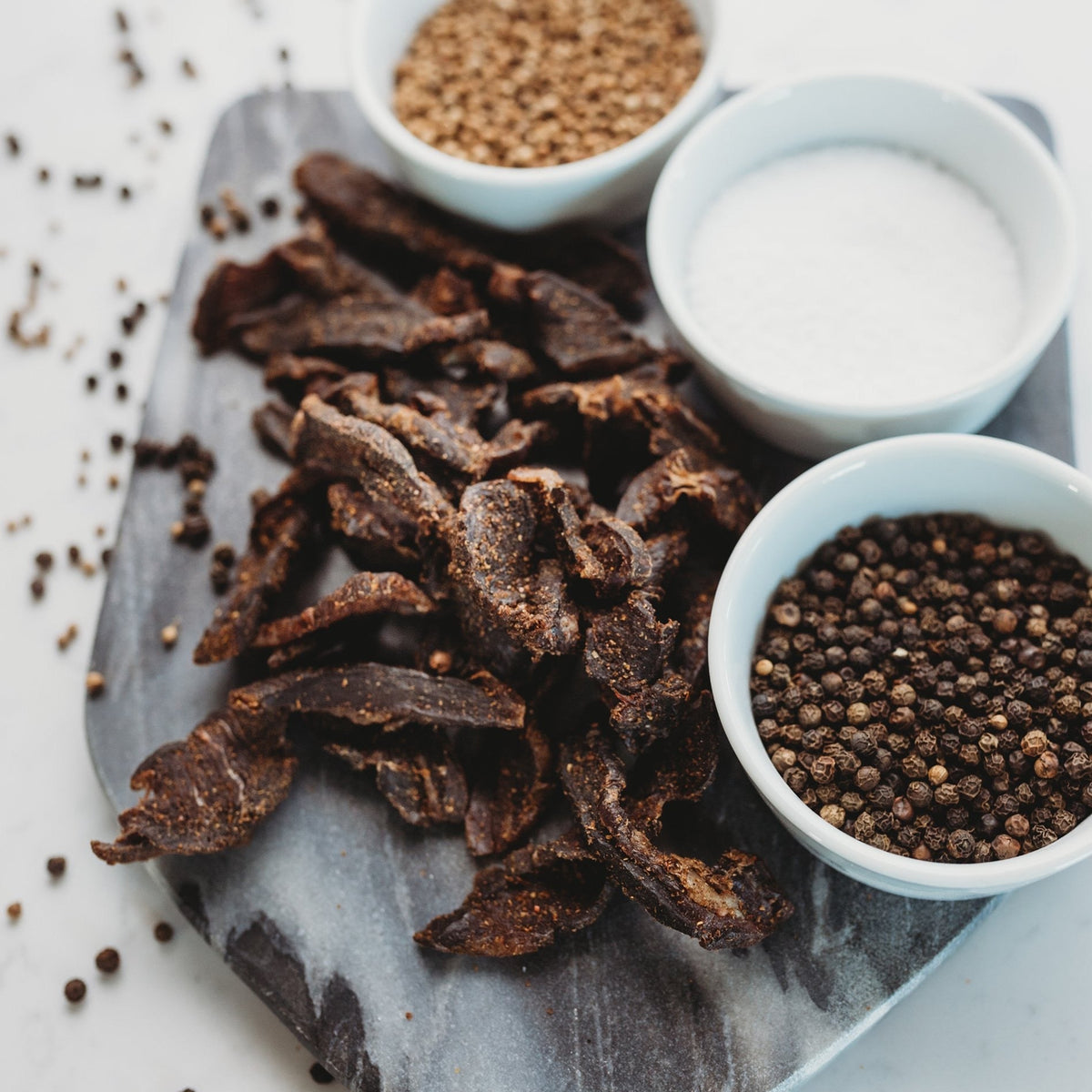
The wet middle in slab biltong is not underprocessing. It is the intended result of controlled cure depth. Salt and spice penetration follows a gradient: edges cure within days, but the center of a thick slab remains mildly cured and wet for weeks. The exterior crust forms a moisture and flavor barrier that keeps the interior wet without food safety compromise, provided slab thickness is matched to humidity and cure duration. A fully dry center would mean the texture gradient is gone. And so is the point.
Ready to try it? Buy Glatt Kosher biltong online. Made in Florida, free US shipping on orders over $50.
Every other page you will find on this topic treats the wet middle as either a problem to solve or a safety threshold to clear. That framing gets it backwards. Eliminating the wet center through deeper cure penetration is not a success. It is a failure. The gradient from crusty exterior to moist, mildly cured center is the structural proof that the cure was managed deliberately, not lazily. It is the whole thing.
How Cure Depth Actually Works in a Thick Slab
Salt does not teleport to the center of a thick cut of beef. It moves inward gradually, pulled by osmotic pressure, and the speed at which it moves depends on the surface area it contacts, the ambient humidity, and the density of the meat it is traveling through. In a thin slice, that process completes quickly and fairly evenly. In a slab, it does not.
The edges of a slab begin drawing salt and spice immediately. Within the first day or two, the outer layers are already taking on flavor and losing surface moisture. The center, though, is still largely untouched. The cure has not reached it yet. This is not a malfunction. This is the gradient forming.
What the surface is doing during this time matters enormously. As the exterior loses moisture and takes on seasoning, it begins to firm and tighten. It develops what we call the exterior crust, and that crust starts doing real structural work. It slows moisture loss from the interior by creating a physical barrier between the wet center and the dry air. The surface is drying. The interior is not. And that gap between surface drying speed and cure penetration speed is exactly where the wet-center phase lives.
Cure depth is limited by salt and spice penetration speed, not drying time alone. You could hang a thick slab for twice as long in a controlled environment and the exterior would continue to firm without the center necessarily curing all the way through. The two processes run on different timelines. That is why slab thickness determines the moisture retention ceiling. A thicker cut holds a wet center longer because the cure cannot outrun the surface drying rate. Choosing a thick slab is choosing that ceiling deliberately.
Temperature and humidity swings during the cure make this dynamic more pronounced, not less. When ambient humidity drops, the surface dries faster. When it rises, the surface drying slows but the interior stays wet either way, because salt has not reached it yet. Managed well, those swings become a feature of the process. They are what gives the exterior its firm, almost bark-like character while leaving the interior tender. They are not variables to eliminate. They are variables to read.
The Exterior Crust Is Not Decoration
People focus on the wet center because it surprises them. What they tend to miss is what makes that wet center possible: the exterior crust, which is doing two jobs simultaneously and neither one is cosmetic.
The first job is moisture retention. Once the crust forms, it acts as a barrier. The interior cannot lose moisture as quickly as it otherwise would, because the dried exterior is sitting between the wet center and the air. This is why you can slice into a properly cured slab weeks after the cure began and still find that tender, almost glossy interior. The crust locked it in. Without that barrier, the moisture gradient collapses. The whole slab goes dry, or it goes soft all the way through. Neither is what you want.
The second job is flavor. The surface spices, whatever blend was applied before hanging, concentrate and intensify as the exterior dries down. They do not stay uniformly distributed. They stay on the surface, where they had the most contact time and the most moisture to bind with during the early cure phase. The result is a surface that carries the bright, punchy expression of the seasoning, while the interior carries something mellower and more integrated, because the spices that did penetrate had weeks in a wet, low-oxygen environment to meld with the beef.
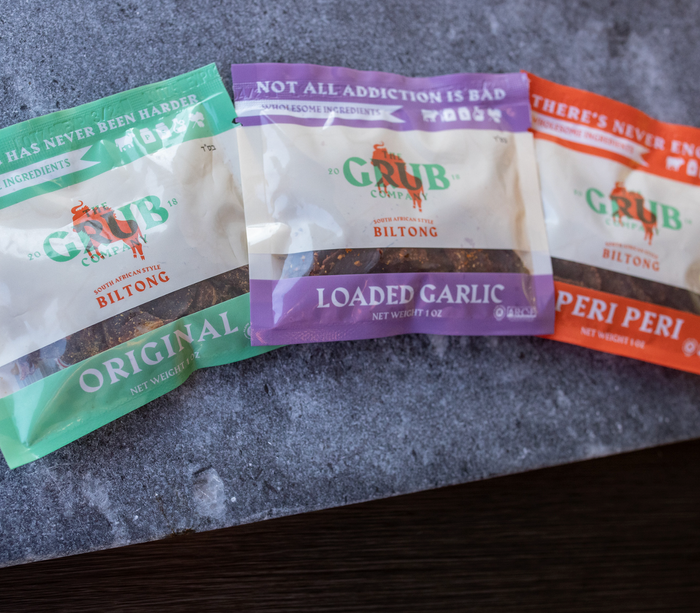
This is not an accident. It is the mechanism behind what we mean when we talk about flavor layering in our three profiles. Original, Peri Peri, and Loaded Garlic each express differently at the crust than they do at the wet center, because spice placement depth separates the experience into two distinct flavor registers. The first bite, with its crusty edge, hits differently than the pull from the center. You are not eating one flavor. You are eating the cure's timeline compressed into a single slice.
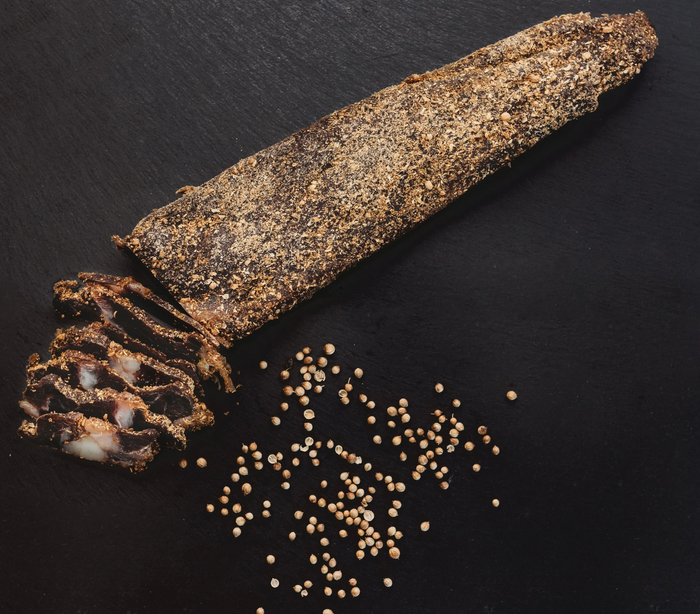
Consider what happens when you slice fresh off a whole slab. That first cut opens the gradient to the air. You see the color difference immediately: the darker, firmer edge giving way to the lighter, softer interior. That color difference is the cure depth made visible. You are looking at the salt and spice front, frozen mid-journey through the meat. Eating it fresh like this is the only way to experience both registers at once. Which brings us to why slicing matters as much as curing does.
Why Slicing Fresh Destroys and Pre-Sliced Product Loses
Pre-sliced biltong keeps drying after it is packaged. This is not a flaw in the packaging. It is physics. Once you slice a slab, you have opened the interior to the air. The moisture gradient that was protected by the exterior crust is now exposed. The cut surfaces begin drying. The interior pulls toward equilibrium with the ambient humidity inside the bag. Over time, the wet center that made the slab worth buying flattens out. By the time a pre-sliced bag reaches you, has sat in transit, and opened at room temperature, the gradient is narrower than it was when the slice was made. Sometimes it is gone entirely.
This is the case for slicing fresh from a whole slab, and it is the reason the Biltong Slabs in our catalog are sold as whole pieces. Slicing every bite fresh off the slab is not a romantic ritual. It is the only way to preserve the texture gradient that the cure spent weeks building. You get to decide how thick to cut. You get to decide how much crust to include in each slice. You are in control of the ratio, and that ratio is what makes each bite different from the last.
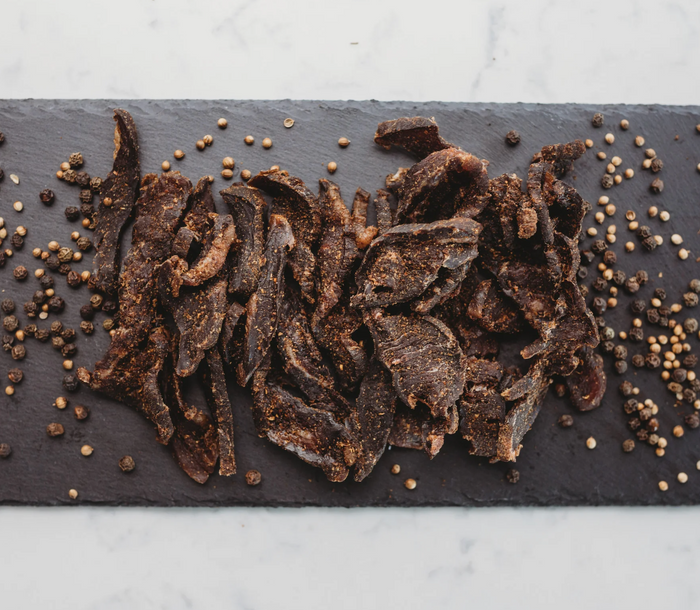
The Sliced Biltong and Sliced Biltong Mini's in our catalog serve a different purpose. They are the format for everyday snacking, for tossing in a bag, for the charcuterie board where convenience matters as much as presentation. They are made from the same grass-fed beef, cured with the same process. But the gradient has already narrowed by the time they reach you, because that is the nature of pre-sliced product. It is a real trade-off. Worth knowing before you decide which format fits what you are doing.
Imagine you are hosting. You have a board going: a few accompaniments, maybe a sharp cheese from somewhere else on the table, some crackers. You slice the slab tableside, and the first thing people notice is that the inside looks different from the outside. They ask about it. You explain, briefly, what they are looking at: the cure gradient, still intact, the moisture barrier still doing its job until the moment the knife went through. That moment of visible craft is part of what you bought. Pre-sliced product cannot give you that.
Grass-Fed Fat Structure and Why It Matters Here
Not all beef slabs behave the same in the curing environment, and the difference comes down to fat. Grass-fed beef carries a different fat structure and marbling distribution than grain-finished beef. The fat in grass-fed cuts tends to be more finely distributed through the muscle tissue rather than concentrated in large pockets. That distribution affects how moisture moves through the meat during the cure.
A more evenly marbled cut holds moisture differently than one with dense fat deposits sitting between muscle fibers. The fat does not pull salt the way lean tissue does. It moves more slowly through the cure process. In a thick slab, this means the fat-rich interior tends to stay wetter longer, not because the cure is failing to reach it, but because the fat itself slows moisture loss and resists the salt front in a way that lean tissue does not.
The result is a wet center that is stable, not fragile. The fat structure is helping hold that moisture in place while the exterior crust handles its job on the other side of the gradient. This is why we source grass-fed beef and why that sourcing choice is not just a marketing posture. The fat profile of the beef is part of what makes the wet-center phase work without degradation. A lean, grain-finished cut would lose interior moisture more aggressively during the same cure. The gradient would collapse faster. The wet center would be thinner, drier, or gone.
When you slice into one of our slabs and find that moist, almost glossy center, the grass-fed sourcing is part of what you are tasting. The fat that sat between those muscle fibers during the weeks of cure kept the interior where it needed to be. That is a concrete consequence of a sourcing decision, not a vague quality claim.
Why Scarcity Is a Cure Depth Problem, Not a Supply Problem
The Biltong Slabs in our catalog are $58 per pound. Inventory is low by design: we set aside only a handful of slabs per batch, and that limited supply means wait times of two to three weeks are normal. People sometimes read that as a logistics problem. It is not. It is a cure depth problem, which is the same as saying it is a craft problem.
Slab production cannot be rushed without collapsing the gradient that makes the slab worth buying. You cannot accelerate salt penetration without changing the product. You cannot shorten cure duration for thick cuts without either pulling them before the exterior crust has fully formed or accepting a wetter, less structurally sound slab that will dry out unevenly post-sale. The cure timeline is the product. Trying to produce more slabs faster means producing different slabs, worse ones, slabs where the wet center is a problem to apologize for instead of a gradient to show off.
Choosing the slab format is choosing that timeline. The wait is real. The scarcity is real. And both are a direct consequence of refusing to compromise cure depth for throughput. If you want the gradient, you wait for the gradient. If you want something available immediately in any quantity, the Sliced Biltong is right there, and it is a genuinely good product. But it is a different product.
The Biltong Sampler Pack is worth mentioning here too, because if you have never tasted all three flavor profiles, you should do that before committing to a full slab. The Sampler gives you Original, Peri Peri, and Loaded Garlic in one order for $12.99. You will learn quickly which profile you want to experience fresh off the slab, with the full gradient intact, because the flavor differences between those profiles are sharpest when you are eating the spice at its two registers: the bright, concentrated crust and the melded, mellow interior. That separation is most pronounced on the slab. That is where you taste what the cure did.
The wet middle is not a problem. It is not a compromise. It is the whole argument for why slab biltong exists as its own format. If you wanted it dry all the way through, you would buy something else. You would buy slices, or chips, or jerky. The slab exists because the gradient exists, and the gradient exists because the cure was managed well enough to build it. That is the only honest bottom line here.
If the wet center ever feels like something to worry about, slice thinner, include more crust in each piece, and taste what you have. Worry less. You are holding a cure that worked.
These questions come up every time someone opens their first slab and wonders what they are looking at. Here are the ones we hear most.
Frequently Asked Questions
Is the wet center in slab biltong safe to eat?
Yes. The wet center in slab biltong is the result of controlled cure depth, not underprocessing. The exterior crust forms a moisture and flavor barrier that keeps the interior moist while the salt and spice gradient works inward. When slab thickness is matched to cure duration and ambient humidity, the interior remains stable without food safety compromise. The wet center is mildly cured, not raw. It does not look or taste like uncured beef. It is beef that the cure has not fully reached yet, which is exactly the condition that produces the texture gradient the slab format is built around.
Why does my slab biltong look different on the outside than the inside?
That color difference is the cure depth made visible. The darker, firmer exterior has been exposed to salt, spice, and air for the full duration of the cure. The lighter, softer interior has only received partial salt and spice penetration because cure depth lags behind surface drying speed in a thick cut. The two zones have different moisture content, different seasoning intensity, and different texture. That is the gradient working as intended. When you slice fresh off the slab, you are seeing the salt front frozen mid-journey through the meat. It is not a sign that something went wrong.
Why do Biltong Slabs have a two-to-three week wait time?
Because the cure cannot be rushed without changing the product. Slab biltong requires enough hang time for the exterior crust to form properly and for the cure gradient to develop across the full thickness of the cut. We set aside only a handful of slabs per batch rather than scaling up and shortening the process. A faster timeline would mean a shallower gradient, a weaker moisture barrier, and a slab that dries unevenly after it leaves us. The wait is a direct consequence of refusing to compromise cure depth for higher output. Inventory is genuinely limited as a result.
Does sliced biltong have the same wet center as slab biltong?
Not to the same degree. Pre-sliced biltong begins drying through its cut surfaces the moment it is sliced. The exterior crust that protected the wet center in the whole slab no longer covers the interior once the slice is made. By the time the product reaches you, the moisture gradient has narrowed. The Sliced Biltong and Sliced Biltong Mini's are excellent products made from the same grass-fed beef and the same cure process, but they serve a different purpose: everyday snacking, convenience, charcuterie boards. If the wet-center gradient is what you are after, the whole slab is the format that preserves it.
How do the three flavor profiles taste differently on a slab versus sliced?
On a slab sliced fresh, each profile splits into two flavor registers: the bright, concentrated expression at the crust and a mellower, more integrated expression at the wet center. Original is cleanest at the center and most savory at the edge. Peri Peri carries its heat at the surface and softens considerably toward the middle. Loaded Garlic is punchy at the crust and rounder at the center, where the garlic has had weeks to meld with the beef rather than sit on top of it. Pre-sliced product narrows that gap because the interior has already begun drying. The full split between registers is a slab-only experience.
What is the best way to try the three flavors before buying a full slab?
The Biltong Sampler Pack is the right starting point. At $12.99, it includes one mini bag each of Original, Peri Peri, and Loaded Garlic. You will quickly learn which profile you want to experience at full slab scale, with the complete cure gradient intact. The flavor differences are most pronounced on the slab because the two-register experience, bright crust and mellow center, is sharpest there. Sampling first also helps you decide whether you prefer the wet-center experience of a whole slab or the convenience format of the Sliced Biltong, which is a meaningful choice before spending $58.
Does grass-fed beef make a real difference in how the wet center holds up?
Yes, and the reason is fat distribution. Grass-fed beef carries a finer, more even marbling through the muscle tissue compared to grain-finished beef. That fat slows moisture loss and resists the salt front in a way that lean tissue does not, which helps the interior stay wet and stable during the full cure duration. A leaner cut would lose interior moisture more aggressively over the same period. The result would be a shallower gradient and a center that dries out faster. The grass-fed sourcing is not a positioning choice separate from craft. It is part of what makes the wet-center phase structurally sound.
Ready to pick one? Browse Biltong Bulk & Wholesale.