How to Read a Biltong Ingredient Label
A good biltong label is short: beef, salt, vinegar and spices, and nothing you cannot explain. Ours is certified Glatt Kosher biltong, air-dried in small batches in Florida, so we read these labels for a living. This is how to read one line by line, what each ingredient is doing, and what to check when you are not sure.
Start with the order of the list
Ingredients on a US food label are listed from the largest amount to the smallest. So the first line tells you what the product mostly is. For biltong, the first line should be beef, and it should be described plainly.
Here is the Original sliced biltong from Grub: grass-fed kosher beef, coriander, black pepper, salt, garlic, vinegar. Beef first. Then the spices. Then salt, garlic and vinegar. Six items, all of which you could find in a kitchen.
The order tells you something, but not everything. A short list also does not prove quality. It tells you that there is less to hide.
What each ingredient does
Biltong is one of the oldest ways to keep meat. Each ingredient is there for a reason. Here is the traditional set.
Beef
The base. For biltong it is a whole-muscle cut, not ground or reformed. The label may say a type, such as grass-fed. For kosher biltong, the beef itself is also kosher meat, which is why our label says "grass-fed kosher beef." If the label says only "beef," that is acceptable, but the product page should fill in the gaps.
Salt
Salt does the heavy lifting. It draws water out of the meat and helps keep it stable while it dries. Our piece on why biltong is salted before it is spiced explains the order. Salt also affects flavor. If you watch your salt intake for any reason, talk to your doctor and read the nutrition panel on the bag, because we do not publish numbers here that are not on our page.
Vinegar
Vinegar is part of the traditional method. It is applied to the meat before drying. On the label it appears as a single plain word.
Coriander and black pepper
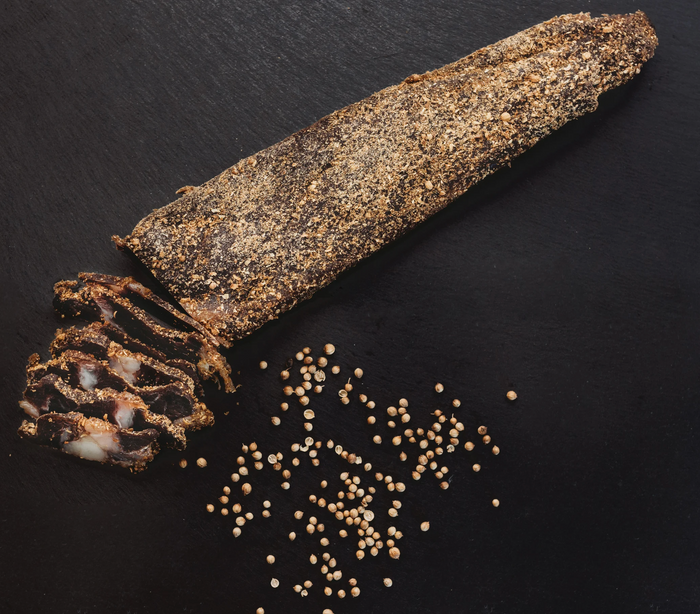
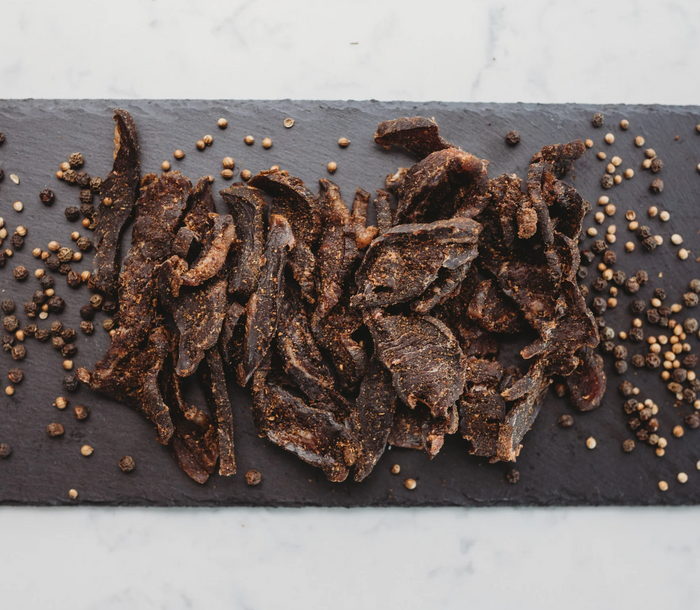
These are the classic biltong spices. Coriander gives the warm citrus note. Black pepper adds bite. If you see them near the top of a short list, that is a traditional spice profile. For more on the role of coriander, see what the coriander is for.
Garlic
Garlic appears in all three of our flavors. In Loaded Garlic, there is also roasted garlic, plus tomato powder, which gives that flavor its rounder, sweeter, savory character.
Red pepper and brown sugar
These show up in Peri Peri. Red pepper is the heat. Brown sugar is the last item on that list, which means it is the smallest amount by weight. Original lists no sugar in its ingredients. Peri Peri does include brown sugar, so read the label if sugar matters to you.
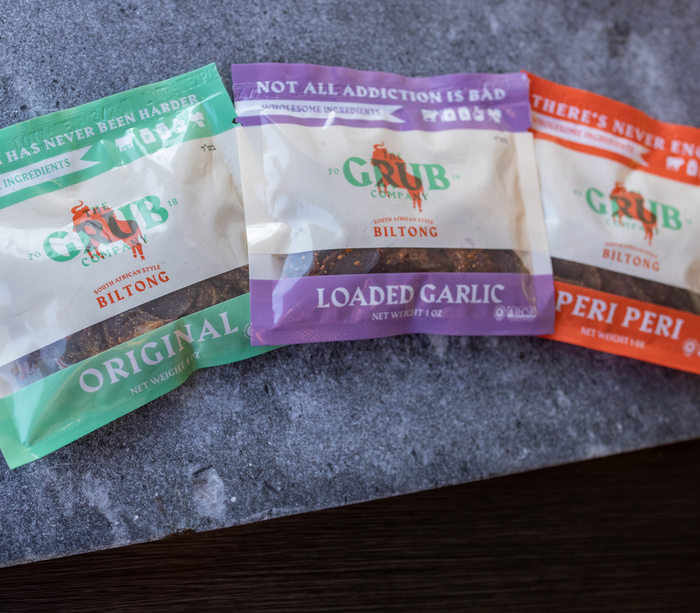
The three Grub labels side by side
- Original: grass-fed kosher beef, coriander, black pepper, salt, garlic, vinegar.
- Peri Peri: grass-fed kosher beef, coriander, red pepper, black pepper, salt, garlic, vinegar, brown sugar.
- Loaded Garlic: grass-fed kosher beef, coriander, garlic, roasted garlic, salt, tomato powder, vinegar.
You can try all three in the Biltong Sampler Pack, and shop the 3 oz bags as Sliced Biltong. Always read the label on the bag in your hand. Recipes can change, and the bag is the final word.
What to look for, and what to question
Not every unfamiliar word is a problem. But some lines deserve a second look.
- A long list of additives. If you cannot say what a line is for, search it or ask the maker.
- A named preservative. Traditional biltong is preserved by salt, vinegar and drying. If a label lists added preservatives, ask why. Our piece on why biltong needs no preservatives explains the traditional approach.
- Sugar in a savory product. A little can be a flavor choice. A lot, high on the list, means you are buying jerky-style sweetness. That is fine if you want it. Know what you are buying.
- "Natural flavors" with no detail. This is common on food labels. If you have an allergy or a dietary rule, ask the maker what it contains.
- Only "spices." A catch-all word is hard to check. If a spice matters to you, ask.
Kosher, allergens and dietary rules
An ingredient label is not a kosher certificate. A list of ingredients can tell you the meat is beef and what the spices are. It cannot tell you how the animal was slaughtered, how the meat was handled, or what was run on the equipment. For that you need a certification mark and a certificate you can look at. Grub biltong is certified Glatt Kosher; the details are on our kosher biltong page.
For allergens, read the "contains" statement and any warning about shared equipment on your own bag. We do not make claims on this page about what a product is free of. If you have a serious allergy, check the bag and ask us before you order. Our guide on biltong and common food allergies lists what to check.
Meat Candy, our beef jerky, is a different product with a glaze. Read its own label rather than assuming it matches the biltong. You can find it, with every other kosher jerky option, in our kosher beef jerky collection.
Reading a label cold: a five-step walkthrough
Say you pick up an unfamiliar bag and have two minutes. Here is the order that works.
- Find the first ingredient. It should be beef. If it is anything else, put the bag down.
- Count the lines. Fewer than ten is typical for a traditional product. More is not a failure, but each extra line needs a reason.
- Find the salt and the vinegar. If both are there, the traditional preserving method is intact. If neither is, ask how it is kept.
- Look at the last lines. The smallest amounts are at the end. Flavor additions such as sugar often sit there, and the end of the list is where surprises hide.
- Find the allergen statement and the certification mark. Both are separate from the ingredient list, and both matter more than the list if you have a rule you keep.
If something does not add up, you do not have to guess. A maker can tell you what a line means. We answer those questions ourselves.
What the label will not tell you
An ingredient list says what is in the bag. It does not say how thick the slices are, how dry the meat was taken, or how the product tastes. It does not say whether the beef was trimmed well or where the animal was raised, unless the maker chooses to say so. It cannot tell you whether a flavor suits your family. That last question takes a taste.
It also cannot replace a conversation with your doctor. If you follow a medical diet, or you are watching a particular ingredient for a health reason, ask your doctor what to look for, and bring the label. We can tell you what is in our bags. We cannot tell you what is right for you.
When a short label is not enough
A clean label does not tell you how well the meat was dried. It does not tell you how thick the cut is, or how it will taste. Two products with the same six-item list can be very different in the hand. That is why we also recommend looking at the product page for method and place. Our guide on how to judge any biltong brand covers the rest.
The label is the beginning of the check, not the end.
A last tip: compare labels from the same flavor family. Original against another maker's plain biltong tells you something. Original against a sweet, glazed jerky tells you nothing, because they are different products made by different methods. Biltong is air-dried and savory. Jerky is cooked, sliced thin and usually sweeter. Put like next to like, and the differences in the lists will actually mean something.
Bottom line
Read biltong labels top to bottom. Expect beef first, then salt, vinegar and spices, in a list short enough to explain from memory. Question long additive lists, added preservatives and vague "spices." Remember that a label is not a certificate. For kosher and allergies, read the bag and ask the maker. To see our labels for yourself, the full range is at Buy Biltong Online.
Frequently Asked Questions
What should be in a biltong ingredient list?
Beef, salt, vinegar and spices. Our Original lists grass-fed kosher beef, coriander, black pepper, salt, garlic and vinegar. Flavored versions add to that.
Does biltong contain sugar?
It depends on the flavor. Original lists no sugar in its ingredients. Peri Peri lists brown sugar. Read the label on your bag, and ask us if you have a question.
Why is there vinegar in biltong?
Vinegar is part of the traditional method and is applied to the meat before drying. On a label it appears as one plain word.
Are there preservatives in biltong?
Traditional biltong is kept by salt, vinegar and air-drying. Check any label for a named preservative, and ask the maker if you see one.
Does an ingredient label tell me if biltong is kosher?
No. A label lists what is in the product. Kosher status comes from a certification and a certificate. Grub biltong is certified Glatt Kosher.
How do I check for allergens?
Read the "contains" statement and any shared-equipment warning on your own bag. If you have a serious allergy, ask us before you order and ask your doctor what is right for you.
Is Meat Candy's label the same as biltong's?
No. Meat Candy is a cooked, glazed jerky with its own ingredients. Read its label separately.