Air Circulation, Humidity, and Hang Time: What Industrial Drying Actually Loses
In biltong drying, air circulation, humidity, and hang time are interdependent variables that must be actively balanced: airflow drives surface moisture off, ambient humidity governs the rate of interior moisture migration to the surface, and hang time is the window in which that calibration either succeeds or fails. Industrial jerky ovens fix all three variables for throughput, which over-dries the exterior while leaving the interior unevenly dried and collapses the flavor-concentrating slow-dry effect that extended, humidity-controlled hang time produces. Artisanal open-air biltong drying manages these variables in real time, which is why the final texture and flavor layering of properly hung biltong cannot be replicated by batch processing.
Shop the real thing: buy biltong online, Glatt Kosher and made in Florida. US orders over $50 ship free.
That is the honest answer. But it raises a follow-up question most people do not think to ask: if the drying process is so different, why does the format you buy also matter? The answer is that the physics do not stop when the biltong comes off the hook. They keep working. And that means a slab, a bulk bag, and a mini are not just different sizes. They are different moisture environments, each behaving according to the same three-variable logic that governs the drying room itself.
Why the Industrial Process Is Not Just Faster. It Is Fundamentally Different
Most people assume industrial drying is just a faster version of what artisanal producers do. That assumption is where the misunderstanding starts. Industrial facilities do not simply compress the timeline. They replace the three-variable feedback loop entirely with a fixed-parameter environment designed around one goal: consistent throughput. That is not a criticism. It is what the process is built to do. But it is incompatible with what makes biltong taste the way it does.
Here is what actually happens. In open-air drying, the relationship between airflow and humidity is dynamic. When surface moisture is being driven off quickly by strong airflow, the interior moisture gradient steepens, and the interior dries at a rate that tracks the surface. When humidity in the drying environment rises slightly, that gradient relaxes, and the interior catches up before the surface seals over. It is a feedback loop, and a skilled artisanal producer reads it and adjusts. Hang time is the duration across which that reading and adjusting happens. Cut it short and you have meat that never fully equilibrated. You have an exterior that moved fast and an interior that lagged. You have texture variance baked into every piece, not because of inconsistent handling, but because the process never had the time to finish what it started.
Industrial facilities solve this with uniformity. The fans run at a fixed speed. The climate control holds a set humidity band. The product moves through on a schedule. What you lose is not simply time on the hook. What you lose is the ability of the interior moisture to migrate to the surface at its own pace, guided by the ambient conditions rather than forced by them. The exterior dries faster than the interior can follow. The result is a piece of meat that reads as dry on the outside and dense or chewy in the center, not because of poor ingredients, but because the moisture calibration was interrupted before it could complete.
Flavor concentration is the casualty nobody talks about. Slow, humidity-controlled hang time does something that forced-air heat cannot: it allows the natural proteins and fats in the beef to concentrate gradually, without the cellular damage that heat introduces. The flavors that develop over a properly managed hang are layered in a way that fast drying simply does not produce. You taste it in a piece of biltong the way you taste the difference between a broth that simmered all day and one that was rushed on high heat for an hour. The ingredients were the same. The process was not.
Grass-fed beef makes this even more pronounced. Grass-fed muscle tissue has different fat distribution and moisture retention properties than grain-fed beef, and those differences matter during drying. The moisture does not release the same way. The drying curve is different. An artisanal process that manages humidity and airflow in real time can work with that curve. A fixed industrial parameter set cannot adapt to it. What you get from grass-fed beef in a proper slow-dry is a texture and shelf stability that grain-fed beef in an industrial oven cannot match, not because grass-fed is magical, but because it responds differently to the conditions, and those conditions have to be managed rather than imposed.
How Format Carries the Physics Forward After the Hook
The three-variable logic does not stop when the biltong is done hanging. It continues in the packaging, in the bag, and on your counter. Different formats create different moisture environments, and understanding that is the difference between buying biltong that tastes the way it should and buying biltong that disappointments you for reasons you cannot quite name.
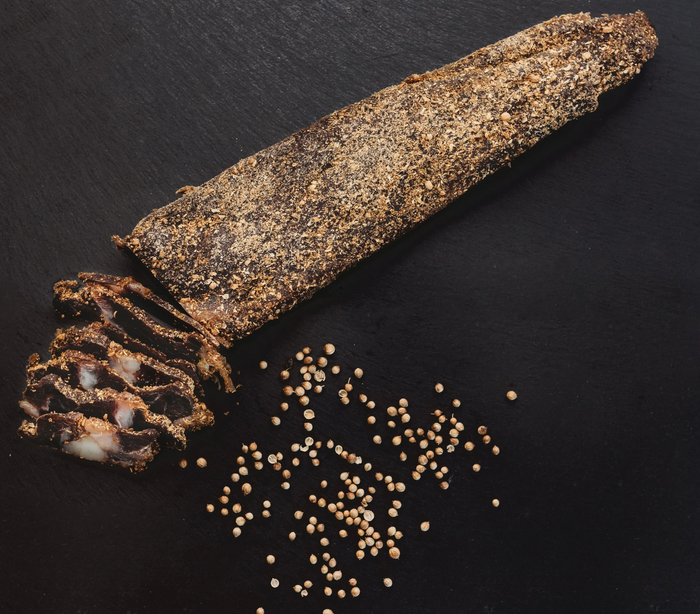
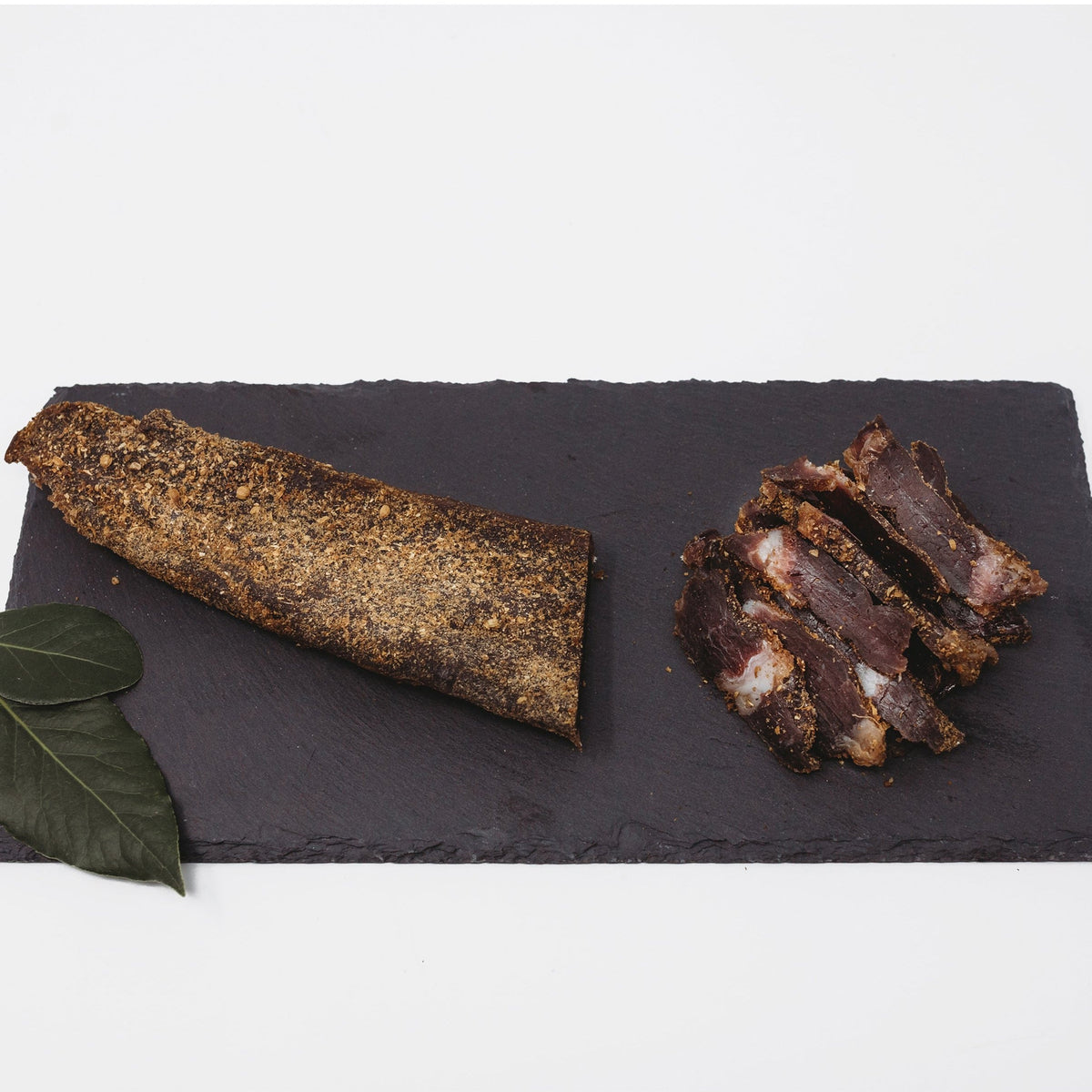
The Biltong Slab is the clearest proof of this. When a slab comes off the hook, the interior moisture gradient has been calibrated across the whole piece. The surface is dry and the core holds the moisture that was meant to stay there. The moment you slice it, you expose that interior to air. You get the full moisture profile of the piece exactly as the drying process left it. Slice it fresh and you are tasting the result of everything that happened during hang time, in the order it was meant to be experienced. That is why slicing fresh off the slab is not a preference. It is a physical fact about what you are eating.
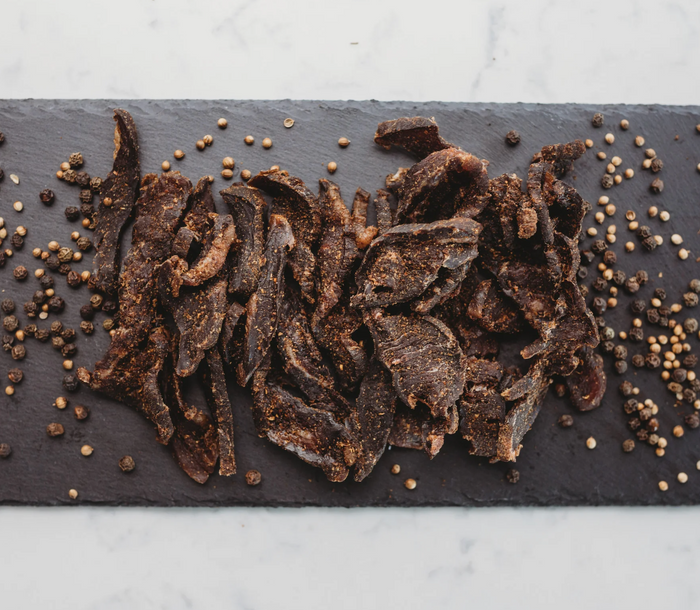
Pre-sliced biltong that sits in a vacuum-sealed bag is a different situation. The slicing happens before the bag. The exposed surfaces begin to re-equilibrate with each other and with the atmosphere in the packaging. Over time, the moisture that was in the interior redistributes across the cut surfaces, and the texture you get when you open the bag reflects that redistribution, not the original drying calibration. This is why bulk format matters. The 1LB bag of sliced biltong minimizes that redistribution because the volume of meat inside is large enough to maintain a shared moisture environment rather than each individual slice equilibrating on its own against an empty bag. More meat, less exposed surface per unit of interior mass, which means the moisture re-equilibration is slower and more controlled. You taste fresher biltong from a pound bag than from a small individual portion, and the reason is physics, not perception.
The Sliced Biltong Minis sit at the other end of the format spectrum, and they do something interesting. Small pieces equilibrate faster. Their surface-to-mass ratio is higher, so they reach moisture equilibrium more quickly during the drying process. That sounds like a disadvantage, but it is actually a control advantage in the right hands. Because the equilibration curve is faster and more predictable with smaller pieces, it is possible to hit a specific final texture with more consistency than you can with a large slab. The minis are not a lesser product. They are a format that trades the depth of the slab experience for tighter textural control on every bite. That is a real trade-off, and the right answer depends on what you are after.
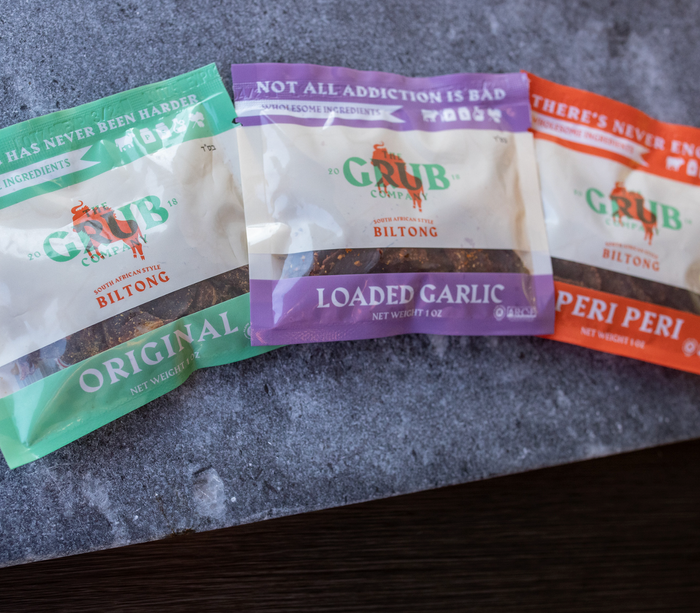
The Biltong Sampler Pack, which includes Original, Peri Peri, and Loaded Garlic in mini bags, is the right starting point if you are trying to learn what these format and flavor differences actually feel like in practice. Three flavors, three small portions, and you can start to notice what each one is doing in your mouth and why. There is a Biltong Selector Quiz on the site if you want a faster route to the right answer, but honestly, tasting is the most useful data.
What Pre-Dry Seasoning Reveals About the Process
The spice blends applied to biltong before it goes on the hook are not just flavoring. They are part of the moisture environment during drying, and they behave differently depending on how that environment is managed. This is a detail that almost no one talks about, and it is the third proof that artisanal open-air drying is not just a slower version of industrial processing. It is a categorically different interaction between the meat and everything around it.
When a spice blend is applied before drying, it sits on the surface of the meat as moisture migrates outward from the interior. That outward migration carries fat-soluble compounds from the meat itself into contact with the spices on the surface. The spices are not just sitting on top. They are participating in a slow chemical exchange driven by moisture movement. The result is flavor that is distributed through the outer layer of the meat, not just coating it. You taste it differently because it is distributed differently.
The Original, Peri Peri, and Loaded Garlic blends each behave differently in that environment because their ingredients have different affinities for moisture and fat. The Peri Peri spices interact with the surface moisture migration differently than the garlic compounds in Loaded Garlic do. This is why the same beef, cured and hung the same way, produces three flavors that feel layered rather than just seasoned. The drying process is doing flavor work that the spices alone could never do. Post-dry seasoning, which is what industrial facilities use when they season at all, misses this entirely. You get spice on the surface and beef underneath. The layering never forms because there is no slow moisture migration to carry it inward.
This is also why the spice interaction is format-sensitive. A slab that you slice fresh preserves the full moisture gradient of the piece, which means the spice interaction near the surface is distinct from the interior. You taste a progression as you eat. Pre-sliced formats that have been sitting show more uniform distribution because the re-equilibration has blurred the gradient. Neither is wrong. They are different experiences that come from the same process at different points in its timeline.
Why the Slab Wait Time Is Actually Evidence, Not Inconvenience
The Biltong Slabs in this catalog carry a note that is worth reading carefully: slab inventory is generally low because only a handful are set aside per batch, and that results in two to three week wait times for shipments. Most businesses would bury that fact or apologize for it. It deserves to be read the other way.
The wait time is not a logistics problem. It is a direct consequence of what artisanal hang time actually requires. You cannot batch-process slabs and hold inventory. The slab has to finish the hang on its own schedule. Pull it early and you have under-calibrated moisture and a product that will not deliver what a slab should deliver. Hold back inventory to match demand and you have customers waiting. The constraint is built into the process, and the process is the product. An industrial facility has no such constraint because it does not have the process. It has a fixed-parameter system that finishes on a clock, not on a calibration.
When you see a two to three week wait on slabs, you are looking at physical evidence of the three-variable feedback loop doing its work. The airflow ran. The humidity was managed. The hang time was honored. The product that comes out of that process is what you are waiting for. That is not a delay. It is the reason the slab is worth fifty-eight dollars a pound when you can buy industrial jerky for a fraction of that at any gas station.
The minis and the bulk sliced format do not carry the same wait because they do not require the same hang time commitment. The format difference maps exactly onto the process difference. Smaller pieces equilibrate faster. The 1LB sliced bag is cut from pieces that finished the hang and were then sliced and bagged to minimize re-equilibration. The wait times across the product line are not arbitrary inventory management. They are a direct readout of how long the drying physics take to do their job at each format level.
Once you understand the three-variable feedback loop and how it manifests differently at the slab level versus the bulk slice level versus the mini level, you cannot unfeel it when you eat the product. You know what the texture you are experiencing means about the process that made it. That is the real value of understanding the drying physics. It is not trivia. It is the reason the product is what it is, and the reason industrial processing will never close the gap no matter how much it refines its equipment.
If you are new to biltong and want to taste the flavor layering and moisture calibration before committing to a full order, the Sampler Pack is the right move. Three flavors, small format, and you will start to notice the things this article has been describing. If you already know what you want and you want the most authentic expression of what open-air drying produces, the Biltong Slab is the answer. Plan for the wait. It is telling you something real.
Ready to pick one? Browse Biltong Bulk & Wholesale.