Why the First Bite of a New Bag Tastes Different From the Last
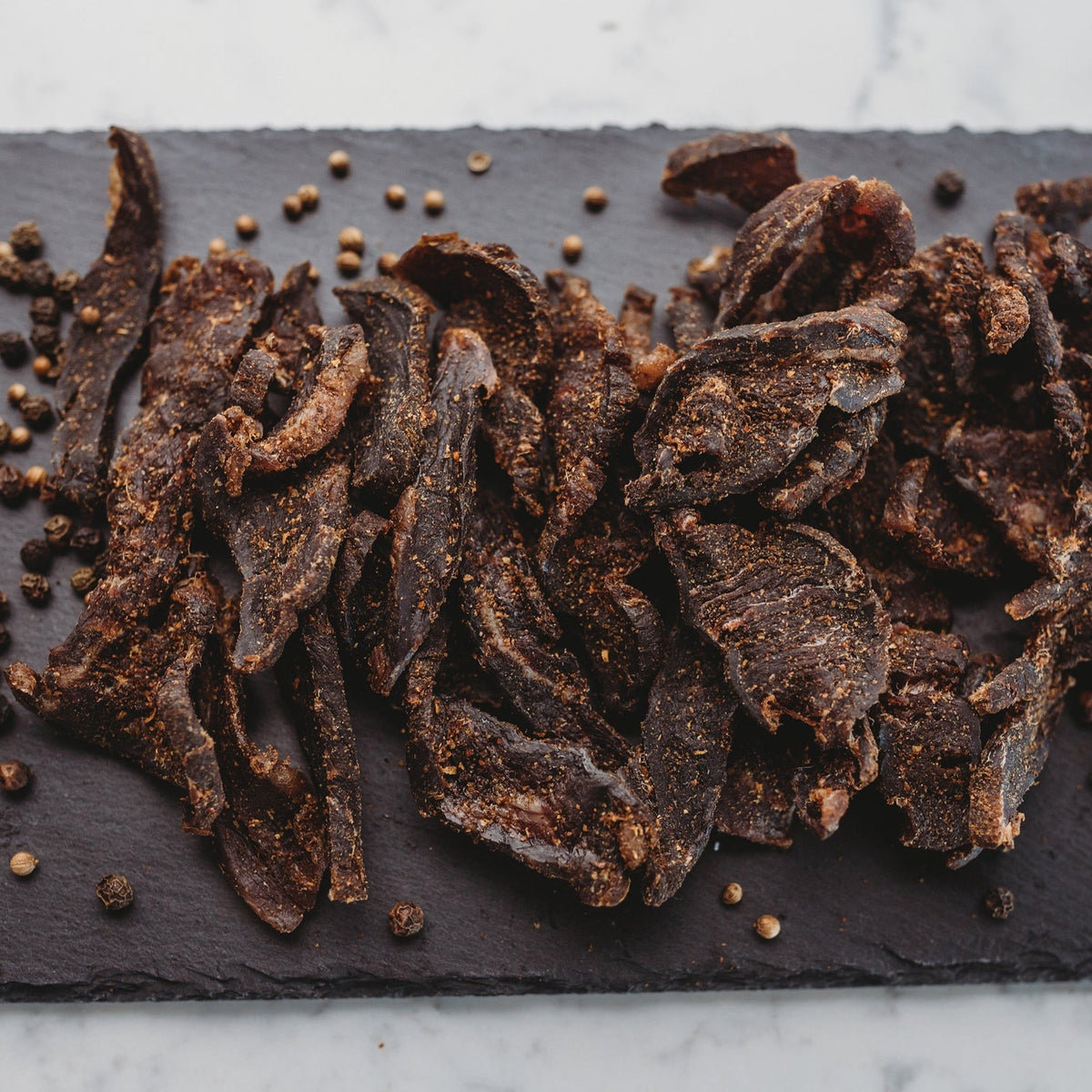
The last piece in a bag is drier, firmer and stronger tasting than the first one, and that is a real change rather than your memory playing tricks. The moment a bag is opened, everything inside it starts trading moisture and aroma with your kitchen, and by the time you get to the bottom the pieces have genuinely moved.
Shop the real thing: buy biltong online, Glatt Kosher and made in Florida. US orders over $50 ship free.
Nobody warns you about this, which is a shame, because once you know what is happening you can steer it. You can hold a bag close to where it started, or you can let it travel and enjoy the other end of the range on purpose. What you should not do is conclude that the last handful was a worse product than the first, because it was the same product at a later point in its own life.
A sealed bag is a tiny climate, and opening it ends that
Before you open it, a bag is a closed system that has already settled. Whatever moisture was in the meat has distributed itself between the pieces and the small volume of air around them, everything has reached equilibrium, and nothing much changes from one day to the next. The pieces are all in the same condition because they have had time to reach agreement.
Opening it introduces a far larger partner to the negotiation. Your kitchen has effectively unlimited air, and that air is almost always drier than the inside of a sealed bag of dried meat. From the first time you open it, the trade runs outward, and it runs a little further every time you open it again.
That is the mechanism. Everything else in this article is a consequence of it, plus one separate change that has nothing to do with water at all.
What leaves first: the aromatics
The first thing you lose is smell, and you lose it within seconds. Open a good bag and there is a rush of it, the vinegar tang, the coriander, the deep beef note underneath. That rush is volatile compounds that had been accumulating in the sealed headspace of the bag, sometimes for weeks, at a concentration far above what the meat itself carries.
Once released they are gone. The bag will never smell like that again, no matter how well you reseal it, because what you smelled was accumulated inventory rather than a steady output. It builds back a little between openings, and never to the same level.
This matters more than it sounds, because a large share of what people experience as taste is actually smell. The first piece from a freshly opened bag is eaten inside a cloud of aroma that the last piece is not. Some of the difference between the first bite and the last is not the meat at all. It is the air you were breathing while you ate it.
What leaves second: surface water
The slower change is moisture, and it works from the outside of each piece inward. Room air is usually drier than the meat, so water moves from the meat into the room, starting at the surface and drawing outward from deeper in the piece to replace what left.
Each opening resets that trade. Air exchanges, the drier room air replaces the more humid bag air, and the process starts again from a lower level. A bag opened once a day for two weeks has had roughly fourteen fresh starts at drying the pieces out, and it shows.
The pieces do not go stale in any spoiling sense. They continue along the same road they were traveling in the drying room, just far more slowly and without anyone supervising. The last piece in a bag has effectively spent longer drying than the first piece did.
Why the last piece is firmer, and why it is not a fault
Firmness in dried meat tracks moisture almost directly. Less water means the protein structure sits closer together and there is less to give when you bite. That is the entire explanation for the texture change between the top of a bag and the bottom.
Calling it a fault would mean calling the whole product a fault, because the same process that made the piece is the process still running. Nothing has gone wrong. A firmer piece is a piece further along a road it was always on, and plenty of people prefer that end of it.
Here is the honest version of the trade. Softer pieces taste more of fresh beef and have more give. Firmer pieces taste more concentrated and take longer to eat, which some people find more satisfying rather than less. Neither one is the correct version. They are two points on the same line, and a bag walks you along it.
Concentration is why the salt and spice come forward
The other thing you notice at the bottom of a bag is intensity. The salt reads stronger, the coriander reads stronger, the beef reads deeper. It is easy to assume the last pieces were seasoned more heavily, or that the spice settled to the bottom.
Neither is what happened. The amount of salt and spice on those pieces has not changed at all. What changed is the amount of water they are dissolved in, which went down. Take water out of a solution and everything left in it becomes a larger fraction of the whole. Concentration is arithmetic, not seasoning.
You can prove it to yourself. Take a firm piece from the bottom of an old bag and seal it with a softer piece from a new bag for a few days. The firm piece will take on moisture from the soft one and its saltiness will fall back, without a single grain of salt going anywhere.
Fat and air, the change that is not about water
There is a second clock running that has nothing to do with moisture. Fat reacts with oxygen, slowly, and every time you open the bag you refresh the oxygen supply. At low levels this is a good thing and a lot of what makes well aged dried meat smell like well aged dried meat rather than like raw beef comes from it.
Past a point it turns, and that change is not reversible the way the moisture changes are. It is the reason the last pieces of a very old bag can taste not just stronger but slightly different in character, with a sharper edge that was not there at the start.
Fatty pieces travel this road faster than lean ones, which is worth knowing if you are the sort of person who picks the leanest pieces first. Doing that leaves the fattiest pieces sitting in the bag the longest, which is exactly backward. If you are going to eat a bag over several weeks, eat the fatty pieces early.
Some of the difference was there before you opened it
Not all of the first to last variation is drift. Some of it was baked in. Muscles are not uniform, drying is not perfectly even across a rack, and a bag of sliced product is filled from a batch that had real variation in it before anyone sealed anything.
Sealed storage narrows that variation over time, because pieces in a closed bag trade moisture until they converge. So a bag that has sat sealed for a while is more uniform than the batch it came from. That is one of the quiet benefits of sealed packaging and nobody ever mentions it.
The practical upshot is that if you open a brand new bag and find real variation inside it, some of it will even out on its own if you reseal it and leave it alone for a few days. Bags fix themselves, up to a point, as long as they stay closed.
Slices drift far more than a slab does
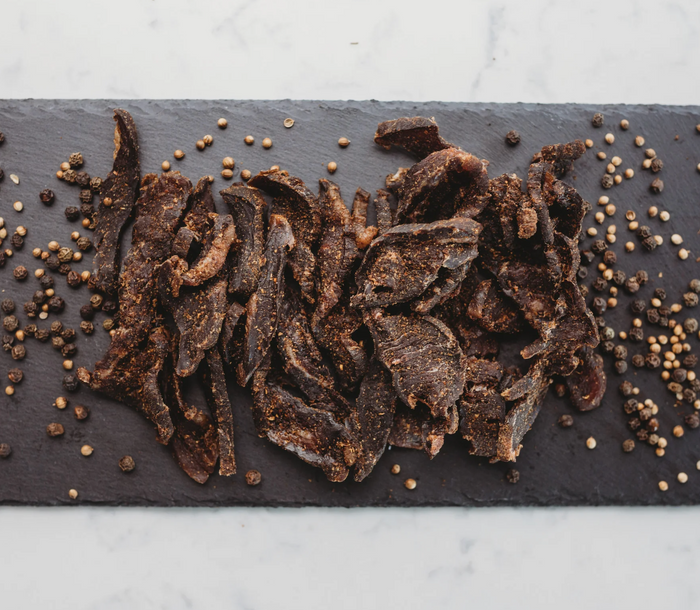
Format changes the size of the whole effect, and it changes it a lot. A slice is nearly all surface, so it trades moisture with the room quickly and its condition can move noticeably within a single week of daily openings. Sliced Biltong at $11.99 and Sliced Biltong Mini's at $4.99 both behave this way, though the mini bag is usually gone before it has time to matter.
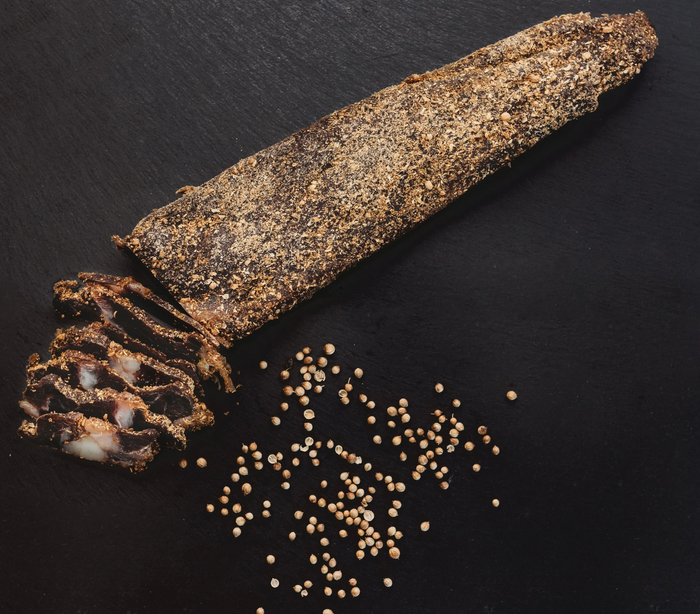
A slab barely moves by comparison. It has a small surface relative to its mass and a dried outer layer that acts as its own barrier, so Biltong Slabs at $58.00 hold their condition through weeks of casual handling. What changes on a slab is only whatever you have cut into, and that is a much smaller problem than a bag of exposed slices.
Bulk Biltong, 1LB of Sliced Biltong, at $58.00 is where this matters most, because it combines the high surface area of slices with a quantity that takes a while to get through. That is the single product in our catalog where how you store it after opening will visibly change what you eat in week three.
How to keep a bag close to where it started
If you want the last piece to eat like the first, the goal is to slow the trade with the room. Four things do most of the work.
- Press the air out before resealing. Less trapped air means less water can leave the meat before the bag reaches equilibrium again.
- Open it less often. Each opening is a fresh start for the drying, so taking out a day's worth in one go beats grazing from an open bag.
- Split a large quantity into smaller sealed portions on day one. A pound divided into four sealed parts loses far less than a pound opened four hundred times.
- Keep it cool and dark. Warmth speeds up every process described in this article, including the one working on the fat.
The portioning point is the one people skip and it is the most effective of the four. It is five minutes of work on the day the bag arrives, and it changes the character of the last portion more than anything else you can do afterward.
How to lean into the other end on purpose
Some people prefer the bottom of the bag, and there is nothing odd about that. Firmer, more concentrated dried meat is a legitimate thing to want, and it is what a lot of traditional dried meat was like before anyone started optimizing for softness.
If that is you, do the opposite of the advice above. Leave the bag loosely closed in a dry room for a few days and it will firm up steadily. It is entirely reversible while the changes are moisture based, so you can always seal it with something softer to bring it back if you overshoot.
What you cannot reverse is the fat change, so this works better with lean pieces than with fatty ones, and it works better over days than over months. Push the moisture as far as you like. Do not use time as the tool when air will do it faster.
What this means for what you should buy
The drift argument has a purchasing consequence and we would rather be straight about it than sell you the largest thing on the page.
If you eat biltong occasionally, buy small. The $11.99 bag of Sliced Biltong finished over a week or two barely drifts at all, and you will get the product close to how it was intended the whole way through. If you eat it constantly and will get through a pound in two weeks, the pound is better value and the drift will not have time to become an issue.
The purchase that disappoints people is the large one bought by an occasional eater. It is the best value on paper and the worst experience in practice, because the last third of it is eaten weeks after the first third and tastes noticeably different. The best value purchase is always the largest one you will finish while it is still where you wanted it.
Bottom line
The first bite tastes different from the last because opening a bag ends the sealed equilibrium it had reached and starts a slow trade with your kitchen. Aromatics leave immediately and never fully return. Surface water leaves gradually, a little more with every opening, so the pieces firm up and the salt and spice read stronger without a grain more of either being present. Fat quietly reacts with air the whole time.
None of that is a fault, and the last piece is not a worse piece. If you want to hold a bag steady, press the air out, open it less, portion a large quantity on day one and keep it cool and dark. If you like the concentrated end, leave it open in dry air for a few days and let it get there faster.
Frequently Asked Questions
Is the last piece in a bag of biltong worse than the first?
No, it is the same product at a later point in its own life. Once a bag is opened, the pieces trade moisture and aroma with your kitchen, so the ones eaten last have effectively spent longer drying than the ones eaten first. They come out firmer and taste more concentrated. That is the same process that made the biltong in the first place, still running slowly and without supervision. Plenty of people prefer that end of the range. Softer pieces taste more of fresh beef and have more give, firmer pieces take longer to eat and read deeper.
Why does the biltong at the bottom of the bag taste saltier?
Because there is less water in it, not because there is more salt on it. The amount of salt and spice on those pieces has not changed at all. What changed is the amount of water they are dissolved in, which went down as the bag was opened and reopened. Take water out of a solution and everything left in it becomes a larger fraction of the whole. You can prove it by sealing a firm piece from an old bag together with a softer piece from a new one for a few days. The saltiness falls back without a grain going anywhere.
Why does the smell fade after the first time I open a bag?
What you smell on first opening is accumulated inventory rather than a steady output. Volatile aroma compounds build up in the sealed headspace of a bag over weeks, reaching a concentration far above what the meat itself carries, and they all leave in the first few seconds. They build back a little between openings and never to the same level. Since a large share of what people experience as taste is really smell, part of the difference between the first bite and the last is the air you were breathing while you ate it.
How do I stop a bag from drying out after I open it?
Four habits do most of the work. Press the air out before resealing, because less trapped air means less water can leave the meat before the bag settles again. Open it less often, since every opening is a fresh start for the drying, so taking out a day's worth in one go beats grazing. Split a large quantity into smaller sealed portions on the day it arrives, which is the step most people skip and the most effective of the four. And keep it cool and dark, because warmth speeds up every process involved.
Can I make biltong firmer on purpose if I prefer it that way?
Yes, and it is easy. Leave the bag loosely closed in a dry room for a few days and it will firm up steadily as moisture leaves. The change is reversible while it is moisture based, so if you overshoot you can seal the pieces with something softer and they will take water back on until the two meet in the middle. This works better with lean pieces than with fatty ones, and better over days than over months, because the slower change that happens to fat in air is not reversible in the same way.
Does this happen to a slab as much as it does to sliced biltong?
Not remotely. A slice is nearly all surface, so it trades moisture with the room quickly and can move noticeably within a week of daily openings. A slab has a small surface relative to its mass plus a dried outer layer that acts as its own barrier, so it holds its condition through weeks of casual handling, and only the part you have cut into is really exposed. The product where this matters most is a pound of slices, which combines high surface area with a quantity that takes a while to get through.
Should I eat the lean pieces or the fatty pieces first?
Eat the fatty ones first, which is the opposite of what most people do. Fat reacts with air over time, and that change is slower than the moisture changes but it is not reversible the same way. Picking out the leanest pieces first leaves the fattiest pieces sitting in the bag the longest, which is exactly backward. If you are going to work through a bag over several weeks rather than several days, take the fatty pieces early and let the lean ones be the ones that wait.