What to Do With the Last of the Bag
The last of a bag of biltong is the best cooking ingredient in your kitchen and almost everybody throws it away. Those small end pieces and the fine crumb underneath them are drier, saltier and more concentrated than anything you ate out of the top of the bag, which makes them poor grazing and excellent seasoning. Treat that last quarter inch as a different product with a different job and you will start buying biltong partly for it.
Where to get it: Glatt Kosher biltong for sale, made in Florida and shipped anywhere in the US (free over $50).
We wrote separately about why the first bite of a bag tastes different from the last, so this is not about explaining the change. This is about what to do with what you are left holding once it has happened. Every one of the uses below is something we do at home with the bottom of a bag, and none of them need a recipe so much as a decision to stop binning it.
What is actually down there
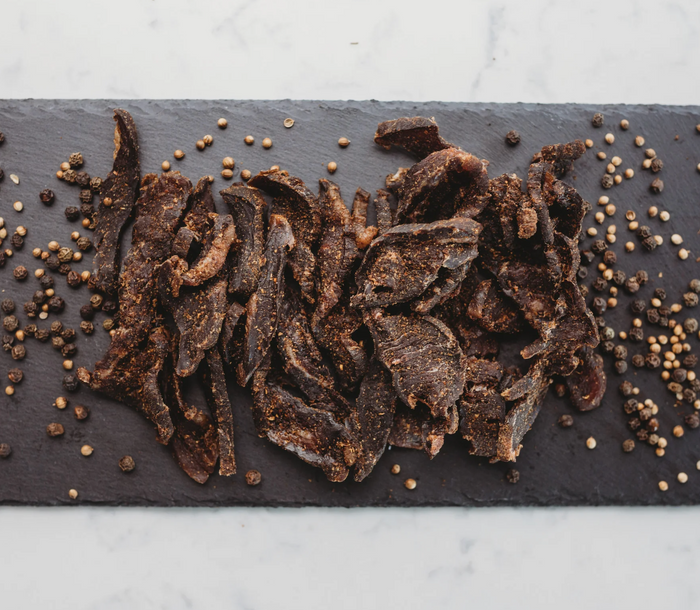
Three things collect at the bottom of a bag, and they are not the same as each other. There are the genuinely small pieces, the ends and the offcuts that were small when they went in. There is the crumb, meaning fragments that broke off larger slices through handling. And there is the loose spice that has shed from the surface of everything else along the way.
That third component is why the bottom of a bag tastes stronger than the meat above it. Coriander and the rest of the coating are not evenly distributed once a bag has been moved around, and gravity concentrates all of it in one place. You are getting meat plus a disproportionate share of the seasoning that was on every other piece.
The small pieces are also drier than the large ones, for the simple reason that a small piece has more surface for its volume and has been losing moisture faster the whole time the bag has been open. Denser, saltier, more concentrated, and more spiced. That is a seasoning profile, not a snacking one.
Why the bottom of the bag is worth more than the top
There is a general rule in cooking that concentrated things are more useful than dilute ones, because you can always add water and you can rarely take it away. Dried mushrooms outperform fresh ones in a stock. Tomato paste does work that chopped tomatoes cannot. The bottom of a biltong bag sits in exactly that category.
An ounce of the large slices from the top of a bag is a snack. An ounce of the fines from the bottom, scattered across four plates, changes four dishes. In terms of what it does per gram, the part everybody discards is doing considerably more work than the part everybody pays attention to.
It is also free, in the sense that you have already bought it. Nobody is going to sell you the bottom of a bag as a product, which is precisely why it is worth knowing what it does.
Over eggs, which is the obvious one
Scrambled eggs and biltong crumb is the use we come back to most. Cook the eggs the way you normally would, take them off the heat, and scatter the crumb over the top at the table rather than mixing it in during cooking.
The reason for adding it late is texture. Dried beef in a hot pan with moisture around it starts to soften and go leathery, which is exactly what you do not want. Added at the last second it stays crisp against the soft egg, and that contrast is the whole point.
The same applies to a fried egg on toast, an omelet, or anything with a runny yolk. The yolk does some of the work of a sauce and the crumb sits on top of it. Season the eggs lightly or not at all, because the crumb is bringing salt of its own.
On a baked potato, and into a mash
A baked potato with butter and biltong fines is a complete lunch made out of things you already had. Split the potato, get butter into it while it is hot enough to melt, and pile the crumb into the middle so it sits in the butter rather than on the dry skin.
Mashed potato works differently. Here you do want some of it stirred through, because the mash is soft all the way down and a purely surface application disappears into the first spoonful. Stir half through, keep half for the top, and hold back on the salt in the mash itself.
Sweet potato takes it better than most people expect. The sweetness against a salty, spiced, savory crumb is a genuinely good pairing and it is the version we make most often when there is more crumb than usual.
Stirred into butter
This is the one that turns the bottom of a bag into something with a shelf life of its own. Soften a stick of butter, work the fines and small pieces through it with a fork, roll it into a log in parchment and keep it in the fridge.
What you get is a compound butter that melts over a steak, a chop, corn, or a piece of bread and delivers concentrated beef and coriander wherever it lands. A slice off the log the moment a steak comes off the heat does more for that steak than most sauces you could make in the same ten seconds.
The practical advantage is that it banks the crumb. Instead of a bag with an awkward inch left in it sitting in a cupboard, you have a log in the fridge that keeps for as long as the butter does and gets used a slice at a time.
Scattered on soup and stew at the table
Anything smooth and savory takes a spiced, salty crumb as a topping the way a soup takes croutons. Butternut squash, pea, potato and leek, lentil, anything in that family. The rule again is that it goes on at the table, in the bowl, never into the pot.
Into the pot it hydrates, softens and gives up its spice to the liquid, which is not a disaster but it is a waste of texture. On top of the bowl it stays distinct for as long as it takes to eat, and every spoonful gets a bit of it.
Stews and chilis are the same story with a bigger flavor already in the bowl, so use more of it. A thick beef chili can take a genuinely heavy scatter without noticing.
Instead of croutons in a salad
The job a crouton does in a salad is to provide something dry and crunchy against wet leaves, and biltong fines do that job better because they bring salt and spice with them rather than needing to be seasoned separately.
They work best in salads that already have a fatty component to hold them, so a Caesar style dressing, an avocado, a soft cheese. On a bare leaf salad with a sharp vinaigrette they slide to the bottom of the bowl and end up in the last serving.
Dress the salad, then add the crumb, then serve immediately. Anything sitting in dressing for more than a few minutes softens, and a softened crumb is doing none of the things you added it for.
On popcorn, which sounds like a joke
It is not a joke. Salted popcorn with biltong fines blitzed a little finer and tossed through it while the popcorn is still warm and slightly buttery is one of the better things you can put in a bowl in front of people, and it costs you the last inch of a bag.
The technique matters slightly. The crumb needs something to stick to, so melted butter or a light oil goes on first and the crumb goes on second, with the bowl tossed between each addition. Dry popcorn and dry crumb simply separate, and all of it ends up at the bottom.
If you want it finer than it comes out of the bag, a few seconds in a spice grinder or a pestle and mortar takes it to something closer to a dust that coats rather than sits.
Made into a rub
The most complete version of all this is to stop treating the bottom of the bag as leftovers and start treating it as an ingredient you produce deliberately. Grind the fines to a coarse powder, keep them in a small jar with a lid, and add to the jar every time you finish a bag.
What accumulates is a beef and coriander seasoning that is genuinely yours and not available anywhere. It goes on roast potatoes before they go in the oven, on a chicken before roasting, into a burger mix, over roasted carrots, into a dry rub for the grill with whatever else you like alongside it.
Keep the jar somewhere dry and use it within a few months. Ground meat has far more exposed surface than whole pieces do, so it does not keep as long as the biltong it came from. A small jar that gets used is the right size. A large jar that sits is not.
What not to do with it
A few things genuinely do not work and it saves time to say so.
- Do not rehydrate it expecting fresh meat. Soaking dried beef gives you soft dried beef, not steak, and you lose the salt and spice into the water.
- Do not simmer it in a liquid for a long time hoping for a stock. It will give up its salt fast and turn the pot aggressively salty before it gives up much beef character.
- Do not fry it hard. Fat and high heat make small dry pieces bitter and hard very quickly.
- Do not add it early in any cooking process. Every use above is a finishing use for a reason.
- Do not store it in a bag with air in it. Once it is fines, get it into a small sealed jar or it will pick up moisture from the room.
The through line is that heat and water are both working against you. Everything the crumb is good at, it is good at cold and dry, applied last.
Adjust the salt in the dish, not in the crumb
One practical note that decides whether any of this works. Biltong is cured with salt and coated with spice, so the fines are considerably saltier per gram than the dish they are going on. If you season the dish normally and then add the crumb, the result is over salted and people blame the biltong.
Under season the base and let the topping finish it. Eggs with no salt at all. Mash with about half what you would normally use. Soup seasoned to just short of right. Then add the crumb and taste, and adjust upward only if it needs it.
Do it in that order and the crumb reads as seasoning, which is what it is. Do it in the other order and it reads as too much, which is a shame given you were about to throw it away.
Bottom line
Stop binning the last of the bag. What is down there is drier, saltier and carries a disproportionate share of the spice that came off every other piece, which makes it a poor snack and an excellent finisher. Eggs, baked potatoes, soup, salad, popcorn and a compound butter cover most of what it is good for, and a jar you add to every time you finish a bag turns it into a seasoning you cannot buy.
The rules are short. Add it at the end, never at the start. Keep it away from heat and standing liquid. Under season the dish underneath it and let the crumb finish the job. And if you find you are running out of fines before you run out of uses, that is what Sliced Biltong Mini's at $4.99 and Sliced Biltong at $11.99 are producing at the bottom of every bag you open.
Frequently Asked Questions
Why is the bottom of a biltong bag saltier and stronger?
Three things collect down there and none of them are the same as the slices on top. The small end pieces have more surface for their volume, so they lose moisture faster and end up denser. The crumb is fragments broken off larger pieces through handling. And loose spice sheds off the surface of everything in the bag and settles at the bottom under gravity. The result is meat carrying a disproportionate share of the coriander and coating that was spread across every other piece.
What is the best use for biltong crumbs?
Over eggs, added at the table rather than in the pan. Scrambled, fried or in an omelet, the crumb stays crisp against the soft egg and the contrast is the whole point. Close behind that are a baked potato with butter, a scatter over soup or chili in the bowl, and a compound butter made by working the fines through softened butter and rolling it into a log for the fridge. That last one banks the crumb so it does not sit in a cupboard.
Can I cook with biltong fines?
Yes, but only as a finishing ingredient. Everything the crumb is good at, it is good at when added cold and late. Put it in a pan or a pot early and it hydrates, softens, goes leathery and gives its spice up to the liquid, which loses you the texture you added it for. Long simmering is worse again, because it releases its salt quickly and turns a dish aggressively salty before it contributes much beef character. Add at the table, every time.
How do I stop a dish going too salty with biltong crumb on top?
Season the base low and let the crumb finish it. Biltong is cured with salt and coated with spice, so the fines are much saltier per gram than the food they are landing on. Eggs need no salt at all. Mashed potato wants about half what you would normally add. Soup should be seasoned to just short of right. Add the crumb, taste, and only then adjust upward. In the other order the dish is over salted and the biltong takes the blame.
Can I make a seasoning jar out of leftover biltong?
That is the most useful version of all of this. Grind the fines to a coarse powder, keep them in a small lidded jar, and add to it every time you finish a bag. What builds up is a beef and coriander seasoning that goes on roast potatoes, chicken before roasting, roasted carrots, or into a burger mix. Keep the jar somewhere dry and use it within a few months, because ground meat has far more exposed surface than whole pieces and does not keep as long.
Should I rehydrate old biltong pieces?
No. Soaking dried beef gives you soft dried beef, not fresh steak, and a good deal of the salt and spice you were after leaches into the water and gets poured away. The concentration is the value of these pieces, so removing it is working directly against what makes them useful. If a piece is too hard to enjoy eating, grind it and use it as seasoning rather than trying to reverse the drying that made it what it is.
Does biltong crumb keep as long as the whole pieces?
No, and it is worth knowing why. Drying and keeping both depend on how much water is chemically available in the meat, and grinding a piece dramatically increases the surface exposed to the air in the room. Fines pick up moisture faster than whole slices do. Keep them in a small sealed jar rather than a bag with air in it, somewhere dry and out of the sun, and use them within a few months rather than treating the jar as permanent.