How Much Biltong to Buy for a Party, Worked Out Properly
Plan on two ounces of biltong per person when it is the main thing people are eating, and one ounce per person when it is one of several snacks on the table. A pound is sixteen ounces, so Bulk Biltong at $58.00 for one pound feeds eight people properly as a main snack or around sixteen as part of a spread. Everything else is adjustment around those two numbers.
Most advice on this question is useless because it refuses to give you a figure. We are going to give you figures, show the arithmetic behind them, and then be honest about where the arithmetic runs out. The one thing we will not do is invent weights for products where the weight is not the number we sell on, so the worked examples below hang off the pound, which is the format where the weight is right there in the name.
The two questions that decide the whole answer
Before any arithmetic, settle two things. First, is biltong the snack or one of the snacks? A table with chips, dips, cheese and a couple of hot things spreads demand across all of them. A table with biltong and a bowl of olives concentrates it.
Second, are people grazing over hours or eating in one sitting? Grazing raises total consumption substantially, because the limit stops being appetite at a moment and becomes appetite across an evening. Somebody who would eat two ounces in one sitting will take three or four across four hours of standing around a kitchen.
Those two questions move the per person figure by a factor of three or four between the low case and the high case, which is why a single number handed over without them is worthless. One ounce each for a well stocked table where people sit down to eat. Three to four ounces each where biltong is the centerpiece and the party runs all evening.
Start from ounces, not from bags
The mistake almost everybody makes is to think in bags. Two bags feels like a lot when you are holding it and disappears in twenty minutes when it hits a bowl. Bags are a purchasing unit. Ounces are a planning unit.
So the method is: pick your per person figure, multiply by heads, and only then work out which combination of products gets you to that weight. Do it the other way around and you will guess low, because a sealed bag always looks bigger than its contents.
Our anchor for this is Bulk Biltong, 1LB of Sliced Biltong at $58.00. Sixteen ounces at $58.00 works out at $3.63 an ounce. Once you have that number, every serving size has a price attached to it and the whole exercise becomes concrete. A two ounce serving costs about $7.25 of biltong. A one ounce serving costs about $3.63.
Why biltong disappears faster than you expect
Two things drive this and neither is about how good it is. The first is that dried meat has had its water removed, so an ounce of biltong is far more meat than an ounce of almost anything else on the table. People do not adjust their handful size for that. They take a handful.
The second is the shape. Slices are small, flat and easy to pick up one at a time, which means there is no natural stopping point. A chicken wing has a bone that ends it. A slice of biltong ends and your hand is already going back. Bowls of sliced biltong empty in a way bowls of most things do not.
Plan for that rather than being surprised by it. Every host we have talked to who under bought did so by roughly half, and none of them were being unreasonable about it. They just used their instinct for a snack that has water in it.
Grazing versus one sitting
Here is the adjustment in numbers. Take your base figure for a seated occasion and add roughly half again for an evening of grazing, and double it for anything that runs past about four hours with drinks involved.
A dinner where biltong is put out beforehand and then people sit down to eat something else is the lowest consumption case there is. Half an ounce to one ounce a head covers it, because there is a hard stop coming and everyone knows it.
A party with no meal, running from seven until late, is the highest. Three ounces a head is not excessive there, and if biltong is the thing people came for it will go higher. The difference between those two cases on twenty people is between about ten ounces and about sixty, which is the difference between one bag and four pounds.
What each format is actually for
The range breaks down cleanly once you think about it as bowls and hands rather than as products.
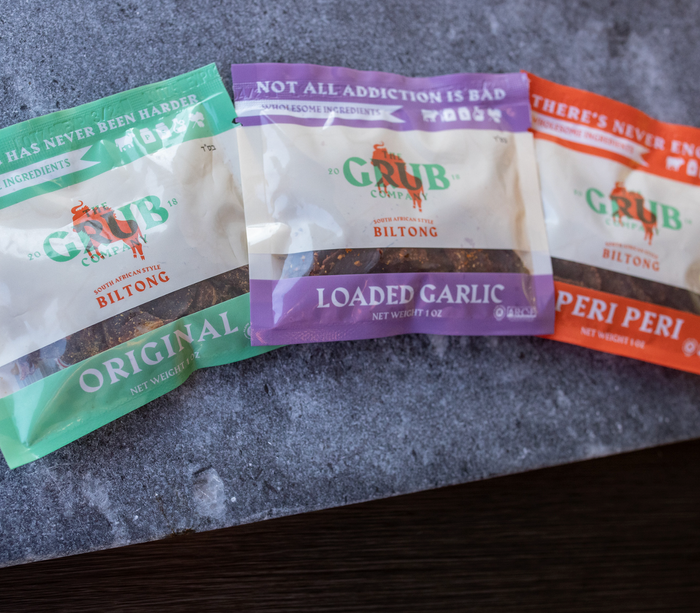
- Sliced Biltong Mini's at $4.99 are a portion. One person, one go. They are the right unit for handing out, for a lunch, or for topping up a bowl without opening something large.
- Sliced Biltong at $11.99 is the standard share bag. It is the unit most people picture when they think of buying biltong for a few friends.
- Biltong Sampler Pack at $12.99 is a tasting proposition rather than a volume one. It answers what do these taste like, not how do I feed twelve people.
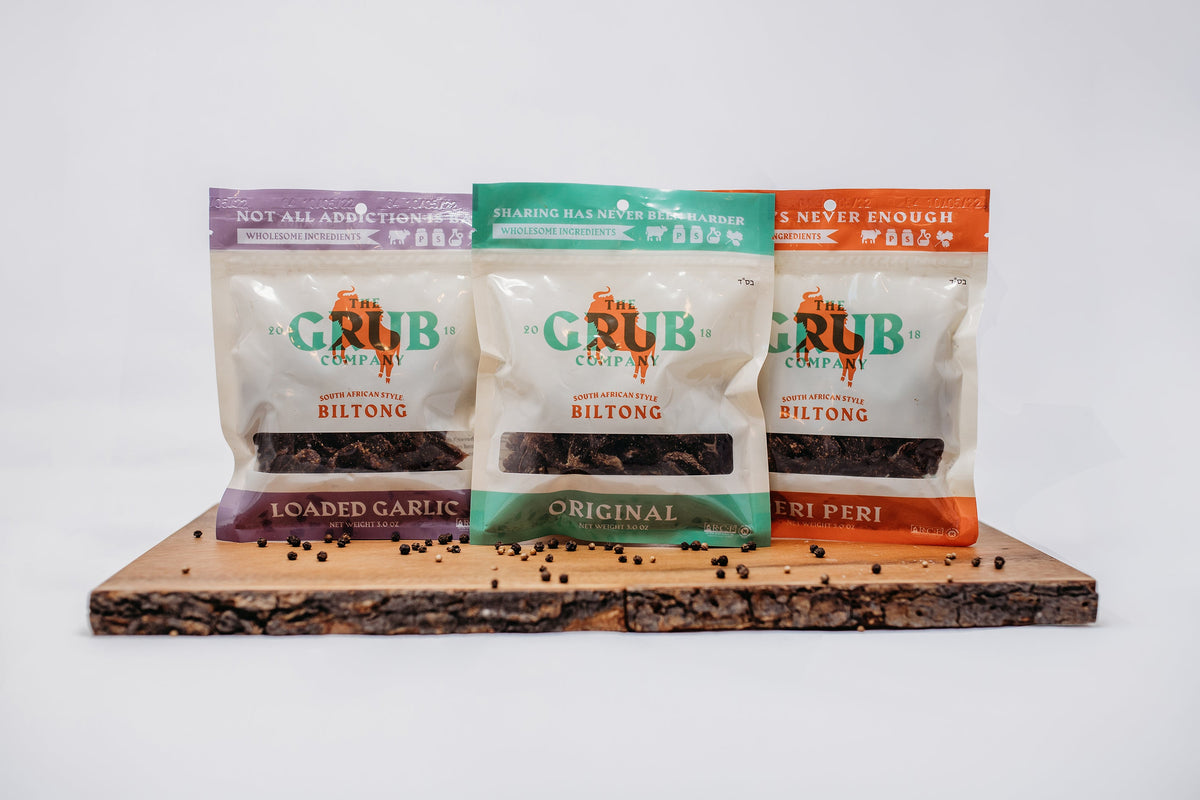
- Bulk Biltong, 1LB at $58.00 is the party unit and the only one where the weight is on the label. Everything you plan should be counted in these.
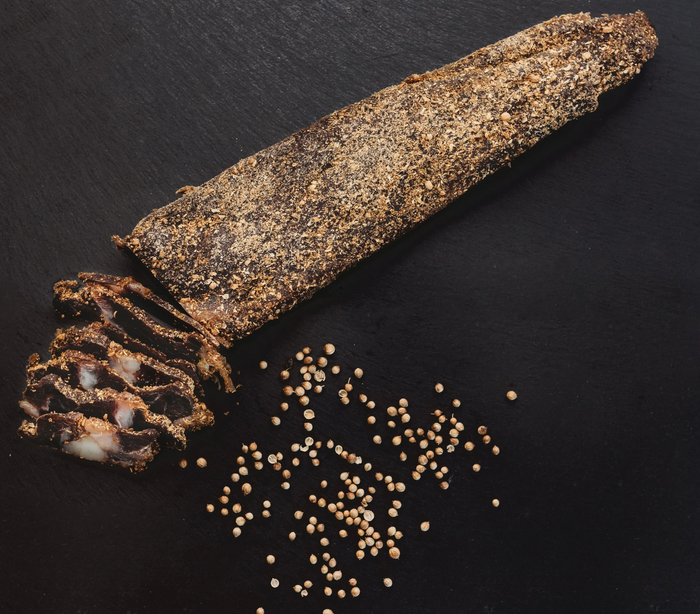
- Biltong Slabs at $58.00 is a different kind of object. It is dried whole and you cut it yourself, which makes it a centerpiece with a knife and a board rather than a bowl you set down and walk away from.
For an actual party, the pound is the workhorse and the smaller formats are the fine tuning.
Worked example: four people, an evening in
Biltong is one of two or three things on a low table, people are drinking, and this runs three hours. Call it one and a half ounces a head, so six ounces total.
That is comfortably inside a single Sliced Biltong at $11.99 with the option of a Mini's bag at $4.99 alongside it if the group is enthusiastic. Total spend somewhere between $11.99 and $16.98.
Buying a pound for four people would be over buying by a wide margin unless you actively want leftovers, which is a defensible position given that biltong keeps well and a bag of it in the cupboard is never a problem. If you would rather not, the pound is the wrong purchase at this size.
Worked example: eight people, biltong as one of several
Eight people, a full table with other snacks, three or four hours of grazing. One and a half ounces a head is twelve ounces.
Bulk Biltong at $58.00 gives you sixteen ounces, which covers it with four ounces to spare. That is $7.25 a head and there is meat left over. The alternative, if you would rather not go to a pound, is two Sliced Biltong bags at $11.99 each plus a couple of Mini's at $4.99, which comes to $33.96 and lands somewhere near the target without you knowing exactly where.
We would take the pound. It is the only option where you know what you are getting, and the leftovers keep.
Worked example: twelve people, biltong as the main snack
Twelve people, biltong is the point, the evening runs four hours or more. Two and a half ounces a head is thirty ounces.
Thirty ounces is just under two pounds. Two units of Bulk Biltong at $58.00 comes to $116.00 for thirty two ounces, which is $9.67 a head and a small margin over. If you want to trim it, one pound plus two Sliced Biltong bags at $11.99 gets you to something near twenty four ounces for $81.98, and you accept a slightly tighter run.
Our honest advice at this size is to buy the two pounds. Running out at a party you built around a single food is a worse outcome than a half pound left in the cupboard, and unlike most party food, the surplus does not spoil on you overnight.
Worked example: twenty people, a game day
Twenty people, several hours, biltong sharing top billing with other food. Two ounces a head is forty ounces, which is two and a half pounds.
Round up to three pounds at $58.00 each, so $174.00, or $8.70 a head. If the crowd is a known quantity and you are confident nobody is arriving hungry, two and a half pounds is achievable by buying two pounds plus a handful of Sliced Biltong bags at $11.99.
Twenty is also the point where format mix starts to matter as much as total weight, which is the next section.
Two bowls beat one bowl
Once you are past about ten people, splitting the same weight across two or three bowls in different parts of the room changes consumption. One bowl creates a line and a cluster, and a cluster empties a bowl. Two bowls at opposite ends of a room get picked at rather than raided.
It also protects you from the failure mode where the first six people through the door eat two thirds of what you bought. Hold a pound back, put out half of what you have, and refill once. That single habit is worth more than an extra pound of purchasing.
A slab at $58.00 does this job on its own, since a whole slab and a knife slows everybody down to the speed of cutting. That is either a feature or an annoyance depending on the party.
The cost per head, stated plainly
At $3.63 an ounce, the arithmetic is not complicated and we are not going to dress it up. One ounce a head is $3.63 per person. Two ounces is $7.25. Three ounces is $10.88.
For a light spread that is entirely reasonable against what any other decent snack costs per head. For an all evening graze where biltong is the main event, you are looking at ten dollars a person, and that is a real number that deserves a real decision rather than a shrug at a checkout.
The way to bring it down without under feeding anyone is to make biltong one of two or three good things rather than the only good thing. A pound alongside decent cheese and bread feeds a room. A pound alone in the middle of a table does not.
Where the arithmetic runs out
Two honest limits. The first is that we have quoted per ounce math off the pound because that is the format where the weight is stated. We are not going to back calculate weights for the other bags and present them as fact, so treat the smaller formats as adjustments rather than as precise units.
The second is that groups vary more than any formula allows for. A room of people who grew up on biltong will go through it at a rate that surprises anyone who did not. A room meeting it for the first time will nibble and then, about forty minutes in, stop nibbling and start eating. Both of those are real and neither is predictable from a headcount.
Use the numbers as a floor rather than a ceiling. Nobody has ever complained about the extra half pound.
Bottom line
One ounce a head when it is one of several snacks. Two ounces when it is the main one. Three when the party runs all evening and biltong is what people came for. Multiply by heads, then buy in pounds, because Bulk Biltong at $58.00 for sixteen ounces is the only format that lets you plan by weight rather than by guess.
For four people, one Sliced Biltong at $11.99 does it. For eight, one pound. For twelve, two pounds. For twenty, three. Split whatever you buy across two bowls and hold some back for a refill, and if you land long, the leftovers keep in a cupboard in a way that no other party food does.
Frequently Asked Questions
How much biltong per person should I plan for?
Two ounces a head when biltong is the main thing people are eating, and one ounce a head when it is one of several snacks on a full table. Push that to three or four ounces if the party runs all evening with drinks and no meal, because grazing raises total consumption well beyond what the same person would eat in one sitting. Bulk Biltong at $58.00 is one pound, or sixteen ounces, so it covers eight people as a main snack or about sixteen as part of a spread.
How many people does a pound of biltong feed?
Eight as a main snack at two ounces each, or around sixteen as one of several things on the table at one ounce each. Bulk Biltong, 1LB of Sliced Biltong at $58.00 works out at $3.63 an ounce, which puts a two ounce serving at about $7.25 a head. If the event runs four hours or more with no sit down meal, treat a pound as feeding five or six rather than eight, because standing and drinking raises how much people take.
What should I buy for a party of twenty?
Three pounds. At two ounces a head, twenty people need forty ounces, which is two and a half pounds, and rounding up to three units of Bulk Biltong at $58.00 gives you $174.00 total, or $8.70 a head, with a sensible margin. Split it across two or three bowls in different parts of the room rather than one large bowl, because a single bowl creates a cluster and a cluster empties it. Hold back a pound and refill once.
Is it cheaper to buy one large bag or several small ones?
Per ounce, the pound is the planning format and the only one where the weight is on the label, so it is the one to build a party around. Sliced Biltong at $4.99 in the Mini's size and $11.99 in the standard size are adjustments rather than volume purchases. For four people one $11.99 bag is right and a pound would be over buying. For eight or more, go to Bulk Biltong at $58.00 and use the smaller bags to top up.
Why does biltong disappear so much faster than other snacks?
Because the water is gone. An ounce of dried beef is far more meat than an ounce of almost anything else on the table, and nobody adjusts their handful size to account for that. The shape matters too. Slices are small and flat and easy to take one at a time, so there is no natural stopping point the way a bone or a large piece provides. Hosts who under buy almost always do so by about half.
What do I do if I buy too much?
Keep it. Unlike almost every other party food, properly dried biltong stored cool, dark and dry is not a problem the next morning. The salt and the low water activity that make it stable on a shelf are still doing their work after the guests leave. Reseal what is left, get the air out, and it will hold up for a good while. That is the main reason we tell people to round up rather than cut it fine.
Should I put out a slab or sliced biltong for a party?
Sliced, for anything where you want people to help themselves and you want to walk away. Biltong Slabs at $58.00 need a sharp knife, a board and somebody willing to cut, which turns them into a centerpiece rather than a self serve bowl. That is a real advantage at a sit down gathering where you want the pace slowed down, and a real nuisance at a busy room where nobody has a free hand.