What Are Biltong Slabs? A Guide for Game Day Hosts
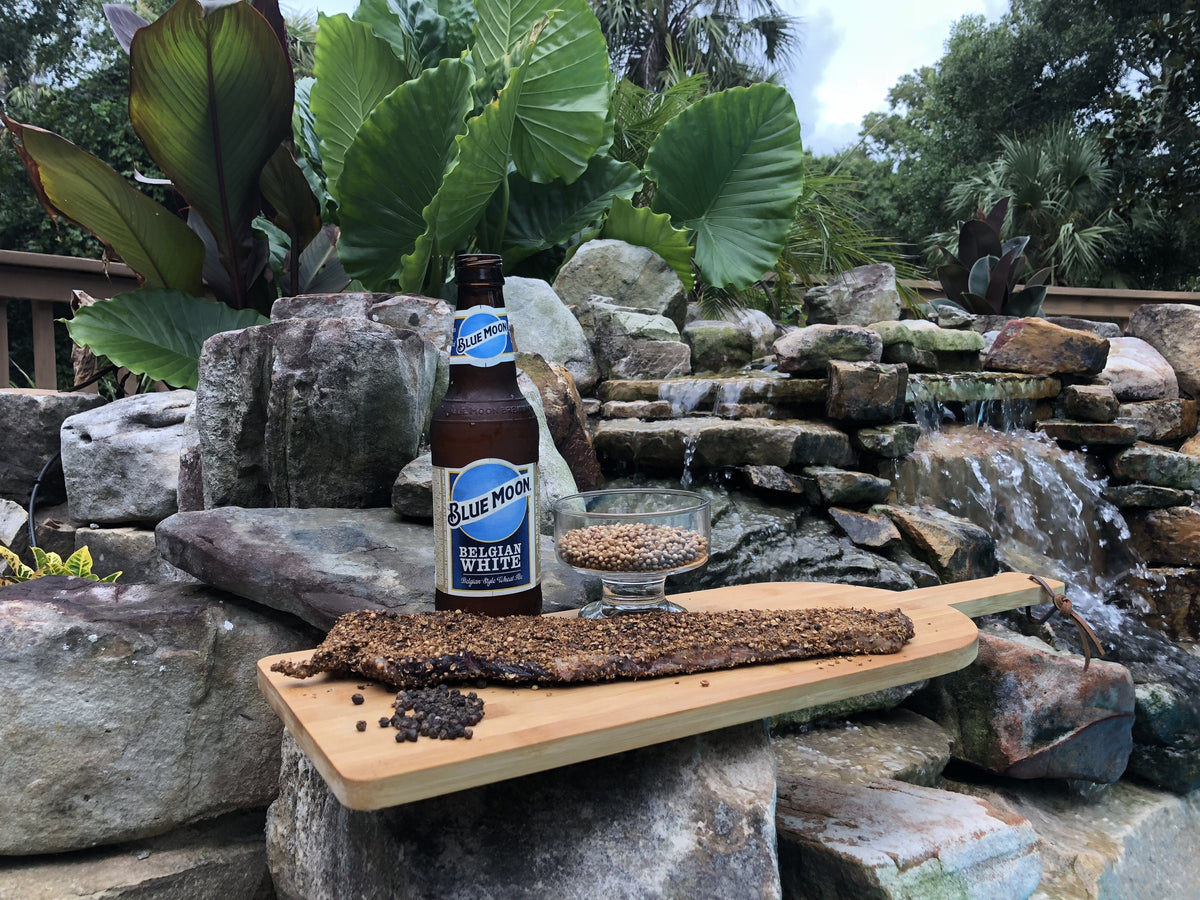
A biltong slab is a whole piece of beef, dried intact and never cut down, that you slice yourself when you are ready to eat it. Ours are $58.00. That single structural difference, dried whole and sliced later rather than sliced first, changes how it tastes, how long it stays good on a table, and who it makes sense for. For one person eating alone it is more work than it is worth. For a room full of people over an afternoon it is the format that actually holds up.
Want some on hand? Order biltong online: Glatt Kosher, air-dried in Florida, free US shipping over $50.
We are writing this for the host, because hosting is where a slab earns its keep. A bowl of pre-sliced biltong put out at kickoff is at its best in the first twenty minutes and slowly declining after that. A slab sitting on a board with a knife next to it is at its best whenever somebody decides to cut a piece, which is the entire argument.
What a slab actually is
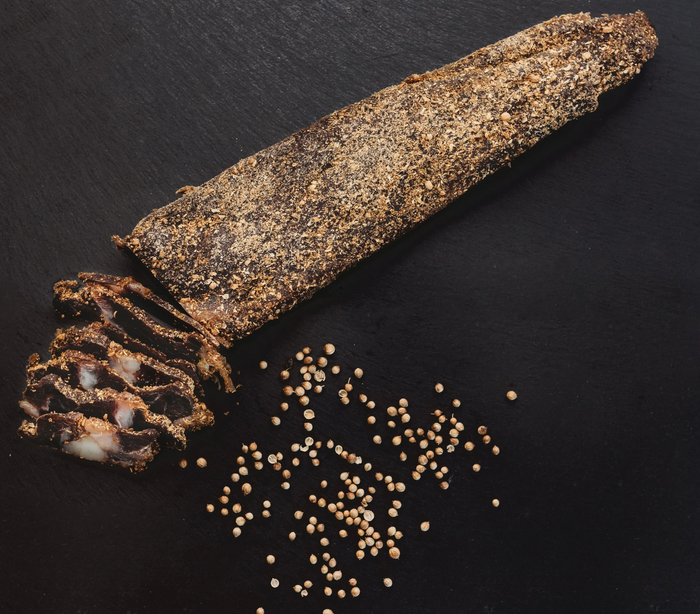
Start with the shape of the thing. A slab is a length of muscle that went into the drying room whole and came out whole. Nobody portioned it, nobody put it through a slicer, and nobody sealed it while it was still soft. It has an outside and an inside, and those two parts of the same piece of meat are noticeably different from each other.
That is not true of sliced biltong. When meat is cut into slices before or soon after drying, every slice is mostly surface. There is no protected interior left, because the interior became exterior the moment the blade went through. Sliced biltong is a genuinely good product and we sell plenty of it. It is simply a different object, and pretending the two are the same size of the same thing is how people end up disappointed with one of them.
Why drying whole makes an outside and an inside
Air only reaches a piece of meat at its surface. As water leaves through that surface, the outer layer firms up, darkens, and becomes a denser band. It is not a crust in the baked sense, more a graded shell that gets progressively softer as you move inward. The meat behind it stays redder, softer and shielded from the air.
That shell then slows everything that happens next. Oxygen has a harder time reaching the fat in the middle. Moisture has a harder time leaving. The piece is, in effect, storing itself. This is why a whole dried muscle keeps developing quietly for a long time while sliced meat settles into whatever it is going to be much sooner.
The flavor consequence, stated plainly
Cut into a slab and you get both parts of it in one slice. The firm outer band carries most of the concentrated flavor and most of the spice, because spice sits on the surface and nowhere else. The softer interior carries the moisture and the direct beef character. A slice that runs from one edge through the middle to the other edge is the whole piece in miniature, and it eats with more range than any single-texture product can.
Pre-sliced biltong trades that range for consistency. Every piece is roughly the same as every other piece, which is exactly what you want from something you are eating out of a bag while you work. It is not what you want on a board in front of people who are going to eat it slowly and talk about it.
Cutting to order is the point, not a chore
The reason a slab holds up over a long afternoon is that most of it is still uncut for most of the afternoon. Every slice you take exposes two new faces to the air, and those faces start drying and oxidizing the moment they are exposed. On a bowl of pre-sliced, that clock started before the bag was even opened, and all of it is running at once.
On a slab, the clock only runs on the small area you have cut. The rest of the piece is still sitting behind its own shell, unchanged. Cut six slices at a time rather than the whole thing at once and the last piece anyone eats is close to as good as the first. That is a hosting advantage that no packaging can give you.
What you need at the board
Very little, and none of it special.
- A sharp knife. Sharpness matters more than shape here. A dull blade tears dried meat rather than cutting it and gives you ragged, uneven pieces.
- A board with some grip. Dried meat slides more than you expect.
- Somewhere for people to put the pieces, which can be as simple as a small bowl next to the board.
A dedicated biltong cutter is a nice object and plenty of people own one. It is not required. A cook's knife you already sharpen will do the job, and a serrated knife works too, though it leaves a rougher edge on each piece. If you are the kind of host who puts out a cheese board and lets people help themselves, you already own everything you need.
Thickness is the dial you control
This is the part people underuse. On pre-sliced product, someone else already made this decision for you. With a slab you get to make it, and it changes the eating more than most people expect.
Thin slices are milder and easier to chew, which suits guests who have never had biltong before and are not sure about it. Thick slices give you the full range of the piece, the firm outer band and the softer middle in one bite, and they take longer to eat. A good move for a mixed room is to cut some of each and let people take what looks right to them. Nobody has to be told which one to pick.
Find the grain before you start
Look at the piece and you will see the direction the muscle fibers run. Cutting across those fibers shortens them and gives you a piece that bites through easily. Cutting along them leaves the fibers long and gives you the traditional chew that people who grew up on this stuff go looking for.
For a room of guests, across the grain is the safer default. It is less work to eat, it goes further in conversation, and it does not ask anyone to commit to a five minute chew while holding a drink. If you have a few people who know biltong, cut them a couple of pieces the long way and watch them notice.
How it holds through a whole afternoon
Game day is a long window. Food goes out early and people graze at it for hours, and most snack food does not survive that. Chips go soft. Dips warm up and separate. A bowl of anything sliced dries at the edges and starts looking tired.
A slab does none of that, because the part that is exposed to the room stays small. Dried beef is already stable at room temperature by design, which is the whole reason the food exists. It was made to travel and to keep without power. Sitting on a coffee table for four hours is nothing to it. The only real enemy is direct sun through a window, which warms the fat and speeds up the changes air is making to it, so put the board somewhere shaded and forget about it.
Feeding a room versus feeding a person
Here is where the format argument becomes a purchase decision. Dried beef is dense. A small amount of it goes further than the same visual volume of almost any other snack, because most of the water has been removed and what is left is concentrated meat. People eat less of it than they expect to and they eat it more slowly.
What that means for a host is that a slab does not need to look like a mountain to feed a room. What it does need is to be available for the whole event rather than gone in the first half hour, and cutting to order is what achieves that. A bowl gets emptied because it is there to be emptied. A slab gets sliced because someone wants a piece.
Where a slab is the wrong call
We would rather talk you out of it than have you buy the wrong format. Do not buy a slab if you want something to throw in a bag and eat in a car. Do not buy one if you are the only person eating it and you eat dried beef occasionally. Do not buy one as a first taste of biltong, because $58.00 is a lot of money to spend finding out whether you like a flavor.
For those situations we make Sliced Biltong at $11.99 and Sliced Biltong Mini's at $4.99, and the Biltong Sampler Pack at $12.99 exists specifically for people who do not yet know what they like. If you want volume of sliced product rather than a whole piece, Bulk Biltong, 1LB of Sliced Biltong is $58.00, the same price as the slab, and it is the right answer for anyone who wants a lot of ready-to-eat pieces with no knife involved.
Setting the board up so people use it
Guests are shy about cutting into a whole piece of anything. Left alone with an uncut slab and a knife, a lot of people will quietly decide it is not for them. The fix is to cut the first several slices yourself before anyone arrives and leave them fanned out next to the piece. That establishes what the object is and what you are supposed to do with it.
Say one sentence about it when the first person asks. Air dried beef, not smoked, cut it as thick as you like. That is genuinely all the explanation anyone needs, and it is more inviting than a long story about South Africa. People who like it will come back to the board on their own, and that is when the slab starts doing its job.
The questions you will get, and short answers
Put an unfamiliar piece of meat on a table and people ask about it. The questions are always the same three, so here they are with answers short enough to give while holding a plate. Is it raw? No. It was cured and then dried, which means it was never cooked and never left raw either. Salt, acid and air did the work that heat does in other foods.
Why is it not in the fridge? Because most of the water is gone and what remains is bound up by salt, so there is very little for spoilage organisms to work with. Dried meat existed long before refrigeration and this is the reason it did. And what is the spice? Coriander mostly, with pepper. Warm rather than hot. Three sentences covers every question a room will ask, and then you can go back to the game.
What else goes on the table with it
Biltong is salty, dense and dry, which tells you what it wants next to it. Anything with moisture and a little acid does well alongside, because it resets your palate between pieces. Pickles, a sharp cheese, a bowl of olives, fruit that leans tart rather than sweet. It also sits comfortably next to bread and butter, which sounds plain and is not.
What it does not need is another salty dry thing competing with it. Put two bowls of salted snacks side by side and people stop tasting either one properly. If the slab is the centerpiece of your board, give it contrast rather than reinforcements. Keep the board away from anything hot as well, since warmth is the one condition that genuinely works against dried meat over a long afternoon.
What to do with what is left
A slab almost never gets finished at one event, and that is fine, because the leftover is a better keeper than any opened bag. The uncut portion is still sitting behind its shell. Put it somewhere cool, dark and dry with some air around it. A paper bag or a cloth wrap in a cupboard is a better home for it than a sealed plastic bag, which traps whatever moisture is still coming out of the piece and holds it against the surface.
The cut face will keep drying and will get firmer over the following days. That is not damage. If it goes further than you want, cut thinner slices from it. The thinner you cut a firm piece, the softer it eats, which is a useful trick that works on any dried meat and costs nothing.
Bottom line
A slab is the format for feeding a room, and the reason is structural rather than sentimental. Dried whole, it keeps most of itself protected until the moment somebody cuts a piece, so the food on your table at hour four is close to the food that was there at hour one. You control thickness, you control grain direction, and the leftover keeps better than any opened bag. If you are buying for yourself and want convenience, buy sliced. If you are the person who puts out the food and wants it to still be good when the game ends, buy the slab.
Frequently Asked Questions
What is a biltong slab?
It is a whole piece of beef that was dried intact and never cut down, so you slice it yourself when you want to eat it. Because it dried as one piece, it has a firm darker outer band and a softer redder interior, and a slice cut through it gives you both at once. Sliced biltong is the same meat handled differently, portioned before or soon after drying, so every piece is mostly surface. Our Biltong Slabs are $58.00, the same price as Bulk Biltong, 1LB of Sliced Biltong.
How do I cut a biltong slab?
With a sharp knife on a board that does not slide. Sharpness matters more than the type of knife, because a dull blade tears dried meat instead of cutting it. Look at the piece first and find the direction the muscle fibers run. Cutting across the fibers gives pieces that are easier to bite through, which is the better default for guests. Cutting along them gives the long traditional chew. Vary the thickness on purpose, since thin slices eat mild and easy while thick ones give you the full range of the piece.
Why does a slab hold up better over a long party than a bowl of slices?
Because most of it stays uncut for most of the event. Every cut face is newly exposed to air and starts changing immediately. On pre-sliced biltong, every piece in the bowl is already fully exposed and all of them are changing at the same time. On a slab, only the small area you have cut is affected and the rest is still behind its own dried outer layer. Cut a few slices at a time rather than the whole piece and the last one anyone eats is close to the first.
Does a biltong slab need to be refrigerated?
No. Air dried beef is stable at room temperature by design, which is why the food exists at all. It was made to travel and keep without power. A slab sitting out on a board for an afternoon is entirely normal. Keep it out of direct sunlight and away from a heat source, since warmth speeds up the changes that air makes to the fat. For longer keeping, store the uncut portion somewhere cool, dark and dry with some air around it rather than sealed in plastic.
How should I store the leftover piece?
Give it air rather than sealing it. A paper bag or a cloth wrap in a cool dark cupboard is better than a zip-top bag, which traps moisture still coming out of the meat and holds it against the surface. The cut face will keep firming over the following days, which is normal and not a fault. If the piece gets firmer than you like, cut thinner slices from it. Thin slices off a firm piece eat much softer than thick ones, and that trick works on any dried meat.
Should I buy a slab or sliced biltong for a party?
Buy the slab if you want food that stays good for the whole event and you do not mind cutting it. Buy sliced if you want zero effort and people helping themselves from a bowl. Bulk Biltong, 1LB of Sliced Biltong at $58.00 is the volume answer with no knife involved. Sliced Biltong at $11.99 suits a smaller gathering. If some of your guests have never eaten biltong, the Biltong Sampler Pack at $12.99 alongside a slab is a reasonable way to give them a low-commitment first taste.
How do I get guests to actually eat it?
Cut the first several slices yourself and leave them fanned out next to the piece before anyone arrives. People are shy about being the first to cut into a whole piece of anything, and an uncut slab with a knife next to it reads as somebody else's project. Once slices are visible, the object explains itself. When the first person asks, one sentence covers it. Air dried beef, not smoked, cut it as thick as you like. Anyone who likes it will come back to the board on their own.