African Dried Cured Meat: What It Is and Where Biltong Fits
African dried cured meat is meat preserved with salt and acid and then hung in moving air until enough water has left it that it keeps on its own. No oven, no smoker, no heat driving the process. Biltong, the South African version made from beef, is the example most people outside the continent have actually eaten, and it is what we make. The category is wider than that one word, and anyone asking what African dried cured meat is deserves the method first and the product second.
Shop the real thing: buy biltong online, Glatt Kosher and made in Florida. US orders over $50 ship free.
What follows is the category as we understand it from standing inside it. Where a point would need a date, a region or an attribution we cannot stand behind, we have described the practice instead of asserting a history. That leaves the writing plainer and leaves you with more you can actually rely on.
The method is what defines the category
Every dried cured meat in this family is built the same way at the level that matters. Meat is cut into pieces that expose a lot of surface for their weight. The pieces are treated with salt, usually with an acid alongside it, and usually with spice. Then they hang in air that keeps moving over them until they have lost a large share of their water.
That is the whole architecture. Everything else is variation, and the variations are real, but they sit on top of one shared idea. The meat is never brought to a temperature that cooks it. Preservation comes from taking water out and making what remains a hostile place for anything that would spoil it.
This is why the category reads as one thing to anyone who works with it and as several unrelated snacks to anyone who has only met it in a bag. A whole hanging piece and a thin cut strip were made by the same process, at different points along it.
Salt first, then acid
Salt does the heavy work. It pulls water out of the meat by simple physics, and the water it pulls carries away part of what would otherwise let spoilage organisms get going. A piece that has been properly salted has already changed before it ever meets moving air.
Acid comes next, and vinegar is the usual choice. A wash of vinegar drops the surface pH, which matters most in the first hours when the meat is still wet and still vulnerable. It also leaves a background sourness that most people never consciously taste but would notice immediately if it were gone.
The two together are the cure. Neither is doing the job alone. Salt without acid leaves the surface open in the early window. Acid without enough salt leaves too much water in a piece that then has to dry faster than it should. The order and the balance are the parts a maker actually thinks about.
Air rather than heat
The dividing line in this whole category is that the meat dries in air at ordinary temperature rather than in heat. Warm, dry, moving air takes water off the surface. Water from deeper inside migrates outward to replace it. That migration takes time, and time is the ingredient nobody can shortcut.
Push the temperature up and you get a different food. The proteins on the outside set, the surface hardens, and the water still sitting in the middle can no longer get out easily. That is the whole of the difference between biltong and beef jerky, which is heat-dried, and it is the only paragraph this piece spends on that comparison because the category question is bigger than the pairing.
The trade-off with air is honest and worth stating. Air drying is slow, it needs the room conditions to behave, and it produces a less uniform result than a machine holding a set temperature. What you get back is a texture and a beef taste that heat cannot produce at any setting.
What actually keeps it, and it is not the moisture number
People assume a dried meat keeps because it is dry, and that is close enough to be misleading. The number that governs keeping is water activity, meaning how much of the water inside the meat is chemically available rather than how much water is present.
Salt, acid and the structure of the meat itself all bind water so that it is there but not usable. Two pieces can read the same on raw moisture and behave completely differently on a shelf because one has its water tied up and the other does not. This is why a slow, even dry beats a fast, hard one every time.
The practical consequence for anyone eating this food: a piece that feels dry on the outside is not necessarily finished. A fast dry sets a firm skin and traps available water in the middle. It feels ready and is not. Nothing about this is visible from a photograph, which is why the method a maker uses is worth more to you than any description of the result.
Where biltong sits inside all this
Biltong is the South African expression of the method, made from beef, cured with salt and vinegar, spiced with coriander among other things, and hung to dry in moving air. It is the most widely made and most widely sold member of the family, and it is the one this store exists to produce.
What separates it from other dried meats is the vinegar and the coriander together with a drying window that is usually shorter than the driest traditions in the category. Biltong is often eaten while it still has real moisture in it. Cut a good piece and the middle should be darker and softer than the edge.
That preference for a wetter finish is a genuine style choice rather than an accident. It gives more beef taste and less concentrated salt. It also gives a shorter comfortable window, since a wetter piece keeps changing faster than a drier one. Makers who dry harder are not doing it wrong. They are buying keeping time with texture, which is the oldest trade in this category.
Droewors, the other name worth knowing
Droewors is the dried sausage of the same tradition, made by taking a spiced sausage and hanging it to dry the same way a whole piece of muscle would be hung. It is a food type rather than anybody's product name, and it belongs in any honest answer about South African dried meat.
Because it is ground meat in a casing rather than a solid muscle, it dries differently. There is no grain to slice across and no interior to protect, so the whole thing firms up together and ends up drier throughout than a comparable piece of biltong.
We do not make it. We mention it because someone asking about the category and hearing only about biltong has been given a partial answer, and a partial answer from a seller is usually a sales pitch wearing a coat.
The cut, and why it is chosen
Silverside and topside are the cuts most associated with biltong, and the reasons are structural rather than romantic. Both come from the back leg, both are lean, and both have long muscle fibers running one way, which yields long pieces that hang well.
Direction matters more than most people expect. A piece cut along the grain dries evenly and eats with a fibrous pull that people either love or find hard work. A piece cut across the grain gives shorter fibers and a softer bite. Neither is an error, but a maker choosing between them is choosing what the eating experience will be.
Lean is preferred because lean dries predictably. A cut riddled with connective tissue dries around it rather than through it, and connective tissue does not soften without heat and moisture, which is precisely what this method removes.
Fat and lean do not behave the same
Fat does not dry. Water leaves lean muscle and the muscle changes. Fat has very little water to lose, so it stays roughly what it was while everything around it shrinks and firms.
That gives a piece with fat on it a split personality. The lean goes chewy and concentrated, the fat stays soft and rich, and biting through both at once is the reason many people prefer fatty biltong. It is also the reason fatty pieces have a shorter comfortable life. Fat carries taste, and over enough time exposed fat changes character in ways lean does not.
So a maker keeping fat on is choosing eating quality over keeping time, and one trimming it back is choosing the opposite. Anyone who tells you their way is simply better has skipped past the trade they made.
Whole and hanging, or cut and bagged
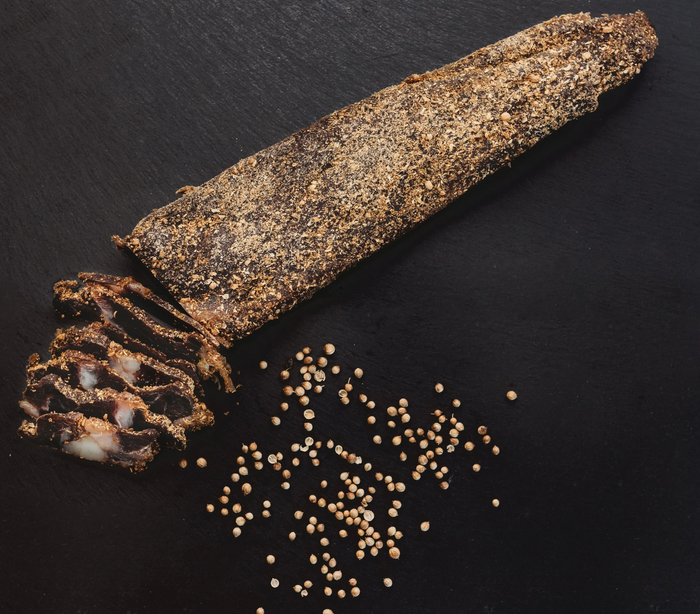
The single biggest format decision in this category is whether the meat is dried whole and cut later or cut before it finishes drying. A slab dried whole exposes very little surface for its mass, so its interior stays softer and its water leaves slowly and evenly. It is sliced when somebody wants to eat it.
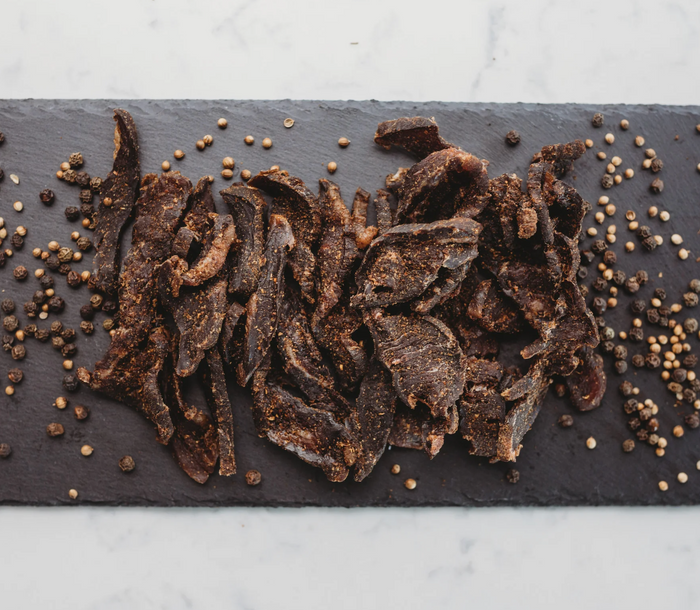
Meat that is cut thin and then dried, or cut soon after drying, reaches you ready to eat. It carries far more cut surface, so it takes on more spice per bite and its texture is consistent from the first piece to the last. It also carries on drying in the bag faster than a whole piece would, because there is so much more surface for water to leave from.
Both are legitimate. Our Biltong Slabs at $58.00 are the whole-piece version and Sliced Biltong at $11.99 is the ready-to-eat one. The choice between them is not about quality. It is about whether you want to do the last step yourself.
Coriander, and why spice is not decoration here
Coriander is the spice most associated with biltong, and it does more than season. Whole seed, toasted and cracked, gives a warm citrus note that sits against the sourness of the vinegar and stops the salt from being the only thing you taste.
Spice in this category goes on before drying rather than after, which changes what it does. It is on the meat through the entire time water is leaving, so it works into the surface rather than sitting on top of it. This is why dried meat spicing tastes integrated in a way that a sprinkle at the end never does.
Every maker has a hand of their own here, and the differences between two well-made pieces of biltong are often more about spice balance than about anything else. That is the part of this craft that stays genuinely personal.
The texture range, from wet to hard
If you lined up everything in this category by dryness you would get a long spectrum rather than two camps. At the wet end sits meat pulled early, soft in the middle, tasting mostly of beef, with weeks rather than months of comfortable life. At the dry end sits meat taken much further, hard, concentrated, spice-forward and stable for a long time.
Both ends have people who consider them the only correct version, and both are wrong to be certain. Where a piece sits on that line is a decision, made by a maker who knew what they were giving up.
For someone new to the category, this spectrum is the thing worth understanding before spending real money. Most disappointing first purchases are not bad products. They are products sitting somewhere on this line that the buyer did not expect.
How to try the category without guessing
The honest advice is to start small and start with variety, because the useful question is not whether you like African dried cured meat in the abstract. It is which point on the dryness and spice range suits you.
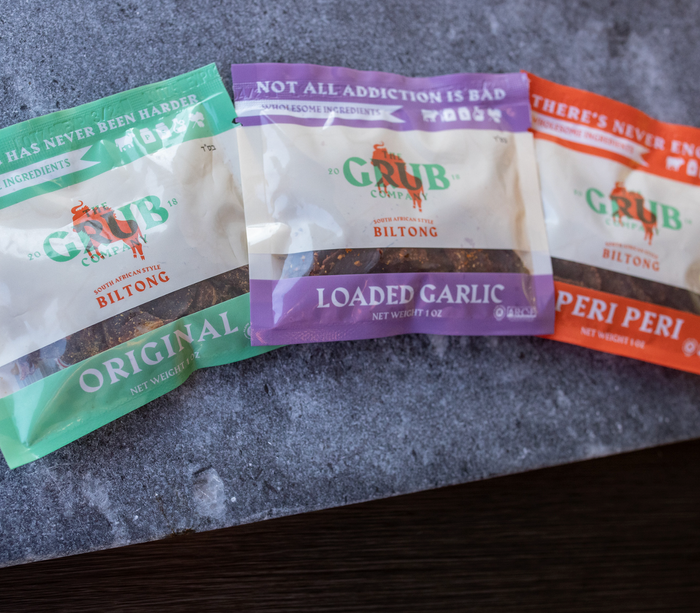
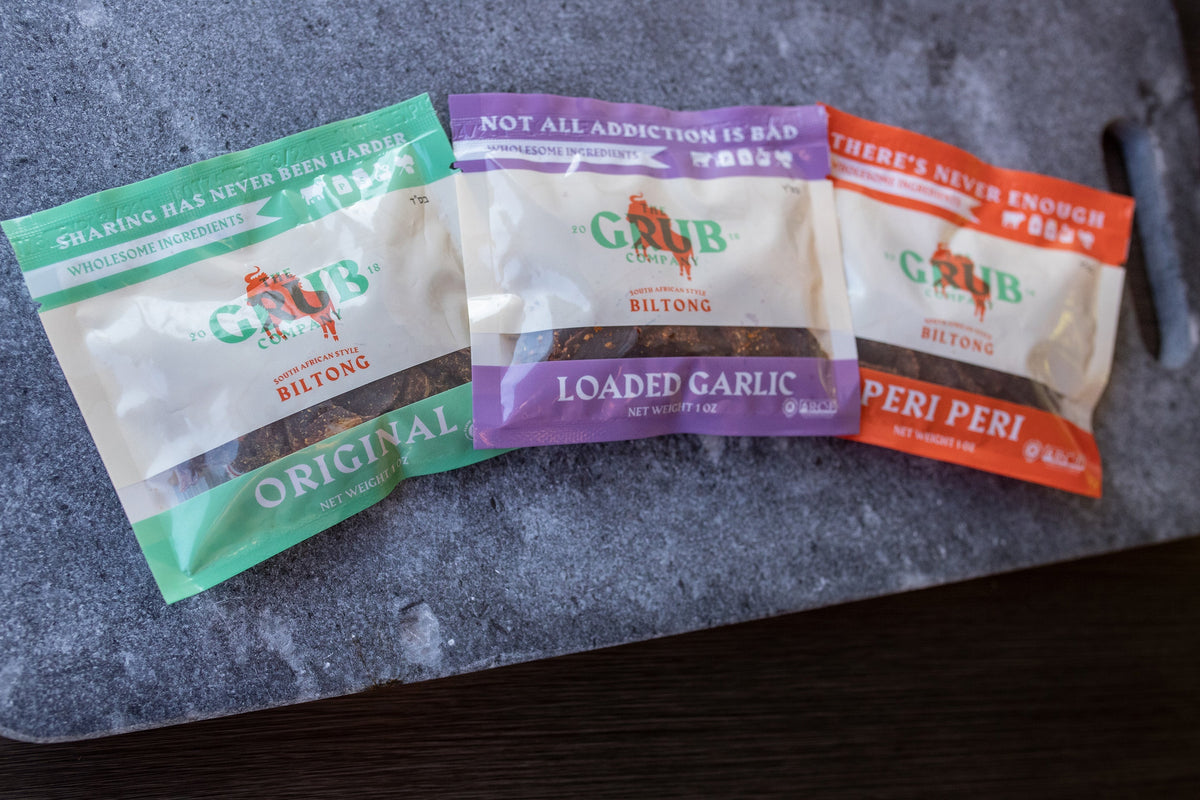
- Biltong Sampler Pack at $12.99. The sensible first purchase, because it answers the range question in one sitting rather than across three separate orders.
- Sliced Biltong Mini's at $4.99. The smallest way in, for anyone who wants to spend as little as possible finding out.
- Sliced Biltong at $11.99. The everyday size once you know you like it.
- Biltong Slabs at $58.00. Whole pieces you cut yourself, the closest thing by mail to a butcher counter slicing to order.
- Bulk Biltong, a full pound of sliced, at $58.00. A restock order for people who already know their own pace.
- Meat Candy at $7.99. The jerky in our lineup, there for people who want the heat-dried style alongside.
We would not start at $58.00. A full pound is a commitment made on information you do not have yet.
What we will not claim
There is a version of this article that opens with a confident story about who first hung meat in African air, when, and why. We have not written it, because we would be repeating something we cannot verify and dressing it up as knowledge.
What can be said without inventing anything is that hanging salted meat in hot dry moving air is a method that works, that it needs no equipment beyond salt and airflow, and that it produces food that keeps in places and periods where refrigeration was not available. The practice explains itself.
We would rather be the seller who tells you where the solid ground ends. Everything above about salt, acid, water activity, cuts, fat and format is craft we work with directly. The origin stories are somebody else's field and we have left them there.
Bottom line
African dried cured meat is a family of preserved meats built on one method: cure with salt and acid, spice it, and let moving air take the water out over time without cooking. Biltong is the beef version from South Africa and the one you are most likely to be able to buy. Droewors is the dried sausage of the same tradition. The differences that matter across the whole category are dryness, cut, fat and spice, and every one of them is a trade somebody chose.
If you are meeting the category for the first time, the Biltong Sampler Pack at $12.99 answers more questions per dollar than anything else we sell. Once you know where you sit on the dryness range, everything else in the lineup becomes an easy choice.
Frequently Asked Questions
What is African dried cured meat?
It is meat preserved by curing with salt and usually an acid such as vinegar, spicing it, and then hanging it in moving air at ordinary temperature until enough water has left it that it keeps on its own. Nothing is cooked and nothing is smoked. The best known example available in America is biltong, the South African beef version. Droewors, a dried spiced sausage, belongs to the same tradition. The unifying idea is not a recipe but a method: take the water out slowly, with salt and acid doing the early work and airflow doing the rest.
Is biltong the same as African dried cured meat?
Biltong is one member of the category rather than the whole of it. It is the South African beef version, cured with salt and vinegar, spiced with coriander among other things, and air dried. Because it is the most widely made and most widely exported example, the two terms often get used as if they were the same thing. They are not. The category also covers dried sausage such as droewors and covers a wide range of dryness levels and spice styles, some far harder and more concentrated than typical biltong.
How is it preserved without cooking or refrigeration?
Through water. Salt draws water out of the meat and binds part of what stays behind. Vinegar drops the surface pH during the vulnerable early hours. Then moving air carries water off the surface while water from deeper inside migrates outward to replace it, over hours and days rather than minutes. What actually governs keeping is water activity, meaning how much of the remaining water is chemically available, not the raw moisture percentage. A piece can feel dry and still hold available water in the middle if it was dried too fast.
What is droewors?
Droewors is a dried spiced sausage from the same South African tradition as biltong, made by hanging sausage to dry in air rather than by cooking or smoking it. Because it is ground meat in a casing rather than a solid piece of muscle, it dries all the way through more evenly and typically ends up firmer and drier than biltong of a similar age. There is no grain to slice across, so it is usually eaten as whole sticks or broken pieces. We do not make it, but any honest answer about South African dried meat should name it.
Which cuts of beef are used?
Silverside and topside are the cuts most associated with biltong. Both come from the back leg, both are lean, and both have long muscle fibers running in a consistent direction, which means they hang well and dry predictably. Lean matters because fat does not dry, and heavy connective tissue never softens under a method that uses no heat and no moisture. The direction of the cut changes the eating as much as the cut itself, since slicing along the grain gives a longer fibrous pull and slicing across it gives a softer bite.
Why is it so hard to find in American stores?
American grocery distribution was built around heat-processed, hard-sealed, shelf-stable snacks, and air-dried meat is naturally none of those. To survive a slow route through several warehouses, a dried meat generally has to be made drier and saltier than the maker would otherwise choose. So what does reach a shelf is often the least representative version of the category. Buying direct from someone who dries it keeps the chain short enough that the product does not have to be rebuilt for the journey, which is why online is the normal way to get it rather than a fallback.
What should I buy first if I have never tried it?
The Biltong Sampler Pack at $12.99. The question that decides whether you like this category is not really beef versus something else, it is where on the wet-to-dry range your taste sits, and a sampler settles that in one sitting. If you want to spend less to find out, Sliced Biltong Mini's at $4.99 is the smallest bag we make. Once you know what you like, Sliced Biltong at $11.99 is the everyday size, and Biltong Slabs at $58.00 or Bulk Biltong at $58.00 are restock orders rather than opening moves.