Low-Sodium Beef Jerky: What the Label Means, and Where Biltong Fits
Real low-sodium beef jerky is hard to find, because salt is what makes jerky safe to store. Read the Nutrition Facts panel, not the front of the bag, and treat any cured meat as a salty food, our own certified Glatt Kosher biltong included.
Related: Salty Snacks: Better Ones Than Chips, and When Salt Is the Point
We make certified Glatt Kosher biltong and beef jerky, so we spend our days thinking about salt. Here is the straight version of what "low sodium" means on a label, why jerky resists it, and where biltong fits. We will also tell you when neither is the right snack for you.
Why jerky is salty to begin with
Jerky is dried meat. Drying alone is not enough to keep it safe on a shelf for months. Salt does the other half of the job.
Salt pulls water out of the meat. It makes the surface a hostile place for bacteria. It also firms the texture and carries flavor. Take most of it away and you no longer have the same product. You have meat that needs a refrigerator.
That is not a modern shortcut. People have salted meat to preserve it for thousands of years. In kosher meat, salt does a second job, because meat is salted and rinsed to draw out blood. We wrote about that link in Salt, Kashrut, and Cured Meat.
So the honest starting point is this. Cured meat is salty by nature. A jerky can be less salty than another jerky. It cannot be a low-salt food in the way an apple is.
What "low sodium" on a label actually means
On a food package in the United States, "low sodium" is not a casual phrase. The FDA regulates it as a defined nutrient claim. A product may only use it if it stays under a fixed sodium limit for a serving. The wording on the front of the bag has to be backed by the numbers on the panel.
Under the federal rule, 21 CFR 101.61, a food can say "low sodium" only if it has 140 mg of sodium or less per serving, and "very low sodium" means 35 mg or less. Small-serving foods like jerky face an extra test on top of that. What matters for shopping is the pattern below.
- "Low sodium" is a regulated claim with a numeric ceiling. If a bag says it, the panel should back it up.
- "Reduced sodium" is a comparison. It means less than the maker's own regular version. A reduced-sodium jerky can still be a salty jerky.
- "Lightly salted," "less salty" and "no salt added" are marketing language or have narrower meanings. Do not treat them as a promise about the number on the panel.
- "Natural" and "uncured" say nothing about sodium. Many jerkies marketed that way still lean on salt, plus soy sauce or celery-based curing agents.
The rule that works every time is simple. Turn the bag over. Find the serving size. Find the sodium line. Then compare the sodium to the serving size, not to the bag.
How to read a jerky label for sodium
Four steps. They take thirty seconds in a store.
- Check the serving size first. A small serving makes the sodium number look friendlier. A bag that says 3 servings may be one sitting for you.
- Find the sodium line and the % Daily Value. The % Daily Value tells you how much of a day's limit one serving uses. It is the fastest way to compare two bags.
- Scan the ingredients for hidden salt. Soy sauce, teriyaki, Worcestershire and many seasoning blends all add sodium on top of the salt itself. Our guides on soy sauce in jerky and Worcestershire explain why they also create kosher problems.
- Compare per ounce, not per bag. Bags come in different sizes. Divide so you are comparing like for like.
One more habit helps. Do not let sweetness fool you. A sugary glaze can cover salt on the tongue. A sweet jerky can carry as much sodium as a savory one.
Where biltong fits
Biltong is not a low-sodium food either. We say that plainly, because some people assume that "air-dried" means "light on salt." It does not.
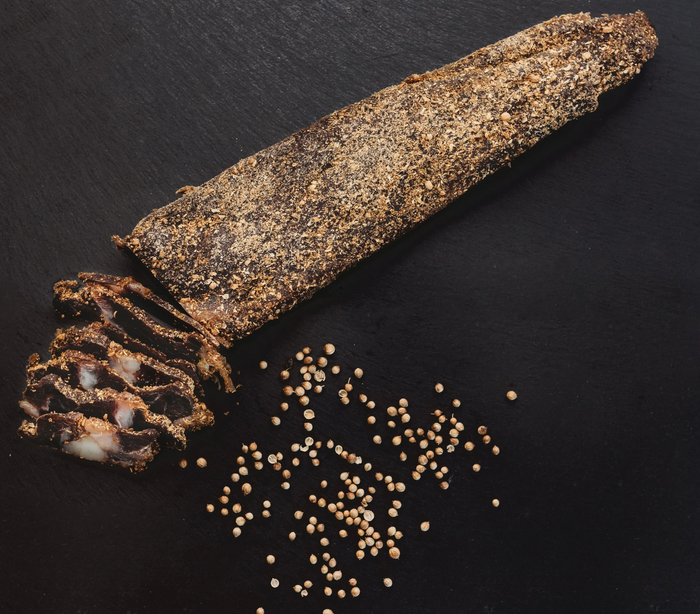
Biltong is salted before it is spiced, then cured with vinegar and dried in moving air. We explain the reason in Why Biltong Is Salted Before It Is Spiced. The salt is doing the preserving, exactly as it does in jerky.
Kosher biltong is salted twice, for two different reasons. First, the raw meat is koshered. In melichah, the meat is soaked, covered in coarse salt to draw out blood, then rinsed thoroughly. That salt is rinsed off, and it does not preserve the meat. Then the biltong cure uses salt, vinegar and spice to make it shelf-stable. We cover how the two connect in Salt, Kashrut, and Cured Meat.
Here is what is different, and it is worth knowing.
- Short ingredient lists. Our Original Sliced Biltong is grass-fed kosher beef, coriander, black pepper, salt, garlic and vinegar. No soy sauce. No Worcestershire. No glaze. The salt is in the list because it has to be.
- No marinade soaking in sauce. Many jerkies sit in a wet marinade, and every ingredient in it can add sodium. Biltong is dry-seasoned.
- Nothing hiding in the sauce. With a short list, you can see what is in the bag. You can judge it for yourself.
What we will not do is hand you a sodium figure we cannot stand behind in this article. Read the Nutrition Facts panel on the bag you are holding. That is the number that counts, and it is printed on every bag.
For a closer look at protein and sodium together, see Is Biltong Healthy? Protein, Sodium, and What's Actually in the Bag.
Ways to enjoy cured meat when you are watching salt
If you have been told to cut back on sodium, the answer is not always to avoid jerky or biltong forever. It is to treat them as the salty foods they are. A few habits make that work.
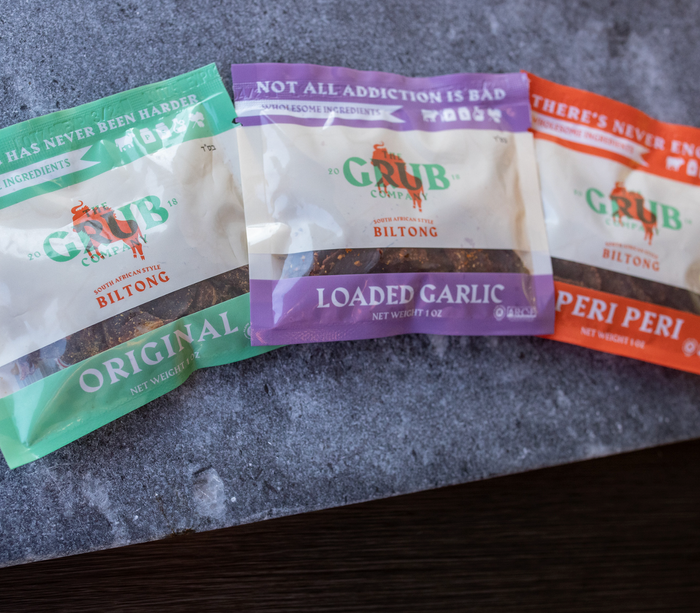
- Buy small bags. The sampler or one-ounce bags make portioning automatic. A Biltong Sampler Pack gives you three small bags. It is a good way to taste the range without opening a big bag and eating through it.
- Treat it as a flavor, not a base. A few slices of biltong on a salad or a board does a lot of work. A whole bag as a meal is a different matter.
- Pair it with unsalted food. Fruit, raw vegetables or unsalted nuts balance the plate.
- Drink water. This is not medical advice. It is just the obvious thing to do with a salty snack.
- Watch the rest of your day. A cured-meat snack matters more on a day when everything else is also salty.
Our biltong collection lists every size and flavor, so you can pick the smallest bag that suits you.
When biltong is the wrong pick
Biltong is the wrong pick if a doctor has told you to follow a strict low-sodium diet. In that case, do not shop by marketing words. Ask your doctor or dietitian for your daily limit, then check each food against it. A cured meat snack may simply not fit, and that is fine.
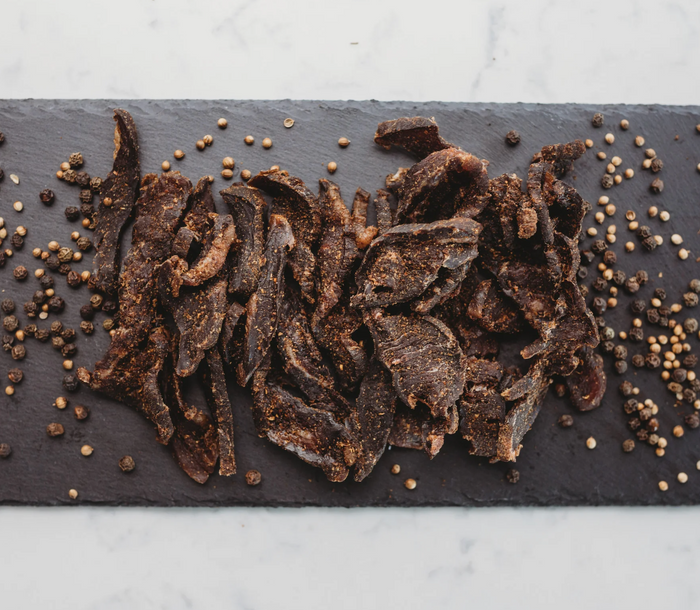
It is also the wrong pick if you want a soft, sweet chew. Biltong is savory and dry-cured. If you like a sweet glaze, our cooked kosher beef jerky is the closer match. It is a different product, not a lower-salt one. Sweet does not mean less sodium.
If low sodium is your priority, here are the options we would suggest looking at.
- Fresh or home-roasted meat, where you control the salt.
- Plain cooked chicken or turkey from your own kitchen, kept on the right side of your meat and dairy separation.
- A snack that is not cured meat at all, if sodium is your main limit.
The bottom line
Jerky and biltong are salty because salt is what keeps them safe. A "low sodium" claim is a regulated phrase, so check it against the Nutrition Facts panel. Read serving size first, compare per ounce, and ignore front-of-bag buzzwords. If you do eat cured meat, choose a short ingredient list, keep the portion small and know that it is a salty food. All of our meat snacks are certified Glatt Kosher, and US orders over $50 ship free.
Frequently Asked Questions
Is there such a thing as low-sodium beef jerky?
Rarely. Salt is what preserves jerky, so real low-sodium jerky is the exception, not the rule. Some brands use less salt than others, but less salt is not the same as low sodium. Always check the Nutrition Facts panel rather than trusting the front of the bag.
What does "low sodium" mean on a food label?
It is a defined claim regulated by the FDA. A food can only use it if it stays under a set sodium limit per serving. The rule is in 21 CFR 101.61, which you can read on fda.gov or ecfr.gov.
Is "reduced sodium" the same as "low sodium"?
No. "Reduced sodium" only means less than the maker's regular version of that product. A reduced-sodium jerky can still be high in sodium. Compare the number on the panel.
Is biltong lower in salt than jerky?
Not automatically. Biltong is salted and vinegar-cured, so it is a salty food. The difference is a shorter ingredient list with no sauce or glaze, which makes it easier to see what you are eating. Check the panel on each bag.
Is Grub's biltong low sodium?
No. We do not sell it as a low-sodium food. Salt is in the ingredients because it preserves the meat. Our Original biltong is grass-fed kosher beef, coriander, black pepper, salt, garlic and vinegar. Read the Nutrition Facts panel on the bag for the exact sodium.
How can I eat jerky or biltong if I am watching my sodium?
Keep portions small, buy one-ounce bags, and pair it with unsalted foods. Count it against your day's total. If you have a medical sodium limit, ask your doctor or dietitian whether it fits.
Why does kosher meat taste salty?
Mostly because it is cured, not because it is kosher. Kosher meat is salted and rinsed to draw out blood, and that salt is rinsed off. A cured snack like biltong is then salted again for preservation, and that cure is what makes it salty. Ask your rabbi about any question on how the salting works.