Types of Biltong: Cuts, Formats and Thickness Explained
There are three things people mean by "types of biltong": the cut of beef it was made from, the format it is sold in, and how far it was dried. All three change the eating experience more than flavor does. This guide covers each, and ends with a table telling you which combination to buy for what.
Where to get it: Glatt Kosher biltong for sale, made in Florida and shipped anywhere in the US (free over $50).
Type 1: the cut of beef
Biltong is made from lean, long-grained muscle. Cuts with heavy marbling do not work, because fat does not lose water the way muscle does — it stays soft while the meat around it dries, and it can go rancid before the piece is stable.
| Cut | Character | What it produces |
|---|---|---|
| Silverside | Very lean, long straight fibers, firm | The classic. Clean shred, holds shape, dries evenly. The benchmark cut. |
| Topside | Lean, slightly softer, a little more give | More tender, slightly higher yield, less structure |
| Eye of round | Extremely lean, uniform | Very consistent pieces; can be austere on its own |
| Sirloin / rump | More fat, richer | Richer flavor, shorter shelf life, harder to dry evenly |
| Brisket / forequarter | Fattier, coarser grain | Used where hindquarter is unavailable; needs careful trimming |
Most serious makers use a blend, usually silverside-led with some topside. The ratio is a real production decision: silverside gives structure and consistency, topside gives tenderness and yield. Shift it too far toward topside and pieces lose their shape in the bag; too far toward silverside and the result can be tough.
Grass-fed versus grain-fed
Grass-fed beef is leaner and more deeply flavored, with a firmer texture. Grain-fed is fattier and milder. For biltong, leaner is generally better, because the drying works more predictably and there is less fat to oxidize. Grass-fed biltong also tends to be darker.
Type 2: the format
This is the choice you actually make on a product page, and it matters more than most buyers expect.
| Format | What it is | Typical size | Best for | Trade-off |
|---|---|---|---|---|
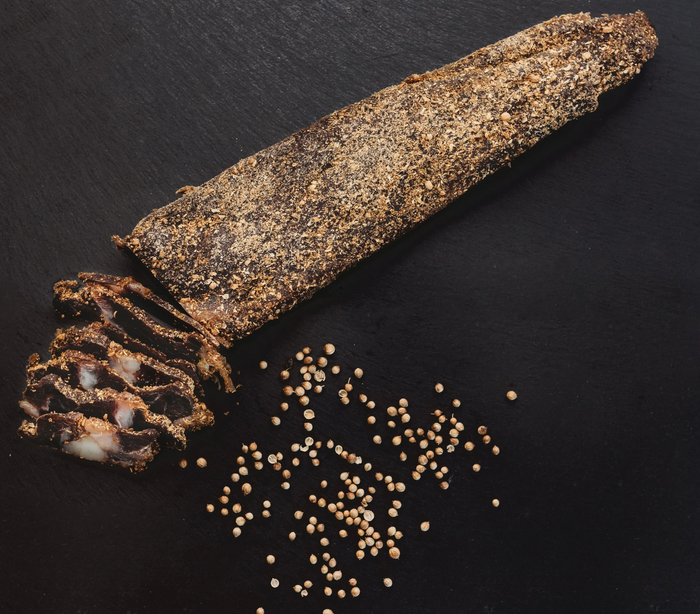
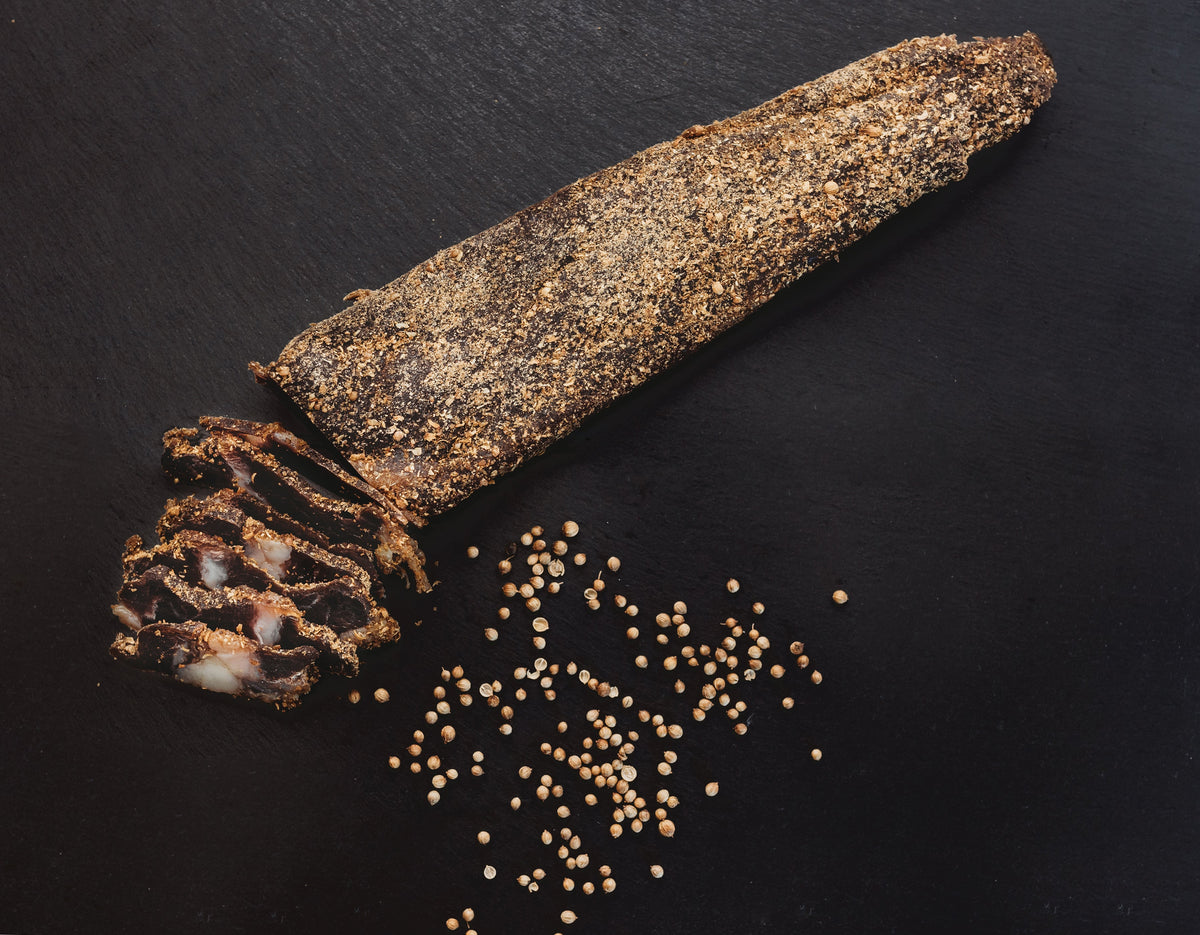
| Slab | A whole dried strip, uncut | ~1 lb | Boards, hosting, slicing to taste | You need a sharp knife and a minute |
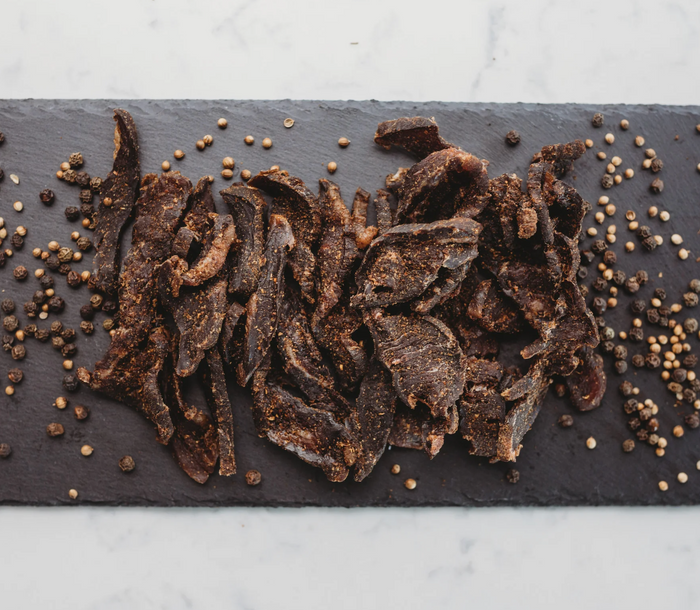
| Sliced | Cut across the grain into pieces | 3 oz bags | Everyday eating, sharing, lunchboxes | More surface area, so it dries faster once open |
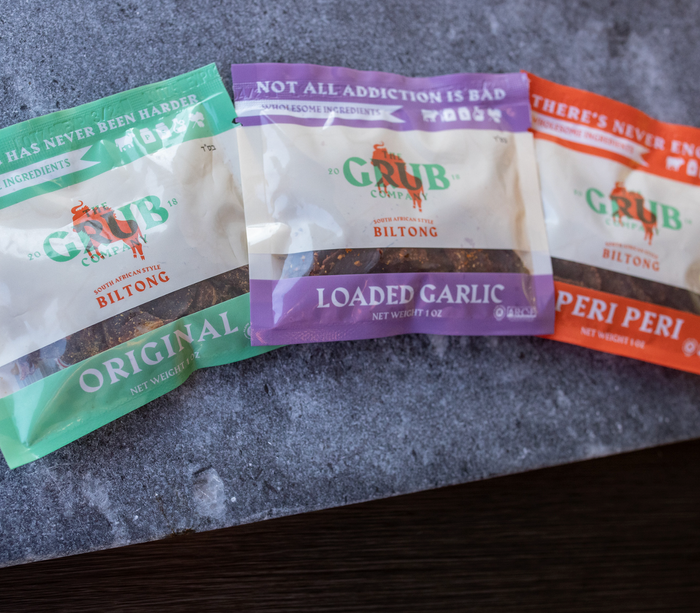
| Minis | Smaller pieces, single-serve bags | 1 oz | Trying flavors, gym bags, kids, travel | Highest cost per ounce |
| Bulk sliced | Sliced, in quantity | 1 lb | Households, offices, meal prep | Must be portioned on arrival |
| Sampler | Mixed flavors, small quantities | ~3 oz mixed | First order, gifts | Not enough of any one to settle in with |
| Sticks / droëwors | Dried sausage, biltong spice profile | Varies | Snacking on the move | A different product, not biltong |
| Chili bites | Small, drier, spiced pieces | Varies | Heat seekers, beer snacks | Drier by design; not for everyone |
Slab versus sliced — the real difference
A slab is not just an unsliced bag. It behaves differently.
Because a slab has far less exposed surface area, it holds its moisture much better once opened. A slab left out for a week is still good; sliced biltong left out for a week is jerky-hard. A slab also lets you choose thickness at the moment of eating, which is genuinely useful — thick for chewing, paper-thin for a board.
The trade-off is friction. Sliced biltong is ready. A slab requires a knife, a board and thirty seconds, and that is enough to stop most people most of the time. Buy a slab if you enjoy the ritual or you are serving people. Buy sliced if you want to eat it in the car.
Type 3: how far it was dried
This is the axis South Africans argue about, and it is entirely preference.
| Style | Character | Suits |
|---|---|---|
| Wet | Soft, deep red core, yields immediately | People new to biltong; anyone who dislikes chewy snacks |
| Medium | Firm edge, tender center — the standard | Most people, most of the time |
| Dry | Firm throughout, shreds, intense flavor | Traditionalists; long keeping; strong flavor |
A useful fact: you can move down this table at home but not up. Leave a bag open overnight and medium becomes dry. There is no way to add moisture back without ruining it. So if you are unsure, buy on the wetter side and dry it to taste.
Thickness
Slice thickness changes the eating experience as much as dryness does. Thin slices — under 2 mm — read as delicate and disappear quickly; good on a board with cheese. Standard slices of 3–5 mm are the everyday format. Thick cuts of 8 mm or more are for chewing slowly, and are what most people picture when they think of biltong.
Flavors
Flavor is the last thing to worry about, not the first, because the cut and the dryness decide texture and texture decides whether you enjoy it.
- Original — coriander, black pepper, salt, garlic, vinegar. The reference point. Start here.
- Peri Peri — real heat, built on red pepper, usually with a little sugar for balance.
- Garlic — roasted garlic forward, savory rather than hot.
- Chili bites — heat plus a drier texture.
- Smoked and BBQ variants — closer to jerky in profile; less traditional.
One practical note: judge a maker on their Original. It is the blend with nowhere to hide. If the Original is good, the flavored versions will be too.
Which should you buy?
| Situation | Buy |
|---|---|
| Never had biltong | 3 oz sliced, Original, medium dry |
| Deciding between flavors | Minis, one of each |
| Feeding a household weekly | Bulk sliced, portioned on arrival |
| Hosting or building a board | Slab, sliced thin at the table |
| Gym bag or desk drawer | Minis — the portion control is the point |
| Kids | Minis, Original, on the wetter side |
| Long trip or camping | Slab — it survives being opened for days |
| Gift for someone you do not know well | Sampler or mixed minis |
| You found jerky too sweet | Sliced Original — it is the opposite end |
| You like it very chewy | Any format, then leave the bag open overnight |
The cuts, in detail
Cut selection is the decision a maker makes before anything else, and it constrains everything downstream — how evenly the piece dries, how it holds together, how long it keeps, and what it feels like to eat.
Silverside
The benchmark. A long, lean muscle from the outside of the hindquarter with straight, parallel fibers and almost no intramuscular fat. It dries at a predictable rate, holds its shape through days of hanging, and produces the clean shred people associate with good biltong.
Its weakness is that it can be austere on its own — very lean means very little of the fat that carries flavor. Which is why most makers blend rather than using it alone.
Topside
From the inside of the same leg. Slightly softer, a little more give, marginally more fat. It yields more finished product per pound of raw beef and produces a more tender result, but it holds structure less well — push a blend too far toward topside and pieces start losing their shape in the bag.
Eye of round
Extremely lean and unusually uniform, which makes it forgiving to dry and very consistent piece to piece. The same uniformity makes it slightly characterless compared with silverside.
Rump and sirloin
More fat, richer flavor, shorter shelf life. Fat does not lose water the way muscle does, so a fattier cut dries unevenly, and the fat can oxidize — going rancid, with a distinct paint-like smell — before the meat is stable. Used deliberately by some makers for a richer product, at the cost of keeping time.
Forequarter cuts
Chuck, shoulder, brisket. Coarser grain, more connective tissue, more fat. Used where hindquarter is unavailable — most commonly for kosher production, where hindquarter requires skilled porging that is rarely done outside Israel. Workable with hard trimming and careful drying, but it is a constraint rather than a preference.
The ratio question
| Blend | Result | Suits |
|---|---|---|
| Silverside-heavy | Firm, consistent, clean shred, drier finish | Traditional styles, long keeping, slabs |
| Balanced | The commercial middle — structure with tenderness | Most everyday sliced biltong |
| Topside-heavy | Softer, higher yield, less structural | Wet styles; risks losing shape |
| Forequarter | Richer, coarser, shorter shelf life | Kosher production, some regional styles |
Very few makers publish their ratio, and it is a fair question to ask. The answer tells you more about what you will receive than any flavor description.
Grass-fed against grain-fed
A genuine difference rather than a marketing one, and it changes the finished product in specific ways.
| Grass-fed | Grain-fed | |
|---|---|---|
| Fat content | Lower, and more evenly distributed | Higher, more marbling |
| Flavor | Deeper, slightly mineral | Milder, sweeter |
| Drying behavior | More predictable — less fat to complicate it | Uneven where marbling is heavy |
| Finished color | Darker | Lighter |
| Keeping | Better — less fat to oxidize | Shorter |
| Texture | Firmer | Softer |
For biltong specifically, leaner is generally better. The drying works more predictably and there is less fat sitting exposed to air for days. That is a process argument rather than a health one — grass-fed suits the method, which is a different claim from grass-fed being better for you.
The three dryness styles, and how to tell them apart
Dryness is measured by weight loss during drying, and it changes the eating experience more than flavor does.
| Style | Weight lost | Cut face | In the mouth | Keeps |
|---|---|---|---|---|
| Wet | ~50% | Deep red through most of the piece | Soft, yields immediately | Shortest window once opened |
| Medium | 55–60% | Firm dark rim, red center | Firm then separates — the standard | The usual figures |
| Dry | 65%+ | Uniformly dark, little gradient | Firm throughout, shreds, intense | Longest; most forgiving |
Two practical points. You can move drier at home but never wetter — leave a bag open overnight and medium becomes dry, with no way back. And dryness is not freshness. A very dry piece is not old, and a wet piece is not necessarily fresher; both are choices made in the drying room.
Thickness, and why it is a separate decision
Slice thickness is set after drying and changes the experience as much as dryness does.
| Thickness | Character | Best for |
|---|---|---|
| Under 2 mm | Delicate, disappears quickly, spice-forward | Boards, with cheese; eating a lot without noticing |
| 3–5 mm | The everyday format — balance of chew and ease | General snacking |
| 8 mm+ | Substantial, slow, beef-forward | Chewing deliberately; what most people picture |
| Whole slab | You decide at the moment of eating | Hosting, and anyone who wants control |
Thinner slices taste more of the spice, because there is proportionally more surface — where the coriander and pepper are — per bite. Thicker slices taste more of the beef. Neither is better; they are different ratios of the same two things.
Slab against sliced: the decision most people get wrong
This is the choice with the largest practical consequences and the least attention paid to it.
A slab is not simply unsliced biltong. Because it has far less exposed surface relative to its mass, it holds moisture much better once opened — an opened slab is still good a week later, while an opened bag of sliced has noticeably hardened in two or three days. The outer layer acts as its own barrier for everything behind it.
It also gives you thickness control at the moment of eating: paper-thin for a board, thick for chewing.
The cost is friction. Sliced biltong is ready. A slab requires a knife, a board and thirty seconds, and that is enough to stop most people most of the time. Plenty of slabs sit on counters for a month while their owners buy sliced.
| Slab | Sliced | |
|---|---|---|
| Once opened, room temperature | A week or more | 2–3 days |
| Thickness control | Yours | The maker's |
| Effort per serving | A knife and thirty seconds | None |
| Travel and camping | Excellent — survives repeated opening | Fine for a short trip |
| Likely to actually get eaten | Only if you enjoy the ritual | Always |
The honest advice: buy a slab if you will genuinely cut it, and sliced if you are not sure. Behaving realistically about yourself matters more here than the product difference.
The related products, and where they stop being biltong
| Product | What it is | Relationship to biltong |
|---|---|---|
| Chili bites | Small, drier, chili-spiced pieces | Biltong — same process, different size and heat |
| Biltong sticks | Narrow strips dried whole | Biltong, cut differently |
| Droëwors | Dried sausage, coriander-led spice | Not biltong — ground and cased, not whole muscle |
| Biltong powder / dust | Ground offcuts and crumbs | A by-product, and an excellent seasoning |
| Game biltong | Kudu, springbok, eland, ostrich | Biltong — leaner, denser, more strongly flavored |
| "Biltong-style" jerky | Heat-dried, often sweetened | Not biltong — a jerky process wearing the name |
The line is the method, not the shape. Anything vinegar-cured and air-dried without heat is biltong whatever its dimensions. Anything cooked is not, however it is cut and whatever the label says.
How the three axes interact
Cut, dryness and format are not independent choices. They compound, and some combinations work considerably better than others.
| Combination | Result |
|---|---|
| Lean cut + slab + medium dry | The traditional benchmark. Keeps well, slices to taste, holds structure |
| Lean cut + sliced + wet | Excellent eating, shortest window. Buy small and finish it |
| Lean cut + sliced + dry | Very stable, intense, chewy. The style that travels best |
| Fattier cut + slab + wet | Rich but risky — the shortest shelf life of any combination |
| Fattier cut + sliced + dry | Works, but the fat can taste rancid before the meat does |
| Any cut + minis + wet | Best for children and newcomers — small, soft, portioned |
The pattern worth remembering: fat is the variable that shortens everything. A lean cut forgives a lot. A fatty one narrows your options on both format and keeping time.
Reading a bag before you open it
- Color gradient on the cut faces. A darker rim and lighter center is the record of slow drying. Uniform color means dried hard, or dried with heat.
- Piece size consistency. Wildly varying pieces suggest offcuts rather than a graded product — not necessarily worse, often better value, but know what you are buying.
- Visible fat. A little is fine and adds flavor. Thick white seams mean casual trimming, and those pieces will go rancid first.
- Spice coverage. An even coat of cracked coriander and pepper. Bare patches mean the coating was rushed.
- Loose spice at the bottom. A small amount is a good sign — it means the seed was cracked rather than powdered.
- The oxygen absorber. Its presence is what makes a months-long shelf life credible.
Flavors, and why they matter less than the other three axes
Flavor is the axis people choose first and the one that matters least, because cut, dryness and format decide texture — and texture decides whether you enjoy the piece at all.
| Flavor | What is in it | Character | When to choose it |
|---|---|---|---|
| Original | Coriander, black pepper, salt, garlic, vinegar | Beef first, warm citrus from the coriander, no heat | Always first. The fair test of any maker |
| Peri peri | The above plus red pepper, usually a little brown sugar | Real heat; the sugar balances rather than sweetens | Once you know you like the base |
| Garlic | Roasted garlic forward, often with tomato powder | Savory and deep rather than hot | Intensity without chili |
| Chili bites | Chili, plus a drier finish | Heat and a firmer chew at once | Beer snacks; heat seekers |
| Smoked / BBQ variants | Smoke flavoring, often sugar | Closer to jerky in profile | Less traditional; check the ingredient list |
One rule that holds across every maker: judge them on their Original. It is the blend with nowhere to hide. If the Original is good, the flavored versions will be. A producer leaning on chili is frequently covering for something.
Which to buy, by situation
| Situation | Buy | Reasoning |
|---|---|---|
| Never had biltong | 3 oz sliced, Original, medium dry | The reference point, in the easiest format |
| Deciding between flavors | Minis, one of each | Cheapest way to taste the range |
| Feeding a household weekly | Bulk sliced, portioned on arrival | Best cost per ounce; sliced means no prep |
| Hosting or building a board | Slab, sliced thin at the table | Looks like food; you control thickness |
| Gym bag or desk drawer | Minis | The portion control is the point |
| Children | Minis, Original, wetter style | Soft, portioned, no heat; cut small for toddlers |
| Long trip or camping | Slab | Survives being opened and closed for days |
| A gift for someone you do not know well | Sampler or mixed minis | Never guess another person's heat tolerance |
| You found jerky too sweet | Sliced Original | The specific thing you are looking for |
| You like it very chewy | Any format, then leave the bag open overnight | You can dry it further; you cannot reverse it |
What changes between makers, even at the same format
Two bags labeled identically can differ substantially, and the differences trace to specific production decisions rather than to chance.
- The silverside-to-topside ratio. Rarely published, always tasteable. More silverside means firmer and more consistent; more topside means softer and higher yield.
- How long the salt sat. Longer salting draws more water out before drying starts, which shortens the hang and pushes the salt level up.
- Dip or soak on the vinegar. A soak gives a pronounced tang; a quick dip leaves it in the background.
- Whether the coriander was toasted. The single biggest flavor variable, and the easiest to detect — toasted smells nutty and citrusy, untoasted tastes flat and faintly soapy.
- Cracked or ground spice. Cracked clings and stays aromatic through days of airflow. Ground coats unevenly and gives up its aroma in the first day.
- How far the batch was dried. The same recipe at 50% and 65% weight loss is two noticeably different products.
- Slice thickness. Usually set by machine, rarely mentioned, and it changes the eating experience more than flavor does.
This is why brand loyalty in biltong runs stronger than in most snack categories. People are not attached to a logo. They are attached to a specific combination of these seven variables that they have decided is correct — and a maker who changes one of them quietly will hear about it.
Why format decides whether you finish the bag
An underrated point that changes what people should actually buy.
Format determines friction, and friction determines consumption. Sliced biltong gets eaten because it requires nothing. A slab requires a knife and a board, and in practice most households will do that twice and then leave it. Minis get eaten because they are portioned and portable.
So buy the format that matches how you will really behave rather than the one that sounds best. A slab is genuinely the better product — better keeping, thickness control, more impressive on a table — and it is also the format most likely to sit unopened. If you know you will cut it, buy it. If you are not sure, buy sliced.
Storage differs by type, and nobody mentions it
Every guide gives one set of storage numbers. In practice they shift depending on which type you bought, because exposed surface and fat content both change how fast a piece exchanges moisture with the room.
| Type | Opened, room temperature | What limits it |
|---|---|---|
| Whole slab | A week or more | Very little exposed surface; the outside protects the rest |
| Sliced, thick | 3–4 days | Moderate surface area |
| Sliced, thin | 2–3 days | High surface area — dries fastest |
| Minis | Each bag is its own clock | Sealed individually; the format's real advantage |
| Chili bites | Longer than sliced | Already drier than standard |
| Fattier cuts | Shortest of all | Fat oxidizes on exposure to air and light |
| Droëwors | Shorter than biltong | Contains fat by design; more sensitive to warmth |
Two consequences worth acting on. If a bag will live on your counter for two weeks, a slab is not a preference — it is the correct format, and it will still be good when sliced biltong would have hardened. And if you buy fattier or richer biltong for the flavor, treat its shelf life as genuinely shorter and refrigerate it sooner, because rancid fat is what fails first rather than the meat.
Minis deserve their own line. They are the most expensive format per ounce, and what you are buying is not meat — it is thirty individual seals. For a lunchbox, a gym bag or a household that opens a bag and forgets it, that is frequently worth the premium.
Game biltong, briefly
For most of biltong's history the raw material was not beef. Inland southern Africa carried enormous antelope herds, and a successful hunt produced far more meat than could be eaten before it spoiled — so game biltong was the standing answer.
It is a genuinely different product. Game meat is leaner, denser and more strongly flavored than beef, and it dries faster because there is less fat and less water to lose. Kudu is the connoisseur's choice; eland was prized for its size; springbok is finer-grained and milder; ostrich is leaner still.
Beef became standard as commercial cattle farming grew and hunting became regulated. In South Africa game biltong remains a premium seasonal product tied to the hunting calendar. Outside the country it is effectively unavailable — which is why biltong in the United States means beef, and why anyone selling you "kudu biltong" domestically is worth a second question.
Quick answers
What is the best cut for biltong? Silverside, usually blended with topside.
Is slab better than sliced? Better at keeping and at thickness control; worse at convenience.
Why is biltong cut with the grain? To keep the long fibers intact so the dried meat shreds rather than tears. It is then sliced across the grain after drying, which is what makes it easy to eat.
Is thicker biltong better? Not better — different. Thick chews longer and tastes stronger; thin is more delicate and works on a board.
What is droëwors? Dried sausage using the biltong spice profile. A relative, not a type of biltong.
How the three axes interact
Cut, format and dryness are not independent choices — they compound, and some combinations work much better than others.
| Combination | Result |
|---|---|
| Lean cut + slab + medium dry | The traditional benchmark. Keeps well, slices to taste, holds structure. |
| Lean cut + sliced + wet | Excellent eating, shortest window. Buy small and finish it. |
| Lean cut + sliced + dry | Very stable, intense, chewy. The style that travels best. |
| Fattier cut + slab + wet | Rich but risky — fat plus moisture is the shortest shelf life of any combination. |
| Fattier cut + sliced + dry | Works, but the fat can taste rancid before the meat does. |
| Any cut + minis + wet | Best for children and newcomers. Small pieces, soft texture, portion controlled. |
The pattern worth remembering: fat is the variable that shortens everything. A lean cut forgives a lot; a fatty one narrows your options on both format and keeping time.
Reading a bag before you open it
You can learn most of what you need through the window of the pack.
- Color gradient on the cut faces. Sliced biltong should show a darker rim and a lighter center. Uniform color throughout means it was dried hard, or dried with heat.
- Piece size consistency. Wildly varying pieces suggest offcuts rather than a graded product. Not necessarily bad — often better value — but know what you are buying.
- Visible fat. A little is fine and adds flavor. Thick white seams mean the trimming was casual, and those pieces will go first.
- Spice coverage. An even coat of cracked coriander and pepper. Bare patches mean the coating was rushed.
- Loose spice at the bottom. Normal, and a small amount is a good sign — it means the spice was cracked rather than powdered.
- An oxygen absorber. Small sachet, usually flat. Its presence is what makes a months-long shelf life credible.
Why format decides whether you finish the bag
An underrated point, and it changes what people should actually buy.
Format determines friction, and friction determines consumption. Sliced biltong is eaten because it requires nothing. A slab requires a knife and a board, and in practice most households will do that twice and then leave it. Minis get eaten because they are portioned and portable.
So the honest advice is to buy the format that matches how you will really behave rather than the one that sounds best. A slab is genuinely the better product — better keeping, thickness control, more impressive on a table. It is also the format most likely to sit unopened. If you know you will cut it, buy it. If you are not sure, buy sliced.
What changes between makers
Two bags labeled the same way can differ substantially, and the differences are not random — they trace back to specific production decisions.
- The silverside-to-topside ratio. More silverside means firmer, more consistent pieces; more topside means softer and higher yield. Makers rarely publish the ratio, but you can taste it.
- How long the salt sat. Longer salting draws out more water before drying begins, which shortens hang time and pushes the salt level up.
- Dip or soak on the vinegar. A soak gives a pronounced tang; a quick dip leaves it in the background.
- Whether the coriander was toasted. The single biggest flavor variable, and the easiest to detect — toasted coriander smells nutty and citrusy, untoasted tastes flat and slightly soapy.
- How far the batch was dried. The same recipe at 50% and 65% weight loss produces two noticeably different products.
- Slice thickness. Often set by machine and rarely mentioned, but it changes the eating experience more than flavor does.
This is why brand loyalty in biltong is stronger than in most snack categories. People are not attached to a logo; they are attached to a specific combination of these variables that they have decided is correct.
See every format we make — slabs, sliced, minis and bulk, in Original, Peri Peri and Loaded Garlic.
Building a board rather than a snack? What to buy, and what to put next to it.
Every format side by side — slabs, sliced, minis, bulk and the sampler.