The History of Biltong: 350 Years, Two Traditions and a Spice Route
Biltong is older than South Africa, older than Afrikaans, and older than the word itself. It is what happens when a European preserving tradition built on vinegar and spice meets an African one built on sun and wind — in a place where meat spoils in a day and there is no ice for eight thousand miles. This is where it came from, how it got its name, and why it still tastes the way it does.
Before anyone wrote it down
Drying meat in strips is not a South African invention. It is the obvious answer to an obvious problem, and people across southern Africa were doing it long before any European arrived — cutting game into thin lengths and hanging it in dry air, sometimes salted, sometimes not.
The Khoikhoi, herders across the Cape long before the Dutch, preserved meat this way. So did peoples further north and east. The technique needs nothing: no vessel, no fire, no salt if the air is dry enough. Cut it thin, hang it up, let the climate do the work.
That is the foundation everything else was built on. When Europeans arrived, they did not introduce dried meat to southern Africa. They introduced vinegar and spice to a place that already knew how to dry it.
What the Khoikhoi were already doing
It is worth being precise about the part that came first, because it is usually skipped in a sentence.
The Khoikhoi were pastoralists — cattle and sheep herders across the Cape and up the west coast, moving with grazing and water. Herding produces a specific problem that hunting does not: you periodically have a whole animal, all at once, in a hot climate, with no way to keep it. Everything not eaten in the first day is lost unless it is preserved.
Their answer was to cut meat into strips and dry it in the open air. In much of southern Africa the climate does the work — hot days, low humidity, reliable wind. Salt was used where it was available, from coastal pans and inland deposits, and where it was not, the air alone was frequently enough.
Two features of that practice carried straight into biltong and are still there. Strips rather than chunks, because surface area is what lets water leave before spoilage sets in. And hanging in moving air rather than laying meat out, because a piece touching a surface stays wet where it touches and rots from that point.
Neither is obvious. Both are the accumulated result of people getting it wrong for a very long time.
The Cape as a victualling station
The Dutch East India Company — the VOC — did not set out to found a colony in 1652. It set out to solve a logistics problem.
The voyage between the Netherlands and the East Indies took six months in each direction. Crews arrived sick, and a large share of them arrived dead, mostly from scurvy and from spoiled provisions. The Cape sat almost exactly halfway. A garden, a herd and a butchery there could resupply passing ships with fresh food and preserved meat for the second half of the journey.
That purpose shaped what happened next in a way that matters for biltong. The station existed to preserve food for long journeys. It had salt, it had vinegar, it had spices from the return trade, and it had a permanent institutional interest in meat that kept. When settlers began farming inland and needed to preserve their own, they were drawing on a supply chain built for exactly that.
What arrived with the ships
| What arrived | Why it changed the method |
|---|---|
| Vinegar | A cheap acid that drops surface pH before drying starts. The single most important addition, and unique to this tradition |
| Salt | Available in quantity for the first time, which made the method reliable rather than weather-dependent |
| Coriander | Came down the spice routes from the East. Became the signature flavor and stayed |
| Black pepper | Same route. Heat, structure, and a mild antimicrobial effect nobody could yet explain |
| European curing habits | Dutch and German salting and hanging practice, applied to a hotter climate than either was designed for |
Put those together with a drying technique already in use, and you have biltong. Not invented on a date — assembled over decades, out of two traditions and a trade route.
The word
"Biltong" is Afrikaans, from Dutch roots. Bil means rump or hindquarter. Tong means strip or tongue.
So the name is a description of the raw material: a strip cut from the rump. Not the animal, not the flavor, and — the question everyone asks — no tongue involved.
That the name describes the cut tells you something. The defining feature, to whoever named it, was not the spice or the vinegar or the drying. It was that you took a whole hindquarter muscle and cut it into long strips. That is still the difference between biltong and everything else in the dried-meat family.
The Great Trek, and why the recipe stopped changing
The 1830s and 1840s are when biltong became fixed.
Tens of thousands of Boer families left the Cape Colony and moved inland by ox-wagon — the Voortrekkers. They were traveling for months across country with no towns, no markets and no way to keep fresh meat. What they carried had to survive heat, motion and time, and be edible without cooking, because firewood was not always available and stopping was not always safe.
Biltong was the answer, and the conditions of that journey selected the recipe:
- Heavy salt, because failure meant losing the food you were carrying
- Vinegar, because it worked in heat where salt alone was marginal
- Coriander, because it kept well, traveled well, and masked nothing — it complemented
- Thick strips, because they dried slowly and kept longer than thin ones
- Game as often as beef — eland, kudu, springbok, whatever the hunt produced
A recipe that has to work or you go hungry does not drift much. The blend that came out of those wagons — beef or game, vinegar, salt, coriander, pepper — is recognizably the blend sold today, which is unusual for any food across nearly two centuries.
Why coriander, of all things
It is the one ingredient people cannot place, and its presence is the clearest fingerprint of the tradition.
Coriander seed came to the Cape on the spice route from the East Indies. Roasted and cracked, it turns warm and faintly citrusy — nothing like the green herb. It does three useful things at once: it tastes good against beef, it keeps indefinitely in seed form, and it has mild antimicrobial properties, which mattered before anyone knew why.
No other major dried-meat tradition is built on it. Kilishi in West Africa uses groundnut paste and chili. Qwanta in Ethiopia uses berbere. American jerky uses smoke and sugar. If you taste coriander in dried beef, you are tasting the Cape spice trade.
Game, and the hunting culture that fed it
For most of biltong's history it was not primarily beef.
Inland southern Africa carried enormous herds of antelope, and for farming and trekking families a successful hunt produced far more meat than could be eaten before it spoiled. Biltong was the standing answer, and the animals it was made from read like a list of the region's wildlife: eland, prized for its fat and size; kudu, still the connoisseur's choice; springbok, leaner and finer-grained; gemsbok, blesbok, ostrich.
Game biltong is genuinely different from beef biltong. The meat is leaner, denser and more strongly flavored, and it dries faster because there is less fat and less water to lose. It is also more forgiving of a hot climate for exactly that reason.
Beef became the standard as commercial cattle farming did, and as game populations fell and hunting became regulated. In South Africa today game biltong remains a premium product tied to hunting season. Outside the country it is effectively unavailable, which is why biltong in the United States means beef.
The drying box, and what it says about a culture
By the twentieth century refrigeration had removed every practical reason to make biltong, and production went up rather than down.
What changed was where it happened. Butcheries made it commercially. And an enormous number of South African households made it at home, in a purpose-built box — a wooden or cardboard cabinet with a low-wattage bulb for gentle convection and a small fan for airflow, hung with hooks, kept in a garage or a spare room.
It is worth pausing on how unusual that is. Very few countries have a standard domestic appliance dedicated to a single preserved meat. Italians do not have a prosciutto cupboard. The drying box exists because biltong stopped being a preservation method and became a thing people simply wanted, in enough quantity that buying it all was not the obvious answer.
Along with it came the arguments — wet against dry, thick against thin, how long to leave it in the vinegar, whether sugar belongs in the spice at all. Those arguments are the reliable sign of a living food rather than a museum piece.
Where it sits in South African life
Biltong is not a regional specialty within South Africa. It is national, and it turns up in the same places every time: at the braai, at rugby, on road trips, in school lunchboxes, in the glovebox, and in the hands of anyone spending a day outdoors.
The rugby association is strong enough to be a cliché — biltong and a stadium are a fixed pairing — and it makes practical sense. It needs no refrigeration, no cutlery, no plate, no preparation, and it survives being carried around in a pocket all afternoon. Those are the same properties that made it work on an ox-wagon.
It also functions as a marker of home in a way few foods manage. South Africans who have lived abroad for decades will describe the biltong they can get locally as almost right, or nearly there, or fine but not the same. That is not really a judgement about the meat. It is a food that people measure against a memory, which is a difficult standard for any producer to meet and worth understanding if you are one.
The rest of the family
| Name | Where | What it is | Cured with |
|---|---|---|---|
| Biltong | South Africa | Whole strips, air-dried | Vinegar, salt, coriander |
| Droëwors | South Africa | Dried sausage, same spice family | Vinegar, salt, coriander |
| Bokkoms | South African west coast | Salted, wind-dried whole mullet | Salt, sun, wind |
| Kilishi | Nigeria, Niger, Chad | Paper-thin beef sheets, spice-pasted | Groundnut paste, spices |
| Qwanta | Ethiopia, Eritrea | Strips dried, often fried after | Salt, berbere |
| Ch'arki | Andes | Freeze-dried llama and alpaca | Salt, altitude, sun |
That last one is worth a moment. Ch'arki is Quechua, from the Andes, and it is the word English borrowed as jerky. So biltong and jerky are not two versions of one thing that split — they are two entirely separate inventions on two continents, which happen to solve the same problem and later ended up on the same shelf.
Bokkoms, and what it tells you
Worth mentioning because it explains something about the whole culture. On the west coast, mullet is salted whole and hung in the wind until hard — no heat, no smoke, just salt and the Atlantic air.
The technique is identical in principle to biltong. What changes is the raw material and the climate. Meat, fish, even fruit were preserved the same way, because in that place at that time it was the method that worked.
Biltong is not a snack that happened to become traditional. It is the one survivor of a whole preserving culture, and the reason it survived the arrival of refrigeration is simply that it tastes good enough to want anyway.
From necessity to national habit
By the twentieth century the fridge had removed the reason for biltong and it did not matter at all. It had become food people wanted rather than food people needed — sold at butcheries, made at home in drying boxes, eaten at rugby matches and on road trips and at every braai.
The home-drying box is worth noting as a cultural artifact: a wooden or cardboard cabinet with a light bulb and a small fan, found in an enormous number of South African garages. Very few countries have a standard domestic appliance for one preserved meat.
How it reached America
Two waves, and you can still see both in where it is sold.
Emigration. From the 1970s onward, South Africans settled in South Florida, Southern California, Atlanta, Houston and the New York metro. They wanted the food they grew up on. Small makers started up to serve them — frequently in a garage before a facility.
The protein-snack boom of the 2010s. This created an American audience actively hunting for jerky alternatives with less sugar, and biltong began appearing outside specialty shops for the first time.
Those two audiences want different things. The first knows exactly what it should taste like and is judging you against a memory. The second has no reference point and is likely to try a flavored version first. Any maker serving both has to get the traditional blend right, because that is the one being measured.
The spice route that made the flavor possible
Coriander did not grow at the Cape when the Dutch arrived. It reached South Africa the same way pepper, cinnamon and cloves reached Europe — along a trade network that ran from the Indonesian archipelago and the Indian subcontinent, through the Indian Ocean, and around the bottom of Africa.
The Cape's position on that route is the entire reason biltong tastes the way it does. A supply station on the Atlantic side of the Americas would have produced a dried meat seasoned with whatever was to hand there. A station halfway to the Indies produced one seasoned with coriander and black pepper, because those were the goods physically passing through.
Which means the flavor of biltong is a direct fingerprint of seventeenth-century shipping. The recipe records a trade route the way a fossil records a climate.
Four myths worth retiring
"Biltong is South African jerky." They are separate inventions on different continents. "Jerky" comes from Quechua ch'arki in the Andes; biltong comes from Dutch via Afrikaans. Neither descends from the other, and the methods are opposites — one cooks, the other never does.
"The Voortrekkers invented it." They fixed it. The technique predates them by centuries and the vinegar-and-coriander version predates the Great Trek by roughly 180 years. What the Trek did was select hard for a version that had to work, and freeze it there.
"It has tongue in it." The tong in the name is Dutch for strip. It describes the shape of the cut.
"It was always beef." For most of its history it was as often game — eland, kudu, springbok. Beef became standard only as commercial cattle farming did.
How it reached the rest of the world
Biltong left South Africa in the second half of the twentieth century, carried by people rather than by exporters — and it went where they went. Substantial South African communities formed in the United Kingdom, Australia, New Zealand, Canada and the United States, and in each of them the same pattern repeated: someone started making biltong for the community, usually small, usually at first for people who already knew what it was.
That is why biltong availability in any country maps onto emigration history rather than onto food trends. In the UK it has been ordinary for decades. In the US it clustered in South Florida, Southern California, Atlanta, Houston and the New York metro long before any American had heard of it.
The second wave was entirely different. The protein-snack boom of the 2010s created an American audience actively looking for jerky alternatives with less sugar, and biltong walked into a gap that had opened without it. That audience arrives with no reference point at all — which is a very different customer from someone measuring you against their childhood.
A maker serving both has to satisfy people who know exactly what it should taste like and people who have never encountered it. In practice that means getting the traditional blend right and letting the flavored versions be the entry point, rather than the other way round.
What has actually changed in 350 years
| Then | Now | |
|---|---|---|
| Meat | Game or cattle, whatever there was | Beef, usually silverside and topside |
| Acid | Vinegar | Vinegar |
| Spice | Coriander, pepper, salt | Coriander, pepper, salt |
| Drying | Wind and shade | Controlled airflow and humidity |
| Judging doneness | By hand and by eye | Water activity, measured |
| Keeping it | Hung in cloth | Sealed bag, oxygen absorber |
| Why | Because meat spoiled | Because people like it |
Look down the middle three rows. The ingredients have not moved. What modernized is measurement and packaging — knowing when it is done, and keeping it that way. The food itself is the same food that crossed the Orange River in an ox-wagon.
Regional habits within South Africa
There is no formal regional classification the way there is with Italian salumi, but preferences do vary, and they follow climate more than borders.
| Where | Tendency | Why |
|---|---|---|
| Highveld — Johannesburg, Pretoria | Drier styles | High altitude, low humidity. Meat dries fast and hard whether you intend it or not |
| Coastal — Durban, the KZN coast | Wetter styles, shorter keeping | Humid air fights the drying, so pieces come off sooner |
| Western Cape | Mixed, often vinegar-forward | The oldest tradition, closest to the original method |
| Karoo and farming districts | Game biltong, thicker cuts | Hunting culture and space to hang a whole season's worth |
Those are habits rather than rules, and any butchery will make what its customers ask for. But it explains something about the diaspora argument over what "proper" biltong is: a Johannesburg childhood and a Durban childhood produce genuinely different expectations, and both are authentic.
The same logic governs anyone making it today. Humidity is the variable that decides how a batch behaves, which is why a recipe that works perfectly in Arizona needs adjusting in Florida — and why the drying room, not the spice blend, is where the craft actually lives.
A rough timeline
| When | What happened | What it changed |
|---|---|---|
| Before 1600s | Khoikhoi and other southern African peoples dry meat in strips, hung in moving air | The technique. Strips, and hanging rather than laying flat |
| 1652 | The VOC establishes a victualling station at the Cape | Salt, vinegar and spices arrive in quantity, aimed at preserving food for long voyages |
| Late 1600s–1700s | Settler farming spreads inland; the two practices merge | Vinegar-and-coriander biltong takes shape. The name appears in Afrikaans |
| 1830s–1840s | The Great Trek — mass migration inland by ox-wagon | The recipe is selected hard by necessity and effectively fixed |
| Late 1800s–1900s | Commercial cattle farming grows; game populations fall and hunting is regulated | Beef becomes the default raw material |
| Mid 1900s | Refrigeration arrives and biltong production increases anyway | It becomes food people want rather than food they need |
| Mid–late 1900s | The home drying box becomes a standard domestic fixture | Biltong becomes something households make, not only buy |
| 1970s onward | South African emigration to the UK, Australia, Canada and the US | Small makers appear abroad, serving communities that already know it |
| 2010s | The protein-snack boom in the United States | A second, entirely new audience with no reference point |
| Now | Water activity measured; oxygen-absorber packaging | The ingredients are unchanged; measurement and packaging modernized |
Why the recipe survived when the need did not
Most preservation foods die when the reason for them disappears. Refrigeration killed off a great deal of salting, smoking and potting across the world within two generations — those foods were solutions, and once the problem went, so did they.
Biltong did not, and the reason is worth naming plainly: it is good. Not good-for-a-preserved-food. Good enough that people who have a working fridge and a butcher two streets away still want it, still make it at home, and still argue about how it should be done.
There is a second reason, less romantic. The method produces something no fresh meat can: concentrated flavor and a texture that only comes from slow water loss at room temperature. You cannot get biltong by cooking beef any more than you can get cheese by heating milk. It survived because it is not a substitute for anything.
That is also why the ingredient list has barely moved in three and a half centuries. When a recipe has been optimized under real pressure — where failure meant going hungry a long way from help — and the result happens to taste right, there is very little left to improve.
What the word tells you that the history books do not
Etymology is a decent historical instrument when the written record is thin, and biltong's related vocabulary is unusually informative.
Biltong — bil (rump) + tong (strip). Names the cut, which tells you the cut was the distinguishing feature to whoever coined it.
Droëwors — droë (dry) + wors (sausage). Named by contrast with fresh boerewors, which tells you the sausage came first and the dried version was understood as a variant of it.
Bokkoms — dried, salted whole mullet from the west coast. A different raw material, the same wind and salt.
Braai — from braaivleis, "grilled meat". The social occasion biltong most often accompanies.
Read together, those names describe a food culture organized around what to do with meat when you have too much of it and no cold — by cut, by dryness, by whether it is fresh or preserved. Biltong is the piece of that system that outlived the problem.
Quick answers
Where does biltong come from? South Africa, from a merger of indigenous meat-drying practice and Dutch settler curing from the mid-1600s onward.
Who invented it? Nobody. It assembled over decades out of two traditions and a spice route.
How old is it? The name and the recipe are roughly 350 years old. The underlying technique is far older.
What does the word mean? Rump strip, from Dutch bil and tong.
Is jerky related? Not by descent. "Jerky" comes from Quechua ch'arki in the Andes — a separate invention on a different continent.
Was it originally beef? Often game — eland, kudu, springbok. Beef became standard as cattle farming did.
What biltong actually is → · Taste the tradition →
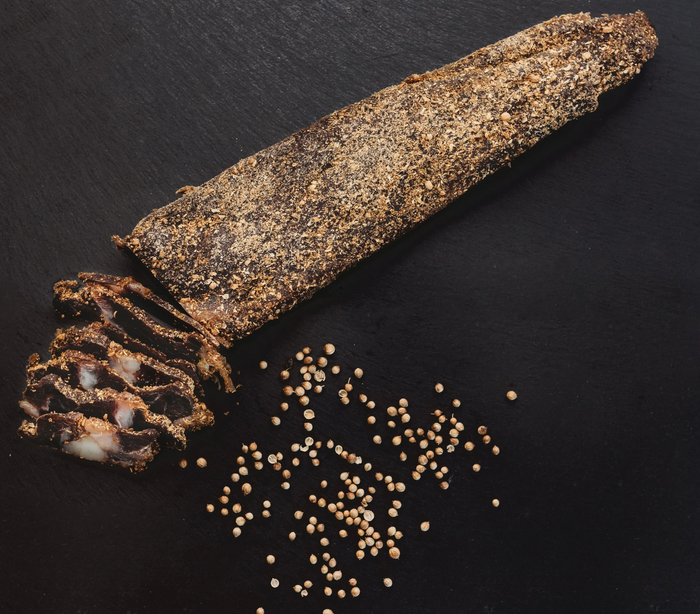
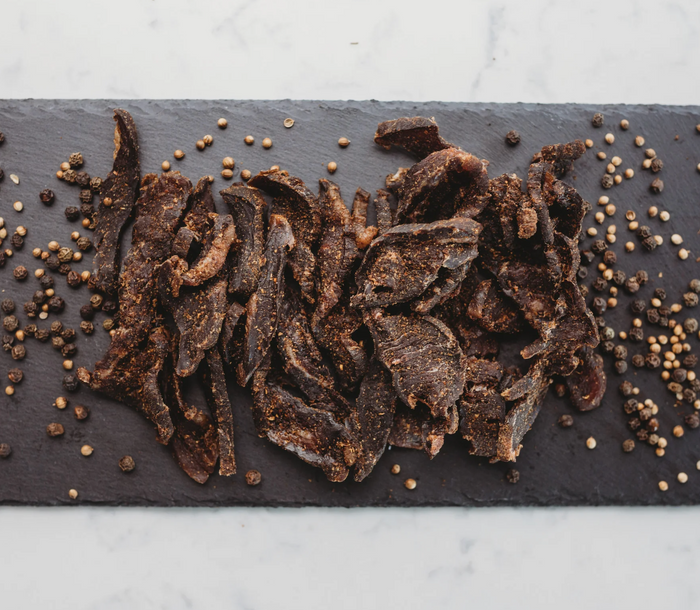
Two hundred years on, the method has barely changed. This is what it produces today — air-dried, never heated, made in Florida in small batches.