Biltong Nutrition: Protein, Sodium, Keto and How It Compares
Biltong is roughly 12 g of protein and 80 calories per ounce, with essentially no carbohydrate and no added sugar. Its one genuine drawback is sodium, because salt is doing preservation work rather than seasoning work. This guide covers the numbers, how it compares to jerky and protein bars, and whether it fits keto, paleo, carnivore, low-sodium and post-workout eating.
Related: The Healthiest Beef Jerky: How to Read the Label
Related: Low-Sodium Beef Jerky: What the Label Means, and Where Biltong Fits
Where to get it: Glatt Kosher biltong for sale, made in Florida and shipped anywhere in the US (free over $50).
The numbers
| Per 3 oz (85 g) | Biltong | Mass-market jerky | Typical protein bar |
|---|---|---|---|
| Calories | ~240 | ~250–300 | ~200–250 |
| Protein | ~36 g | ~27–33 g | ~20 g |
| Added sugar | 0 g | ~15–20 g | ~5–15 g |
| Total carbohydrate | Near zero | ~20–25 g | ~25–30 g |
| Fat | Low (cut-dependent) | Low to moderate | Moderate |
| Sodium | High | High | Low |
| Ingredient count | 5–7 | 12+ | 15+ |
| Protein per 100 calories | ~15 g | ~11 g | ~9 g |
The biltong column is The Grub Company's own figures — 36 g of protein and 240 calories per 3 oz bag. The other columns are category ranges, because brands vary widely.
That last row is the one that matters most. Protein per 100 calories is the honest measure of a protein food, because it strips out portion-size games. Biltong at roughly 15 g per 100 calories is close to the top of what any whole food achieves — it is essentially concentrated lean beef with the water taken out.
Figures vary by cut, flavor and how far a batch was dried. Always read the panel on the bag you actually bought; a drier batch will be denser in every number, including sodium.
Why the protein number is so high
No trick, just arithmetic. Drying removes roughly half to two thirds of the meat's water. Protein does not leave with the water, so what remains is a much higher concentration of it by weight.
An ounce of biltong is somewhere around two to three ounces of raw beef. That is why an ounce fills you up more than an ounce of most snacks, and it is also why biltong is not cheap — the yield is the cost.
The protein itself
Beef is a complete protein: all nine essential amino acids, in ratios that suit human requirements. It is particularly high in leucine, the amino acid most associated with triggering muscle protein synthesis.
Air-drying at room temperature is a gentle process from a nutritional standpoint. High-heat cooking can degrade some heat-sensitive nutrients; biltong is never heated, which is one of the quieter advantages of the method over jerky.
Beef also brings a useful micronutrient profile — iron in the heme form the body absorbs most readily, zinc, vitamin B12, selenium and niacin. Because biltong is concentrated, an ounce carries meaningfully more of each than an ounce of fresh beef would.
Sodium — the honest part
Biltong is a salty food and cannot really be otherwise. Salt is not seasoning here; it is one of the three barriers that makes uncooked meat safe, alongside vinegar and drying. Remove the salt and you do not have a lower-sodium biltong, you have a food safety problem.
Practical guidance:
- Read the panel. Sodium varies substantially between makers and between batches at different dryness levels.
- Portion deliberately. An ounce is a sensible serving. The bag is not.
- Count it into the day. If biltong is your snack, spend your sodium budget elsewhere accordingly.
- If you are on a sodium-restricted diet, this is a food to eat occasionally and in measured amounts, or to discuss with your clinician. That applies equally to jerky, cured meats and hard cheese.
- Note that active people lose sodium through sweat, which is one reason biltong works well as a training snack for some people and poorly for others.
Does biltong fit your diet?
| Diet | Fits? | Notes |
|---|---|---|
| Keto | Yes | Near-zero carbohydrate in an unsweetened blend. Check flavored versions for sugar. |
| Low-carb | Yes | One of the easiest high-protein snacks to fit |
| Paleo | Usually | Meat, salt, vinegar, spice. Check for added sugar or soy in flavored blends |
| Carnivore | Yes | Original blends are meat, salt and spice |
| Whole30 | Check | Depends entirely on added sugar and any additives |
| Gluten-free | Usually | Traditional blends contain no gluten ingredients; verify the label |
| Dairy-free | Yes | No dairy in biltong |
| Nut-free | Yes | No nuts; useful for school and camp |
| Low-sodium | No | Salt is structural, not optional |
| Calorie-restricted | Yes, with portioning | High satiety per calorie, but easy to eat a lot of |
| Halal | Only if certified | Requires its own certification |
| Kosher | Only if certified | Most biltong is not. Look for a named agency |
Biltong for training
It works well for a specific set of reasons, and badly for one.
What works: a high protein-to-calorie ratio, complete protein with plenty of leucine, no sugar spike, no refrigeration, no preparation, and it fits in a bag. As a post-training protein source when a meal is an hour or two away, it is hard to beat for convenience.
What does not: it is not a recovery food on its own. There is essentially no carbohydrate in it, so if you are training hard and relying on glycogen replenishment, biltong is the protein half of the answer and you need to bring the other half. Pair it with fruit or a starch.
The sodium can cut either way. If you have sweated heavily, replacing sodium is useful. If you have not, it is just a salty snack.
Biltong versus other high-protein snacks
| Snack | Protein per 100 cal | Added sugar | Ingredients | Needs a fridge? |
|---|---|---|---|---|
| Biltong | ~15 g | None | 5–7 | No |
| Beef jerky | ~11 g | Usually | 12+ | No |
| Protein bar | ~9 g | Usually | 15+ | No |
| Greek yogurt | ~10 g | Varies | 1–3 | Yes |
| Hard-boiled eggs | ~8 g | None | 1 | Yes |
| String cheese | ~9 g | None | 3–5 | Yes |
| Almonds | ~4 g | None | 1 | No |
The pattern is clear enough: the foods that beat biltong on ingredient simplicity need refrigeration, and the foods that match it on shelf stability lose on sugar and ingredient count. Biltong's actual niche is the overlap — high protein, short label, no fridge.
How much is a sensible amount?
An ounce is a serving: roughly 12 g of protein and 80 calories. Two ounces is a substantial snack and a reasonable upper bound for most days, mainly on sodium grounds rather than calorie grounds.
The practical risk with biltong is not that it is unhealthy but that it is very easy to eat. It is savory, dense and does not produce the sugar-crash signal that makes people stop eating jerky. Pouring a portion out rather than eating from the bag is the whole discipline.
Why the protein number is so high
No trick, just arithmetic — but it is worth spelling out because the number looks implausible next to other snacks.
Drying removes roughly half to two thirds of the meat's water. Protein does not leave with the water. So what remains is a much higher concentration of protein by weight than the beef you started with.
| Raw beef, 3 oz | Biltong, 3 oz | |
|---|---|---|
| Starting material | 3 oz of beef | 6–9 oz of beef, dried down |
| Protein | ~20 g | ~36 g |
| Water | ~65% | Under 30% |
An ounce of biltong is somewhere between two and three ounces of raw beef. That is why it fills you up more than an ounce of almost anything else, why the price per ounce looks high next to chips and entirely reasonable next to steak, and why the protein figure is not marketing.
Protein per 100 calories — the number that actually compares
Grams per serving is close to meaningless across brands, because serving sizes are inconsistent and frequently chosen to flatter. Protein per 100 calories strips that out.
| Food | Protein per 100 cal | Added sugar | Ingredients | Needs a fridge? |
|---|---|---|---|---|
| Biltong | ~15 g | None | 5–7 | No |
| Chicken breast, cooked | ~19 g | None | 1 | Yes |
| Beef jerky | ~11 g | Usually | 12+ | No |
| Greek yogurt, plain | ~10 g | Varies | 1–3 | Yes |
| Protein bar | ~9 g | Usually | 15+ | No |
| String cheese | ~9 g | None | 3–5 | Yes |
| Hard-boiled eggs | ~8 g | None | 1 | Yes |
| Roasted chickpeas | ~5 g | None | 2–4 | No |
| Almonds | ~4 g | None | 1 | No |
Read the first and last columns together. Chicken breast beats biltong on protein density and needs cooking and refrigeration. Everything shelf-stable that competes on convenience loses on sugar or ingredient count.
The niche biltong occupies is the overlap: high protein, short ingredient list, no fridge. That is a small space, and very little else is in it.
The protein itself
Beef is a complete protein — all nine essential amino acids in proportions that suit human requirements. It is particularly high in leucine, the amino acid most associated with triggering muscle protein synthesis, which is why animal protein is generally more efficient per gram for that purpose than most plant sources.
Air-drying at room temperature is gentle by comparison with cooking. High heat can degrade some heat-sensitive nutrients; biltong is never heated, which is a quiet advantage over jerky that rarely gets mentioned.
Because the meat is concentrated, the micronutrients concentrate too:
| Nutrient | Why it matters | Note |
|---|---|---|
| Iron (heme) | The form the body absorbs most readily | Considerably more per ounce than fresh beef |
| Zinc | Immune function, wound healing | Red meat is among the best sources |
| Vitamin B12 | Nerve function, red blood cells | Found almost exclusively in animal foods |
| Selenium | Antioxidant enzymes | Concentrated by drying |
| Niacin (B3) | Energy metabolism | Concentrated by drying |
| Creatine | Naturally present in muscle meat | Survives air-drying |
None of that makes biltong a supplement, and it should not be sold as one. It makes it concentrated beef, with the nutritional profile concentrated beef has.
Sodium — the part that deserves the most honesty
Biltong is a salty food and cannot be otherwise. This is not a formulation choice a producer could dial back.
Salt is one of the three barriers that make uncooked meat safe, alongside the vinegar and the drying. It draws water out of the meat and out of any bacteria present, and it does that work from the first hour. Remove the salt and you do not get a lower-sodium biltong; you get a food-safety problem.
Practical guidance:
- Read the panel. Sodium varies substantially between makers and between batches at different dryness levels — a drier batch is denser in every number, sodium included.
- Portion deliberately. An ounce is a serving. The bag is not.
- Count it into the day. If biltong is your snack, spend your sodium budget accordingly elsewhere.
- If you are on a sodium-restricted diet, treat this as an occasional food in measured amounts, or discuss it with your clinician. The same applies to cured ham, hard cheese and most crackers.
- Note that active people lose sodium in sweat, which is one reason biltong works well as a training snack for some people and poorly for others.
- Drink water with it. A salty, dense, low-moisture food is thirsty work.
Anyone selling genuinely low-sodium biltong is doing something else to compensate, and it is fair to ask what.
Reading a nutrition panel properly
Three traps make cross-brand comparison harder than it looks, and all three are avoidable.
Serving size is not standardized. One brand's panel is per ounce, another's per 28 g, another's per bag. Convert everything to the same basis before comparing anything — a bag that looks lower in sodium is frequently just declaring a smaller serving.
Dryness shifts every number at once. A drier batch is denser in protein, calories and sodium alike, because the same meat weighs less. Two products from the same maker at different dryness levels will not have identical panels, and neither is wrong.
"No sugar added" is not "no sugar." Some heat blends include a small amount of brown sugar for balance, and a tomato-based blend brings its own. Read the ingredient list rather than only the sugar line — small amounts can round to zero on a panel.
A fourth, subtler one: protein figures for dried meat are sometimes calculated rather than measured. A producer who states 36 g per 3 oz should be able to say whether that came from a lab or from a calculation based on the raw meat and the weight loss. Both are legitimate; the first is more reliable.
Does biltong fit your diet?
| Diet | Fits? | Notes |
|---|---|---|
| Keto | Yes | Near-zero carbohydrate in an unsweetened blend. Check flavored versions |
| Low-carb | Yes | One of the easiest high-protein snacks to fit |
| Paleo | Usually | Meat, salt, vinegar, spice. Check for added sugar or soy in flavored blends |
| Carnivore | Yes | Original blends are meat, salt and spice |
| Whole30 | Check | Depends entirely on added sugar and additives |
| Gluten-free | Usually | No gluten ingredients in a traditional blend; verify the label |
| Dairy-free | Yes | No dairy anywhere in biltong |
| Nut-free | Yes | Useful for schools and camps |
| Low-FODMAP | Check the garlic | Plain blends are fine; garlic-forward ones are not |
| Low-sodium | No | Salt is structural, not optional |
| Calorie-restricted | Yes, with portioning | High satiety per calorie, and easy to eat a lot of |
| Halal | Only if certified | Requires its own certification |
| Kosher | Only if certified | Most biltong is not. Look for a named agency |
Biltong for training
It works well for a specific set of reasons and badly for one, and being clear about both is more useful than a blanket recommendation.
What works: a high protein-to-calorie ratio, complete protein with plenty of leucine, no sugar spike, no refrigeration, no preparation, and it fits in a bag. As a protein source when a meal is an hour or two away, it is hard to beat for convenience.
What does not: it is not a recovery food on its own. There is essentially no carbohydrate in it, so if you are training hard and relying on glycogen replenishment, biltong is the protein half of the answer and you need to bring the other half. Pair it with fruit, a starch, or a drink that carries carbohydrate.
Sodium cuts both ways. If you have sweated heavily, replacing sodium is useful and biltong does it incidentally. If you have not, it is simply a salty snack.
| When | Amount | Pair with |
|---|---|---|
| Pre-training, 60–90 min before | 1 oz | Something with carbohydrate — biltong alone is not fuel |
| Post-training, meal an hour away | 1–2 oz | Fruit or a starch |
| Endurance, mid-session | Not ideal | Too dense and too salty mid-effort |
| Cutting weight | 1 oz, counted | High satiety per calorie; watch total sodium |
| Travel and competition days | 1–2 oz | Reliable when food options are not |
How much is a sensible amount
An ounce is a serving: roughly 12 g of protein and 80 calories. Two ounces is a substantial snack and a reasonable upper bound most days — on sodium grounds rather than calorie grounds.
The practical risk with biltong is not that it is unhealthy but that it is very easy to eat. It is savory and dense and it does not produce the sugar-crash signal that eventually makes people stop eating jerky. Pouring a portion out rather than eating from the bag is the entire discipline, and it is worth more than any of the numbers above.
Is it processed meat?
A fair question that deserves a straight answer rather than a defensive one.
Yes, biltong is processed meat. "Processed" in a nutritional context means preserved by salting, curing, fermentation, smoking or similar — and biltong is salted, cured and dried. It meets the definition.
What the definition does not do is distinguish between things that are quite different from each other. Consider what sits inside that same category:
| Biltong | Typical deli meat | Hot dog | |
|---|---|---|---|
| Ingredients | 5–7 | 10–20 | 15–25 |
| Nitrates / nitrites | None required | Usually | Usually |
| Added sugar | None in Original | Often | Often |
| Fillers, binders, phosphates | None | Common | Common |
| Mechanically separated meat | No — whole muscle | Sometimes | Frequently |
| Smoke or smoke flavoring | No | Often | Often |
Much of the research concern around processed meat centers on nitrites and on high-heat cooking. Biltong involves neither: no nitrites are needed because the acid and the depth of drying do the preserving, and no heat is applied at any point.
That is not a health claim, and it should not be read as one. It is a statement that "processed meat" is a wide category, that biltong sits at the short-ingredient-list, no-nitrite, no-heat end of it, and that anyone applying general guidance about processed meat should know which end they are dealing with.
Comparing it honestly to what it replaces
The useful question is rarely "is biltong healthy" in the abstract. It is "is biltong better than the thing I would otherwise have eaten."
| Instead of… | The swap gives you | The catch |
|---|---|---|
| A protein bar | More protein per calorie, no sugar alcohols, six ingredients instead of fifteen | More sodium; no carbohydrate |
| Mass-market jerky | Around 15–20 g less sugar per 3 oz, no nitrites | Costs more |
| Chips or crackers | Real protein instead of almost none, much higher satiety | Similar sodium; more calories per ounce |
| Cheese | Fleishig rather than dairy; no refrigeration | Comparable sodium |
| Nuts | Roughly four times the protein per calorie | Nuts have better fats and far less sodium |
| Skipping the snack entirely | Protein and satiety | Calories and sodium you would not otherwise have had |
That last row is the honest one. Biltong is a good answer to "I am going to eat something." It is not an argument for eating something.
Fat, and why it varies more than the label suggests
The fat content of biltong is the least predictable number on any panel, and the reason is the cut rather than the recipe.
Traditional biltong uses lean hindquarter muscle — silverside and topside — with very little intramuscular fat. Made that way it is a genuinely lean product. But cut selection varies between makers, and a producer using rump, sirloin or forequarter cuts will produce noticeably fattier biltong from the identical spice blend and drying process.
| Cut used | Fat, roughly | Other effects |
|---|---|---|
| Silverside / topside | Low | Dries evenly; longest keeping |
| Eye of round | Very low | Very consistent |
| Rump / sirloin | Moderate | Richer; shorter shelf life |
| Forequarter | Higher | Needs hard trimming; used where hindquarter is unavailable |
Grass-fed against grain-fed shifts it again — grass-fed is leaner and more deeply flavored, grain-fed fattier and milder.
The practical consequence: if fat matters to you, the cut is the thing to ask about, not the flavor. And a maker who names their cut is telling you something a nutrition panel alone will not.
Calories, and why the density surprises people
Around 80 calories an ounce, or roughly 240 for a 3 oz bag. That sounds modest until you remember what an ounce represents — two to three ounces of beef with the water taken out.
Two consequences follow. Biltong is more calorie-dense per ounce than most snacks people compare it to, because water weighs a great deal and there is very little left. And it is also far more satiating per calorie, for the same reason plus the protein.
For most people that trade is favorable: you eat fewer calories in total because you stop sooner. For anyone counting closely, the number to internalize is that a bag is a small meal rather than a snack, and a pound is roughly 1,300 calories.
Children, and how to think about portions
Biltong works well for children for reasons that have nothing to do with nutrition claims: it needs no refrigeration, no utensils and no plate, it contains no nuts or dairy, and it is not sweet. In a lunchbox those properties are worth more than any macro.
Two caveats, and they are practical rather than nutritional.
Sodium. Children need less than adults, and biltong is salty by design. Treat one ounce as a portion rather than handing over a bag. Single-serve minis solve this by construction, which is much of what you are paying for.
Texture, for toddlers. Firm dried meat is a choking risk in the same way any firm food is. Buy on the wetter side, cut it small, and supervise — the same rules that apply to hard cheese, raw carrot and whole grapes.
For school-age children none of this is complicated. It is one of very few shelf-stable, nut-free, dairy-free foods with real protein in it, which is exactly the gap most lunchboxes have.
What biltong is not
Worth stating plainly, because the protein-snack market encourages overclaiming.
It is not a supplement. It is beef with the water removed, and its nutritional profile is the profile of concentrated lean beef — nothing has been added or fortified.
It is not a complete meal. There is essentially no carbohydrate and very little fat in a lean blend. As the protein component of a meal it is excellent; on its own it is one macronutrient.
It is not low-sodium, and cannot be made so. Anyone marketing it that way has changed something else, and it is fair to ask what.
It is not a weight-loss product. It is high in protein and satiating, which helps, and it is also calorie-dense and very easy to eat. Portioned, it supports the goal. From the bag, it does not.
What it is: a shelf-stable, six-ingredient, unsweetened source of complete protein that needs no preparation. That is a genuinely useful thing to have, and it does not need to be more than that.
Quick answers
Is biltong healthy? As a high-protein, low-carb, short-ingredient snack, yes — with sodium as the real caveat.
How much protein is in biltong? Roughly 12 g per ounce; about 36 g in a 3 oz bag.
Is biltong keto? Yes, in an unsweetened original blend. Check flavored versions.
Is biltong good for weight loss? It is high in protein and satiating, which helps. Portion it and count the calories like anything else.
Is biltong better than jerky nutritionally? Generally yes, and the reason is sugar — 15–20 g in a typical 3 oz jerky bag versus none.
Is biltong high in sodium? Yes. That is inherent to the method.
Does biltong have carbs? Near zero in an original blend. Heat blends may include a small amount of sugar.
Is it processed meat? It is cured, which is a form of processing. It is also five to seven ingredients with no nitrates, which is a very different thing from most products in that category.
Reading a biltong nutrition panel properly
Three traps make cross-brand comparison harder than it looks.
Serving size is not standardized. One brand's panel is per ounce, another's is per 28 g, another's is per bag. Convert everything to the same basis before comparing anything — a bag that looks lower in sodium is often just a smaller serving on the label.
Dryness shifts every number. A drier batch is denser in protein, calories and sodium alike, because the same meat weighs less. Two products from the same maker at different dryness levels will not have identical panels, and neither is wrong.
"No sugar added" is not "no sugar." Some heat blends include a small amount of brown sugar for balance, and a tomato-based blend brings its own. Read the ingredient list, not just the sugar line — small amounts can round to zero on a panel.
Where the sodium actually comes from
Worth understanding, because it explains why low-sodium biltong is not really a product category.
Salt is applied early, before drying, and it does two jobs at once: it draws water out of the meat by osmosis, and it makes the environment hostile to bacteria at the point when the meat is most vulnerable. Then the meat loses half to two thirds of its weight in water — but the salt does not leave. So the sodium concentrates along with everything else.
That is the whole mechanism, and it means the sodium is not an additive choice a maker could simply dial down. Reduce it meaningfully and you compromise both the drying and the safety margin. Anyone selling genuinely low-sodium biltong is doing something different to compensate, and it is fair to ask what.
Fitting it into a day
| Use | Amount | Pair with |
|---|---|---|
| Mid-afternoon snack | 1 oz | Nothing needed |
| Post-training protein | 1–2 oz | Fruit or a starch, for the carbohydrate half |
| Breakfast supplement | 1 oz | Eggs, or on its own with coffee |
| Travel meal replacement | 2–3 oz | Fruit and water — and mind the sodium |
| On a board | 1–2 oz per person | Sharp cheese, pickles, dried fruit |
| Late-night, low-carb | 1 oz | Nothing — it is one of the better options here |
Water is the one to remember. A salty, dense, low-moisture food is thirsty work, and drinking alongside it is a sensible habit rather than a marketing line.
See our nutrition — 36 g protein and 240 calories per 3 oz bag, no MSG, no preservatives, no nitrates. Full panels are printed on every bag.
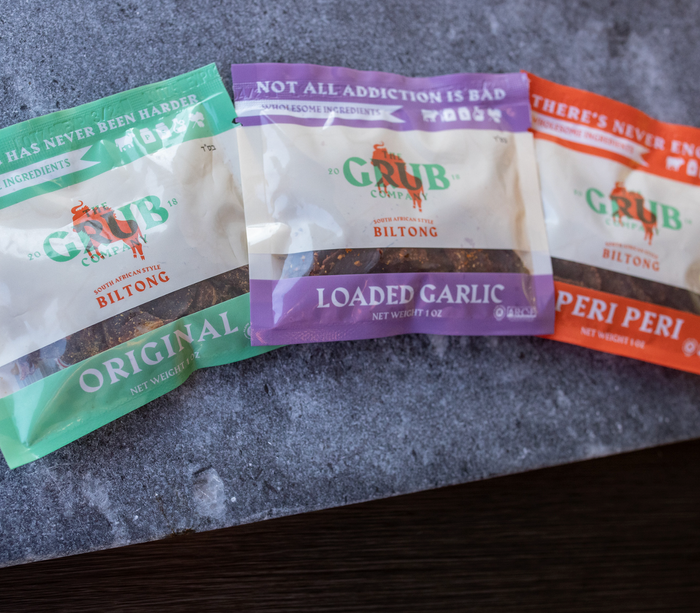
The high-protein range, with the full numbers on every bag.