Biltong Near Me: Where to Buy It in Person in the USA
Biltong is sold in person in the US almost entirely through kosher grocers, South African specialty shops and a small number of butchers. It is not a supermarket product in most of the country. This guide covers where to actually look, what to check when you find it, which states have real availability, and when ordering online is the better answer.
Where biltong is actually sold in person
| Type of shop | Likelihood | What to expect |
|---|---|---|
| Kosher grocers and markets | High in Jewish population centers | The most reliable channel in the US. Usually one or two brands, sliced format. |
| South African specialty shops | High where they exist | The best range, including droëwors and chili bites. Rare outside a few metros. |
| Independent butchers | Occasional | Some carry a local maker. Worth asking even if you see none on the shelf. |
| Health and supplement stores | Occasional | Usually the protein-marketed brands rather than traditional biltong. |
| Farmers markets | Occasional | Small local makers; freshness is often excellent. |
| Mainstream supermarkets | Low | Growing slowly. Usually in the jerky section, and usually the sweeter styles. |
| Gas stations and convenience | Very low | Jerky, not biltong, in almost every case. |
The kosher-grocer channel surprises people who do not expect it. There are two reasons for it: biltong suits kosher certification well, and the South African Jewish community — a large share of whom emigrated to the US, UK and Australia — has eaten biltong for generations. So the shops serving that community stock it as a staple rather than a novelty.
Where to find our biltong in person
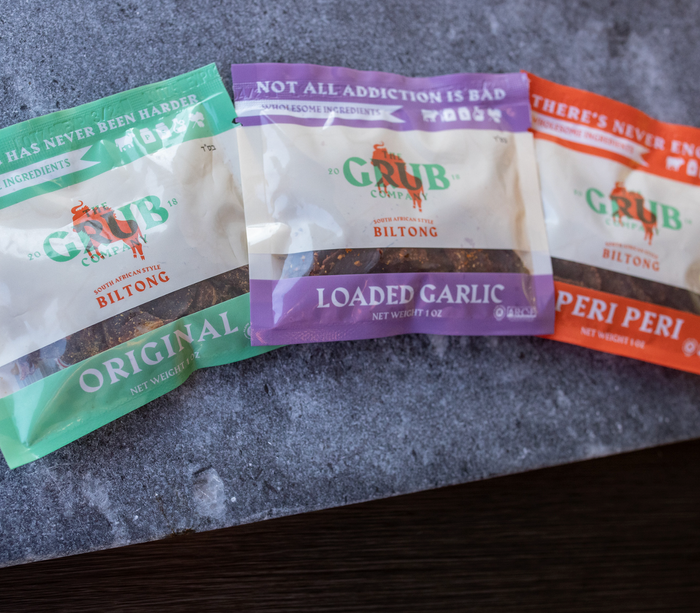
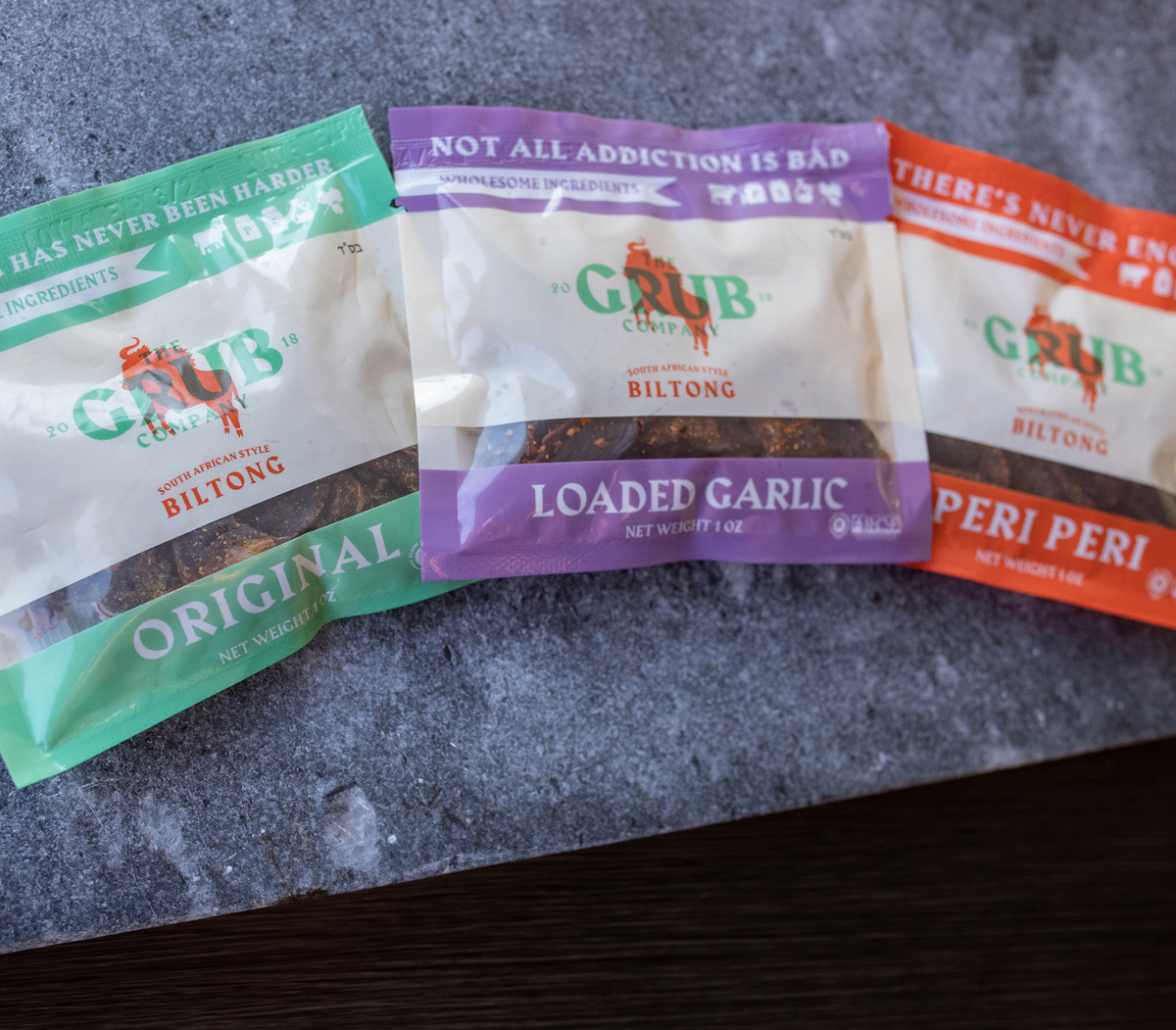
The Grub Company is currently stocked in eleven shops across seven states, with more coming. Every one of them is a kosher grocer.
| State | Shop | Location |
|---|---|---|
| New York | Kahan's Superette | 317 Kingston Ave, Brooklyn, NY 11213 |
| KolSave Market | 11 Lawrence Ln, Lawrence, NY 11559 | |
| Village Jerk | New York | |
| Florida | Kosher Kingdom | 3017 Aventura Blvd, Aventura, FL 33180 |
| KC Market (Kosher Central) | 5650 Stirling Rd, Hollywood, FL 33021 | |
| PensaKosher | Pensacola, FL | |
| Massachusetts | The Butcherie | 428 Harvard St, Brookline, MA 02446 |
| Georgia | The Spicy Peach | 2887 N Druid Hills Rd, Atlanta, GA 30329 |
| Arizona | Imperial Market & Deli | 737 E Glendale Ave, Phoenix, AZ 85020 |
| California | Chabad of Mill Valley | 515 Throckmorton Ave, Mill Valley, CA 94941 |
| Texas | The Mercantile on Main | Round Rock, TX |
Coming soon: Gourmet Glatt in Cedarhurst (Five Towns), Boro Park and Lakewood, plus Wesley Kosher and Evergreen in Monsey.
Stock lists change. The current list lives here — and if your local kosher grocer is not on it, ask them. Shops stock what customers request, and that is genuinely how most of the list above happened.
Which metros have real availability
Speaking generally about the US market rather than any one brand:
- New York and New Jersey — the deepest availability in the country, concentrated in Brooklyn, the Five Towns, Monsey, Lakewood and Teaneck.
- South Florida — Aventura, Hollywood, Boca Raton and Miami Beach all have kosher grocers who stock it. South Florida also has a substantial South African expat community, which helps.
- Los Angeles — the Pico-Robertson and Fairfax corridors.
- Chicago — West Rogers Park.
- Atlanta, Phoenix, Boston, Baltimore, Dallas and Houston — one or two reliable shops each.
- Everywhere else — sporadic. Online is usually the practical answer.
How to search for it locally
- Search "kosher market" plus your city before searching "biltong" plus your city. The shop is easier to find than the product, and the shop is where the product is.
- Search "South African shop" or "South African store" plus your metro. These are rare but excellent when they exist.
- Call rather than visit. Biltong is a slow-turning item; whether it is in stock today is a genuine question.
- Ask your butcher. Independent butchers often carry a local maker and do not advertise it.
- Check the maker's stockist page. Most small producers publish one, and it is more current than a directory.
- Ask the shop to order it. Small grocers order on request more readily than people assume.
What to check in the shop
Buying in person gives you one advantage over buying online — you can inspect it. Use that.
- Color. Deep red-brown, darker at the edges. Uniform pale brown suggests heat drying. Gray is a bad sign.
- The seal. Intact, with an oxygen-absorber sachet inside. A plain zip bag on a warm shelf is a gamble.
- The date. Biltong is best within weeks of drying. A pack date beats a best-before date if both are shown.
- The ingredient list. Beef, vinegar, salt, coriander, pepper, garlic. Sugar high in the list means jerky seasoning.
- Where it sits. A shelf above a warm case or in direct light is a worse shelf than a cool one.
- The certification, if you need it — a named agency, not the word "kosher" printed by the brand.
In store versus online
| In store | Online | |
|---|---|---|
| Range | One or two SKUs, usually sliced | Every flavor and format |
| Freshness | Depends how fast the shop turns it | Often shipped days after drying |
| Inspection | You can see it first | You cannot |
| Price | Retail markup | Better per ounce, especially in bulk |
| Immediacy | Today | Days |
| Bulk and slabs | Rarely stocked | Standard |
| Certification check | Read the pack | Read the certificate |
The sensible split most regular buyers land on: buy the weekly bag from the local shop if there is one, and order online for anything else — bulk, slabs, specific flavors, gifts, or when the shop is out.
If there is nothing near you
This is the situation for most of the country, and it is not much of a problem. Biltong is one of the better foods to buy online: it is shelf-stable, it needs no cold chain, and a sealed bag arriving after three days in transit is in exactly the condition it left in.
Two things worth doing on a first online order. Buy a sampler or minis rather than committing to a pound of one flavor. And check the free-shipping threshold before you build the cart — shipping is often what decides the real cost per ounce.
Why availability is where it is
The map of US biltong availability looks arbitrary until you overlay two other maps, at which point it becomes obvious.
The first is Jewish population centers. Biltong certifies well and sells steadily in kosher grocers, so the shops that stock it exist wherever those communities do — Brooklyn, the Five Towns, Monsey, Lakewood, Teaneck, South Florida, Pico-Robertson, West Rogers Park, Brookline, Atlanta, Phoenix.
The second is South African emigration. Substantial expat communities settled in South Florida, Atlanta, Southern California, Houston and the New York metro from the 1970s onward. They arrived already knowing what biltong was, which creates the kind of steady demand a retailer can plan around.
Where those two overlap — South Florida most obviously — you get the best in-person availability in the country. Where neither applies you get almost none, regardless of city size. That is why a buyer in a large midwestern metro can find nothing locally while someone in a small Florida town has three options within half an hour.
The channels, ranked by how likely they are to have it
| Type of shop | Likelihood | What to expect | Worth calling first? |
|---|---|---|---|
| Kosher grocers and markets | High in Jewish population centers | The most reliable channel in the US. Usually one or two brands, sliced format | Yes — it turns slowly |
| South African specialty shops | High where they exist | The best range, including droëwors and chili bites. Rare outside a few metros | Worth the trip if you have one |
| Independent butchers | Occasional | Some carry a local maker and do not advertise it | Yes — ask even if you see none |
| Health and supplement stores | Occasional | Usually protein-marketed brands rather than traditional biltong | Check the ingredient list |
| Farmers markets | Occasional | Small local makers; freshness is often excellent | Seasonal |
| Mainstream supermarkets | Low | Growing slowly. Usually in the jerky section, often the sweeter styles | Varies enormously by store |
| Gas stations and convenience | Very low | Jerky, not biltong, in almost every case | No |
The kosher-grocer channel surprises people who do not expect it. Two reasons: biltong suits kosher certification unusually well, and the South African Jewish community — a large share of whom emigrated to the US, UK and Australia — has eaten it for generations. The shops serving that community stock it as a staple rather than as a novelty.
How to actually search for it
One practical thing that saves a lot of wasted searching: the product name plus your city usually returns national online sellers, because few local shops list individual products on their websites.
Searching the shop type works far better.
- Search "kosher market" or "kosher grocery" plus your city before searching "biltong" plus your city. The shop is easier to find than the product, and the shop is where the product is.
- Search "South African shop" or "South African store" plus your metro. Rare, but excellent where they exist.
- Call rather than visit. Biltong is a slow-turning item; whether it is in stock today is a genuine question.
- Ask your butcher. Independent butchers frequently carry a local maker without advertising it.
- Check the maker's stockist page. Most small producers publish one, and it is more current than any directory.
- Ask the shop to order it. Small grocers order on request far more readily than people assume.
What to check when you find it
Buying in person gives you one real advantage over ordering: you can inspect it before you spend anything. Use that.
| Check | Good | Bad |
|---|---|---|
| Color | Deep red-brown, darker at the edges | Uniform pale brown suggests heat drying; gray is a warning |
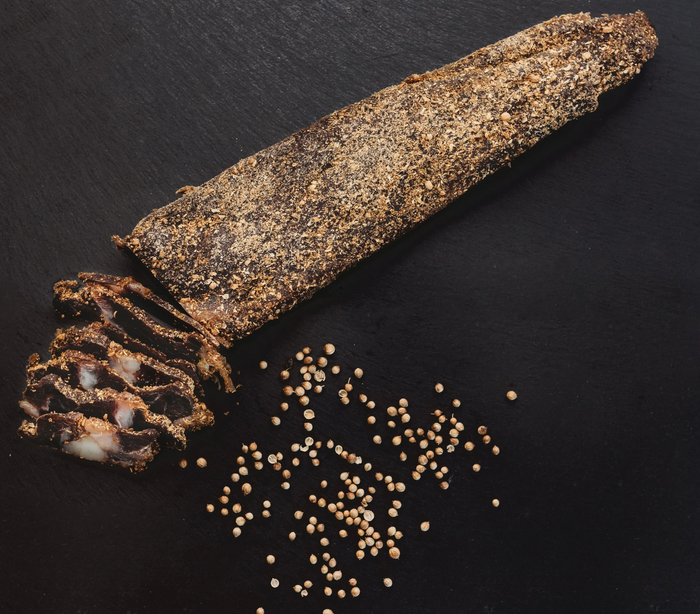
| The cut face | Firm dark rim, softer redder center | Uniform throughout |
| The seal | Intact, with an oxygen-absorber sachet | A plain zip bag on a warm shelf |
| The date | A pack date, ideally recent | Only a best-before, or none |
| Ingredients | Beef, vinegar, salt, coriander, pepper, garlic | Sugar high in the list; nitrites |
| Where it sits | A cool shelf, out of direct light | Above a warm case, or in a sunny window |
| Certification | A named agency, if you need it | The word "kosher" printed by the brand |
The shelf position is worth a look and almost nobody checks it. Heat and light both work against dried meat over weeks — heat moves moisture around inside the bag, and light accelerates fat oxidation. A bag that has spent two months above a warm deli case is not the same product as the identical bag from a cool back shelf.
Where in the US actually has it
Speaking generally about the market rather than about any one brand.
| Metro | Availability | Where to look |
|---|---|---|
| New York / New Jersey | Deepest in the country | Brooklyn, the Five Towns, Monsey, Lakewood, Teaneck |
| South Florida | Excellent | Aventura, Hollywood, Boca Raton, Miami Beach — plus a large South African community |
| Los Angeles | Good | Pico-Robertson, Fairfax |
| Chicago | Good | West Rogers Park |
| Atlanta | Moderate | Toco Hills and the Druid Hills corridor |
| Baltimore / Silver Spring | Moderate | Pikesville, Kemp Mill |
| Phoenix, Boston, Dallas, Houston | One or two reliable shops each | Kosher grocers |
| Everywhere else | Sporadic | Online is usually the practical answer |
If you are not near one of those, that is the normal case rather than bad luck — and it is not much of a problem, for reasons in the next section.
Asking a shop to stock it
This works far more often than people expect, and small grocers are used to the request. What makes the difference is asking specifically rather than generally.
Give the manager three things: the maker's name, whether it is certified if that matters to their customers, and the fact that you will buy it regularly. Shops stock on expected turn, and one committed customer naming a product is far more useful than a vague suggestion that biltong is popular.
If they are interested, point them at the producer's wholesale contact rather than trying to broker it yourself. Makers handle this routinely — most stockist lists grew exactly this way, one customer request at a time.
It also helps to know what you are asking them to take on. Biltong is a slow-turning specialty item with a months-long shelf life, which is a low-risk thing for a grocer to try: it does not spoil quickly on the shelf, and a case is not a large commitment. Saying that out loud sometimes makes the difference.
In store against online
| In store | Online | |
|---|---|---|
| Range | One or two SKUs, almost always sliced | Every flavor and format |
| Freshness | Depends how fast that shop turns it | Often better — shipped days after drying |
| Inspection | You can see color, cut and date | Not possible |
| Price per ounce | Retail markup | Better, especially in bulk |
| Immediacy | Today | Days |
| Slabs and bulk | Rarely stocked | Standard |
| Certification check | Read the pack | Read the certificate |
| Supporting the shop you rely on | Yes, and that matters | No |
The assumption that in-store is fresher is usually backwards for this category, and it is worth explaining why. A maker shipping direct sends product that was in the drying room recently — days to a few weeks. A grocery shelf holds product that arrived on a delivery schedule and sits until it sells. For a slow-turning item, that can be considerably longer than the transit time of a mail order.
None of which makes shop-bought biltong worse. It makes the pack date the thing to look at rather than the channel. A recently packed bag on a shelf beats an old bag shipped fast, and the reverse is also true.
The split most regular buyers settle on: the weekly bag from a local shop if there is one, and online for anything else — bulk, slabs, specific flavors, gifts, or when the shop is out.
What to do when the shop is out
Biltong is a slow-turning item in most shops, so an empty shelf is common and says nothing about the shop or the product.
- Ask when the next delivery is. Small grocers usually know, often to the day.
- Ask them to hold some. A shop that knows a customer is waiting will set it aside.
- Ask which format they can get. A shop stocking sliced can frequently order slabs or another flavor without much trouble.
- Order online in the meantime and keep the local relationship for the weekly bag. Most regular buyers end up doing both.
Why supermarkets mostly do not carry it
Worth understanding, because it explains why searching the obvious places fails and stops you concluding that biltong is unavailable near you.
Supermarket buying decisions are driven by turn — how many units a foot of shelf sells per week. Biltong loses on every input to that calculation:
- Low recognition. Most American shoppers have never heard the word, so it does not sell itself off a shelf the way jerky does.
- Higher price point. Two to three pounds of beef per finished pound puts it above the jerky it would sit beside, and shelf comparison is unforgiving.
- Small producers. Air-drying takes days per batch, so few makers can supply pallets on a national schedule.
- Slow turn. A specialty item that sells a few units a week does not earn its shelf space in a chain store.
Specialty grocers work on entirely different arithmetic. They serve a community that already knows the product, they accept slower turn on items their customers specifically want, and they buy from small suppliers as a matter of course. That is the whole reason biltong lives in kosher and South African shops rather than in the snack aisle.
It is also why the situation is changing slowly rather than not at all — as recognition grows, the turn calculation shifts, and biltong has started appearing in some larger stores. Usually in the jerky section, and usually the sweeter, more jerky-like styles, which is worth knowing before you get excited about a supermarket find.
If there is nothing near you
This is the situation for most of the country, and it genuinely is not much of a problem.
Biltong is one of the better foods to buy online: it is shelf-stable, it needs no cold chain, it does not melt or break, and a sealed bag arriving after three days in transit is in exactly the condition it left in. There is no equivalent of a bruised avocado.
Two things worth doing on a first online order. Buy a sampler or minis rather than committing to a pound of one flavor — flavors differ more here than in the jerky aisle, because no sugar is smoothing everything toward the middle. And check the free-shipping threshold before you build the cart, since a single small bag with paid postage can work out worse per ounce than anything else on the site.
You also get things a shop cannot offer: whole slabs, bulk, every flavor, and a producer who can tell you when the batch was dried.
Buying it while traveling
A situation worth its own note, because biltong is one of the better things to pick up on a trip and one of the easier ones to get wrong.
| Where you are | Worth looking? | What to know |
|---|---|---|
| South Africa | Obviously | Butcheries make it fresh daily. Do not try to bring it home — US rules on meat imports are strict |
| United Kingdom | Yes | Widely available; decades of South African community. Same import caution |
| Australia, New Zealand | Yes | Strong local production |
| Israel | Yes | Hindquarter is properly porged there, so kosher biltong is easier to find |
| Continental Europe | Patchy | Concentrated in cities with South African communities |
| Within the US | Yes | No restrictions on carrying it between states — pack it sealed |
Domestic travel is straightforward: sealed biltong needs no refrigeration, does not leak, has no smell problem in a bag, and is fine in carry-on. It is one of the better foods to take on a flight precisely because it asks nothing of you.
International is where people get caught. Bringing meat into the United States from abroad is restricted regardless of packaging, and a bag of biltong in a suitcase is exactly what agricultural inspection is looking for. Eat it there, and buy domestically when you get home.
The honest summary
If you live in one of about eight metros, you can buy biltong in person from a kosher grocer or a South African shop, and you should — it supports the shops that make the category viable, and you get to inspect what you are buying.
If you do not, the answer is online, and that is not a consolation prize. You get better range, frequently better freshness, better price per ounce, and formats no shop stocks.
Either way, the two things that decide quality are the same: the pack date and the ingredient list. Everything else — channel, brand story, packaging — is secondary to those two.
Why "near me" searches struggle with this product
If you have already searched and found nothing useful, the problem is probably the search rather than the supply.
Local search works by matching businesses to categories. A restaurant is a restaurant; a hardware store is a hardware store. Biltong has no category. The shops that carry it are listed as kosher grocers, delicatessens, international food stores or butchers — none of which contains the word you are searching for.
Worse, product-level inventory is almost never published. A grocer with three bags on a shelf has not listed them anywhere a search engine can read, so no amount of searching the product name will surface that shop.
Three consequences worth acting on:
- Search the shop type, not the product. "Kosher market near me" will find the shop; "biltong near me" will find national websites.
- Expect the map results to be wrong more often than usual. A listing that mentions biltong may be years out of date, and a shop that stocks it may never mention it.
- Phone calls beat searching. Thirty seconds on the phone settles what twenty minutes of searching cannot, because the answer lives in someone's head rather than on a website.
This is one of the few remaining product categories where the old method genuinely outperforms the new one, and it is worth knowing before you conclude nothing is available near you.
Local pickup, where it exists
Worth asking about even when a maker does not advertise it prominently. Small producers frequently offer collection from their own premises, and it is the freshest biltong you will ever buy — often within days of coming off the rack, with no transit at all.
Two practical notes. Order online first and choose pickup at checkout rather than turning up expecting a shop; most drying facilities are not retail spaces and will not have stock on a counter. And call to confirm what is actually available before you drive, because a small maker's stock genuinely changes batch by batch.
If you live within reach of one, it is the best combination of price, freshness and choice available anywhere — you skip both the retail markup and the shipping.
Quick answers
Where can I buy biltong near me? Start with kosher grocers, then South African specialty shops, then independent butchers.
Does Whole Foods sell biltong? Some locations carry biltong-branded snacks, usually in the jerky section and often the sweeter styles. Availability varies enormously by store.
Why is biltong sold in kosher stores? Because it certifies well and because the South African Jewish community has eaten it for generations.
Can I ask a shop to stock it? Yes, and it works more often than you would think. Small grocers order on request.
Is store-bought fresher than online? Usually the reverse. A maker shipping direct is often sending product dried more recently than a shelf that gets restocked monthly.
How to ask a shop to stock it
This works far more often than people expect, and small grocers are used to the request. What makes the difference is asking specifically rather than generally.
Give the manager three things: the maker's name, whether it is certified if that matters to their customers, and the fact that you will buy it regularly. Shops stock on expected turn, and one committed customer who tells them what to order is more useful than a vague suggestion that biltong is popular.
If they are interested, point them at the producer's wholesale contact rather than trying to broker it yourself. Makers handle this routinely — most stockist lists grow exactly this way, one customer request at a time.
Why availability is concentrated where it is
The map of US biltong availability looks arbitrary until you overlay two other maps.
The first is Jewish population centers. Biltong certifies well and sells steadily in kosher grocers, so the shops exist wherever those communities do — Brooklyn, the Five Towns, Monsey, Lakewood, Teaneck, South Florida, Pico-Robertson, West Rogers Park, Brookline.
The second is South African emigration. Large expat communities settled in South Florida, Atlanta, Southern California, Houston and the New York metro. They arrived already knowing what biltong is, which creates demand a retailer can count on.
Where those two overlap — South Florida most obviously — you get the best in-person availability in the country. Where neither applies, you get almost none, regardless of city size. That is why a buyer in a large midwestern metro can find nothing locally while someone in a small Florida town has three options.
A note on "biltong near me" searches
One practical thing worth knowing: searching for the product name plus your location will often return national online sellers rather than local shops, because few local shops list individual products on their websites.
Searching for the shop type works much better. "Kosher market near me," "South African store," or "specialty butcher" will surface the places that actually carry it, and a phone call settles the rest in thirty seconds. It is a rare case where the less obvious search is the more effective one.
What to do when the shop is out
Biltong is a slow-turning item in most shops, which means an empty shelf is common and does not indicate anything about the shop or the product. A few practical responses:
- Ask when the next delivery is. Small grocers usually know, and often to the day.
- Ask them to hold some. A shop that knows a customer is waiting will set it aside.
- Ask which format they can get. A shop stocking sliced can often order slabs or a different flavor without much trouble.
- Order online in the meantime and keep the local relationship for the weekly bag. Most regular buyers end up doing both.
Local versus direct, on freshness
The assumption that in-store is fresher is usually backwards for this category, and it is worth explaining why.
A maker shipping direct sends product that was in the drying room recently — days to a few weeks. A grocery shelf holds product that arrived on a delivery schedule and sits until it sells. For a slow-turning item, that can be considerably longer than the transit time of a mail order.
None of which makes shop-bought biltong bad. It makes the pack date the thing to look at rather than the channel. A recently packed bag on a shelf beats an old bag shipped fast, and vice versa.
See the current stockist list, or order online — free US shipping over $50.
Nowhere near a stockist? Ordering direct takes two days and needs no cold chain.