Is Biltong Safe to Eat? How Curing and Drying Work
Biltong keeps without refrigeration because three things act on it at once: salt, acid from vinegar, and the removal of water. None of those is cooking. A cured dried meat arrives at stability by a different route than a roast does, and the route is worth understanding, because almost every question people have about biltong is really a question about that route.
Ready to try it? Buy Glatt Kosher biltong online. Made in Florida, free US shipping on orders over $50.
We are a producer, not a regulator, so this piece explains the mechanism rather than issuing verdicts. What is safe for any particular person to eat is a conversation for that person and their own physician, and we will not have it on a blog. What we can do is show you what curing and drying actually do to a piece of beef, and what that means for the product in your hand.
What preservation has to stop
Microorganisms need water, something to eat, a temperature they tolerate and time. Meat gives them three of those four for free. Every preservation method ever invented works by taking away one or more of the four, and the methods differ only in which lever they pull and how hard.
Cooking pulls the temperature lever. Freezing pulls the temperature lever from the other end and also takes the time lever away by pausing everything. Curing and drying pull the water lever, and acid narrows the range of things that can grow at all. Biltong is a water lever product with an acid assist, which is exactly what a salami is and exactly what jerky is not.
Water activity, not moisture percentage
This is the concept that makes the rest of the subject make sense, and it is almost never explained properly. Water activity means how much of the water in a food is chemically available, free to take part in reactions and free for an organism to use. It is not the same as the raw moisture percentage, which only tells you how much water is present by weight.
Salt and other dissolved solids bind water to themselves and hold onto it. Water that is bound is still in the food and still counts toward the moisture percentage, but it is no longer available. That is why two products can have identical moisture readings and behave completely differently on a shelf, and why the moisture number on its own has never told anybody very much.
Once you have that idea, the whole biltong process reads clearly. Drying removes water outright. Salting takes a share of the water that is left and locks it up. The two mechanisms attack the same target from different sides, which is why the traditional method uses both rather than picking one and pushing it to an extreme.
Where the salt goes, and why it takes its time
Salt does not teleport into the middle of a piece of beef. It dissolves at the surface and then moves inward, slowly, driven by the difference in concentration between the outside and the inside. Meanwhile water is moving the other way. That exchange is the actual event of a cure, and it runs on its own schedule regardless of what anyone would prefer.
Thickness is therefore the single biggest variable in the whole process. The distance from surface to center decides how long salt needs, and doubling the thickness of a piece more than doubles the time. This is not a shortcoming of the craft, it is the geometry of the thing, and every producer works within it rather than around it.
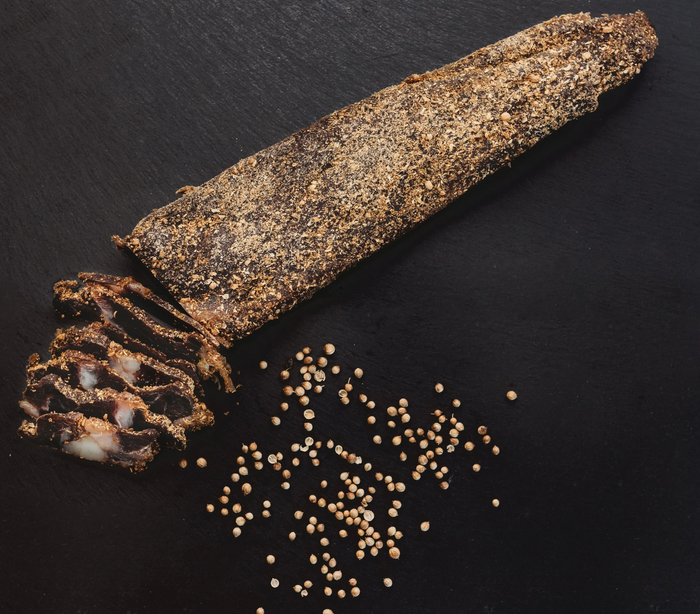
It also explains why a slab and a sliced piece are genuinely different products rather than different packaging. A slab dries as one thick object and is cut afterwards, so its interior spent the whole cure a long way from any surface. Meat that is thinner from the start has a much shorter journey for both salt going in and water coming out.
What the vinegar contributes
Vinegar puts acid on the meat immediately. Acidity narrows the range of organisms that will grow on a surface, and the surface is where anything that lands on meat lands first. Because the acid is applied rather than cultured, it is there from the first hour, before drying has made any progress at all. That timing is the point.
Vinegar also does something for the eating quality that nobody planned but everybody now expects. It gives biltong the clean sour edge that sits behind the coriander and pepper, and it firms the surface slightly in a way that helps the spice hold. Take the vinegar out and you do not have a milder biltong. You have a different food.
Airflow is the third leg
Salt and acid do nothing if the water never leaves. Air moving across a surface carries away the moisture that has migrated there, which keeps the gradient alive so more water follows. Still air saturates against the meat and the whole process stalls. Air that is too dry or too fast causes the opposite problem.
The failure mode there has a name that describes it exactly: case hardening. The outside gives up its water so fast that it tightens into a shell, and that shell then blocks the water still sitting in the middle from getting out. The piece looks finished and is not. Everything about traditional biltong drying, the patience and the moderate conditions, exists to avoid that outcome.
Why slow is deliberate
It is tempting to read slow drying as old fashioned inefficiency. It is the opposite. Slow drying is the only way for the moisture gradient inside a thick piece to stay gentle enough that the center keeps pace with the edge, and it is the only way salt gets far enough in before the outside closes.
Push the pace and you get an outcome that fails on both counts at once. The eating quality drops because the texture goes hard on the outside and stays soft in the middle. The keeping quality drops because the interior never reached the state the process was aiming for. There is no version of this where hurrying produces a better result.
Whole muscle changes the arithmetic
An intact piece of muscle has one exposed surface, the outside. Ground meat has surface everywhere, because grinding turns the interior into exterior and mixes it all together. This is why the handling standards around ground products are stricter than for whole cuts, and it is a genuine structural difference rather than a matter of degree.
Biltong is whole muscle. Silverside and topside are the usual cuts, both large, lean and uniform, which makes them predictable to cure and dry. The lean matters too, because fat holds onto water differently from muscle and does not give it up on the same schedule, so a fatty piece dries unevenly by definition.
What a producer actually controls
From the inside, making biltong well is a matter of controlling a short list of things and then not deviating. The meat coming in and how it was handled before it arrived. The trim, and how consistent the pieces are, because a batch of mixed thicknesses cannot dry evenly. The salt and vinegar step and how long it runs. The condition of the drying air. The time.
Everything on that list is boring and repeatable, which is the point. Consistency is the whole discipline. A producer who can tell you what they do at each of those five stages, and who does the same thing every time, is telling you far more than any adjective on a package. In the United States, dried meat production sits under federal and state oversight with record keeping to match, and that record keeping exists precisely because the process cannot be judged by eye.
Why heat is not the only route
People raised on cooked meat reasonably ask how something uncooked can be a finished food. The answer is that heat is one lever among several, and it is not the lever this category pulls. Cured and dried meats are a very old family of foods that reach stability through water removal, salt and acidity, and they are made and sold under modern oversight on that basis rather than as an exception to it.
The confusion is understandable because heat is fast and visible and the other route is slow and invisible. Nothing about a piece of biltong looks like a process happened to it, except that it got smaller and darker. But something did happen to it, over days, and the fact that it took days is the evidence rather than the doubt.
The same trick, in foods you already trust
Water activity is not a biltong concept, it is a food concept, and once you see it you find it everywhere in the pantry. Honey keeps indefinitely at room temperature because its sugar binds nearly all its water. Jam works the same way, which is why sugar quantity in a jam recipe is a preservation instruction rather than a taste preference. Salt cod and country hams keep because salt did to their water what sugar does in honey.
Dried fruit, hard cheeses and cured olives are all sitting on the same principle at different points along the scale. None of those foods is cooked into stability, and nobody finds any of them strange. Biltong feels unusual mainly because the category it belongs to is less familiar in an American kitchen, not because the mechanism behind it is unusual at all.
Framing it that way also makes the limits obvious. Every one of those foods can be pushed out of its stable state by the wrong storage, because in every case the environment can put water back. A jar of honey left open in a damp room behaves worse than a sealed one, and dried meat is no different. The principle protects the food and the storage protects the principle.
What you can observe in a finished piece
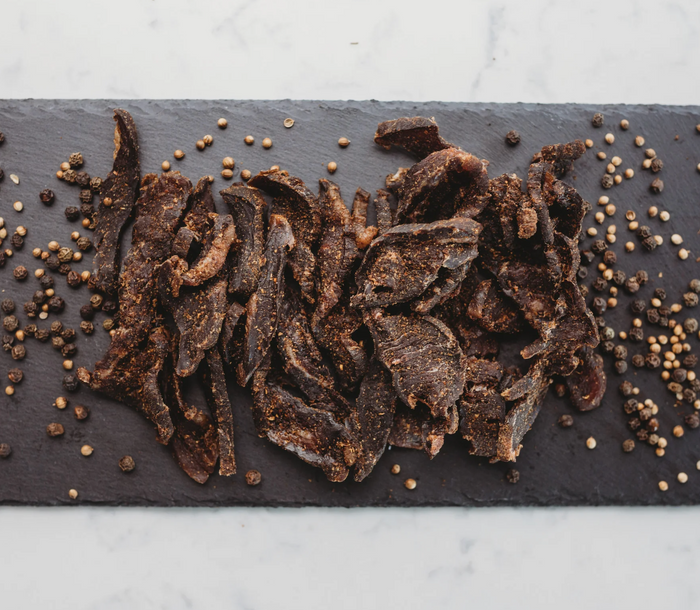
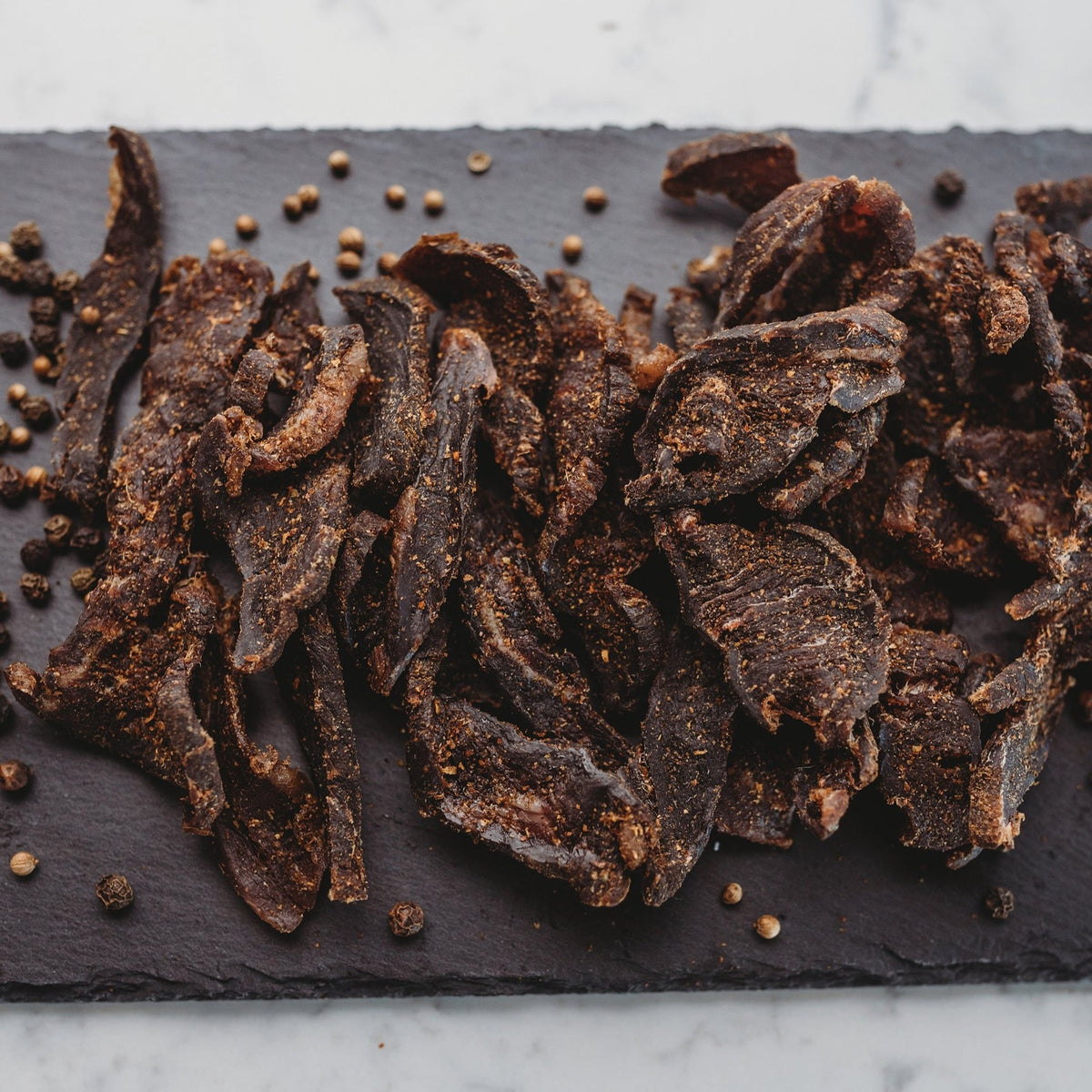
You cannot see water activity, but you can read a few things directly. Good biltong is firm and even in the hand rather than soft in one spot and hard in another. The cut face shows dry fibers rather than anything glossy. The smell is beef, vinegar and spice, with nothing sour beyond the vinegar note and nothing sharp underneath it.
A white powdery coating, most often around a fat edge, is usually surface fat or salt showing itself, and it wipes away. Fuzzy growth with actual texture, appearing in patches, is a different thing entirely and means the piece met more moisture than it should have. The difference is genuinely visible once you have seen both, and the smell settles it when your eyes are not sure.
Storage can undo the drying
The most overlooked point in this whole subject is that water activity is not permanently fixed. A dried product sitting in humid air will take moisture back out of that air, and as available water goes up, the conditions that were holding steady stop holding. Nothing about the curing was wrong. The environment changed the number afterwards.
Which is why storage advice is not an afterthought bolted onto a dried meat. It is the last stage of the same process. A sealed container in a stable spot away from heat and steam preserves the state the drying created. A bag left open on a counter in a humid kitchen works against it. Sliced product has far more exposed surface than a whole slab, so it responds to its surroundings much faster.
Questions worth asking any producer
- What cut is it, and is it whole muscle or reformed.
- Is it dried with air or with heat.
- What is actually in the cure, and how long does it run.
- How is it packed, and what happens to it after it is opened.
- How thick is it, since thickness drives everything else.
A producer who can answer those five without reaching for marketing language is a producer who knows their own process. That is a far better signal than any claim on the front of a package, and it is the same list we would want answered if we were the ones buying.
How our formats differ on this
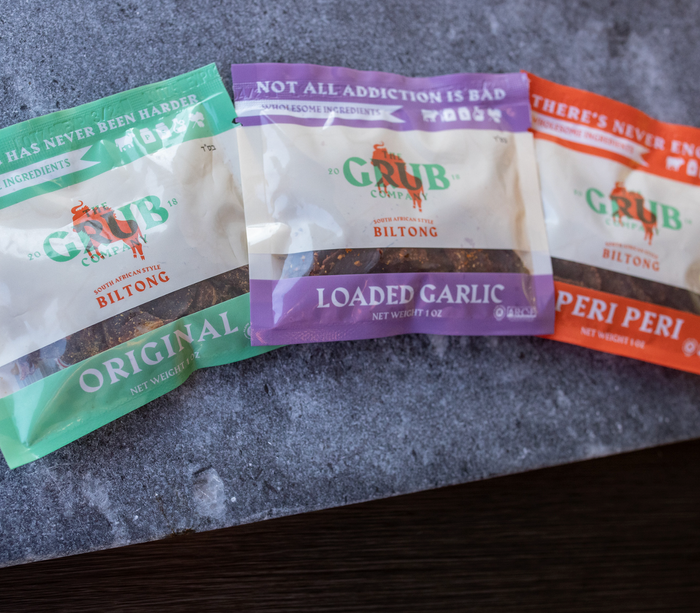
Sliced Biltong at $11.99 and Sliced Biltong Mini's at $4.99 are cut product, which means more exposed surface and a faster response to whatever air they sit in once opened. The Biltong Sampler Pack at $12.99 sits in the same category. Biltong Slabs at $58.00 are the opposite case, whole until you cut them, and the interior of an uncut slab is protected by every millimeter of meat around it. Bulk Biltong at $58.00 is a pound of sliced product, which is exactly the case where portioning before storing pays off most.
Bottom line
Biltong is a water activity product. Salt binds part of the water, drying removes the rest, vinegar puts acid where organisms would otherwise land first, and airflow and time make the whole thing possible. Cooking is a different mechanism, not a superior one, and this category has never used it. Judge a dried meat by whether its maker can describe those steps precisely, and by whether the piece in your hand is firm, even and smells the way it should. Then store it in a way that keeps the state the drying worked for.
Frequently Asked Questions
What does water activity mean in a dried meat?
Water activity describes how much of the water in a food is chemically available rather than how much water is present. Some of the water in a cured meat is bound to salt and other dissolved solids and cannot take part in reactions or be used by an organism. That bound water still counts toward the moisture percentage on paper, which is why two products can show the same moisture reading and behave nothing alike. Water activity is the number that actually tracks how a dried meat holds up, and it is the reason the traditional method uses salt and drying together instead of relying on either one alone.
Is biltong raw?
Biltong is uncooked, which is not the same as untreated. It is wiped or soaked in vinegar, salted and spiced, then dried in moving air over days. That combination removes a large share of the water, binds part of what remains, and puts acid on the surface from the first hour. Cured and dried meats are an old and well understood family of foods that reach a stable state without applied heat, and they are produced under modern oversight on that basis. Heat is one preservation lever among several, and this category has always pulled the other ones.
Why does thickness matter so much?
Because salt has to travel and water has to escape, and both journeys are measured from the surface to the center. Doubling the thickness of a piece more than doubles the time the process needs, so thickness sets the schedule for everything else. It also explains why a slab and a sliced product are genuinely different rather than the same thing packaged differently. A slab dries as one thick object and is cut afterwards, so its interior spent the whole cure a long way from any surface. Consistent thickness within a batch matters just as much, since mixed pieces cannot dry evenly.
What is case hardening?
Case hardening is what happens when the outside of a piece gives up its water far faster than the inside can follow. The surface tightens into a shell, and that shell then blocks the moisture still sitting in the middle from getting out. The piece looks finished from the outside and is not finished at all. Air that is too dry or moving too fast is the usual cause. Almost everything about traditional biltong drying, the moderate conditions and the patience, exists to keep that from happening.
Does vinegar do anything besides add tang?
Yes, and the tang is arguably the side effect. Vinegar puts acid onto the meat surface immediately, before drying has made any real progress, and acidity narrows the range of organisms that will grow there. The surface is where anything landing on meat lands first, so treating it at the very start of the process is the point of the step. The clean sour edge you taste behind the coriander and pepper comes along with it, and it also helps the spice hold. Remove the vinegar and you do not get milder biltong, you get a different food.
Can storage undo the drying?
The state a dried meat reaches is not permanently fixed. A dry product sitting in humid air will draw moisture back out of that air, and as the available water climbs, the conditions the drying established stop holding. Nothing about the original curing was wrong, the surroundings simply moved the number afterwards. That is why storage is the last stage of the same process rather than a separate topic. Sliced product has far more exposed surface than an uncut slab, so it responds to its environment much faster and benefits most from a sealed container in a stable spot.
How can I tell good biltong from a bad batch by looking at it?
Firmness that is even across the piece is the first thing. Soft in one spot and hard in another suggests the drying was uneven. The cut face should show dry fibers rather than anything glossy, and the smell should be beef, vinegar and spice with nothing sour beyond the vinegar and nothing sharp underneath. A white powdery coating, usually near a fat edge, is generally surface fat or salt and wipes away. Fuzzy growth with real texture appearing in patches is a different thing and means the piece met more moisture than it should have.
Every concern on this page is about process control, which is a question for the maker rather than the category. Ours is vinegar-washed, salted and air-dried for days, sealed with an oxygen absorber, and made in one building in Florida.