Biltong vs Droewors: Same Kitchen, Two Different Snacks
Biltong is sliced or slab whole-muscle beef, cured and air-dried. Droewors is spiced ground meat in a thin casing, also air-dried. Same flavor family, same country, different food: biltong is the one you slice and chew, droewors is the one you bite off a stick.
We make certified Glatt Kosher biltong and Meat Candy in Florida, not droewors, so this comparison comes from a biltong maker and we will be fair to the other side. Droewors is a good snack, and there are situations where it is the better pick. Our kosher certification page explains how Grub's works, which matters once the question turns to what a kosher household can actually buy.
Where they come from
Both belong to the South African tradition of drying meat in moving air, a tradition shaped by climate and by the need to keep meat without refrigeration. The two foods share a spice family built around coriander, plus salt, pepper and often vinegar. If you taste one and then the other, you will recognize the same kitchen.
The word gives the distinction away. Biltong is a meat strip, drawn from a word that points to the strip of rump. Droewors is Afrikaans for "dry sausage." One begins with a piece of muscle and the other begins with a grinder.
The starting material is the whole difference
Everything else flows from what goes in.
Biltong: whole muscle
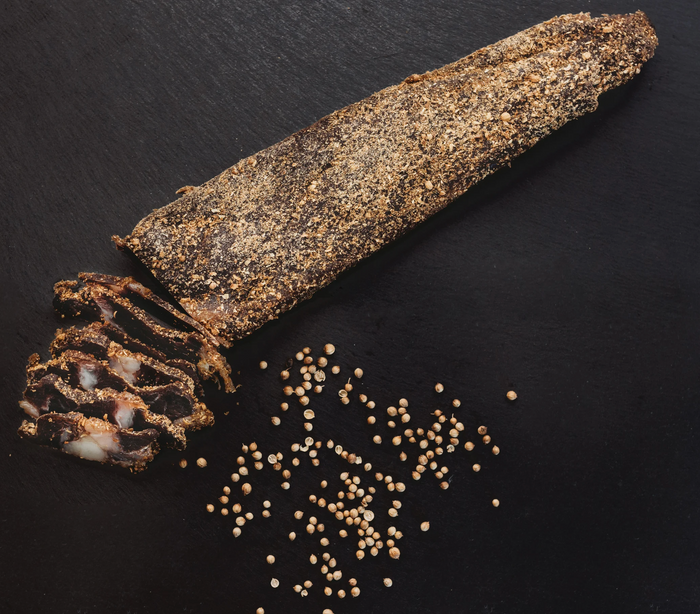
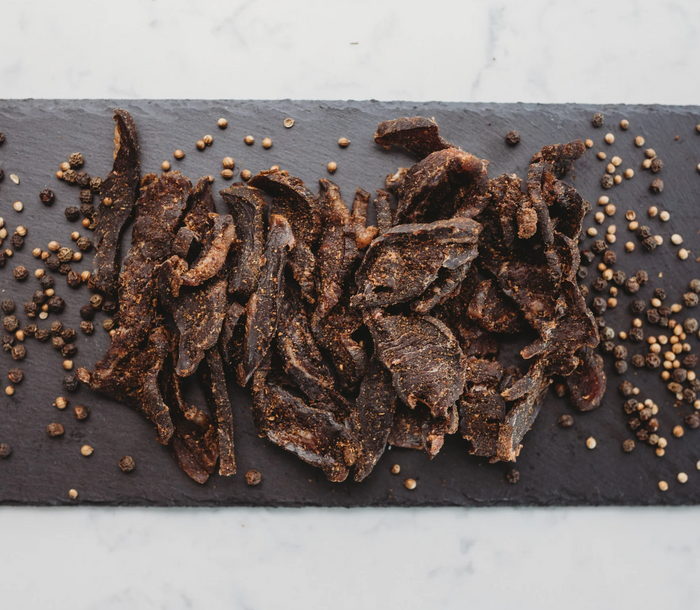
A piece of beef is cut into strips or kept as a slab. It is cured with vinegar, salt and spices and hung to dry. Because it is one piece of muscle, the grain runs through it, and the texture changes from the firm outside to a softer center. You get a bite that gives way rather than fighting back. How dry you like it is a choice you make when you buy, or when you cut a slab. Our piece on meat snacks compared shows where each sits among dried meat snacks.
Droewors: ground and filled
Ground meat, usually beef, is mixed with seasoning and commonly some fat. It is filled into a thin casing and hung to dry. Because the meat is ground, the texture is even from one end to the other. Because it is thin, it dries relatively quickly. The result is a firm stick with a snap, and a flavor shaped by the fat and the spice mixed through it.
Neither is better in the abstract. Whole muscle gives you the chew and the grain. Ground meat gives you consistency and the sausage character. It comes down to which you prefer to eat.
Taste and texture side by side
- Flavor. Both are savory and coriander-led. Biltong tends to taste more of the beef itself, with the vinegar and spice around it. Droewors tastes of the beef, spice and fat together, in one blended note.
- Texture. Biltong varies across the piece and can run from tender to firm depending on thickness. Droewors is more uniform, firm and brittle at the snap.
- Fat. Droewors is a mixture, and fat is a common part of it. Biltong is cut from a piece of beef, so the fat you see is whatever the piece carried. We will not put a number on either, since makers differ.
- Sweetness. Neither is sweet by nature. Some flavors of biltong add a little brown sugar, like our Peri Peri, but the profile stays savory.
- Eating. Biltong: eat a slice, or cut a slab to your thickness. Droewors: bite a piece off the stick. Droewors is neater to hold. Sliced biltong is easier to share from a bowl.
Which one wins in which situation
A fair answer depends on the moment.
- Eating with one hand while driving. Droewors is tidy and holds together. Sliced biltong works too, since there is nothing to cut, and it needs no utensils.
- Sharing at a table or party. Sliced biltong in a bowl disappears quickly. A stick has to be broken or cut for sharing.
- You like a firm, even snap. That is droewors.
- You like to choose the thickness. That is a biltong slab. A slab is an ingredient, not a snack, so it needs a board and a knife and someone willing to use them.
- A first-time taster. Biltong is the easier starting point because the flavor is the pure reference for the whole family.
The honest trade-off: if you specifically want a sausage texture, biltong is not it. We make biltong and Meat Candy, not droewors, so we cannot offer you that stick. If a snappy sausage is what you want, you will need to look elsewhere, and if you keep kosher, look for a clear certification mark on the package.
The kosher question
For any dried meat to be kosher, the animal, the slaughter, every ingredient and the process all have to qualify. Sausage adds a casing and a mixed filling, which means more items that need to be acceptable. That does not make a sausage impossible. It means you should check, not assume. A kosher household should look for a visible certification mark on the package, and ask a rabbi about anything the label does not settle. Biltong is simpler on this front: one cut of beef, a short list of seasonings. Ours lists grass-fed kosher beef, coriander, black pepper, salt, garlic and vinegar for Original. Peri Peri and Loaded Garlic add their own seasonings, listed on the bag. Our biltong and Meat Candy are certified Glatt Kosher. Both are meat, so keep them off a dairy table.
Safety, storage and shelf life
Both are cured and dried rather than cooked, and both are ready to eat as they come. Biltong is shelf-stable and needs no refrigeration. For our own products, keep bags sealed, away from heat and out of damp. We cannot speak to another maker's droewors, so follow the directions printed on whatever you buy. If you have questions about how air-dried meat is safe to eat, read is biltong raw, cooked and safe.
What we would buy from us
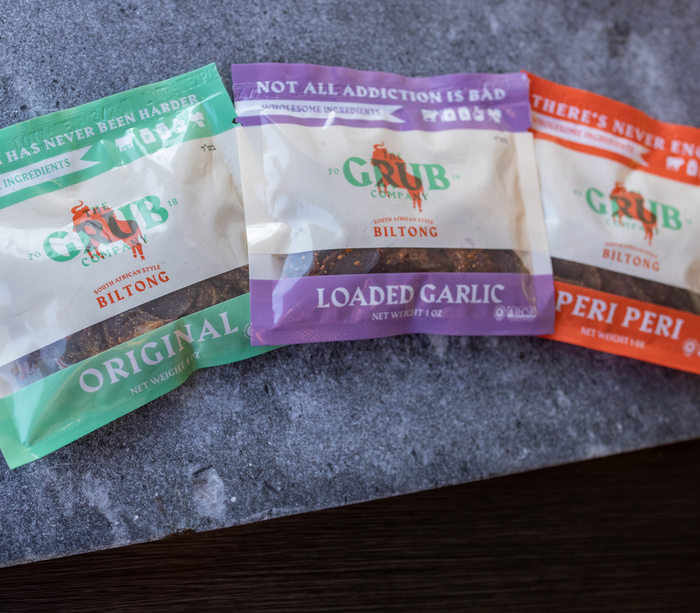
If you came for the savory, coriander-led South African taste, start with Sliced Biltong. It comes in three ounces of sliced, ready-to-eat biltong in Original, Peri Peri or Loaded Garlic. Original is the reference point. Peri Peri has real heat building behind it. Loaded Garlic is roasted and savory rather than hot. If you want to choose your own thickness, our Biltong Slabs are a pound of biltong, uncut, in the same three flavors. For the full range, see the biltong collection. If you would like something sweeter and chewier, our kosher beef jerky collection shows Meat Candy. US orders over $50 ship free.
Bottom line
Biltong is whole-muscle beef, cured and air-dried, with a changing texture and a clean beef flavor. Droewors is ground, spiced and filled into a casing, with an even snap. They are close cousins with different personalities. Pick biltong if you want the chew, the choice of thickness and a simple ingredient list. Pick droewors if you want a firm stick. If you keep kosher, make the certification mark your first check on either.
Frequently Asked Questions
What is the difference between biltong and droewors?
Biltong is whole-muscle beef cut into strips or kept as a slab, cured and air-dried. Droewors is ground, spiced meat in a thin casing, then air-dried. The flavor family is similar, and the texture and form are different.
Which is healthier, biltong or droewors?
We will not make a health claim. Both are meat snacks and both are high in protein, but they differ by maker and by recipe. Read the label on any bag, and ask your doctor about specific dietary needs.
Is droewors the same as a beef stick?
They are similar in shape, but droewors is air-dried and seasoned in the South African style, with coriander as a signature. Many beef sticks are made differently, so compare labels rather than assume.
Does Grub sell droewors?
No. We make biltong and Meat Candy, not droewors. Both are certified Glatt Kosher.
Which is better for a first-timer?
Biltong. It is the reference point for the whole tradition, and sliced biltong needs nothing from you. Start with the Original flavor, then move to Peri Peri or Loaded Garlic.
Do biltong or droewors need refrigeration?
Our biltong does not. Keep bags sealed and away from heat. For any other product, follow the storage directions on the package.
Can I eat biltong or droewors at a dairy meal?
No. Both are meat, and meat and dairy are not served together. How long to wait between them is a matter of family custom, so ask your rabbi.