Airplane Snacks: What Gets Through Security and What Travels Well
The best airplane snacks are solid, dry, quiet and sealed, and solid food is allowed through TSA security in both carry-on and checked bags. We make certified Glatt Kosher biltong and jerky, so this guide covers what TSA says on tsa.gov, what to pack, and where our own snacks are the wrong choice.
Related: Gifts for Travelers: Food That Clears Security and Survives the Bag
What TSA says about food, from tsa.gov
We read TSA's own "What Can I Bring?" food pages before writing this. Here is what they say, and where they go quiet.
- Solid food is allowed. TSA's food pages say solid food items (not liquids or gels) can go in carry-on or checked bags.
- Meat is allowed. TSA lists cooked meat with no liquid as a yes for both carry-on and checked bags. Fresh meat has extra rules about ice packs, which have to be completely frozen at screening.
- Liquids, gels, spreads and pastes follow the 3-1-1 rule. In a carry-on, each container must be 3.4 ounces (100 milliliters) or less and fit in one quart-size bag. Hummus, peanut butter, creamy dips, honey and jam all fall here. Larger amounts go in checked bags.
- Officers may ask you to take food out. TSA says officers may tell travelers to separate foods and other items from a carry-on if they clutter the X-ray image.
- The officer has the last word. TSA's wording is that the final decision rests with the TSA officer on whether an item is allowed through the checkpoint.
Here is what the pages do not say. They do not name jerky, biltong or dried meat as an item. They do not set a limit on how much solid food you can bring. We are not going to tell you TSA has "approved" a specific snack, because it has not. What you can say is that dry, sealed, solid food is the easy case, and TSA's own guidance for anything not listed is to ask. TSA runs AskTSA for that, and you can text "Travel" to 275-872.
Rules change. Check the "What Can I Bring?" food page on tsa.gov the week you fly.
What makes a good airplane snack
Security is only the first test. The second test is a seat 31B with a tray table the size of a paperback.
- It is solid. Solid food skips the 3-1-1 rule entirely. That one fact removes most of the security stress.
- It needs no fridge. A cabin has no cold storage and an airport day can run ten hours. Anything that has to stay cold is a gamble.
- It needs no utensils. No fork, no knife, no spoon. You eat it with your hands.
- It does not crumble. Crackers in a carry-on become dust. You will find them in your laptop bag next week.
- It does not smell. Tuna, hard-boiled eggs and reheated anything make you unpopular for two rows in every direction.
- It has protein. Airport food is mostly refined carbs. Protein is what carries you from the gate to your connection without a second meal.
There is a seventh test for kosher travelers. You often cannot trust what is sold past security, and on a plane you may have no choice at all. A snack that is already certified, already sealed and already in your bag solves a problem the terminal cannot.
Snacks that travel well
These pass most or all of the tests. Pack what suits your trip, and check the labels and certification of anything you buy.
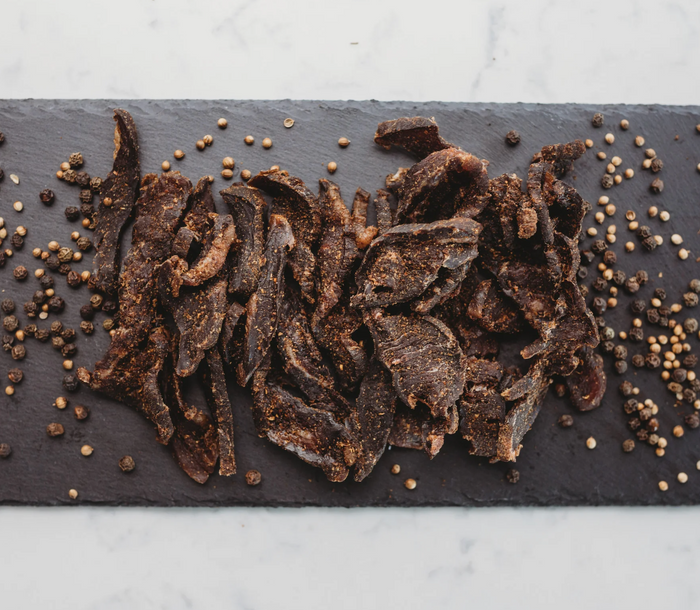
- Dried beef. Biltong and jerky are beef with the water taken out. That is why a sealed bag survives a bag room, a middle seat and a delay. It is protein, it is quiet and it is ready to eat. This is the category we make.
- Nuts and seeds. Real protein, no fridge, no utensils. They are dense in calories, so a small bag is a snack. Check for nut allergies in your row before you open one, and note that some airlines announce nut-free flights.
- Roasted chickpeas. Crunchy and pareve, so they work for a traveler who is also avoiding mixing meat and dairy.
- Whole fruit. An apple or a banana is solid, so it passes security. Eat or toss it before you land. Many countries restrict fresh produce at the border.
- Dried fruit. TSA lists dried fruit as allowed. It is sweet and light, but it does not hold you for long.
- Plain crackers or pretzels. Fine as a base. Pack them in a hard container so they arrive whole.
- A frozen-solid or room-temperature sandwich. A sandwich is solid food. Keep it simple and plan to eat it within a few hours.
Where biltong and jerky fit, and where they do not
Both are ready to eat. Never cook either one. Open the bag and eat.
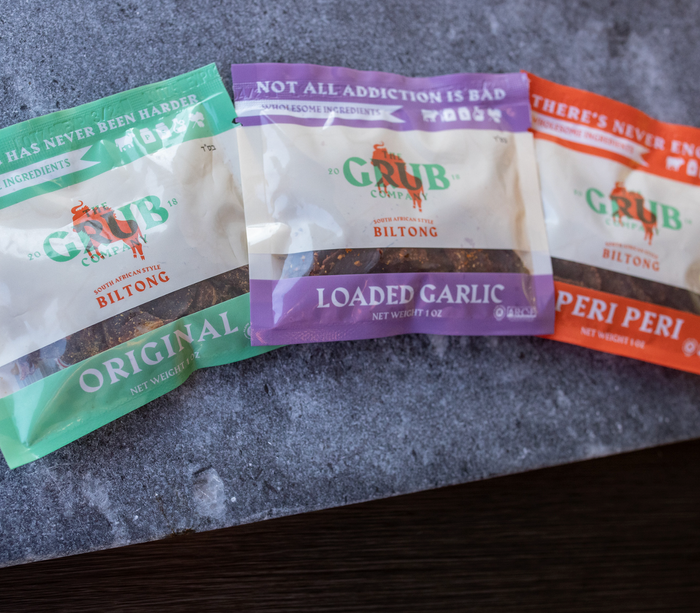
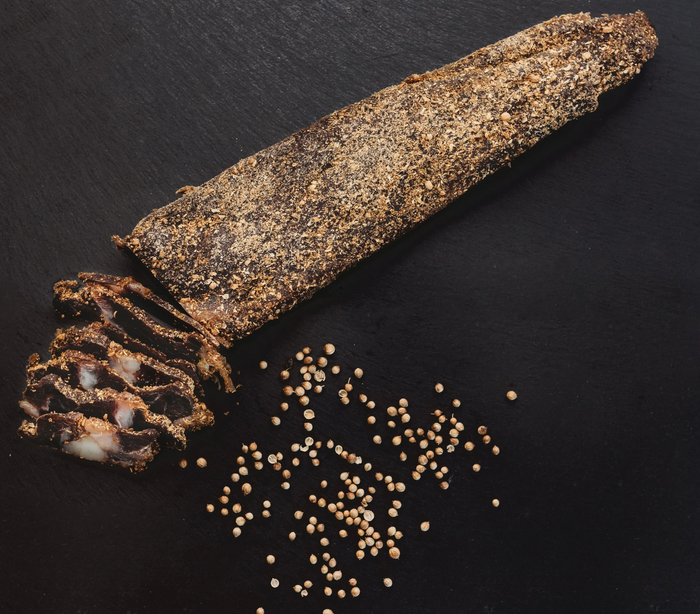
- Biltong is cured with vinegar, salt and spices, then air-dried. It is savory, it tears rather than fights back, and it is the better pick if you want something that is not sweet. Our Sliced Biltong comes in three-ounce bags in Original, Peri Peri and Loaded Garlic. It is already sliced, so there is nothing to cut.
- Jerky is cooked, glazed and sweeter. Our Meat Candy (our beef jerky) comes in Hickory Kickory Dock and Baa-Baa BBQ Sheep. If you want jerky that is certified Glatt Kosher, start with our kosher beef jerky collection.
For a flight, the small bag is the smart one. Our Sliced Biltong Mini's are one ounce each, sealed, in the same three flavors. You can finish one in a sitting, so you are not carrying an open bag for the next leg. If you are bringing more for a trip, you can see every size on Buy Biltong Online.
Pack it flat. A sealed bag that is crushed under a laptop is still safe, but it arrives as shards. Keep it in a pocket of your personal item so you can reach it without opening the overhead bin.
The honest trade-offs:
- Peri Peri has real heat. It is not the pick for a shared armrest unless you know your seatmate. Original is the safe one.
- Biltong is the wrong pick if you want a soft, sweet snack. It is savory and salty. Pair it with water, because a dry cabin and a salty snack make you thirsty.
- Jerky is the wrong pick for a long chewing session. It is chewier than biltong and it is sweet. Some people want that. Some do not.
- A smell is possible. Dried beef is far milder than a hot meal, but a sealed bag opened in a quiet cabin is noticeable. Eat it where it will not bother anyone.
We wrote more on what holds up on the road in Biltong for Travel: What Survives a Trip and What Does Not, and on the business traveler's version in Kosher Jerky on a Business Trip.
What to leave at home
- Anything you cannot carry through as a solid. Soup, yogurt, hummus, dips and spreads above 3.4 ounces are checked-bag items.
- Anything messy. A snack that needs a napkin and a wet wipe is a bad plan at 35,000 feet.
- Strong-smelling food. If you would not want to sit next to it, do not unwrap it.
- Anything you cannot afford to have set aside. An officer can ask you to remove food from a bag, and the final call is theirs. Do not pack a snack you would be upset to lose at the checkpoint.
- Meat and dairy together. Keep them separate in your bag, and keep to your family's custom on waiting between a meat meal and a dairy one. On a long trip, plan the order of your snacks.
Flying internationally or on a holiday
TSA is only the US departure checkpoint. Your destination country sets its own rules for bringing food in, and many restrict meat and animal products. Check that country's official customs guidance before you pack meat for an international flight. We will not guess at another country's rules.
If you are traveling on Pesach, check for a Pesach certification on anything you pack, and ask your rabbi about anything you are unsure of. We only describe our products the way our labels do.
Also remember that we ship in the US only. If you are flying out of the country, buy before you leave.
The bottom line
Pack solid, sealed, protein-first food and you have solved most of the problem. TSA allows solid food in carry-on and checked bags, does not name jerky or biltong, and leaves the final decision to the officer, so keep it simple and keep it reachable. A one-ounce bag of certified Glatt Kosher biltong in your pocket beats a terminal meal you cannot trust. US orders over $50 ship free.
Frequently Asked Questions
Can you bring snacks through TSA?
Yes. TSA's food pages say solid food items can go in carry-on or checked bags. Liquids, gels, spreads and pastes in a carry-on must be 3.4 ounces (100 milliliters) or less each and fit in one quart-size bag. The officer makes the final call at the checkpoint.
Can you bring beef jerky or biltong on a plane?
TSA's food list does not name jerky or biltong, so we cannot point to a line that approves either. TSA does allow solid food and cooked meat with no liquid in carry-on and checked bags. Dried, sealed beef is a solid food. If you want certainty, ask AskTSA before you fly.
Do I have to take snacks out of my carry-on?
Not always, but you may be asked. TSA says officers may tell travelers to separate foods and other items that clutter the X-ray image. Keeping your food in one easy-to-reach pocket makes that quick.
What are the best snacks for a long flight?
Solid, sealed, no-mess foods with protein: dried beef, nuts, roasted chickpeas, whole fruit and plain crackers. Skip anything that needs a fridge, a utensil or a lot of napkins. Pack a little more than you think you need, because delays are common.
Is kosher jerky or biltong okay to eat on the plane without cooking it?
Yes. Biltong is cured and air-dried and jerky is cooked and dried. Both are ready to eat when you open the bag. Do not cook either one.
Can I bring biltong on an international flight?
That depends on the country you are flying to. TSA covers the US departure checkpoint only. Many countries limit meat and animal products at the border, so check the destination's official customs guidance before you pack. We ship within the US only.
Which of your products is best for flying?
Sliced Biltong Mini's. They are one ounce, sealed and ready to eat, so you finish one in a sitting. Original is the safest flavor to share. Peri Peri has real heat.