What "Glatt Kosher" Certification Actually Means for Grub Company's Biltong and Beef Jerky
Glatt is Yiddish for "smooth." On a meat package it refers to the animal's lungs — specifically, that they were found free of the adhesions that would otherwise require closer examination. It is a stricter standard within kosher, not a separate category, and it is one of the most misunderstood words in the kosher aisle. Here is what it actually means, and what it tells you when you are buying dried meat.
The lungs, and why they decide it
After kosher slaughter, the animal is inspected. One of the checks is the lungs, which are examined for sirchot — adhesions, meaning scar tissue left behind by past illness or injury.
An animal whose lungs are found free of problematic adhesions is described as glatt, from the Yiddish for smooth. An animal with adhesions that need closer examination may still be perfectly kosher under standard halacha, following a further process of inspection — but it is not glatt.
So the word is not a general quality claim, a hygiene claim, or a health claim. It describes the outcome of one specific inspection.
Glatt versus kosher versus "kosher-style"
| Term | What it means | What it does not mean |
|---|---|---|
| Kosher | Meets the requirements of Jewish dietary law, under supervision | Not a health, hygiene or quality claim |
| Glatt kosher | Lungs found free of problematic adhesions — a stricter standard within kosher | Not a separate category, and not "extra clean" generally |
| Kosher-style | Nothing. A marketing phrase with no supervision behind it | Not kosher in any sense |
| Pareve | Neither meat nor dairy | Beef products are meat, never pareve |
| Hechsher | The certification symbol of a supervising agency | Not every hechsher is accepted by every community |
| Shechita | The kosher slaughter process itself | One requirement among several, not the whole standard |
In American usage, "Glatt Kosher" on beef has also come to signal a generally higher level of supervision throughout production. Strictly, though, the word refers only to the lung inspection. Both things are true at once, which is part of why the term confuses people.
A note that matters more than the definition
Glatt applies to beef and other ruminants — animals with lungs that get inspected this way. You will sometimes see the word used loosely on poultry or on products where it does not strictly apply. That is a signal to look at the certification itself rather than the adjective.
Which is the general rule: the adjective on the front of a package is not the claim. The hechsher is the claim.
What to actually check on any dried meat
- A named certifying agency, not the word "kosher" printed by the brand about itself.
- A certificate you can view. Certificates carry expiry dates, and a producer confident in its supervision publishes them rather than referring to them. Ours are linked from our FAQ.
- What the certificate covers. Certified beef processed in an uncertified facility is not a certified product. The certificate should name the finished item.
- Whether it is current. A certificate from three years ago is a question, not an answer.
- Whether your community accepts that agency. Standards differ between communities, and this is a question for your rabbi rather than for a website.
If you need glatt specifically, ask for it specifically, and check the certificate rather than the packaging copy. That is true of any producer, including us.
Why so little dried meat is certified at all
Worth knowing, because it explains why the certified market is so small.
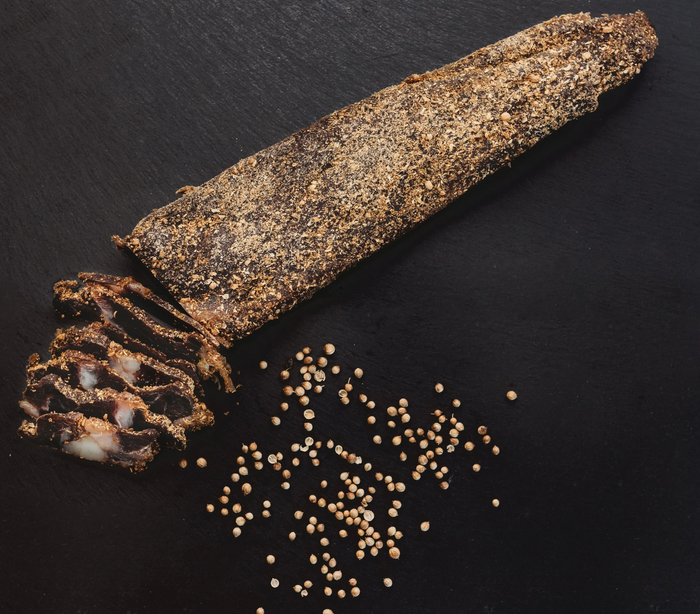
Biltong is traditionally made from silverside and topside — cuts from the hindquarter. The hindquarter contains the sciatic nerve and its surrounding forbidden fats, which must be removed through a skilled process called nikkur, or porging. Outside Israel that work is rarely done commercially, so most kosher butchers do not sell hindquarter beef at all.
A kosher dried-meat maker therefore either sources properly porged hindquarter or reformulates around forequarter cuts. Both add cost and both require expertise.
Jerky has a different problem. Its marinades are where certification usually fails: Worcestershire sauce traditionally contains anchovies, soy sauce is frequently uncertified, and "natural flavors" is exactly the kind of ingredient supervision exists to inspect. A jerky recipe can start with kosher beef and still fail on a sauce.
Why biltong is unusually easy to certify
- No dairy anywhere. Meat, salt, vinegar and spice — nothing creates a meat-and-dairy question.
- No wine. The cure uses vinegar, and certified vinegar is straightforward.
- Nothing is cooked. Because no heat is applied, questions about bishul akum do not arise in the same way.
- A six-ingredient list. Fewer ingredients means fewer certifications to chase.
What does require care is the facility, which must be supervised, and the equipment, which must be kosher and either dedicated or properly kashered.
The inspection itself, in more detail
Understanding what actually happens makes the term far less mysterious, and it explains why glatt is a matter of degree rather than a different kind of kosher.
After shechita, the animal undergoes bedikah — inspection — to confirm it is free of conditions that would render it treif. Lungs receive particular attention, because lung damage is both common and diagnostic of past disease.
The inspector is looking for sirchot: adhesions where lung tissue has stuck to the chest wall or to itself, usually scar tissue from an old infection or injury. What happens next depends on what is found:
| What is found | Status |
|---|---|
| Lungs entirely smooth, no adhesions | Glatt — from the Yiddish for smooth |
| Minor adhesions that resolve under examination | Accepted as glatt under many standards |
| Adhesions requiring closer examination, which then pass | Kosher, but not glatt |
| Adhesions that do not resolve | Not kosher |
Two things follow. First, a meaningful proportion of otherwise kosher animals are not glatt — which is why glatt beef costs more: the supply is a subset. Second, the middle two rows are where communal standards differ, and it is why "glatt" does not mean precisely the same thing to every certifying agency.
Why the word gets used loosely
In American usage "Glatt Kosher" has drifted beyond its literal meaning to signal a generally higher standard of supervision across the whole process — not just the lungs.
Both things are now true at once, which is the source of most confusion. Strictly, the word describes one inspection outcome for ruminants. Colloquially, it functions as shorthand for stricter supervision generally, and you will see it on products where the literal sense cannot apply at all.
| On a package of… | Does "glatt" literally apply? |
|---|---|
| Beef, lamb, veal | Yes — these are the ruminants whose lungs are inspected |
| Chicken, turkey, duck | No — poultry has no equivalent inspection |
| Fish | No |
| Dairy, bakery, packaged goods | No — used colloquially, if at all |
| A restaurant or caterer | Colloquially, meaning the meat used is glatt |
The practical rule: when the adjective cannot literally apply, read the certification instead. The hechsher is the claim. The adjective on the front is a description of it, and sometimes a loose one.
The other terms you will meet
| Term | What it means | Common misunderstanding |
|---|---|---|
| Shechita | The kosher slaughter process, performed by a trained shochet | That it is the whole of kashrut — it is one requirement among several |
| Bedikah | Post-slaughter inspection, including the lungs | Confused with glatt, which is one possible outcome of it |
| Nikkur / porging | Removal of forbidden fats and the sciatic nerve from the hindquarter | Assumed to be a trim; it is a skilled dissection |
| Melichah | The salting process that draws out blood | Confused with seasoning — it is a kashrut requirement |
| Fleishig | Meat, for the purpose of separation from dairy | — |
| Pareve | Neither meat nor dairy | People ask whether dried beef counts. It does not — beef is meat |
| Hechsher | The certification symbol of a supervising agency | That all are equivalent; communities differ |
| Mashgiach | The supervisor who oversees production | — |
Melichah is worth a moment for anyone thinking about dried meat specifically, because it means kosher beef has already been salted before it reaches a biltong maker. That interacts with a process whose own second step is salting, and a maker working with kosher meat has to account for it rather than simply following a standard recipe.
What supervision covers, beyond the animal
People frequently assume certification is essentially about slaughter. For a manufactured product it reaches much further, and the scope explains both the cost and why so few producers bother.
- The meat's provenance — shechita, bedikah, and where required the nikkur that makes hindquarter cuts usable.
- Every other ingredient — vinegar, salt, and each spice, all requiring their own certification. One uncertified ingredient invalidates the product.
- The equipment — knives, racks, hooks, trays and the drying space itself must be kosher and either dedicated or properly kashered.
- The facility — what else is produced there, and when.
- Packaging and sealing — including how a batch is identified so it can be traced.
- Ongoing inspection — a live relationship rather than a one-time audit, which is why certificates carry expiry dates.
It is a set of constraints on every input and every surface in a building, maintained continuously — not a sticker bought once.
What to check on any package
- A named certifying agency, not the word "kosher" printed by the brand about itself.
- A certificate you can view, with a date on it. Producers confident in their supervision publish them.
- What the certificate covers — the finished product, not only the meat. Certified beef processed in an uncertified facility is not a certified product.
- Whether it is current. A certificate from three years ago is a question rather than an answer.
- Whether your community accepts that agency. Standards differ, and this is a question for your rabbi.
- For a reseller, who actually makes it. A shop selling several brands is passing on someone else's certification.
The phrase that should end a purchase is "kosher-style." There is no such standard and no supervision behind it, and it usually means the opposite of what a shopper assumes.
Why so little dried meat is certified at all
Two separate obstacles, and they affect biltong and jerky differently.
For biltong: the cut
Biltong is traditionally made from silverside and topside — hindquarter muscles. The hindquarter contains the sciatic nerve and surrounding forbidden fats, which must be removed by nikkur. Outside Israel that work is rarely done commercially, because the labor cost exceeds what the resulting meat fetches, so kosher butchers generally sell forequarter only.
A kosher biltong maker therefore either sources properly porged hindquarter, or reformulates around forequarter cuts — which are fattier and coarser-grained, and need harder trimming and different drying. Both are expensive, and that is the entire reason the certified biltong market is small.
For jerky: the marinade
Jerky fails somewhere else entirely. Its marinades are where certification usually breaks down: Worcestershire sauce traditionally contains anchovies, raising a fish-and-meat question; soy sauce is frequently uncertified; and "natural flavors" is exactly the kind of ingredient supervision exists to inspect. A jerky recipe can start with kosher beef and still fail on a sauce.
Which is why, once the meat problem is solved, biltong is easier to certify than almost any other cured meat: no dairy, no wine, no cooking, no casings, no starter cultures, and a five-to-seven item ingredient list.
Halal, and why the two do not transfer
A frequent assumption, and incorrect in both directions.
Kosher and halal are separate systems with separate requirements, separate certifying bodies and separate slaughter practices. Kosher certification does not make a product halal, and halal certification does not make it kosher. Some requirements overlap — both prohibit pork, both require specific slaughter — and the overlap is not sufficient for either standard.
If you need halal dried meat, look for a halal mark specifically. The same reasoning in this guide applies: a named certifying body, a viewable certificate, and coverage of the finished product rather than only the raw material.
Reading a hechsher
The symbol is the whole claim, so it is worth knowing how to read one rather than treating them all as interchangeable.
A hechsher identifies the agency supervising production. Agencies differ in standards, in the communities that accept them, and in what they will certify. Some are national and widely recognized. Some are the personal certification of an individual rav, trusted within a specific community and unfamiliar outside it — which is a difference in recognition rather than in rigor.
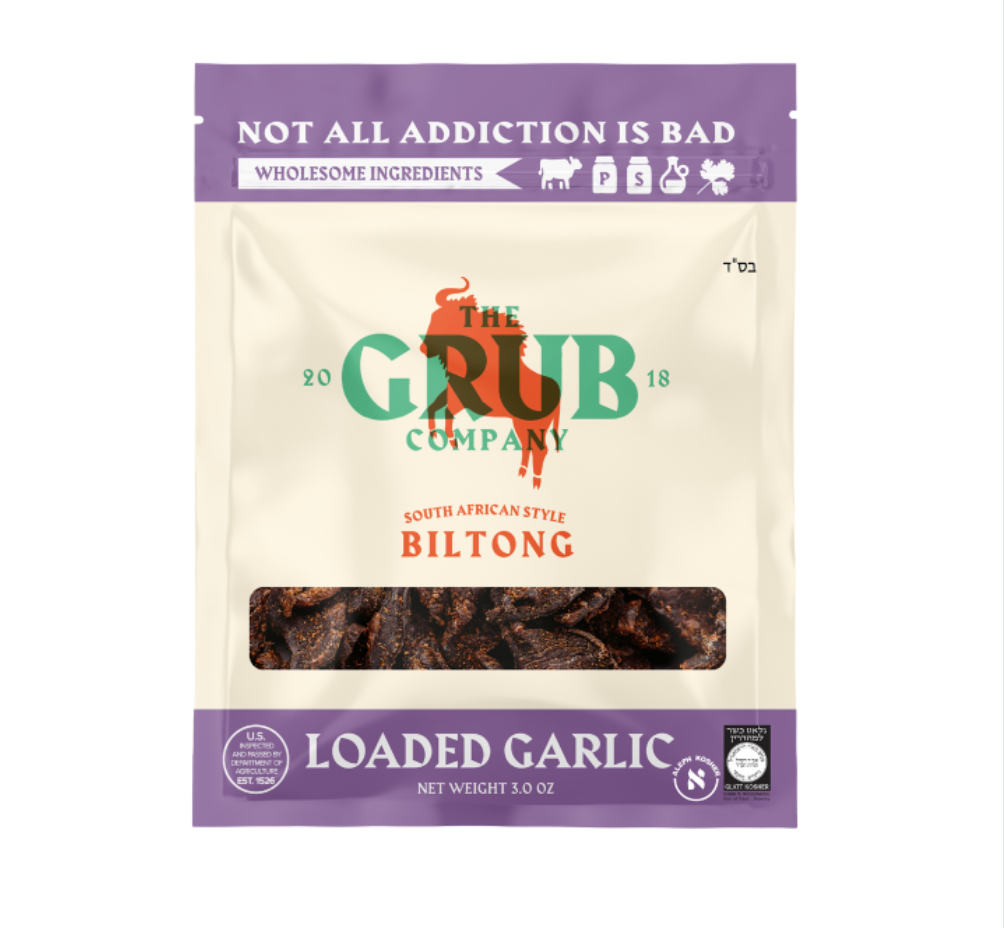
Two additional marks often appear alongside the symbol. A meat designation confirms the product is fleishig — for beef, always the case. Some agencies also indicate the level of supervision, whether an inspector was present continuously or periodically, though that detail is usually on the certificate rather than the pack.
The practical rule: the symbol tells you who stands behind the product; whether that agency meets your standard is a question for your rabbi. No producer can answer it for you, and any producer claiming their hechsher is universally accepted is overreaching.
Batch numbers, and why they matter here more than elsewhere
A batch number on a package is a good sign rather than an industrial detail, and for kosher products it carries specific weight.
It means the producer can tell you which slaughter the meat came from, what certification applied at the time, and when the batch was made. That matters because supply conditions genuinely change — a certifying body's availability, a supplier's capacity, the cuts obtainable in a given month — and a producer who tracks batches can tell you honestly what changed and when.
A producer who cannot is asking you to trust a claim with nothing behind it. It is a fair question to ask, and the answer is informative regardless of what it is.
Common misconceptions, cleared up
"Glatt kosher means healthier or cleaner." No. It is a supervision standard about lung adhesions. It is not a nutrition, hygiene or food-safety claim, and it says nothing about how the animal was raised.
"Glatt is a separate category from kosher." No — it is a stricter standard within kosher. Everything glatt is kosher; not everything kosher is glatt.
"Kosher-style is a lesser certification." It is not a certification at all. There is no standard and no supervision behind the phrase.
"A rabbi blesses the food." A persistent myth. Supervision is inspection and process control — sourcing, equipment, ingredients, facility — not a blessing.
"All hechsherim are equivalent." They are not, and which ones a household accepts is a communal question rather than a factual one.
"If it says kosher on the front, it is certified." Only if an agency's symbol appears. A brand writing "kosher" about itself is making a claim, not showing a certification.
"Dried beef might be pareve because it is shelf-stable." No. Beef is meat regardless of how it is preserved or where it is sold.
What this means when you are buying dried meat
Putting it together into something usable.
If you need glatt specifically, ask for it specifically and check the certificate rather than the packaging copy. The adjective on the front is a description; the hechsher is the claim; the certificate is the evidence.
If you need kosher but not necessarily glatt, the market is slightly wider, and the same three checks apply — named agency, viewable certificate, covering the finished product.
And in either case, remember that certification and quality are separate questions. A certificate tells you the product meets a kashrut standard. It tells you nothing about whether the beef was good, whether the drying was done properly, or whether it will taste of anything. Those are judged the same way as any other dried meat: the cut, the process, the ingredient list, and what the cut face looks like when you open the bag.
Where kosher dried meat is actually sold
| Channel | Likelihood | What to expect |
|---|---|---|
| Kosher grocers and markets | High | The reliable channel. Usually one or two brands |
| Direct from a certified maker | High | Full range, freshest, best per-ounce price, certificate on the site |
| Kosher sections of large supermarkets | Occasional | Thin, and often only around Yom Tov |
| Health and supplement stores | Low | Protein-marketed brands, rarely certified |
| Mainstream snack aisle | Very low | Check for a hechsher rather than assuming |
| Gas stations and convenience | Effectively never | — |
This is why many people conclude certified dried meat does not exist. It does — it is simply not sold where dried meat is normally sold, because the customers who need it shop somewhere else.
Where it earns its place in a kosher household
Certified dried meat solves a specific and recurring problem: substantial protein that needs no kitchen, no heating, no refrigeration and no utensils. There are not many foods that clear all four at once, and fewer still that are certified.
| Occasion | The problem it solves |
|---|---|
| Shabbos afternoon | The long stretch between meals with no cooking possible |
| Seudah shlishit | A third meal, often light and late |
| Shalach manos | Something savory among a table of sweets |
| Yom Tov away from home | Hotels and travel with no kashrut infrastructure |
| Kiddush or simcha | Food that sits out safely for hours |
| Camp and school | Nut-free, dairy-free, no refrigeration |
| Care packages abroad | Months of shelf life, no cold chain |
One planning note: because sealed dried meat keeps three to six months, buying ahead of a busy season costs nothing — and avoids the weeks when every kosher grocer is stretched and the things you need sold out on Tuesday.
Why kosher costs more, itemized
| Cost | Why it exists |
|---|---|
| Kosher slaughter | Shechita is slower and more skilled than conventional slaughter, and a proportion of animals are rejected at inspection |
| Glatt specifically | Only a subset of otherwise-kosher animals qualify, so the supply is narrower again |
| Cut restrictions | Either you pay for porged hindquarter, or you work around it with cuts that yield less usable meat |
| Supervision | An ongoing relationship with a certifying agency, not a one-time fee |
| Certified inputs | Every spice, the salt and the vinegar must themselves be certified |
| Facility and equipment | Dedicated or properly kashered, which limits what else the space can produce |
Those stack on top of the ordinary economics of air-dried meat: two to three pounds of beef per finished pound, and a controlled room occupied for days per batch. Certified air-dried beef is therefore one of the more expensive dried meats available, and the price is almost entirely explained by process rather than by positioning.
Which is worth knowing in the other direction too. Certified dried meat priced well below the category is a question rather than a bargain — something upstream has changed, and it is fair to ask what.
The short version
Glatt means the lungs were smooth. It is stricter than kosher rather than different from it, it applies to beef and other ruminants, and in American usage it has also come to signal higher supervision generally.
On any package — anyone's — the certificate is the thing to read, not the adjective. A named agency, a viewable and current certificate, covering the finished product rather than only the meat. Whether that agency meets your standard is a question for your rabbi, and no producer can answer it for you.
A note on what a page like this can and cannot settle
Everything above is general — how the inspection works, what the terms mean, what to check. None of it establishes that any particular product is acceptable to you, and it is worth being explicit about that boundary.
The question has two parts, and only one is factual. Whether a product carries valid certification is a matter of record: an agency, a certificate, a date, a scope. That is checkable, and anyone can check it.
Whether that agency meets your standard is a communal and halachic question, and it belongs with your rabbi. Standards differ between communities for reasons that are considered rather than arbitrary, and a producer's marketing copy is not the place that gets resolved.
What a maker owes you is the first part done properly and transparently: name the agency, publish the certificate, keep it current, state clearly what it covers. What they cannot do is decide the second part for you.
How the melichah step interacts with dried meat
A detail specific to kosher dried meat that almost nothing explains, and it affects the finished product.
Kosher meat undergoes melichah — a salting process that draws out blood — before it reaches any producer. So kosher beef arrives already salted, and already having lost some moisture.
Biltong's own second step is salting, for entirely different reasons: drawing water out ahead of drying, and creating an environment hostile to bacteria. A maker working with kosher meat therefore has to account for salt that is already there, rather than following a recipe written for unsalted beef.
Get that wrong in one direction and the result is aggressively salty. Get it wrong in the other and the drying starts from a weaker position than intended. It is one of the quieter reasons kosher biltong is not simply standard biltong made from different meat, and one of several places where a maker who has done it for years produces a noticeably better product than one who has just started.
Common questions
Is glatt kosher healthier than kosher? No. It is a supervision standard about lung adhesions, not a nutrition or safety claim.
Is glatt kosher more expensive? Usually, because a smaller share of animals qualify and supervision costs money.
Does glatt apply to chicken? Not strictly — the term describes ruminant lung inspection. Seeing it on poultry is a reason to read the certification rather than the adjective.
Is "kosher-style" a lesser certification? It is not a certification at all. There is no standard and no supervision behind the phrase.
Does kosher certification make something halal? No. They are separate systems with separate requirements and separate certifying bodies, and neither implies the other.
Can I rely on a symbol I do not recognize? That is a question for your rabbi. Agencies differ, and which ones a household accepts is a community matter rather than a factual one.
Where do I check yours? Our Kashrus certificates are linked from the FAQ, and the certification is stated on each product listing.
The short version
Glatt means the lungs were smooth. It is stricter than kosher, not different from it. It applies to beef. And on any package — ours included — the certificate is the thing to read, not the adjective.
More on our kosher biltong → · What makes jerky kosher →
If you want to see what certification looks like on an actual shelf rather than in the abstract, every certified format we make is in one place — with the ingredients and the certificate on each one.