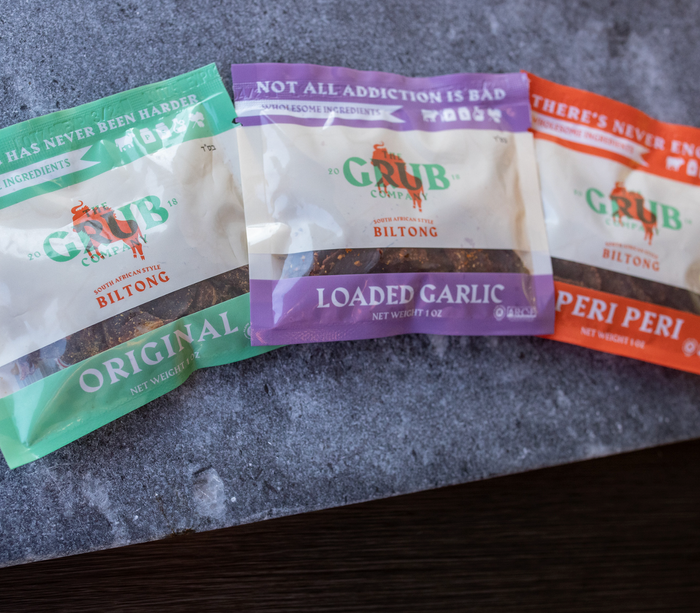
Buying Biltong in Bulk: How Much, What Format, What It Costs
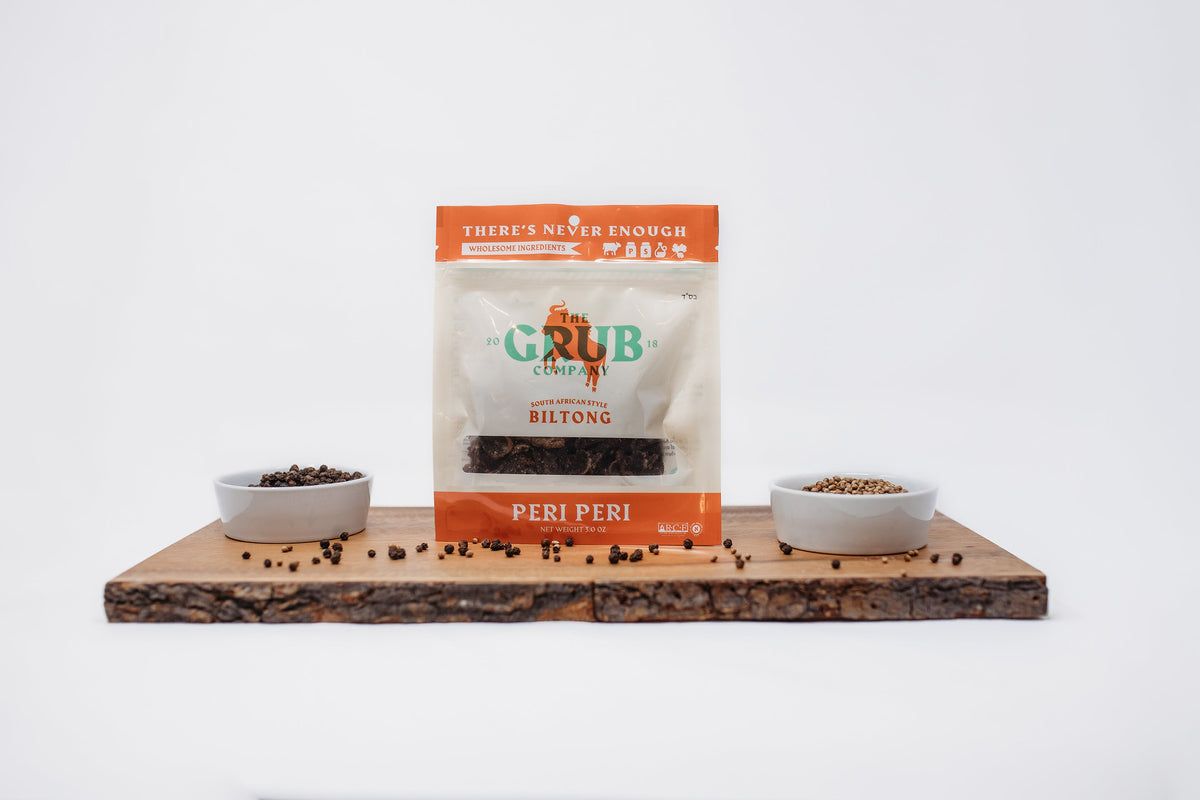
Buying biltong by the pound saves roughly 20–25% per ounce over single bags — but only if you portion it the day it arrives. This guide covers how much to buy, what bulk actually costs, how to store a pound properly, and the difference between buying bulk for yourself and buying wholesale for a business.
What bulk saves you
| Format | Size | Price | Per ounce | vs. single bag |
|---|---|---|---|---|
| Mini | 1 oz | $4.99 | $4.99 | +25% |
| Standard sliced | 3 oz | $11.99 | $4.00 | baseline |
| Bulk sliced | 16 oz | $58.00 | $3.63 | −9% |
| Whole slab | 16 oz | $58.00 | $3.63 | −9% |
Those are The Grub Company's prices, given so the arithmetic is real rather than illustrative. The saving is meaningful but not dramatic, and that is worth knowing before you buy: biltong does not have the steep bulk discount that shelf-stable packaged snacks do, because the cost is in the beef and the drying time, not in the packaging.
Where bulk genuinely pays is shipping. A single 3 oz bag rarely clears a free-shipping threshold; a pound does. Add $3.99 of shipping to a $11.99 bag and your effective per-ounce cost jumps to $5.33 — worse than minis.
How much to buy
The most common bulk mistake is buying more than you can get through before it changes character. Here is a realistic guide.
| Situation | Quantity | Reasoning |
|---|---|---|
| One person, snacking regularly | 3–6 oz per week | A pound is about a month. Portion into four bags. |
| Household of four | 1 lb per 1–2 weeks | It disappears faster than anyone predicts |
| Office of 10, weekly | 1–2 lb | Assume 1.5–2 oz per person per sitting |
| Party or game day, 20 guests | 2–3 lb | ~2 oz per guest if it is one of several snacks; 4 oz if it is the main one |
| Charcuterie board, 8 guests | 8–12 oz | Sliced thin, alongside cheese and other meats |
| Care package | 1 lb sealed | Keeps 3–6 months unopened; do not send opened product |
| Camp or trip, per person per week | 4–8 oz | A slab travels better than sliced |
The rule of thumb that holds up: 2 oz per person if biltong is one of several things on the table, 4 oz if it is the thing people are eating. It goes faster than jerky because it is not sweet — people do not hit the wall.
Sliced or slab, for bulk?
This decides more than the price does.
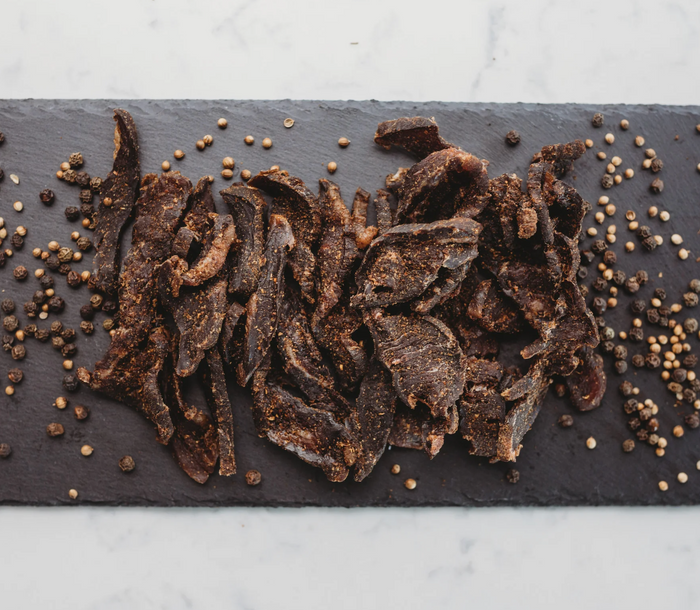
Buy sliced if the point is convenience — meal prep, office snacking, lunchboxes, anything where someone should be able to grab a handful without thinking. The trade-off is surface area: sliced biltong has far more of it, so it dries out faster once a bag is open.
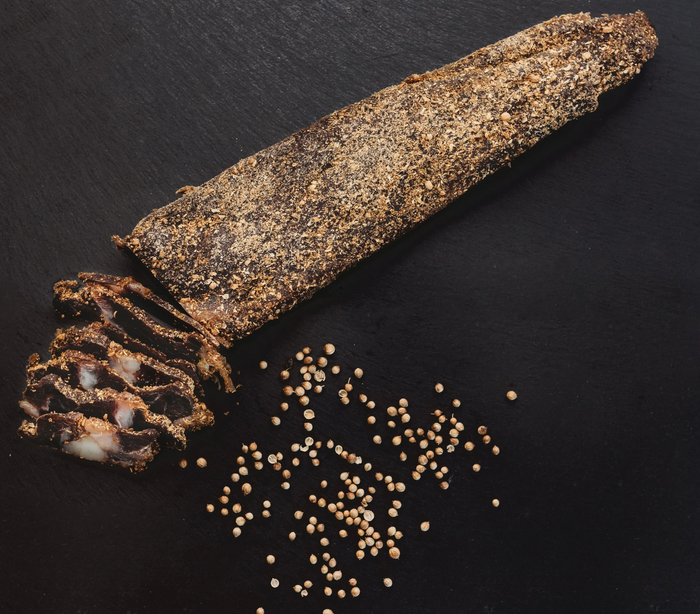
Buy a slab if the pound will be opened and closed repeatedly over weeks, or if you are serving it to people. A slab loses moisture much more slowly because most of the meat is protected by the outside of the piece. It also lets you cut thick or thin to suit the occasion. The cost is a knife and a minute.
For a household buying a pound a month, a slab is usually the better call and most people buy sliced anyway.
Storing a pound properly — the part that decides whether bulk was worth it
This is where bulk buying succeeds or fails, and it takes five minutes on arrival.
- Portion immediately. Split the pound into week-size amounts — four portions for one person, two for a household.
- Seal each portion separately. Vacuum bags if you have them; zip bags with the air pressed out if you do not.
- Keep one out, refrigerate or freeze the rest. The portion you are eating lives in the cupboard. The others should not be opened at all until their turn.
- Freeze anything beyond three weeks out. Biltong freezes well because there is very little free water in it to form damaging ice crystals.
- Thaw in the fridge, then bring to room temperature. Cold biltong tastes flat.
The failure mode is obvious once stated: a pound in one bag, opened daily for a month, is a pound of biltong being slowly dried into something much harder than what you bought. Opening one bag thirty times is far worse for the product than opening four bags seven times each.
Bulk for personal use vs wholesale for a business
These are different transactions and it helps to be clear which one you want.
| Bulk (personal) | Wholesale (trade) | |
|---|---|---|
| Who buys | Households, offices, event hosts | Retailers, groceries, distributors, corporate gifting |
| Quantity | 1–5 lb | Cases, recurring |
| Pricing | Published per-pound price | Negotiated, tiered by volume |
| Packaging | Retail bags | Retail-ready cases, sometimes private label |
| Lead time | Standard shipping | Production scheduling, often weeks |
| How to start | Add to cart | Contact the maker directly |
If you are stocking a store, a deli counter, a corporate gifting program or a subscription box, you want the wholesale conversation, not the bulk product page. Small biltong makers dry to order in batches, which means lead time is real — a case is not sitting in a warehouse waiting for you.
Questions worth asking a bulk supplier
- When was this batch dried? Freshness matters more here than with jerky.
- Is it packed with an oxygen absorber? For a pound you will hold for weeks, this is not optional.
- What is the shelf life from the pack date, not the ship date?
- Sliced or slab, and can I choose?
- Can I mix flavors within a bulk order? Some makers allow it; a pound of one flavor is a long commitment.
- What is the free-shipping threshold? It often decides the real per-ounce cost.
- Is there a subscription option? Recurring delivery usually beats bulk for freshness, at similar cost.
Bulk versus subscription
A genuine alternative that most bulk buyers do not consider. A subscription delivering 3–6 oz weekly or every two weeks gives you fresher product than a pound bought once a month, because every bag is opened new. The per-ounce price is usually a little higher than bulk and lower than single bags, and it removes the portioning discipline that bulk demands.
Choose bulk if you are organized and price-driven. Choose a subscription if you know yourself and the pound would live in one open bag on the counter.
Why the bulk discount is flatter than you expect
Most packaged snacks get dramatically cheaper per unit as you buy more. Biltong barely does, and the reason tells you something about the product.
In most categories, packaging, marketing and distribution are a large share of the unit cost, so buying a bigger box mostly buys you less packaging. In biltong, the cost is almost entirely beef and time. It takes two to three pounds of raw beef to make one finished pound, and a batch occupies a controlled drying room for days regardless of how it will eventually be bagged.
Neither of those gets cheaper at volume. A pound of biltong contains the same beef and the same week of drying whether it is sold as one bag or sixteen.
| What you save by buying bulk | Roughly |
|---|---|
| Packaging and per-bag handling | Real, but small |
| Shipping, by clearing a free threshold | The largest single saving |
| Beef | Nothing |
| Drying time and room | Nothing |
Which is why the honest per-ounce gap between a 3 oz bag and a pound is around 20–25% rather than the 50% people expect — and why the shipping threshold matters more than the volume discount.
The shipping arithmetic, in full
| Order | Product | Shipping | Total | Per ounce |
|---|---|---|---|---|
| One 3 oz bag | $11.99 | $3.99 | $15.98 | $5.33 |
| Two 3 oz bags | $23.98 | $3.99 | $27.97 | $4.66 |
| Four 3 oz bags | $47.96 | $3.99 | $51.95 | $4.33 |
| Five 3 oz bags | $59.95 | Free | $59.95 | $4.00 |
| One 1 lb bulk | $58.00 | Free | $58.00 | $3.63 |
Three things fall out of that table.
A single bag with paid shipping is the worst value available — worse per ounce than buying single-serve minis, which are supposedly the premium format.
The awkward zone is just under the free-shipping threshold. At $47 you are paying $3.99 to avoid spending $3. Adding one more item genuinely costs less in total than not adding it.
The pound is the cheapest per ounce and it clears the threshold on its own, which is most of why it looks like such a jump in value.
Slab or sliced, for a pound
This decides more than the price does, and it is the choice bulk buyers most often get wrong.
| Bulk slab | Bulk sliced | |
|---|---|---|
| Once opened, room temperature | A week or more | 2–3 days per opened portion |
| Why | Little exposed surface; the outside protects the rest | Every piece has cut faces open to the air |
| Effort | A knife and thirty seconds each time | None |
| Thickness | You choose, each time | Fixed |
| Best for | Slow eating, hosting, travel, one person | Households, offices, anywhere convenience decides |
| Risk | It sits uncut on a counter | The last third goes hard |
For a single person eating a pound over a month, a slab is usually the better call — and most people buy sliced anyway, because the knife is enough friction to matter. Be realistic about which of those you are.
Portioning: the five minutes that decide everything
Bulk buying either saves you money or wastes a third of a pound, and the difference is a habit rather than a technique.
The failure mode: a pound arrives in one bag. It is opened on day one and again every day for a month. By week three the remaining meat has been exposed to room air thirty times and is noticeably harder than what you bought. By week four the last of it goes in the bin, and the per-ounce saving has been comprehensively undone.
The fix, on the day it arrives:
- Split the pound into week-size portions — four for one person, two for a household.
- Seal each separately. Vacuum bags if you have them, zip bags with the air pressed out if not.
- Keep one out. Refrigerate or freeze the rest, unopened.
- Do not open the next until the current one is finished.
- Freeze anything more than three weeks away.
Opening one bag thirty times is far worse than opening four bags seven times each, because every opening restarts the exchange with room air for the entire remaining quantity. The reason this works is that biltong is hygroscopic — it takes moisture back out of humid air — so the clock is really counting exposures rather than days.
Freezing a bulk order
Biltong freezes better than most people expect, for the same reason it is shelf-stable: there is very little free water left in it to form the ice crystals that damage texture.
- Portion before freezing. Repeated thaw-refreeze cycles are the one thing that genuinely harms it.
- Wrap tightly, then bag. Two layers beat one.
- Press the air out. Freezer burn is dehydration, and biltong has little moisture to spare.
- Label with the date. Six months passes quickly.
- Thaw in the fridge overnight, then leave it out for half an hour. Cold biltong tastes muted and feels waxy — the fat and the spice aromatics need a little warmth to read.
People who conclude that freezing ruined their biltong have almost always eaten it straight from the fridge.
Bulk for a household, an office, or an event — three different problems
A household
The most forgiving case, and the one where portioning matters most because the pound has to last. Assume 3–6 oz per person per week for regular snackers. A family of four gets through a pound in one to two weeks, which means almost no storage discipline is needed — you will finish it before it can harden.
One person eating a pound over a month is the case that goes wrong, and it is exactly the case where portioning on arrival turns a disappointing month into a good one.
An office
Three mistakes recur, and they are all avoidable.
- Buying a slab. Nobody in an office is going to cut it. Buy sliced.
- One big open bag in the kitchen. It dries out and the last third gets thrown away. Put out one small bag at a time and keep the rest sealed.
- One flavor. Heat tolerance varies more than people expect, and a peri-peri-only supply excludes a chunk of the office. Mix.
For planning: assume 1.5–2 oz per person per sitting, and that biltong disappears faster than jerky because there is no sugar wall to stop at. An office of ten that snacks twice a week moves roughly two pounds a month. Order every two weeks rather than monthly — the freshness difference is noticeable and the storage problem disappears.
An event
Quantity and lead time, in that order.
| Event | People | Biltong | Note |
|---|---|---|---|
| Small gathering | 10 | 1–1.5 lb | Sliced; put out half and hold the rest |
| Party, one snack among several | 20 | 2–3 lb | ~2 oz per person |
| Party, the main thing people eat | 20 | 4–5 lb | ~4 oz per person |
| Large function | 75 | 6–9 lb | Order two weeks ahead |
| Charcuterie board | 8 | 8–12 oz | Sliced thin, alongside cheese |
| Game day / tailgate | 15 | 2–3 lb | It goes faster than you plan for |
The planning fact that catches people out: small makers dry to order in batches, so a large quantity is a production question rather than a stock question. A week or two of lead time is normal and is not a sign of disorganization — it is a sign that they actually dry the product. Ask about lead time before you ask about price.
Bulk against wholesale — different transactions
| Bulk (personal) | Wholesale (trade) | |
|---|---|---|
| Who buys | Households, offices, event hosts | Retailers, groceries, distributors, corporate gifting |
| Quantity | 1–5 lb | Cases, recurring |
| Pricing | Published per-pound price | Negotiated, tiered by volume |
| Packaging | Retail bags | Retail-ready cases, sometimes private label |
| Lead time | Standard shipping | Production scheduling, often weeks |
| How to start | Add to cart | Contact the maker directly |
If you are stocking a shop, a deli counter, a corporate gifting program or a subscription box, you want the wholesale conversation rather than the bulk product page. The economics, the packaging and the scheduling are all different, and a maker will treat it as a different kind of order.
Bulk against a subscription
A genuine alternative most bulk buyers never consider, and for a lot of people the better answer.
A subscription delivering 3–6 oz weekly or every two weeks gives you fresher product than a pound bought once a month, because every bag is opened new. The per-ounce price usually sits between single bags and bulk — worse than a pound, better than one-off bags — and it removes the portioning discipline that bulk demands.
| Bulk | Subscription | |
|---|---|---|
| Price per ounce | Best | Middle |
| Freshness | Declines across the month | Consistent |
| Requires discipline | Yes — portion on arrival | No |
| Waste risk | Real, if you do not portion | Minimal |
| Best for | Organized, price-driven buyers | Everyone who knows they will not portion it |
Choose bulk if you will do the five minutes on arrival. Choose a subscription if you know yourself and the pound would live in one open bag on the counter — which is a completely reasonable thing to know about yourself.
What to ask a bulk supplier
- When was this batch dried? Freshness matters more here than with jerky.
- Is it packed with an oxygen absorber? For a pound you will hold for weeks, this is not optional.
- What is the shelf life from the pack date, not the ship date?
- Sliced or slab, and can I choose?
- Can I mix flavors within a bulk order? A pound of one flavor is a long commitment.
- What is the free-shipping threshold? It usually decides the real per-ounce cost.
- What is your lead time on larger quantities?
- Is there a subscription option, and what does it cost per ounce?
How much is a pound, really
A pound of biltong is not a pound of snack food, and people consistently over-order or under-order because they picture the wrong thing.
Start with what it was: two to three pounds of raw beef, dried down. So a pound of biltong represents roughly the meat content of six to twelve steaks. That is why an ounce fills you up more than an ounce of almost anything else in the snack aisle, and why the price per ounce looks high next to potato chips and reasonable next to beef.
| A pound is roughly… | Amount |
|---|---|
| Servings, at 1 oz each | 16 |
| Protein, total | ~190 g |
| One person snacking regularly | 3–5 weeks |
| A household of four | 1–2 weeks |
| A party of twenty, as one of several snacks | Not quite enough |
| An office of ten, snacking twice a week | About two weeks |
The most common misjudgment is at parties. A pound sounds generous and disappears in an hour, because biltong has no sugar wall — people do not hit the point where they stop. Budget 2 oz per person if it is one of several things on the table, and 4 oz if it is what people are actually eating.
Storing a pound in a humid climate
Every storage figure assumes a cool, dry room. Change that assumption and the numbers move enough to matter, which is why the same advice fails in Florida and works in Arizona.
| Where the opened portion lives | Realistic window | What to do instead |
|---|---|---|
| Air-conditioned house | 3–4 days | Cupboard is fine |
| Average indoor | 2–3 days | Reseal with the air pressed out |
| Humid summer, no air conditioning | 1–2 days | Refrigerate from the start |
| Coastal or tropical | Same day | Refrigerate in a sealed container |
The mechanism is that biltong pulls moisture out of humid air until it balances with the room. In a humid house the meat is slowly rehydrating rather than continuing to dry, and that is the condition under which mold becomes possible. Anyone in a humid climate buying by the pound should plan on refrigerating the working portion rather than treating the cupboard as adequate.
Is bulk actually cheaper?
Per ounce, yes — about 20–25% against single bags, and more once shipping is included.
In practice, only if you portion it. A pound bought at $3.63 an ounce, of which you throw away the last third because it went hard, cost you $5.45 an ounce for what you actually ate — worse than buying 3 oz bags one at a time.
That is the whole calculation. Bulk is not a better deal; it is a better deal conditional on a five-minute habit. If you will do it, buy the pound. If you know you will not, buy smaller or subscribe, and you will spend a little more and waste nothing.
Splitting an order with other people
An underused option, and the cleanest way to get bulk pricing without the storage problem.
Because the per-ounce saving comes mostly from clearing a shipping threshold rather than from volume, three people ordering together get almost all the benefit of a bulk order and none of the month-long open bag. Each person takes home a sealed portion that they open when they get to it.
It works particularly well for an office, a shul, a running club or a group of neighbors — any set of people who would each buy occasionally and none of whom wants a pound. Practical notes: agree flavors before ordering rather than after, split into sealed portions on the day it arrives rather than leaving one bag to be raided, and have one person place the order so there is a single delivery address.
Reordering, and how to find your rhythm
Most people settle into a pattern within two or three orders. Two things speed that up.
Note when you run out, not how much you bought. The useful number is your weekly consumption, and the only way to learn it is to notice the date the last bag emptied. Most people underestimate by roughly half.
Order before you finish, not after. Small makers dry in batches, so there can be a few days between order and dispatch. Ordering when you are down to your last portion means a gap; ordering when you open your last portion means none.
Once you know your weekly rate, the format choice makes itself. Under 3 oz a week and single bags are fine. Three to six ounces and a subscription is usually the best combination of price and freshness. More than that, and a portioned pound is the cheapest way to eat well.
One last thing about buying a pound
The pound is where biltong stops being a snack you buy and starts being a thing you keep — and that shift is worth naming, because it changes how you eat it.
People with a bag treat biltong as an occasion. People with a portioned pound in the cupboard start using it: shredded over a salad on a Tuesday, chopped into eggs, taken on a walk, put out when someone arrives unexpectedly. It moves from the snack drawer to the pantry, and it turns out to be far more useful there.
That is the honest argument for buying in bulk, and it has very little to do with the twenty percent. It is that having enough of something changes what you do with it.
Quick answers
How much biltong per person at a party? 2 oz alongside other food; 4 oz if it is the main snack.
Does bulk biltong last as long as single bags? Only if it stays sealed. Once opened, a pound follows the same two-to-three-day room-temperature clock as any other bag.
Can I freeze a bulk order? Yes — portion first, then freeze. Six months and more is fine.
Is a slab cheaper than sliced? Usually the same price per pound. The difference is keeping quality and convenience, not cost.
Is bulk always cheaper? Per ounce, yes. In practice, no — if you waste a third of it by letting one bag dry out, the 3 oz bags were cheaper.
The shipping threshold math
Shipping is usually what decides the real cost of a bulk order, and it is worth doing the arithmetic before you build a cart.
| Order | Product | Shipping | Total | Effective per oz |
|---|---|---|---|---|
| One 3 oz bag | $11.99 | $3.99 | $15.98 | $5.33 |
| Four 3 oz bags (12 oz) | $47.96 | $3.99 | $51.95 | $4.33 |
| Five 3 oz bags (15 oz) | $59.95 | Free | $59.95 | $4.00 |
| One 1 lb bulk (16 oz) | $58.00 | Free | $58.00 | $3.63 |
Two things fall out of that table. A single bag with paid shipping is the worst value available — worse per ounce than single-serve minis. And the awkward zone is just under the free-shipping threshold, where adding one more bag can cost less in total than not adding it.
The general rule for any maker: find the free-shipping threshold, and build your order to clear it or to stay well under it with a small item. Landing at $47 is the one outcome to avoid.
Running a biltong supply for an office
Offices are the most common bulk buyer after households, and they make the same three mistakes.
- Buying a slab. Nobody in an office is going to cut it. Buy sliced.
- One big open bag in the kitchen. It dries out and the last third gets thrown away. Put out one small bag at a time and keep the rest sealed.
- One flavor. Heat tolerance varies more than people expect, and a peri peri-only supply excludes a chunk of the office. Mix.
For planning: assume 1.5–2 oz per person per sitting, and that biltong disappears faster than jerky because it is not sweet enough to make people stop. An office of ten that snacks twice a week will move roughly two pounds a month. Order every two weeks rather than monthly — the product is better and the freshness difference is noticeable.
What to ask about lead time
Small biltong makers dry to order in batches, which is a genuine constraint rather than an excuse. A batch takes days to a couple of weeks in the drying room, and a producer cannot compress that.
So for anything beyond a normal retail order — a case, a corporate gifting run, a recurring wholesale line — ask about lead time before you ask about price. A maker who says "two weeks" is telling you they actually dry the product. A supplier who can ship a hundred pounds tomorrow is holding stock, which may be perfectly good and is a different proposition.
See bulk and wholesale options, or get in touch about trade pricing if you are stocking a store.
Every format we sell, side by side, with the per-ounce price on each so the bulk math is done for you.
Buying for a crowd rather than a cupboard? Quantities per head for a party or a kiddush.