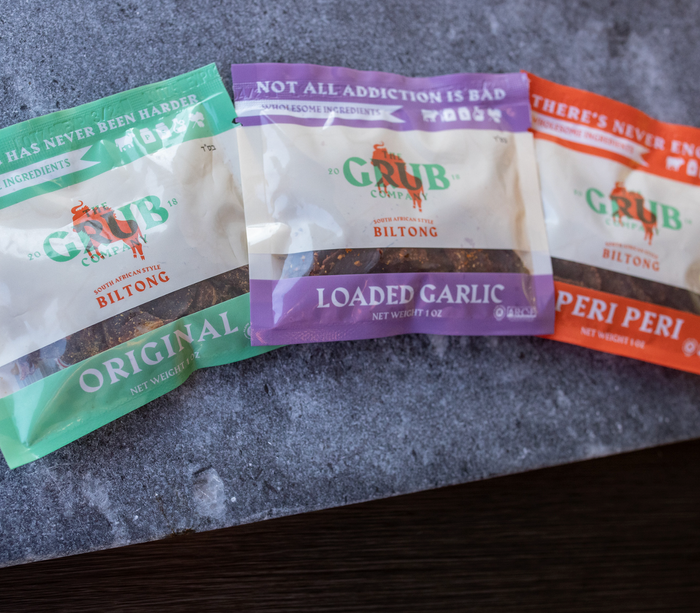
Biltong vs Beef Jerky: The Complete Comparison
Jerky is cooked. Biltong is cured. Everything else — the sugar, the texture, the sodium, the price, the shelf life — follows from that one difference. This is the complete comparison, with the actual numbers rather than the marketing.
Related: Meat Snacks: Jerky, Biltong, Sticks and Crisps Compared
The difference in one table
| Biltong | Beef jerky | |
|---|---|---|
| Origin | South Africa, 17th century | The Americas; the word is from Quechua ch'arki |
| Preservation method | Vinegar cure, salt, air-drying | Heat drying, usually with a marinade |
| Cooked? | No | Yes |
| Drying time | 3 days to 2 weeks | 4–12 hours |
| Cut direction | With the grain, then sliced across after drying | Against the grain, sliced thin before drying |
| Typical marinade | Vinegar only | Soy sauce, sugar, Worcestershire |
| Added sugar | None in an original blend | Commonly 15–20 g per 3 oz |
| Signature spice | Coriander | Varies; often smoke and pepper |
| Texture | Tender, shreds along the grain | Chewy, tears against the grain |
| Preservatives | Not required | Usually sodium nitrite |
| Thickness | Thick strips, cut after | Thin slices |
How each one is actually made
Biltong
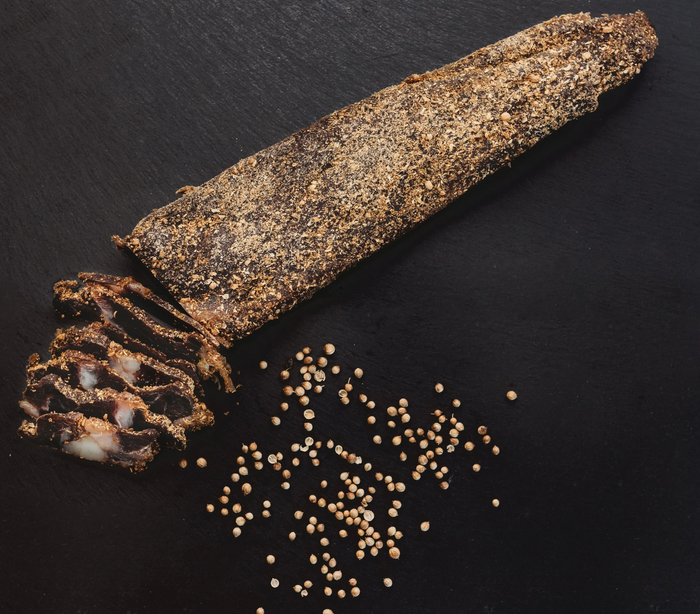
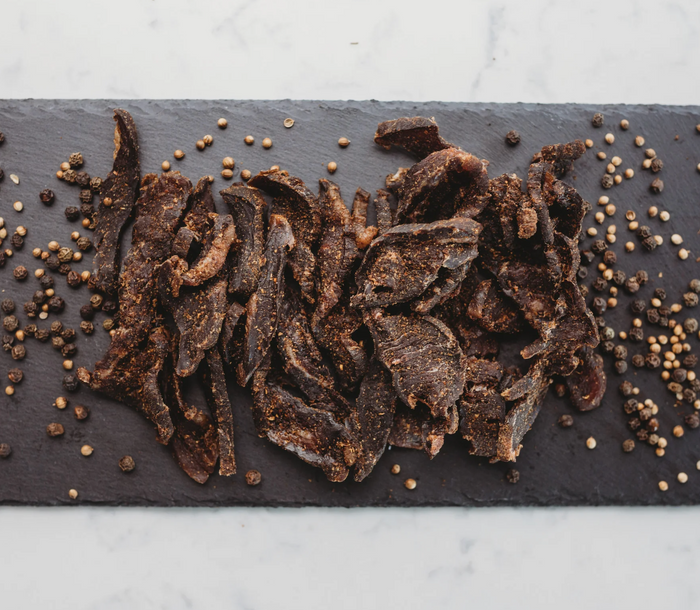
A whole strip of beef, cut with the grain, is washed in vinegar. Salt goes on, draws out water, and the excess is brushed off. The strip is coated in coriander, black pepper, garlic and whatever else the maker uses, then hung in cool, moving, dry air for days. Nothing is heated at any point. When it has lost enough water, it is cut across the grain into slices, or sold whole as a slab.
Jerky
Beef is sliced thin — against the grain — and soaked in a marinade, typically soy-based with sugar. The slices go into a dehydrator or smoker at temperatures high enough to cook the meat, usually 160–175°F, for several hours. The sugar in the marinade caramelizes and glazes the surface. Preservatives are commonly added because the process alone does not produce a shelf-stable product to modern commercial standards.
Nutrition, compared honestly
| Per 3 oz serving | Biltong | Mass-market beef jerky |
|---|---|---|
| Calories | ~240 | ~250–300 |
| Protein | ~36 g | ~27–33 g |
| Added sugar | 0 g | ~15–20 g |
| Carbohydrate | Near zero | ~20–25 g |
| Sodium | High | High |
| Nitrates / nitrites | None required | Commonly present |
| Ingredient count | 5–7 | Frequently 12+ |
The biltong column is The Grub Company's own figures. The jerky column is a category range, because brands vary widely — some premium jerky is much closer to biltong on sugar.
Two honest notes. First, both are salty; neither is a low-sodium food, and biltong's salt is doing preservation work rather than seasoning work. Second, the protein gap is not magic — biltong is generally dried further, so there is more meat per ounce. That also means an ounce of biltong is a bigger portion of beef than an ounce of jerky.
Which one tastes better?
They do not taste like variations of the same food, which is why people who dislike one often like the other.
Jerky leads with the marinade. Sweet, smoky, salty, then the beef underneath. The sugar is doing a lot of the work, and in cheaper products it is covering for a lower-grade cut.
Biltong leads with the beef. There is no marinade to hide behind. You get meat, then salt, then the warm citrus of coriander, then a faint sourness from the vinegar. People who find jerky cloying almost always prefer biltong. People who want a candy-adjacent snack usually prefer jerky.
Texture splits the same way. Jerky is chewy in a way that works your jaw — it is sliced against the grain and cooked, so the fibers are short and tough. Biltong is cut with the grain and never heated, so it separates into soft strands rather than resisting.
Which is healthier?
For most goals, biltong, and specifically because of the sugar. A 3 oz bag of typical jerky can contain as much added sugar as a candy bar. That single fact decides most comparisons:
- Keto or low-carb: biltong fits, most jerky does not.
- Post-workout protein: biltong delivers more protein per calorie.
- Clean label: biltong's ingredient list is short by necessity.
- Kids' snacks: biltong avoids the sugar; check sodium either way.
- Sodium-restricted diets: neither is a good choice.
The genuine caveat is that "biltong" is not a regulated term in the US. Some products sold as biltong are made in a dehydrator with sugar in the mix — jerky with a South African name. Read the ingredient list; it tells you which process was used more reliably than the label does.
Which lasts longer?
Roughly comparable unopened, for different reasons. Commercial jerky achieves long shelf life through preservatives; biltong achieves it through low water activity and oxygen-absorber packaging. Three to six months unopened is a normal biltong figure.
Once opened, jerky holds a bit better, because it is a more thoroughly stabilized product. Opened biltong wants to be eaten within a few days at room temperature, or refrigerated.
Which costs more?
Biltong, usually, and yield is the reason. It takes roughly two to three pounds of raw beef to make a pound of biltong, because the drying goes further. Jerky is dried less far and is often made from cheaper cuts, and the marinade adds weight that you pay for as product.
Compare per ounce, not per bag. Biltong typically runs $3.50–$5.00 per ounce depending on format; mass-market jerky runs lower, premium jerky overlaps.
The two processes, side by side in detail
Almost every difference below flows from one decision made in the first hour: whether heat is used. Everything else follows.
| Stage | Biltong | Jerky | Consequence |
|---|---|---|---|
| Cut | Thick strips, with the grain | Thin slices, against the grain | Biltong keeps long fibers intact and later shreds; jerky's are severed and it tears |
| First treatment | Vinegar wash — an acid | Marinade — soy, sugar, Worcestershire | One protects the meat; the other flavors it |
| Salt | Applied dry, rested, brushed off | Dissolved in the marinade | Biltong loses water before drying starts |
| Spice | Cracked coriander and pepper on the surface | Carried in the liquid | Biltong's spice migrates inward over days |
| Drying | Moving air, room temperature, days | Heat, 135–175°F, hours | The single decisive difference |
| Finish | Sliced across the grain after drying | Packed as-is | Biltong is cut twice, in opposite directions |
| Preservation | Acid, salt, low water activity | Heat, sugar, usually nitrites | Biltong needs no preservatives |
Why heat changes the meat and air does not
This is the part most comparisons skip, and it explains why the two feel so different in the mouth.
Muscle protein is a structure. Apply heat above roughly 140°F and it denatures — the fibers contract, tighten and shorten. That is what makes a cooked steak firmer than a raw one, and it happens to jerky in the dehydrator.
Remove water at room temperature and none of that occurs. The protein structure stays essentially as it was; there is simply less water sitting between the strands. So the finished piece is dense but not contracted, and it comes apart along the lines the muscle was already built on.
That is why properly made biltong pulls into soft threads and jerky resists then gives way. It is not a difference of degree or quality. It is a different physical state of the same protein, and no amount of good jerky-making closes the gap.
Two other things the slow route buys you
The spice ends up inside. Over days, surface salt and spices migrate slowly inward. In a six-hour process there is no time for this, so the seasoning sits on the outside as a coating and the interior tastes of plain dried meat. In a week-long dry, the coriander is in the piece.
The meat's own enzymes keep working. They stay active at room temperature through the drying period, breaking some proteins into smaller fragments — including compounds that read as savory depth. Heat shuts this down almost immediately. It is a large part of why long-cured meats taste more complex than quickly dried ones.
Which is the honest answer to "why can't you just make biltong faster." You can remove the water faster. You cannot make the days pass faster, and some of what you are paying for only happens during them.
The sugar question, properly
The sugar in jerky is not incidental seasoning. It is doing three jobs at once, which is why it is so hard to remove.
- Flavor — it balances soy and salt, and it is what most people actually recognize as "jerky taste".
- Texture — sugar attracts and holds moisture, keeping the meat pliable rather than brittle after heating.
- Browning — under heat, sugar and protein produce the Maillard reactions that give jerky its color and glaze.
Take the sugar out of a jerky recipe and you get something drier, paler and less recognizable. That is why "no sugar added" jerky is a small and slightly awkward category.
Biltong never needed it, because none of those three jobs exists. Flavor comes from beef, coriander and vinegar. Texture comes from slow drying rather than a humectant. There is no browning because there is no heat.
| Per 3 oz | Biltong | Mass-market jerky | Premium / low-sugar jerky |
|---|---|---|---|
| Added sugar | 0 g in Original | 15–20 g | 2–8 g |
| Total carbohydrate | Near zero | 20–25 g | 5–12 g |
| Protein | ~36 g | 27–33 g | 30–36 g |
| Ingredients | 5–7 | 12+ | 8–12 |
| Nitrites | None required | Usually | Often |
Premium jerky closes much of the nutritional gap. What it cannot close is the texture gap, because that comes from heat rather than from the ingredient list.
Which one is right for a given situation
| Situation | Better choice | Why |
|---|---|---|
| Keto or low-carb | Biltong | Near-zero carbohydrate; most jerky is not close |
| Post-workout protein | Biltong | More protein per calorie — but bring carbohydrate separately |
| Kids who want something sweet | Jerky | Honest about what it is |
| A charcuterie board | Biltong | Behaves like bresaola; jerky's glaze fights cheese |
| Glovebox for six months | Jerky | More forgiving of heat and neglect once opened |
| Cutting sugar | Biltong | The whole reason most people switch |
| Cheapest protein per dollar | Jerky | Shorter process, better yield, lower price |
| Someone who dislikes chewy food | Biltong, wetter style | Tender rather than resistant |
| Sodium-restricted diet | Neither | Both are salty by design |
What each one costs, and why
Biltong is generally more expensive, and the gap is structural rather than positioning.
Yield. Two to three pounds of raw beef make one pound of biltong. Jerky is dried less far, and its marinade adds weight back as sellable product.
Time and floor space. A jerky line turns raw beef into packed product inside a shift; the same room runs a batch a day. A biltong room holds one batch for a week or more and produces nothing else meanwhile.
Cut. Biltong needs lean, long-grained hindquarter muscle. Jerky tolerates a wider and cheaper range because the marinade and the heat cover more.
Converted to dollars per ounce, properly made biltong sits in a fairly narrow band. Prices well beneath it mean an input changed — a cheaper cut, a shorter dry leaving water weight, or sugar carrying a weaker product.
How to tell which one is in front of you
Labels are unreliable, because "biltong" is not a protected term in the US and some products sold under the name are made by a jerky process. The meat itself is not so easy to fake.
| Test | Biltong | Jerky |
|---|---|---|
| The cut face | Gradient — dark firm rim, softer redder center | Uniform color throughout |
| How it comes apart | Shreds into strands along the grain | Tears across, in short pieces |
| Surface | Matte, visible cracked spice | Often glossy from a glaze |
| Smell | Beef, vinegar, coriander | Smoke and sweetness |
| Finish | Tastes of beef last | Tastes of glaze last |
| Thickness | Thick pieces | Thin slices |
The cut face is the hardest to fake. That gradient is a physical record of water leaving slowly from the outside inward over days — a six-hour process never has a period long enough to leave one.
Two foods, two continents, no shared ancestor
The most common assumption about these two is that one is a regional variant of the other. They are not related at all.
Jerky comes from the Andes. The word is English's version of Quechua ch'arki — meat, usually llama or alpaca, preserved by the high-altitude combination of cold nights, thin dry air and sun. It reached North America through Spanish contact and was reshaped there: beef instead of camelid, marinade instead of bare salt, and eventually heat instead of altitude.
Biltong comes from southern Africa, where indigenous peoples were drying meat in strips long before Europeans arrived. Dutch settlers from 1652 added vinegar, salt in quantity, and spices carried on the Indies trade route. The Voortrekker migrations of the 1830s and 1840s fixed the recipe by necessity.
Two separate inventions, on two continents, several thousand miles and several centuries apart, solving the same problem with different tools. They ended up beside each other on a shelf because a modern retailer needed a category, not because they share a history.
This is why "South African jerky" is a genuinely misleading phrase. It implies descent that does not exist and imports assumptions — cooked, sweetened, thin — that are wrong in every particular.
Where biltong actually belongs
Put biltong next to the European cured meats rather than next to jerky and it stops looking exotic.
| Biltong | Bresaola | Prosciutto | Jerky | |
|---|---|---|---|---|
| Cooked | No | No | No | Yes |
| Acid step | Vinegar | Wine | None | None |
| Salt cure | Yes | Yes | Yes | In marinade |
| Drying | Days–2 weeks | 1–3 months | 12–36 months | Hours |
| Nitrates | Not required | Usually | Usually | Usually |
| Added sugar | None | None | None | Usually |
Read across that table and biltong lines up with the first three on every row and with jerky on none. It is an uncooked, salt-and-acid-cured, unsweetened whole-muscle meat that happens to be sold in a snack bag. The bag is the only thing it shares with jerky.
It is also the only one of the four that routinely needs no nitrates — the acid start plus a comparatively fast, deep dry does what the long-cure traditions achieve with curing salts.
Five myths worth clearing up
"Biltong is just South African jerky." Different cure, opposite cut direction, no heat, no sugar, separate origins. The only shared feature is dried beef.
"Biltong is healthier because it is imported or artisanal." It is generally better nutritionally because it has no added sugar and a short ingredient list. Those are process facts, not provenance. A badly made biltong with sugar in the mix loses the advantage entirely.
"The red middle means it is undercooked." There is nothing to undercook. A darker firm rim and a softer red center is the correct structure for medium-dried biltong. A uniform cross-section is the thing to be suspicious of.
"Jerky keeps much longer." Unopened, they are broadly comparable — jerky gets there with preservatives, biltong with low water activity and oxygen-absorber packaging. Jerky is more forgiving after opening, which is a real but narrower advantage.
"You can make biltong in a dehydrator." You can dry meat in one. At normal dehydrator temperatures you are cooking it, which produces jerky with biltong spices on it. Some machines have a fan-only setting, and that can work.
If you are switching from jerky
Three things to expect, because the adjustment trips people up.
It will taste plain at first. Not bland — plain. You have been eating a glaze, and its absence reads as absence rather than as beef until your palate recalibrates. Give a new bag three pieces before judging it.
Start with Original, not a hot blend. Peri peri is excellent and it will occupy the entire experience, teaching you nothing about what biltong is.
Buy small. Flavors differ more here than in the jerky aisle, because there is no sugar smoothing everything toward the middle. A pound of one flavor is a month of eating and the most common first-order regret.
And if your first bag is tough rather than tender, that is a batch or a producer problem rather than the category. Good biltong yields.
Texture, in the mouth, described properly
Nutrition tables get quoted constantly and texture almost never does, which is odd, because texture is what most people actually notice and what makes them prefer one over the other.
| Biltong | Jerky | |
|---|---|---|
| First bite | Yields, then separates | Resists, then gives way at once |
| How it breaks up | Into strands, along the grain | Into short pieces, across it |
| Jaw effort | Low to moderate | Moderate to high |
| Surface feel | Dry and matte, spice you can feel | Often slightly tacky from the glaze |
| Moisture impression | Dense but not dry-feeling | Dry, then moistens as you chew |
| Where the flavor is | Throughout — spice migrated inward | Mostly on the surface |
| Aftertaste | Beef and coriander | Sweet and smoky |
The "jaw effort" row is the one that decides preference more than any other, and it explains a pattern producers see constantly: people who dislike jerky specifically because it is hard work frequently like biltong immediately, and assume they must have been served an unusually good example. They have not. They have been served a different food.
The vinegar, and why only one tradition uses it
Of everything separating these two, the vinegar step is the least discussed and arguably the most consequential.
Any no-heat drying method has one genuinely exposed moment: the first hours, when the meat is freshly cut, at room temperature, full of available water, and nothing has dried yet. Jerky gets through that window by cooking. Biltong cannot, so it uses acid.
The vinegar wash drops the pH on the surface exactly when the surface is most vulnerable, and buys the slower barriers — salt, then falling water activity — the days they need to take over. It is the reason the method worked in a hot country with no refrigeration, and it is why biltong needs no nitrites where most cured meats do.
It also leaves a flavor. That faint sourness under the beef is not a by-product to be tolerated; it is a large part of what people mean when they say biltong tastes "cleaner" than jerky. There is nothing sweet covering it.
What to buy first, from either camp
If you have eaten neither, and you want to understand the difference rather than just pick one:
- Buy a small bag of each — 3 oz of Original biltong and a plain jerky, not teriyaki or honey.
- Taste the biltong first, on an empty palate. Note that you can identify beef immediately.
- Then the jerky. Note what you taste first, and how long it takes before beef arrives.
- Go back to the biltong. Most people find it tastes stronger the second time, because the sugar had been flattening everything.
- Pull both apart with your fingers. One shreds along lines; one tears across them. That is the whole story in a physical form.
Five minutes, about fifteen dollars, and you will never again need an article to explain the difference.
What each one is for
The comparison usually gets framed as a contest, which is the wrong shape. They are different tools, and most people who eat a lot of dried meat end up keeping both.
Jerky is a convenience food that happens to contain protein. It is cheap, it is everywhere, it survives a glovebox for months, and the sweetness makes it easy to eat when you are tired or driving. Those are real virtues and there is no reason to be snobbish about them.
Biltong is a cured meat that happens to be sold in a bag. It costs more, it needs slightly more care once opened, and it rewards attention — on a board, with cheese, sliced to a thickness you chose. It also does something jerky cannot: deliver a lot of protein with no sugar and a six-item label.
If you want one sentence: buy jerky for the car, and biltong for the kitchen.
Where each one is sold, and why that differs too
Distribution follows the process, which is why you can buy jerky at a gas station and generally cannot buy biltong there.
| Channel | Jerky | Biltong |
|---|---|---|
| Supermarkets | Everywhere | Occasional, growing slowly |
| Gas stations and convenience | Everywhere | Effectively never |
| Warehouse clubs | Common | Rare |
| Kosher grocers | Occasional | The most reliable channel in the US |
| South African specialty shops | No | The best range where they exist |
| Direct from the maker | Common | Usually the freshest and best value |
The reason is production scale. A jerky line turns beef into packed product inside a shift and can supply national distribution. A biltong room holds a batch for a week or more, which suits a small maker selling direct and does not suit a supply chain that needs pallets on a schedule.
Practically, that means the two are found by different methods. Jerky you buy by walking past it. Biltong you buy by looking for it — a specialty grocer, or the maker's own site, where the range and the freshness are both better anyway.
Common questions
Is biltong just South African jerky? No. Different cure, different cut direction, no heat, no sugar. The only thing they share is that both are dried beef.
Is biltong raw? Not cooked, but not raw either. It is cured — vinegar drops the surface pH, salt draws out water, and the drying takes water activity below the level bacteria need. Same principle as prosciutto.
Which has more protein? Biltong, per ounce, because it is dried further.
Can I make biltong in a dehydrator? You can dry meat in one, but at typical dehydrator temperatures you are cooking it, which makes it jerky. Real biltong needs airflow at room temperature over days.
Why is biltong cut with the grain? Because it is not cooked. Cutting with the grain keeps the long fibers intact so the dried piece shreds instead of tearing. Jerky is cut against the grain to make the cooked, tougher fibers easier to bite.
Does biltong contain nitrates? Properly made, no. It does not need them.
Which should you buy?
| If you want… | Choose |
|---|---|
| Maximum protein per calorie | Biltong |
| No added sugar | Biltong |
| Keto or low-carb compatible | Biltong |
| A short ingredient list | Biltong |
| Sweet and smoky flavor | Jerky |
| The cheapest option per ounce | Jerky |
| A tender texture | Biltong |
| Something that survives a glovebox for months | Jerky |
If you have only ever eaten jerky and found it too sweet, biltong is the thing you have been looking for. Start with an Original blend — it is the reference point, and every other flavor makes more sense once you have tasted it.
Five things people get wrong about the difference
"Biltong is just South African jerky." The most common one. They share only the fact that both are dried beef. The cure is different, the cut direction is opposite, one is heated and one is not, and one is sweetened and one is not. Calling biltong South African jerky is like calling prosciutto Italian bacon.
"Biltong is healthier because it is South African." No — it is generally healthier because it has no added sugar and a shorter ingredient list. Those are process facts, not nationality facts, and a poorly made biltong with sugar in the mix loses the advantage entirely.
"Jerky lasts longer." Roughly comparable unopened. Jerky gets there with preservatives; biltong gets there with low water activity and oxygen-absorber packaging. The difference shows up after opening, where jerky is a little more forgiving.
"The red center means it is undercooked." There is nothing to undercook. A darker, softer center is the correct structure for medium-dried biltong — the outside dries first, so a gradient is what you should expect. A uniform cross-section is the thing to be suspicious of, because it suggests heat.
"You can make biltong in a dehydrator." You can dry meat in one. At standard dehydrator temperatures you are cooking it, which produces jerky with biltong spices on it. Some machines have a fan-only mode, and that can work.
How each is made at commercial scale
The economics explain a lot about why the two products sit where they do on a shelf.
Jerky is fast. Slice, marinate, run a dehydrator or smoker for a shift, package. A producer can turn raw beef into finished product inside a day, the marinade adds weight that becomes sellable product, and preservatives make distribution straightforward. That is why jerky is available at every gas station in America and why it can be priced low.
Biltong is slow. Cut, vinegar, salt, spice, then days of hanging in a controlled space — which means floor area, airflow management and humidity control tied up for a week or more per batch. There is no marinade adding weight, and the drying goes further, so two to three pounds of beef become one pound of product. Batches are planned weeks ahead.
Two consequences follow for a buyer. Biltong costs more, and that is structural rather than a margin decision. And biltong is usually fresher when bought direct from the maker, because there is rarely a long distribution chain between the drying room and you.
Try ours — grass-fed, certified Glatt Kosher, air-dried in small batches, no sugar in the Original blend.
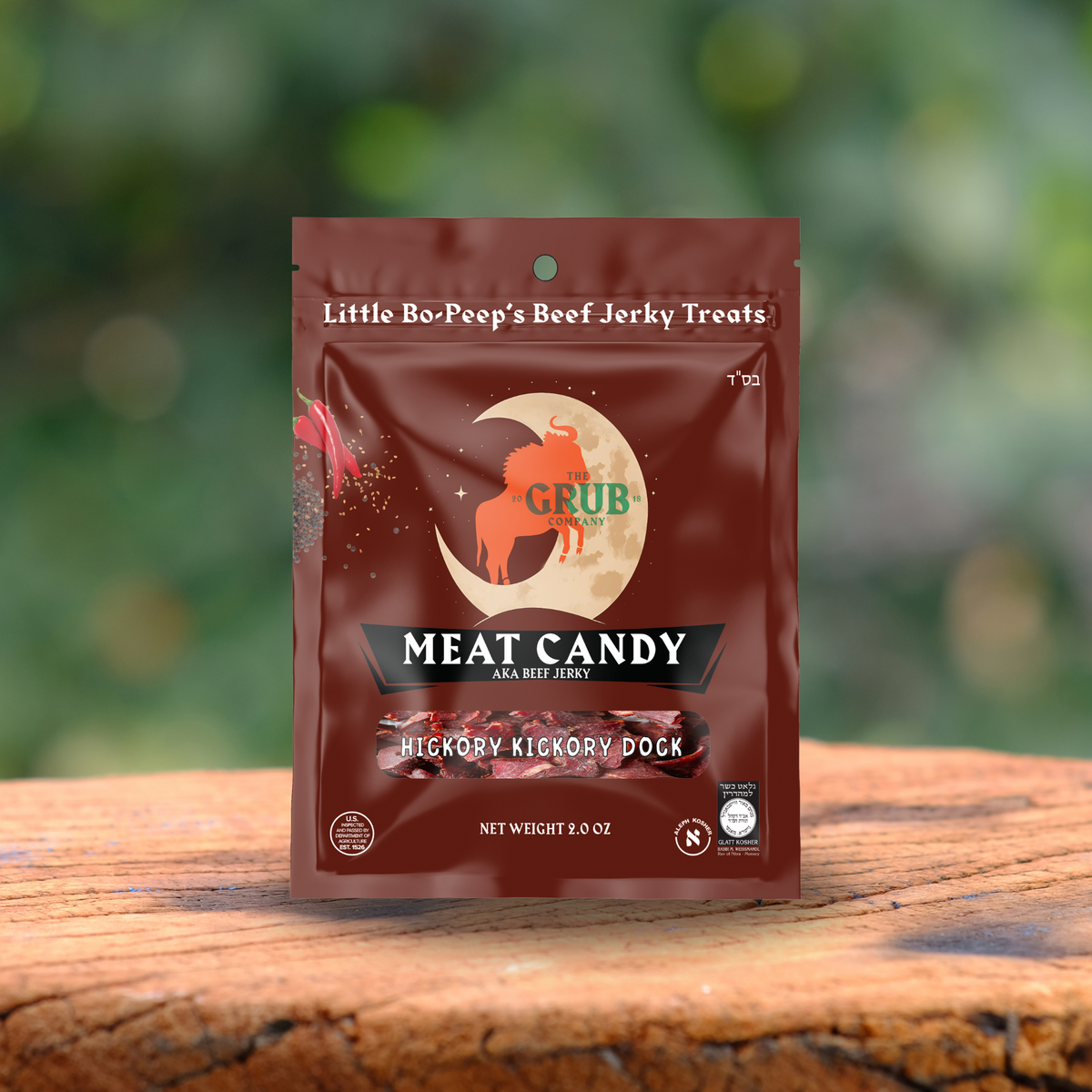
Want the jerky end of the shelf? Meat Candy is here. The biltong is here.