Shabbos and Yom Tov: Food That Needs No Kitchen
The hardest gap in a Shabbos or Yom Tov table is not the meals — it is the long stretch between them. Saturday afternoon, the hours before Havdalah, a second day of Yom Tov, a hot afternoon when nobody wants another slice of cake. Everything left out has to survive without a fridge, without heating, and without anyone cooking. This guide is about what actually works in that window.
Want some on hand? Order biltong online: Glatt Kosher, air-dried in Florida, free US shipping over $50.
The constraints, stated plainly
Food for that window has to clear all of these at once, which is why the honest list is short:
- No cooking, no heating, no reheating.
- No refrigeration for anything sitting out for hours.
- Nothing that needs preparing once the day has started.
- Fleishig or pareve, if it follows a meat meal.
- Substantial, because for many people this replaces a meal.
- Eaten by hand, often standing, often by children.
Cake and nosh clear all six, which is exactly why they dominate. The problem is that a table of sweets is the whole afternoon, and by the third hour nobody wants any more of it.
What actually works, and what fails
| Food | Sits out for hours? | Fleishig-compatible | Substantial? | Verdict |
|---|---|---|---|---|
| Biltong / dried meat | Yes | Yes (it is meat) | Yes | Works |
| Nuts | Yes | Pareve | Moderate | Works, unless a nut-free house |
| Dried fruit | Yes | Pareve | No | Works as a partner, not a centerpiece |
| Crackers, pretzels | Yes | Check the hechsher | No | Filler |
| Cake, cookies, nosh | Yes | Usually pareve | No | Works, and there is already too much |
| Hard cheese | A few hours | No — dairy | Yes | Only at a dairy meal |
| Cold cuts | Not for hours | Yes | Yes | Fine at the meal, not left out |
| Cholent leftovers | No | Yes | Yes | Needs the fridge |
| Fresh fruit | Yes | Pareve | No | Works, needs cutting |
| Hummus and dips | Not for hours | Varies | Moderate | Time-limited |
Read down the "substantial" column. Almost everything that survives the afternoon is a filler, and almost everything substantial needs a fridge or is dairy. Dried meat is the one that clears every column at once, and that is the entire reason it belongs on that table.
Setting it out
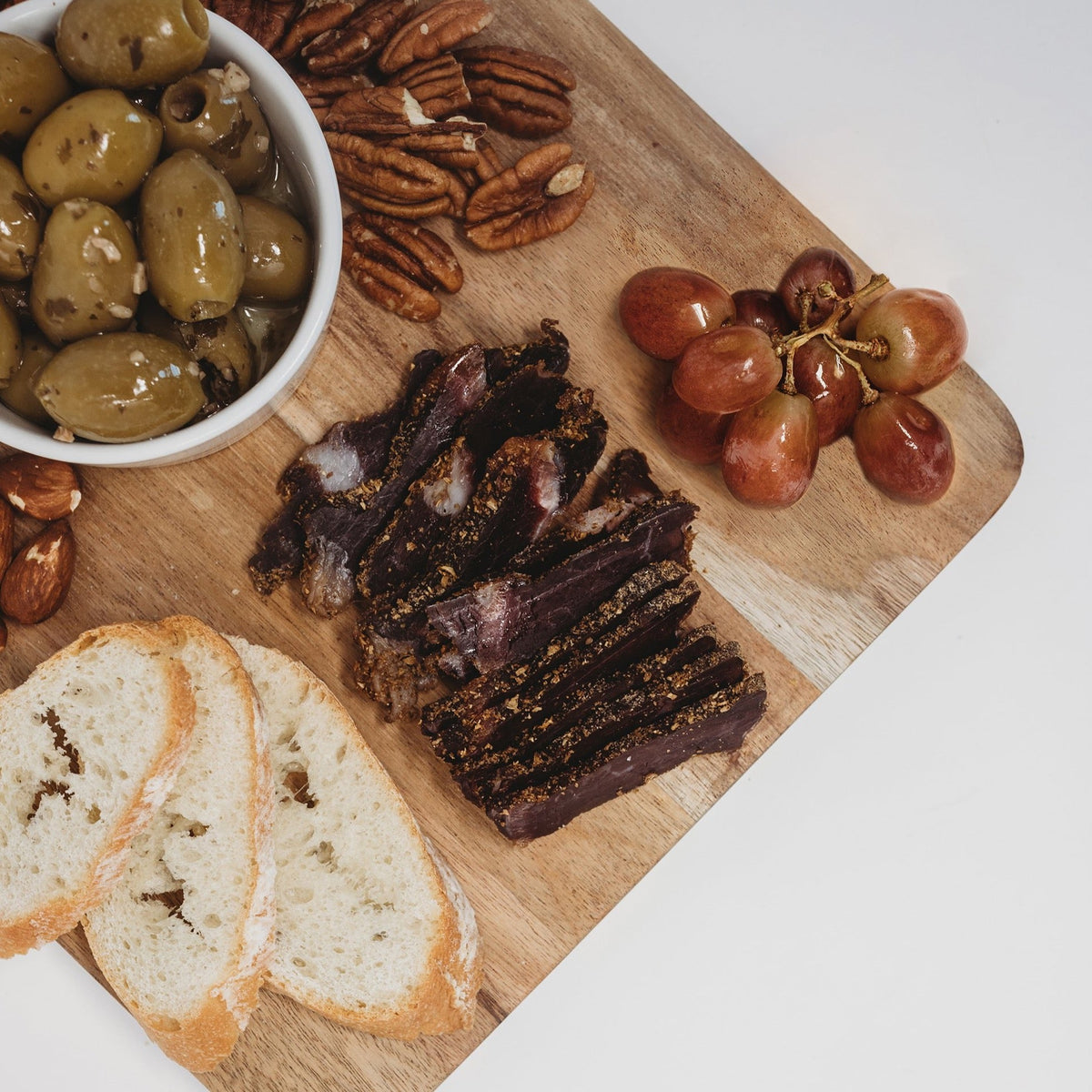
A savory board built around dried meat works because everything on it is shelf-stable and everything contrasts with everything else. Salt against sweet, soft against firm, rich against sharp.
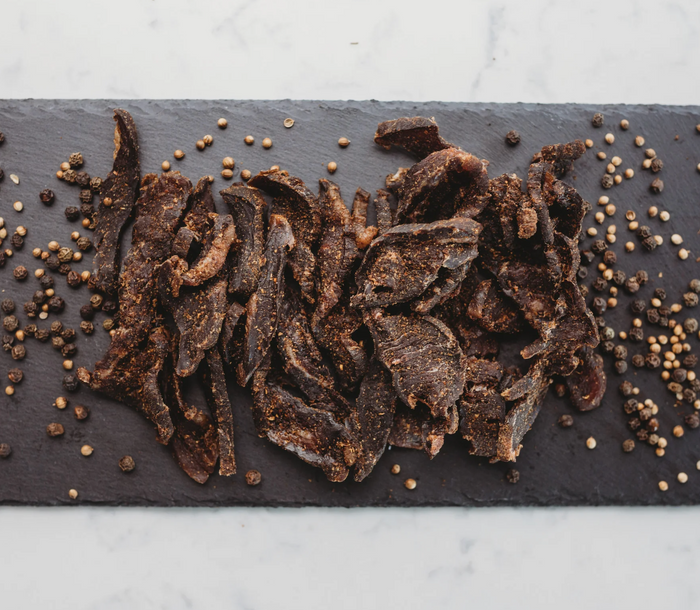
- Sliced biltong as the anchor — ready to eat, no knife.
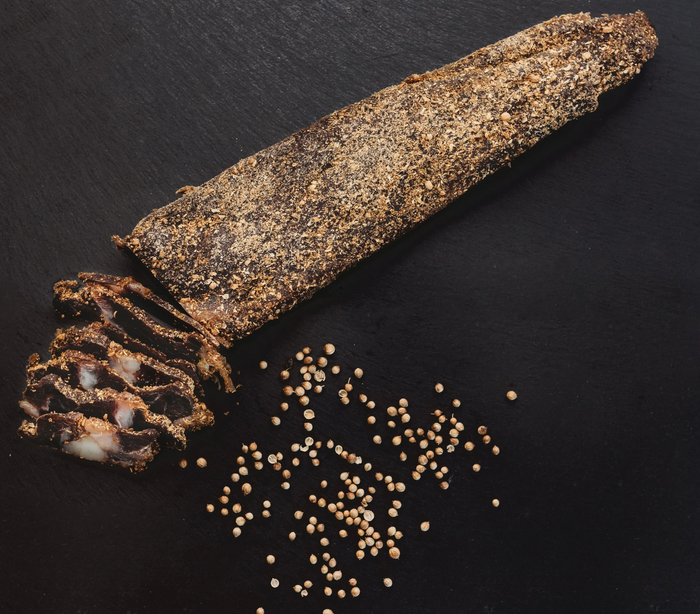
- A slab with a sharp knife if you want people to help themselves and linger. It also holds far better than sliced across a long afternoon, because less surface is exposed.
- Dried apricots or figs — the salt-and-sweet pairing that has worked for centuries.
- Pickles or olives — acid resets the palate between pieces.
- Good crackers to carry it.
- Dark chocolate, which sounds odd next to meat and is very good next to a peri peri blend.
- Whisky or a bold red for the adults, if that is the house style.
What to leave off: anything dairy if the meal was fleishig, anything that melts, and anything sweet enough to take over.
How much to put out
| Setting | Amount of dried meat |
|---|---|
| Family of four, one afternoon | 3–6 oz |
| Family plus guests, 8 people | 8–12 oz |
| Kiddush, 20 people | 2–3 lb |
| Simcha, alongside other food | ~2 oz per person |
| Second day Yom Tov, whole day | Double a single afternoon |
| Seudah shlishit | 4–8 oz for a small group |
The rule that holds: 2 oz per person if it is one of several things on the table, 4 oz if it is what people are actually eating. It goes faster than sweet snacks because there is no sugar wall to stop at.
Preparing before the day starts
Everything here has to be ready before candle lighting, so a short list:
- Open bags in advance and put them in covered bowls or containers. An unopened bag on a Shabbos table is a problem nobody needs.
- Slice the slab beforehand if you are using one, or set out a knife and let people cut — either is fine, but decide first.
- Keep the rest sealed. Opened dried meat wants to be eaten within two or three days; put out what will go, not the whole pound.
- Cover it. Not for freshness over a few hours — for flies and for children.
- For a hot afternoon, keep the reserve somewhere cool and dark rather than on a sunny counter.
Travel, camp and the second day
The same properties that make dried meat work on a Shabbos table make it the default for Yom Tov travel: it needs no kitchen, no cutlery, no cold chain, and a sealed bag keeps for three to six months. For anyone spending a festival away from home, in a hotel, or at a camp, it is one of very few certified foods that can simply be packed and forgotten about.
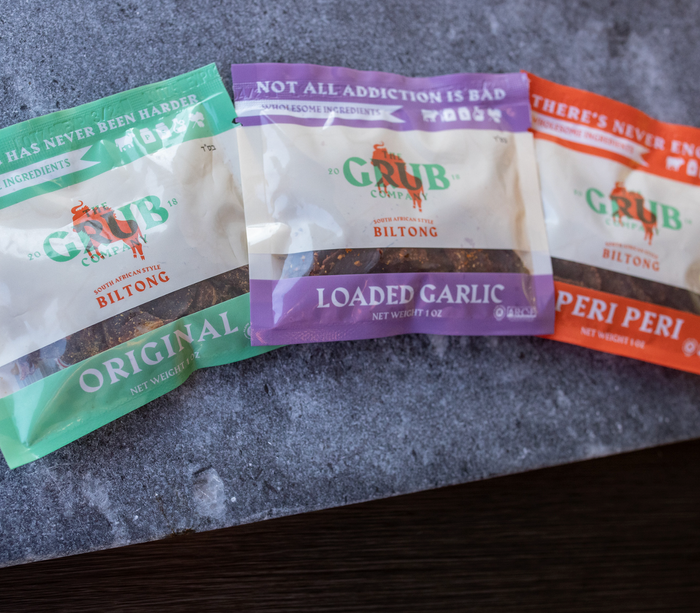
It also solves the child problem. A one-ounce single-serve bag is portioned, needs no plate, and is not another sweet.
What we make
Certified Glatt Kosher biltong, grass-fed, air-dried in small batches: sliced at $11.99 for 3 oz, 1 oz Mini's at $4.99, whole slabs and bulk at $58.00 the pound. Original is beef, coriander, black pepper, salt, garlic and vinegar — nothing else. No dairy, no nuts, no soy, no preservatives.
Unopened it keeps three to six months in a cool, dry place, so buying ahead of a Yom Tov season costs you nothing.
Kiddush and simcha: quantities that actually hold up
Catering a kiddush is mostly a quantity problem, and dried meat behaves differently from the usual table because there is no sugar wall to make people stop.
| Event | People | Dried meat | Note |
|---|---|---|---|
| Small kiddush | 20 | 2–3 lb | Sliced; a slab needs a knife nobody brings |
| Bar mitzvah kiddush | 75 | 6–9 lb | Order two weeks ahead; makers dry in batches |
| Shalosh seudos | 25 | 1–2 lb | Alongside fish and salads |
| Melave malka | 30 | 2–3 lb | Sits out for the whole evening |
| Yom Tov meal, extended family | 15 | 1 lb | Between courses and after |
The one planning fact that catches people: small producers dry to order over days or weeks, so a large quantity is a production question rather than a stock question. Ask about lead time before you ask about price.
Children, and the sweet problem
Most of what children are handed on a Shabbos afternoon is sugar, and by the second hour that shows. A savory option that requires no plate and no supervision changes the shape of the afternoon more than it sounds like it should.
Two practical notes. Single-serve one-ounce bags are portioned, which removes the negotiation entirely. And for toddlers, firm dried meat is a choking risk like any firm food — buy on the wetter, softer side, cut it small, and supervise. Sodium is worth counting for small children too; treat an ounce as a portion rather than a handful.
Buying ahead for a Yom Tov season
Sealed with an oxygen absorber, biltong keeps three to six months in a cool, dry place. That makes it one of the few things on a Yom Tov table you can genuinely buy in advance without any loss — order in Elul for Tishrei and nothing about it is worse for the wait.
Which is a real advantage in a season where every kosher grocer is stretched, deliveries slip, and the things you actually need are the ones that sold out on Tuesday. Buy the shelf-stable part of the table early and leave your shopping trips for what has to be fresh.
Why this gap exists at all
Worth naming the problem precisely, because it explains why the usual advice does not help.
Shabbos and Yom Tov remove three things at once that ordinary snacking depends on: cooking, reheating, and — for anything sitting out — refrigeration. What remains has to be ready before the day starts and stay safe and appetizing for hours afterward.
That constraint is what produces the sweet table. Cake, nosh and chocolate are shelf-stable by nature, pareve by construction, and need no preparation. They fill the gap because they are the easiest things to fill it with, not because anyone chose them.
The awkward part is the long afternoon. A meal ends, the next one is hours away, and what is available is a plate of things that were designed to accompany tea. By the third hour nobody wants any more, and the household is genuinely short of food.
What actually works, ranked
| Food | Sits out hours? | Fleishig-compatible | Substantial? | Needs prep? | Verdict |
|---|---|---|---|---|---|
| Biltong / dried meat | Yes | Yes — it is meat | Yes | No | Works |
| Nuts | Yes | Pareve | Moderate | No | Works, unless nut-free |
| Dried fruit | Yes | Pareve | No | No | A partner, not a centerpiece |
| Crackers, pretzels | Yes | Check the hechsher | No | No | Filler |
| Cake, cookies, nosh | Yes | Usually pareve | No | No | Works, and there is already too much |
| Hard cheese | A few hours | No — dairy | Yes | No | Only at a dairy meal |
| Cold cuts | Not for hours | Yes | Yes | Plating | Fine at the meal, not left out |
| Cholent leftovers | No | Yes | Yes | Needs the fridge | Not for this window |
| Fresh fruit | Yes | Pareve | No | Cutting | Works |
| Hummus and dips | Not for hours | Varies | Moderate | No | Time-limited |
| Hard-boiled eggs | Limited | Pareve | Yes | Made in advance | Works for a shorter window |
Read down the "substantial" column. Almost everything that survives the afternoon is a filler, and almost everything substantial needs a fridge or is dairy. Dried meat is the one row that clears every column at once — which is the entire reason it belongs on that table, and why it has been on South African Shabbos tables for generations.
Setting it out
A savory board built around dried meat works because everything on it is shelf-stable and everything contrasts with everything else. Salt against sweet, soft against firm, rich against sharp.
- Sliced biltong as the anchor — ready to eat, no knife.
- A slab with a sharp knife if you want people to help themselves and linger. It also holds far better across a long afternoon, because less surface is exposed.
- Dried apricots or figs — the salt-and-sweet pairing that has worked for centuries.
- Pickles or olives — acid resets the palate between pieces.
- Good crackers to carry it.
- Dark chocolate, which sounds odd next to meat and is very good next to a peri peri blend.
- Whisky or a bold red for the adults, if that is the house style.
What to leave off: anything dairy if the meal was fleishig, anything that melts, and anything sweet enough to take over.
Preparing before the day starts
- Open bags in advance and put them in covered bowls or containers. An unopened bag on a Shabbos table is a problem nobody needs.
- Slice the slab beforehand if you are using one, or set out a knife and let people cut — either is fine, but decide first.
- Keep the rest sealed. Opened dried meat wants to be eaten within two or three days; put out what will go, not the whole pound.
- Cover it. Not for freshness over a few hours — for flies and for children.
- For a hot afternoon, keep the reserve somewhere cool and dark rather than on a sunny counter.
- Put out a second, smaller bowl if you have children. It halves the number of times someone reaches across the table.
Kiddush and simcha quantities
| Event | People | Dried meat | Note |
|---|---|---|---|
| Small kiddush | 20 | 2–3 lb | Sliced; a slab needs a knife nobody brings |
| Bar mitzvah kiddush | 75 | 6–9 lb | Order two weeks ahead; makers dry in batches |
| Shalosh seudos | 25 | 1–2 lb | Alongside fish and salads |
| Melave malka | 30 | 2–3 lb | Sits out for the whole evening |
| Yom Tov meal, extended family | 15 | 1 lb | Between courses and after |
| Second day Yom Tov, all day | — | Double a single afternoon | Two separate windows to cover |
The planning fact that catches people out: small makers dry to order over days or weeks, so a large quantity is a production question rather than a stock question. Ask about lead time before price. And because sealed dried meat keeps three to six months, ordering well ahead of a busy season costs nothing at all.
Children, and the sweet problem
Most of what children are handed on a Shabbos afternoon is sugar, and by the second hour that shows. A savory option that requires no plate and no supervision changes the shape of the afternoon more than it sounds like it should.
Two practical notes. Single-serve one-ounce bags are portioned, which removes the negotiation entirely. And for toddlers, firm dried meat is a choking risk like any firm food — buy on the wetter, softer side, cut it small, and supervise. Sodium is worth counting for small children too: treat an ounce as a portion rather than a handful.
Travel, camp and the second day
The same properties that make dried meat work on a Shabbos table make it the default for Yom Tov travel: no kitchen, no cutlery, no cold chain, and a sealed bag keeps for three to six months. For anyone spending a festival away from home, in a hotel, or at a camp, it is one of very few certified foods that can simply be packed and forgotten about.
It also solves the child problem in transit. A one-ounce single-serve bag is portioned, needs no plate, and is not another sweet.
Buying ahead for a Yom Tov season
Sealed with an oxygen absorber, dried meat keeps three to six months in a cool, dry place. That makes it one of the few things on a Yom Tov table you can genuinely buy in advance without any loss — order in Elul for Tishrei and nothing about it is worse for the wait.
Which is a real advantage in a season where every kosher grocer is stretched, deliveries slip, and the things you actually need are the ones that sold out on Tuesday. Buy the shelf-stable part of the table early and save your shopping trips for what has to be fresh.
The other windows nobody plans for
The long Shabbos afternoon is the obvious one. Four others catch households out just as reliably.
| Window | The problem | What works |
|---|---|---|
| Friday afternoon | Cooking is done, the meal is hours away, everyone is hungry and the kitchen is off limits | Something savory set aside deliberately, before the rush |
| Second day Yom Tov | Two full days rather than one; the first day's food is gone | Double what you planned, and keep half sealed |
| Motzei Shabbos | Melave malka with nobody wanting to start cooking | A board that needs no preparation |
| Breaking a fast | Sweet food on an empty stomach is unpleasant; heavy food is worse | Small amounts of protein, gently |
| Traveling on erev Yom Tov | Long drives, no kosher food on the route | Sealed bags in the car — the original use case |
What all five share: you cannot cook, you cannot shop, and you have to have decided in advance. Anything that solves them has to be bought before the week starts and keep without attention — which is a short list, and most of it is dried.
Why this food and this problem fit so exactly
It is not a coincidence that dried meat suits Shabbos so well. Both come from the same constraint.
Biltong was invented for a situation where you have meat, no refrigeration, and days ahead of you with no way to cook — a wagon crossing open country in the 1830s. Shabbos creates a structurally similar situation in a modern kitchen: for twenty-five hours you have food but no cooking, and whatever is out has to survive on its own.
A food designed to be eaten with no fire, no ice and no preparation is not being adapted to a Shabbos table. It is being used for exactly what it was made for.
The same logic explains why it has been a fixture in South African Jewish homes for generations rather than being a recent discovery. Long hot afternoons, a food that needs nothing, and a community that already had it in the house.
Practical storage across a long Yom Tov
| Situation | What to do |
|---|---|
| One afternoon | Open a bag, put it in a covered bowl, keep the rest sealed |
| Two-day Yom Tov | Open one bag per day rather than one large bag for both |
| Three-day Yom Tov with Shabbos | Portion into three before it starts; refrigerate what is not out |
| Hot weather | Keep the reserve in the fridge, not the cupboard |
| Leftovers afterward | Reseal with the air pressed out; two to three days, or refrigerate |
The principle: each opening restarts the clock for everything in that bag. Opening one large bag six times over three days is worse for the meat than opening three smaller ones twice each — which is a good argument for buying a format that portions itself.
Building a savory table, not just adding one item
Dried meat on its own is an improvement. A properly built savory board changes the afternoon, and it takes about the same amount of shopping.
The principle is contrast. Everything on it must be shelf-stable, and each item should push against the others: salty against sweet, firm against soft, rich against sharp.
| Role | What to use | Why |
|---|---|---|
| The anchor | Sliced dried meat, or a slab and a knife | Substantial, savory, needs nothing |
| Sweet counterpoint | Dried apricots, figs, dates | The oldest pairing with cured meat there is |
| Acid | Pickles, olives, preserved lemon | Resets the palate; stops the salt accumulating |
| Crunch | Seeded crackers, pretzels | Carries the meat; adds texture |
| Fat | Nuts, if the household is nut-free-free | Rounds off the salt |
| The odd one | Dark chocolate | Sounds wrong, works — especially against a chili blend |
| To drink | Whisky, a bold red, or a hoppy beer | All three cut salt in different ways |
Leave off anything dairy if the meal was fleishig, anything that melts, and anything sweet enough to dominate. And set it out before the day starts — a board assembled in advance is the whole point.
What to buy, concretely
For a household that wants to stop having this problem rather than solve it once:
- A pound, portioned into week-size sealed bags on the day it arrives. One bag out per Shabbos, the rest sealed. This is the single habit that makes it work.
- A box of single-serve minis for lunchboxes, travel, children and Yom Tov away from home.
- A slab, if you host. It holds far better across a long afternoon and looks like food rather than a snack.
- Original as the default, with one flavored option for variety. Original is the one that suits everyone at a table.
- Bought ahead of the season, because it keeps for months and the busy weeks are exactly when the shops run out.
That is a standing order rather than a purchase, and it takes the question off the table for the year.
What a household actually changes
The practical version of all this is small. Nobody needs a new Shabbos routine.
One item joins the shopping list and stays on it. It goes in the cupboard rather than the fridge, so it does not compete for space in the week before a Yom Tov when the fridge is the scarcest thing in the house. It gets portioned once, when it arrives, rather than decided about every Friday. And it comes out with the cake rather than instead of it.
Households that do this stop noticing the afternoon gap within a month, because the gap is not a problem of willpower or planning — it is a problem of nothing suitable being in the house. Put something suitable in the house and it resolves itself.
The rest is preference: which cut, which blend, sliced or a slab, how much a family of six gets through between kiddush and mincha. Those answers vary. The structure does not.
A note on the sweet table
None of this is an argument against cake. The sweet Shabbos table exists for good reasons, it is generous, and for a great many people it is one of the pleasures of the day.
The argument is narrower: a table that is only sweet leaves a gap, and the gap shows up in the same place every week — the middle of a long afternoon, when people are genuinely hungry and what is available is a fourth piece of cake.
One savory, substantial item fixes it. It does not need to displace anything, and it takes no more preparation than the rest of the table, because it takes none at all.
That is the whole case. Add one thing that is meat, keeps without a fridge, and needs no kitchen — and the afternoon stops being a problem to get through.
Common questions
Can dried meat sit out all Shabbos? Yes. It is shelf-stable and does not require refrigeration. Cover it for flies rather than for safety.
Is it fleishig? Yes — beef biltong and jerky are meat, always, regardless of how they are preserved.
Can it be pareve? No. Beef is meat.
How much should I put out? Roughly 2 oz per person if it is one of several things on the table, 4 oz if it is what people are eating.
Will it go hard by the end of the day? A little, and that is fine. Hard dried meat is safe and some people prefer it. A slab holds up better than sliced across a long afternoon.
Can I put the rest back for next week? Reseal it with the air pressed out and eat it within two or three days, or refrigerate it in a sealed container for a week or two.
Is it suitable for a dairy meal? No — it is meat. That is precisely why it works after a fleishig meal, when cheese does not.
See the range → · Sending it as a gift →
Everything on this page that solves the no-kitchen problem is in one place here — sealed, shelf-stable, and certified.
For Purim specifically, the shalach manos formats — individually portioned and not another sweet.