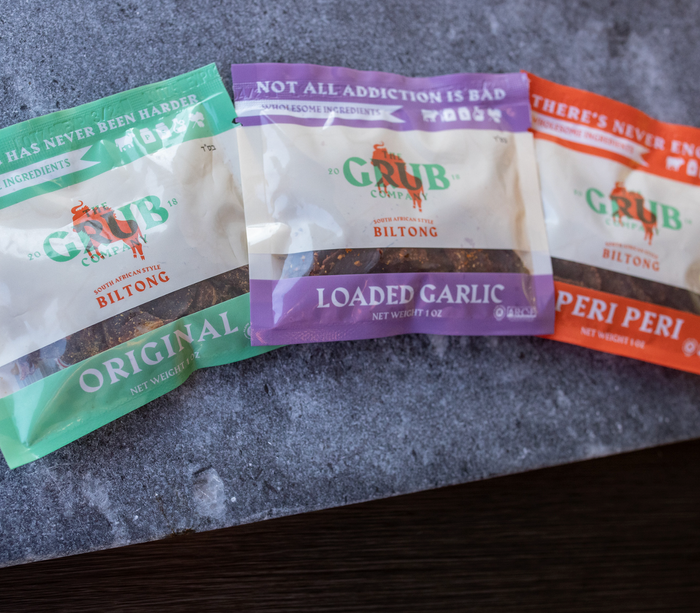
Kosher Snacks With Real Protein: The Honest Short List
The kosher snack aisle is overwhelmingly sweet. Cakes, cookies, chocolate, nosh, candy — and then a small handful of savory options, most of which are crackers. If you are looking for a certified snack that delivers real protein without sugar, the list is short. This guide is that list, with the numbers.
Related: Easy Protein Snacks With No Prep at All · High Protein, High Fiber Snacks: Why Jerky Needs a Partner
Related: High-Protein, Low-Calorie Snacks That Keep Without a Fridge
Shop the real thing: buy biltong online, Glatt Kosher and made in Florida. US orders over $50 ship free.
What "real protein" means here
The useful measure is not grams per bag — bag sizes are inconsistent and that is often deliberate. It is protein per 100 calories. That strips out portion-size games and tells you how much of what you are eating is actually protein.
| Snack | Protein per 100 cal | Added sugar | Ingredients | Needs a fridge? |
|---|---|---|---|---|
| Biltong | ~15 g | None | 5–7 | No |
| Beef jerky | ~11 g | Usually | 12+ | No |
| Greek yogurt | ~10 g | Varies | 1–3 | Yes |
| String cheese | ~9 g | None | 3–5 | Yes |
| Protein bar | ~9 g | Usually | 15+ | No |
| Hard-boiled eggs | ~8 g | None | 1 | Yes |
| Roasted chickpeas | ~5 g | None | 2–4 | No |
| Almonds | ~4 g | None | 1 | No |
| Pretzels | ~2 g | Some | 4–6 | No |
Read that table by the last column as much as the first. Everything that beats or matches biltong on ingredient simplicity — yogurt, cheese, eggs — needs refrigeration. Everything shelf-stable that competes on convenience loses on sugar or ingredient count.
The gap biltong fills is the overlap: high protein, short label, no fridge. That combination is rare in any aisle and rarer in a kosher one.
The constraints a kosher snack usually has to satisfy at once
This is why the list is short. A snack that works for an observant household frequently has to clear several bars simultaneously:
- Certified, by an agency the household accepts
- Not dairy, if it is being eaten after a meat meal or packed alongside one
- Nut-free, for schools and camps
- Shelf-stable, for Shabbos, Yom Tov and travel when no cooking is possible
- Substantial, because it is often standing in for a meal
- Eaten with hands, no plate, no utensils
Cheese fails the first and second. Nuts fail the third. Yogurt fails the fourth. Cake fails the fifth. Biltong clears all six, which is the whole reason it turns up in kosher grocers rather than in the snack aisle of a supermarket.
The honest drawback: sodium
Biltong is salty and cannot really be otherwise. Salt is not seasoning here — it is one of the three barriers that makes uncooked meat safe, alongside vinegar and drying. Remove it and you do not get a low-sodium biltong; you get a food-safety problem.
So treat it accordingly. An ounce is a serving: roughly 12 g of protein and 80 calories. Two ounces is a substantial snack and a sensible upper bound on most days, on sodium grounds rather than calorie grounds. If you are managing sodium closely, this is a food to eat in measured amounts or to discuss with your doctor — and that applies equally to cured meats, cheese and most crackers.
By situation
| Situation | What works | Why |
|---|---|---|
| School lunch, nut-free | 1 oz Mini's | No nuts, no dairy, no refrigeration, portion controlled |
| Camp care package | Sealed bags, several | Three to six months sealed; survives being forgotten in a bunk |
| Post-workout | 1–2 oz, plus fruit | High protein per calorie; bring the carbohydrate separately |
| Long Shabbos afternoon | Sliced bag or a slab | Needs no kitchen and no heating |
| Office drawer | Mini's | The portion control is the point |
| Flights and travel | Sealed bags | No cold chain, no utensils, no smell issues |
| Breaking a fast | Sliced, small amounts | Protein without sugar; go gently |
| Toddlers | Softer, cut small, supervised | Firm dried meat is a choking risk; buy on the wetter side |
What to read on the package
- The hechsher — an agency symbol, not the word "kosher."
- Meat or pareve — beef biltong and jerky are fleishig, always.
- Sugar's position in the ingredient list. Second or third means you are buying a sweet.
- Nitrates and nitrites. Properly dried biltong does not need them.
- Ingredient count. Five to seven is what a real dried-meat blend looks like. Fifteen is a formulation.
- Sodium per serving, converted to the same basis across brands before you compare.
- Allergens. Traditional biltong has no soy, dairy, eggs, nuts, fish or gluten ingredients — but verify the specific product rather than the category.
What we make
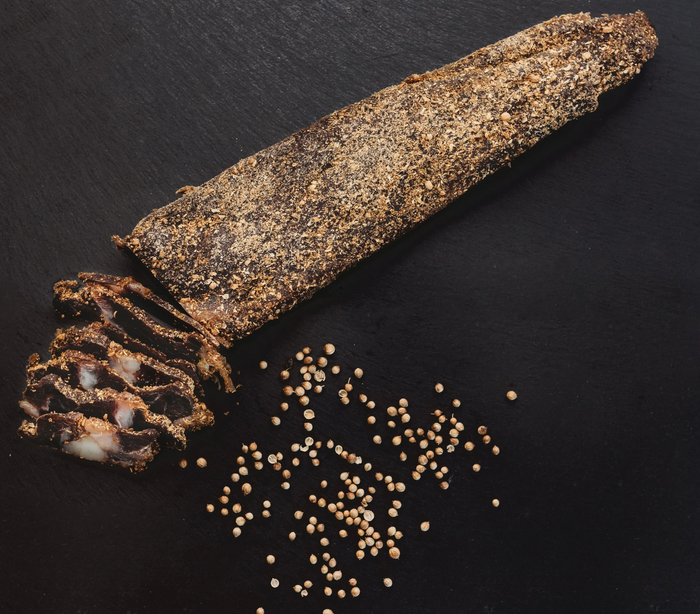
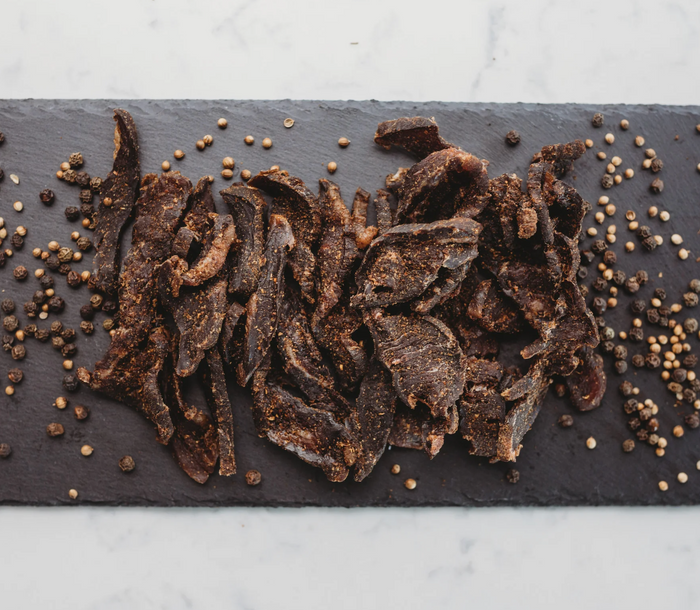
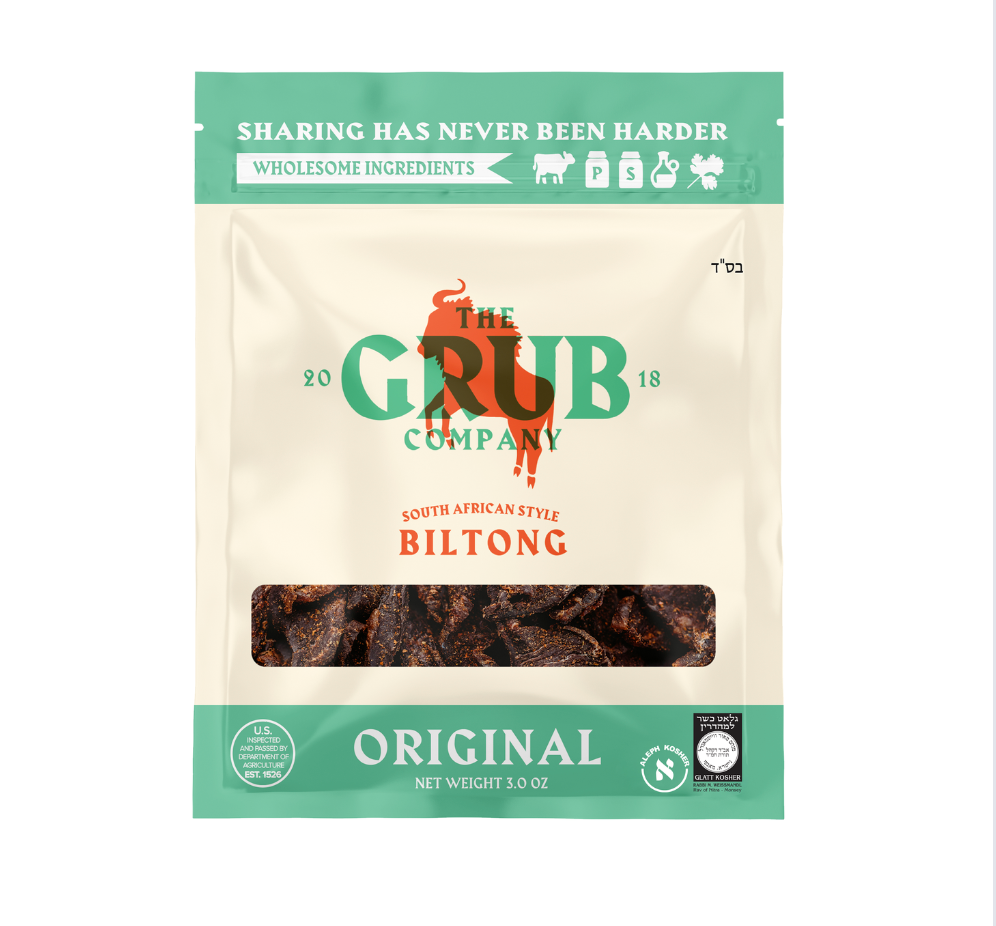
Certified Glatt Kosher, grass-fed, air-dried in small batches: sliced biltong at $11.99 for 3 oz, 1 oz Mini's at $4.99, and a pound at $58.00. 36 g of protein and 240 calories per 3 oz bag, no MSG, no preservatives, no nitrates. Original is beef, coriander, black pepper, salt, garlic and vinegar — that is the whole list.
For the sweet end of the shelf we make a kosher beef jerky called Meat Candy, at $7.99. That one is a treat and we say so.
Why the kosher aisle skews sweet
Walk any kosher grocery and the snack section is cake, cookies, chocolate, nosh and candy, with a small savory corner that is mostly crackers. That is not an accident, and understanding why explains where the gaps are.
Sweet foods are usually pareve. A cake or a chocolate bar can be made without meat or dairy, which means it works after any meal, in any household, at any time. That flexibility is enormously valuable in a kosher context and it shapes what gets manufactured.
Savory protein is almost always meat or dairy, and both carry restrictions. Dairy is unusable after a meat meal and unusable in a fleishig lunchbox. Meat requires certified slaughter, which is a far higher bar than certifying a biscuit.
Shelf life favors sugar. Sugar is itself a preservative, so sweet products keep without refrigeration by default. Savory protein has to solve that problem separately — which usually means drying, curing or canning.
The result is a market where the easy things to make and certify are sweet, and the hard things are exactly what people are short of: substantial, savory, shelf-stable protein.
The dairy problem nobody mentions
A large share of the high-protein snack market is dairy — yogurt, cheese sticks, cottage cheese, whey bars, protein shakes. In a kosher household that quietly removes most of the aisle.
| Protein snack | Status | Usable after a meat meal? | In a fleishig lunchbox? |
|---|---|---|---|
| Biltong, jerky, dried meat | Fleishig | Yes — it is meat | Yes |
| Nuts, seeds | Pareve | Yes | Yes, unless nut-free |
| Roasted chickpeas, edamame | Pareve | Yes | Yes |
| Eggs | Pareve | Yes | Yes |
| Yogurt, cheese, whey bars | Dairy | No, for hours | No |
| Most protein shakes | Usually dairy | No | No |
| Tuna and canned fish | Pareve | Yes, with the usual fish-and-meat caution | Usually |
That constraint is invisible if you do not keep kosher and decisive if you do. It is the single biggest reason the practical list of kosher high-protein snacks is far shorter than the shelf suggests — and why dried meat, which is fleishig and therefore compatible with a meat meal rather than blocked by it, occupies a position almost nothing else does.
Protein bars, honestly
Certified protein bars exist and plenty of people rely on them. Three things are worth knowing before treating them as the default.
The protein number is usually carried by a long formulation. Fifteen or more ingredients is normal — isolates, syrups, gums, sugar alcohols. That is not automatically bad, but it is a different kind of food from beef with salt and spice on it.
The sugar is frequently comparable to a candy bar, or replaced with sugar alcohols that upset a lot of people's digestion. If the reason you reached for protein was to avoid a sugar spike, read the panel rather than the wrapper.
Many are dairy, through whey or milk protein isolate — which puts them back into the constraint above.
Where bars genuinely win: they are cheap, widely available, and they carry carbohydrate as well as protein, which matters after hard training. Dried meat has essentially no carbohydrate, so it is the protein half of a recovery snack rather than the whole thing.
The six constraints a kosher snack usually has to clear at once
This is why the list is short. A snack that works for an observant household frequently has to satisfy all of these simultaneously:
- Certified, by an agency the household accepts
- Not dairy, if it follows a meat meal or is packed alongside one
- Nut-free, for schools and camps
- Shelf-stable, for Shabbos, Yom Tov and travel when no cooking is possible
- Substantial, because it is frequently standing in for a meal
- Eaten with hands — no plate, no utensils, often standing
| Snack | 1 | 2 | 3 | 4 | 5 | 6 |
|---|---|---|---|---|---|---|
| Biltong | ✓ | ✓ | ✓ | ✓ | ✓ | ✓ |
| Beef jerky | Rarely | ✓ | ✓ | ✓ | ✓ | ✓ |
| Cheese | ✓ | ✗ | ✓ | Hours only | ✓ | ✓ |
| Nuts | ✓ | ✓ | ✗ | ✓ | Moderate | ✓ |
| Yogurt | ✓ | ✗ | ✓ | ✗ | ✓ | Needs a spoon |
| Protein bar | ✓ | Often dairy | Often nuts | ✓ | Moderate | ✓ |
| Cake and nosh | ✓ | ✓ | Varies | ✓ | ✗ | ✓ |
| Crackers | ✓ | ✓ | ✓ | ✓ | ✗ | ✓ |
Read down the columns. Cheese fails the second. Nuts fail the third. Yogurt fails the second and fourth. Cake and crackers fail the fifth. Dried meat is the only row that clears all six, which is not a marketing claim — it is why it turns up in kosher grocers rather than in a general snack aisle.
By situation
| Situation | What works | Why |
|---|---|---|
| School lunch, nut-free | 1 oz minis | No nuts, no dairy, no refrigeration, portion controlled |
| Camp care package | Sealed bags, several | Three to six months sealed; survives being forgotten in a bunk |
| Post-workout | 1–2 oz, plus fruit | High protein per calorie; bring the carbohydrate separately |
| Long Shabbos afternoon | Sliced bag, or a slab set out beforehand | No kitchen, no heating, sits out safely for hours |
| Office drawer | Minis | The portion control is the point |
| Flights and travel | Sealed bags | No cold chain, no utensils, no smell problem |
| Breaking a fast | Sliced, small amounts | Protein without sugar; go gently |
| Toddlers | Softer, cut small, supervised | Firm dried meat is a choking risk; buy on the wetter side |
| Yom Tov away from home | Sealed bags, bought ahead | Keeps for months, so buying early costs nothing |
| Hospital or recovery | Minis, wetter style | Easy to eat, needs nothing, high protein |
What to read on the package
- The hechsher — an agency symbol, not the word "kosher".
- Meat or pareve — beef biltong and jerky are fleishig, always.
- Sugar's position in the ingredient list. Second or third means you are buying a sweet.
- Nitrates and nitrites. Properly dried biltong does not need them.
- Ingredient count. Five to seven is what a real dried-meat blend looks like; fifteen is a formulation.
- Sodium per serving, converted to the same basis across brands before comparing.
- Allergens. Traditional biltong has no soy, dairy, eggs, nuts, fish or gluten — but verify the specific product rather than the category.
The sodium conversation, honestly
Dried meat is salty and cannot be otherwise. Salt is not seasoning here — it is one of the three barriers that make uncooked meat safe, alongside the vinegar and the drying. Remove it and you do not get a lower-sodium product; you get a food-safety problem.
So treat it as what it is. An ounce is a serving: roughly 12 g of protein and 80 calories. Two ounces is a substantial snack and a sensible upper bound most days, on sodium grounds rather than calorie grounds.
Practical points:
- Read the panel — sodium varies substantially between makers and between batches at different dryness levels. A drier batch is denser in every number.
- Portion deliberately. Pouring some out rather than eating from the bag is the entire discipline.
- Count it into the day if biltong is a regular snack for you.
- For children, portion smaller. Single-serve minis solve this by construction, which is much of what you are paying for.
- Drink water with it. A salty, dense, low-moisture food is thirsty work.
- On a sodium-restricted diet, this belongs in the same category as cured ham and hard cheese — occasional, measured, and worth discussing with your clinician.
Building a week of it
The practical failure with any bulk snack is buying a pound and letting one open bag go hard on the counter. Five minutes on arrival fixes it.
- Split the pound into week-size portions — four for one person, two for a household.
- Seal each separately, with the air pressed out.
- Keep one out and refrigerate or freeze the rest, unopened.
- Freeze anything more than three weeks away. Dried meat freezes well because there is little free water left to form damaging ice.
- Thaw in the fridge, then warm to room temperature — cold dried meat tastes muted.
Opening one bag thirty times is far worse than opening four bags seven times each, because every opening restarts the exchange with room air for the whole remaining quantity.
For a school year or a camp season, buy ahead. Sealed with an oxygen absorber it keeps three to six months in a cool dry place, so an order placed in August is still good in November — and that is genuinely useful in a household where the busy weeks are the ones when the shops are stretched.
What to look for on a nutrition panel
Three traps make cross-brand comparison harder than it looks.
Serving sizes are not standardized. One brand declares per ounce, another per 28 g, another per bag. Convert everything before comparing — a product that looks lower in sodium is frequently just declaring a smaller serving.
Dryness shifts every number at once. A drier batch is denser in protein, calories and sodium alike, because the same meat weighs less. Two products from the same maker at different dryness are not directly comparable.
Compare protein per 100 calories, not per serving. It strips out the portion games and is the only figure that lets you rank foods honestly against each other.
The other options, assessed fairly
Dried meat is not the only answer, and pretending otherwise would be useless. Here is the honest field.
Nuts and seeds
Pareve, shelf-stable, widely certified, and genuinely good food. The protein density is lower than people assume — roughly 4 g per 100 calories for almonds, against 15 for dried meat — because most of the calories are fat. Excellent food; a modest protein source. And they are out entirely for nut-free schools and camps, which is a large share of the situations this list is for.
Roasted chickpeas and edamame
Pareve, shelf-stable, nut-free, and increasingly available certified. Around 5 g of protein per 100 calories — better than nuts, well short of meat. A good filler and a reasonable lunchbox item.
Hard-boiled eggs
Pareve, cheap, and about 8 g per 100 calories. The obvious drawback is refrigeration, which rules them out for most of the situations here — Shabbos afternoons, travel, camp, lunchboxes without a cool bag.
Tuna and canned fish
Shelf-stable, high protein, widely certified. Two constraints: it needs opening and usually a fork, and fish-with-meat carries its own considerations in many households. Fine at a table; awkward as a snack.
Cheese
High protein, widely certified, needs no cooking. Dairy, which removes it from any fleishig context and from most lunchboxes, and it needs refrigeration for anything longer than a few hours.
Certified protein bars
Convenient, carry carbohydrate as well as protein, and available everywhere. Long ingredient lists, frequently dairy, and usually as much sugar as a confection.
Putting it together
If you want the honest summary: for a snack that is certified, fleishig-compatible, nut-free, shelf-stable, substantial and eaten with your hands, dried meat is close to the only complete answer — and everything else on the list fails at least one of those six.
That is not an argument that biltong is the healthiest food available. Chicken breast beats it on protein density; nuts have better fats; fruit and vegetables do things no dried meat does. It is an argument that in a specific and very common set of circumstances — Shabbos, travel, camp, a fleishig lunchbox, a long day out — the list of things that actually work is short, and this is on it.
Buy an ounce as a serving, keep the rest sealed, and treat the sodium as real. Within those limits it solves a problem that most kosher households have every single week.
Where to actually find it
| Channel | Likelihood | What to expect |
|---|---|---|
| Kosher grocers | High | The reliable channel. Usually one or two brands, sliced format |
| Direct from a certified maker | High | Full range, freshest, certificate published, best per-ounce price |
| Kosher sections of large supermarkets | Occasional | Thin, and often only around Yom Tov |
| South African specialty shops | Where they exist | Excellent range; check certification separately |
| Health and supplement stores | Low | Protein-marketed brands, rarely certified |
| Mainstream snack aisle | Very low | Check for a hechsher rather than assuming |
One thing worth knowing: the best certified options are frequently not in your local shop. A grocer stocks the one product that turns fastest, which is usually sliced Original in a single flavor. Buying direct gets you the range, the formats a shop never carries, and a certificate you can actually read.
Feeding children
Dried meat works unusually well in lunchboxes, and for reasons that have nothing to do with macros: no refrigeration, no utensils, no plate, no nuts, no dairy, and it is not another sweet. In a nut-free school with a fleishig lunch, the list of options is genuinely short and this is on it.
Two caveats, both practical.
Sodium. Children need less than adults. Treat one ounce as a portion rather than handing over a bag — single-serve minis do this for you.
Texture, for toddlers. Firm dried meat is a choking risk in the same way any firm food is. Buy on the wetter side, cut it small, and supervise. The same rules that apply to hard cheese, raw carrot and whole grapes.
For school-age children none of this is complicated, and the fact that it is savory rather than sweet is worth something on its own by the third week of a term.
Why "protein per 100 calories" is the number to use
Every protein snack advertises grams per serving, and it is close to useless for comparison because servings are chosen rather than standardized. A bar declaring 20 g in 250 calories and a bag declaring 12 g in 80 look very different on the front and are not.
Protein per 100 calories fixes that. It answers the only question that matters when you are choosing between two snacks: for the calories I am about to eat, how much of what I want am I getting?
| Food | Protein per 100 cal | What that means practically |
|---|---|---|
| Chicken breast, plain | ~19 g | The ceiling for whole food — and it needs cooking and a fridge |
| Biltong | ~15 g | Close to the ceiling, with none of the requirements |
| Beef jerky | ~11 g | The sugar is what costs it |
| Greek yogurt | ~10 g | Good, and dairy |
| String cheese | ~9 g | Good, and dairy |
| Protein bar | ~9 g | Much of the calorie load is sugar and fat |
| Eggs | ~8 g | Excellent, needs refrigeration |
| Chickpeas, roasted | ~5 g | Mostly carbohydrate |
| Almonds | ~4 g | Mostly fat — good fat, but not a protein food |
The two rows at the top tell the story. Nothing shelf-stable beats dried meat on this measure, and the only whole food that does beat it needs a kitchen and a refrigerator — which are precisely the two things unavailable in every situation this guide is about.
A note on what this list is not
Nothing here is an argument that snacks are the important part of anyone's diet, or that a certified protein snack is a substitute for meals. It is a narrower and more practical claim.
There are recurring situations in observant life — a long Shabbos afternoon, a second day of Yom Tov, a lunchbox that has to be fleishig and nut-free, a camp, a flight, a hospital stay, a fast to break — where cooking is not possible, refrigeration is not available, and what is on the table is overwhelmingly sweet. In those situations people are genuinely short of substantial savory food, and that shortage is what this page is about.
The answer is not complicated: certified dried meat, portioned to an ounce, kept sealed, with the sodium counted honestly. It is not a health product and it does not need to be. It is a food that works when most foods cannot.
Quick answers
What is the highest-protein kosher snack? Dried meat, by a wide margin — roughly 15 g of protein per 100 calories for biltong.
Is biltong keto? Yes, in an unsweetened original blend. Check flavored versions for sugar.
Is it good for kids? Yes, with two caveats: sodium, and texture for toddlers.
Is it gluten free? There are no gluten ingredients in a traditional blend. Check the specific bag.
Can it replace a meal? As the protein half, yes. It has essentially no carbohydrate, so pair it with fruit or a starch.
The dairy problem nobody mentions
A large share of the high-protein snack market is dairy — yogurt, cheese sticks, cottage cheese, whey bars, protein shakes. In a kosher household that quietly removes most of the aisle, because those options are unusable for hours after a meat meal, unusable in a lunchbox packed alongside fleishig food, and unusable at any meat-based simcha.
That constraint is invisible if you do not keep kosher and decisive if you do. It is the single biggest reason the practical list of kosher high-protein snacks is shorter than the shelf suggests.
| Protein snack | Status | Usable after a meat meal? |
|---|---|---|
| Biltong, jerky, dried meat | Fleishig | Yes — it is meat |
| Nuts, seeds | Pareve | Yes |
| Roasted chickpeas, edamame | Pareve | Yes |
| Yogurt, cheese, whey bars | Dairy | No, for hours |
| Eggs | Pareve | Yes |
| Most protein shakes | Usually dairy | No |
Protein bars, honestly
Certified protein bars exist and plenty of people rely on them. Two things worth knowing before treating them as the default.
The protein number is often carried by a long formulation. Fifteen or more ingredients is normal — isolates, syrups, gums, sugar alcohols. That is not automatically bad, but it is a different kind of food from beef with salt and spice on it, and it is worth knowing which one you are eating.
The sugar is frequently the same as a candy bar's, or replaced with sugar alcohols that upset a lot of people's digestion. If the reason you are reaching for protein is to avoid a sugar spike, read the panel rather than the front of the wrapper.
Where bars genuinely win: they are cheap, they are everywhere, and they carry carbohydrate as well as protein, which matters after hard training. Dried meat has essentially no carbohydrate, so it is the protein half of a recovery snack and not the whole thing.
Building a week of it
The practical failure with any bulk snack is buying a pound and letting one open bag go hard on the counter. Five minutes on arrival fixes it: split the pound into week-size portions, seal each separately, keep one out and refrigerate or freeze the rest. Opening one bag thirty times is far worse for the product than opening four bags seven times each.
For a school year or a camp season, buy ahead. Sealed with an oxygen absorber it keeps three to six months in a cool, dry place, so an order placed in August is still good in November.
The short list gets shorter still once you insist on certification. This is what we make that clears it — around 36 g of protein a bag, no added sugar in the Original blend.
Around Purim, these are the baskets-ready formats.